Neuroleptic malignant syndrome in adolescents: four probable cases in the Western Cape
BACKGROUND: Neuroleptic malignant syndrome (NMS) is a rare sideeffect of neuroleptic medication. Most NMS reports have been on adults, and the incidence in children and adolescents is unknown. Objective. This report reviews cases of NMS to highlight possible risk factors for the development of NMS in adolescents. METHOD: Four cases of probable NMS in adolescents diagnosed in the Western Cape between February 2009 and March 2010 are presented. RESULTS: Risk factors in the development of the syndrome in adolescents in the Western Cape may be male gender, polypharmacy, the use of zuclopenthixol acetate (clopixol acuphase), a previous history of extra-pyramidal side-effects or NMS, and a history of substance misuse - in particular methamphetamine. CONCLUSIONS: Caution must be applied in the apparent overuse of intramuscular antipsychotics, and especially zuclopenthixol acetate (clopixol acuphase), in neuroleptic-naïve and agitated psychotic adolescents where the short-term use of benzodiazepines is more appropriate.
Neuroleptic malignant syndrome in adolescents: four probable cases in the Western Cape
Terri Henderson
MB ChB, FCPsych (SA). Lentegeur Hospital, Mitchell's Plain, Cape Town, and the Department of Psychiatry, University of Cape Town
ABSTRACTBACKGROUND: Neuroleptic malignant syndrome (NMS) is a rare sideeffect of neuroleptic medication. Most NMS reports have been on adults, and the incidence in children and adolescents is unknown. Objective. This report reviews cases of NMS to highlight possible risk factors for the development of NMS in adolescents.
METHOD: Four cases of probable NMS in adolescents diagnosed in the Western Cape between February 2009 and March 2010 are presented.
RESULTS: Risk factors in the development of the syndrome in adolescents in the Western Cape may be male gender, polypharmacy, the use of zuclopenthixol acetate (clopixol acuphase), a previous history of extra-pyramidal side-effects or NMS, and a history of substance misuse - in particular methamphetamine.
CONCLUSIONS: Caution must be applied in the apparent overuse of intramuscular antipsychotics, and especially zuclopenthixol acetate (clopixol acuphase), in neuroleptic-naïve and agitated psychotic adolescents where the short-term use of benzodiazepines is more appropriate.
Neuroleptic malignant syndrome (NMS) represents a cluster of adverse effects of antipsychotic medications including: hypertonicity, autonomic instability, fever, and cognitive disturbance.1234
Presentations of NMS vary, and many diagnostic criteria have been proposed.2,3 The DSM-1V-TR diagnostic criteria331
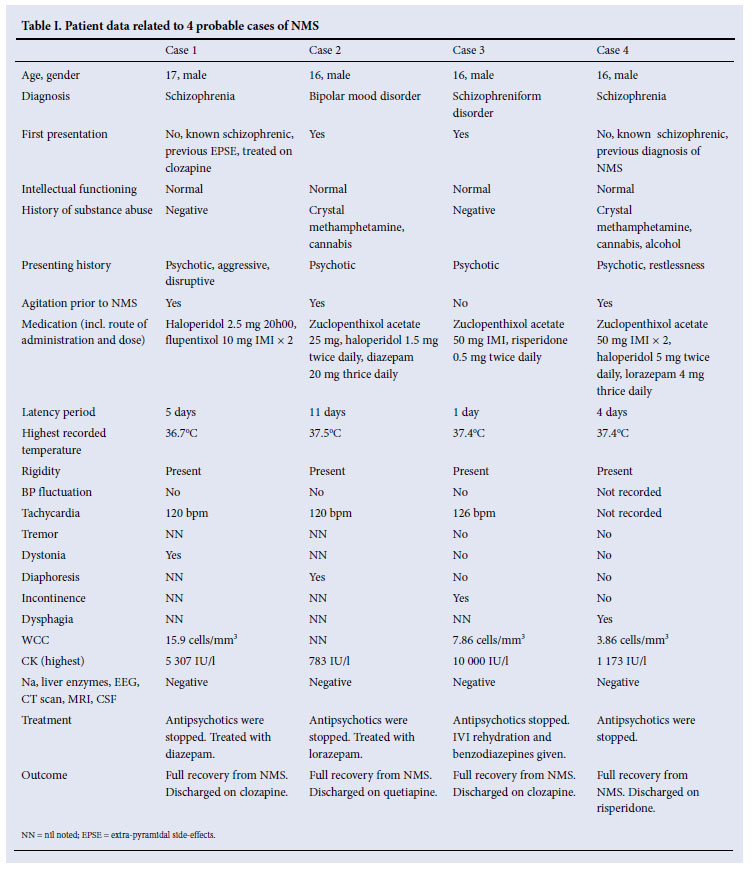
Table I presents data from 4 cases of probable NMS seen between February 2009 and March 2010; all were eventually referred to, and managed at, a rehabilitation unit for adolescents with psychosis at Lentegeur Hospital. They represent 3.6% of admissions over that time. While reference is made to a diagnosis of NMS, it is acknowledged that the evidence is circumstantial and, while fairly strong, is nevertheless presumptive.
Discussion
The cases suggest that male gender and polypharmacy (including the use of 2 or more antipsychotics), a past history of EPSE/NMS and agitation are important possible risk factors for NMS. Although intellectual disability and affective disorders are considered to increase vulnerability to NMS, these cases occurred in adolescents with normal intellectual functioning and without an overwhelming association with affective disorder. Other features include large variations in CK levels and a favourable outcome. Other key risk factors for NMS include: use of physical restraint to control psychomotor agitation, recent commencement of an antipsychotic regime, use of intramuscular antipsychotics, and excessive psychomotor agitation resulting in higher levels of dehydration.556
Body temperature recording in this series was often taken haphazardly and in difficult circumstances such as marked agitation and restlessness, when it is unsafe to use the oral method. Temperature readings were obtained from the axilla. In one case the temperature was never recorded, one patient had no pyrexia, and 2 patients showed only a mild elevation. A core feature of NMS is pyrexia; therefore it could be argued that at least 2 patients did not conform to a 'true' NMS. However, the additional signs and symptoms noted in all the subjects were consistent with a probable diagnosis of NMS.
Important differential diagnoses in adolescents with probable NMS are malignant hyperthermia, heat stroke, anticholinergic delirium, serotonin syndrome, central nervous system infection and neuroleptic-induced dystonia. The latter occurs within 7 days of initiating drug treatment or following a rapid increase in the dose and is an involuntary contraction of muscle groups forcing certain parts of the body into abnormal, sometimes painful, postures. It is not associated with fluctuations in blood pressure, pyrexia, tachycardia or any other additional signs or symptoms seen with NMS.
In 2 of the 4 cases, crystal methamphetamine, a street drug manufactured from ephedrine or pseudo-ephedrine that is smoked or injected and popularly known as 'tik' in the Western Cape, was one of the substances used prior to illness. Its use has accelerated in the Western Cape since 2003, particularly among the youth. This observation suggests a possible relationship between substance abuse and the development of NMS. Methamphetamine causes the release of dopamine and noradrenaline (and, to a lesser extent, serotonin) into the synaptic cleft and inhibits their reuptake. This creates very high intrasynaptic dopamine concentrations that probably accelerate or exacerbate the psychotic process. Chronic use of stimulants such as methamphetamine or cocaine may predispose the individual to NMS.11
Ethics approval
Ethics approval was given by the University of Cape Town Research and Ethics Committee, and the Tygerberg Hospital and Lentegeur Hospital authorities provided permission to extract data from patient folders. I thank Professor Ashley Robins for his assistance in the writing of this paper, and Professor Denise White for her encouragement.
References
- 1. Silva R, Dinohra M, Alpert M, Perlmutter R, Diaz J. Neuroleptic malignant syndrome in children and adolescents. J Am Acad Child Adolesc Psychiatry 1999;38(2):187-194.
- 2. Erermis S, Bildik T, Tamar M, Gockay A, Karasoy H, Sabri Ercan E. Zuclopenthixol-induced neuroleptic malignant syndrome in an adolescent girl. Clinical Toxicology 2007;45:277-280.
- 3. Croarkin P, Emslie G, Mayes T. Neuroleptic malignant syndrome associated with atypical antipsychotics in paediatric patients: a review of published cases. J Clin Psychiatry 2008;69(7):1157-1165.
- 4. Kahn H, Syed N, Sheerani M, Khealini B, Kamal A, Wasay M. Neuroleptic malignant syndrome: need for early diagnosis and therapy. Journal Ayub Med Coll Abbottabad 2006;18:1.
- 5. Viejo L, Morales V, Punal P, Perez J, Sancho R. Risk factors in neuroleptic malignant syndrome. A casecontrol study. Acta Psychiatr Scand 2003;107:45-49.
- 6. Gibson R, Fenton M, Campbell C. Zuclopenthixol acetate for acute schizophrenia and similar serious mental illnesses. Cochrane Database of Systematic Review 2004:3: Art no CD 000525.
- 7. Cohen O, Leibovici L, Mor F, Wysenbeek A. Significance of elevated levels of serum creatine phosphokinase in febrile diseases: a prospective study. Reviews of Infectious Diseases 1991;13:237-242.
- 8. Meltzer H, Cola P, Parsa M. Marked elevations of serum creatine kinase activity associated with antipsychotic drug treatment. Neuropsychopharmacology 1996;15(4):395-404.
- 9. Mahendran R, Winslow M, Lim D. Recurrent neuroleptic malignant syndrome. Aust N Z J Psych 2000;34(4):699-700.
- 10. Batki S, Harris D. Quantitative drug levels in stimulant psychosis: relationship to symptoms severity, catecholamines and hyperkinesias. Am J Addict 2004;13:461-470.
- 11. MaCauly J, Ruiz P. Neuroleptic malignant syndrome: A complication of neuroleptics and cocaine abuse. Psychiatric Q 1991;62(4):299-309.