Gonadal pathology in a girl with 45,X/46,XY mosaicism
To the Editor: A 13-year-old girl presented with short stature and clitoromegaly. The clitoromegaly had been noticed at birth, but medical attention was only sought at age 13. She had not experienced menarche and had a female gender identity. She had no learning disability.
Her height was 136 cm, below the 5th percentile for age. Phenotypical abnormalities suggestive of Turner syndrome included a short neck and bilateral clinodactyly of her 4th digits. She had clitoromegaly (length 25 mm and width 10 mm). She had a normal vaginal opening and labia majora, but no labia minora were present. The urethral opening was in the normal female position. No gonads were palpable. She had minimal axillary hair, Tanner stage 2 breast development and Tanner stage 2 pubic hair development.
Special investigations showed a follicle-stimulating hormone level of 66.5 IU/L and an oestradiol level of <73 pmol/L, in keeping with primary gonadal failure. Her serum testosterone level was significantly elevated at 5.4 nmol/L. G-banding with trypsin treatment and Giemsa stain (GTG-banded) chromosome analysis showed a mosaic karyotype with two cell lines: five cells with a 45,X karyotype and 15 cells with a 46,XY karyotype. On echocardiography a small patent ductus arteriosus (PDA) with left-to-right shunting was detected. Ultrasound examination showed no renal anomalies.
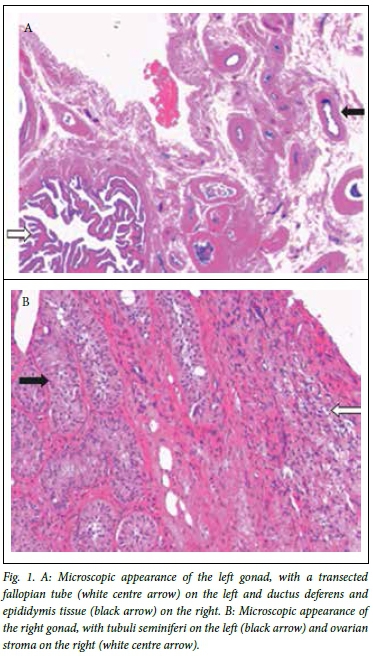
The patient was referred for gynaecological treatment owing to the risk of development of malignant germ cell tumours.[1] Clitoral reduction and bilateral gonadectomies were performed and a pycnotic uterus was found. The right gonad had macroscopic features of a testis (Fig. 1). Sections showed a fallopian tube, testicular tissue comprising prepubertal tubuli seminiferi with an interstitium with Leydig cell hyperplasia, and a small rim of ovarian stroma. On the left a streak gonad was found. Sections showed a transected fallopian tube, ovarian stroma, and tissue in keeping with an epididymus.
Growth hormone therapy was initiated with a good response. Female hormone replacement therapy is to commence when the patient reaches an acceptable height. She is awaiting definitive management of the PDA.
Patients with 45,X/46,XY mosaicism can share clinical features with Turner syndrome, including short stature and cardiac anomalies. [2,3] PDA has rarely been described in association with 45,X/46,XY mosaicism.[3] Recognition of this condition is important because of the risk of malignancy if the gonads are kept in situ.[1] Patients with 45,X/46,XY mosaicism benefit from growth hormone therapy, similar to patients with Turner syndrome and as demonstrated in our patient.[4]
Tanja Kemp, Lizl Smith, Simon Akerman
Endocrinology Unit, Department of Internal Medicine, Steve Biko Academic Hospital and University of Pretoria, South Africa.
References
-
1. Cools M, Pleskacova J, Stoop H, et al. Gonadal pathology and tumor risk in relation to clinical characteristics in patients with 45,X/46,XY mosaicism. J Clin Endocrinol Metab 2011;96(7):E1171-E1180. [http://dx.doi.org/10.1210/jc.2011-0232]
» http://dx.doi.org/10.1210/jc.2011-0232 -
2. Tosson H, Rose SR, Gartner LA. Description of children with 45,X/46,XY karyotype. Eur J Pediatr 2012;171(3):521-529. [http://dx.doi.org/10.1007/s00431-011-1600-9]
» http://dx.doi.org/10.1007/s00431-011-1600-9 -
3. Farrugia MK, Sebire NJ, Achermann JC, Eisawi A, Duffy PG, Mushtaq I. Clinical and gonadal features and early surgical management of 45,X/46,XY and 45,X/47,XYY chromosomal mosaicism presenting with genital anomalies. J Pediatr Urol 2013;9(2):139-144. [http://dx.doi.org/10.1016/j.jpurol.2011.12.012]
» http://dx.doi.org/10.1016/j.jpurol.2011.12.012 -
4. Johansen ML, Hagen CP, Rajpert-De Meyts E, et al. 45,X/46,XY mosaicism: phenotypic characteristics, growth, and reproductive function - a retrospective longitudinal study. J Clin Endocrinol Metab 2012;97(8):E1540-E1549. [http://dx.doi.org/10.1210/jc.2012-1388]
» http://dx.doi.org/10.1210/jc.2012-1388
This month in the SAMJ ...