Modified full-face snorkel masks as personal protective equipment for COVID-19 in South Africa
To the Editor: The COVID-19 pandemic has become the focal point of medicine in South Africa (SA) since March 2020, and 7% of all COVID-19 positive cases are healthcare workers (HCWs).[1] Inadequate personal protective equipment (PPE) was stated as the primary cause of HCWs contracting COVID-19 in China.[2] With PPE shortages envisioned as the global pandemic continues, numerous PPE preservation strategies have been suggested.[3]
Modified full-face snorkel masks (FFSMs) may offer a reusable alternative to N95 respirators. Modifications entail the removal of the snorkel and addition of a 3D printed or moulded adaptor and a heat and moisture exchange (HME) filter, thus meeting N95 protective standards.[4] Numerous FFSMs have been tested and adapted for PPE[5] and are currently in use internationally. [6-8] However, numerous low-cost FFSMs have been banned by international diving operators because of CO2 accumulation leading to deaths.[9] It is therefore incumbent upon HCWs to ensure a safe choice of FFSM when it is to be utilised as PPE.
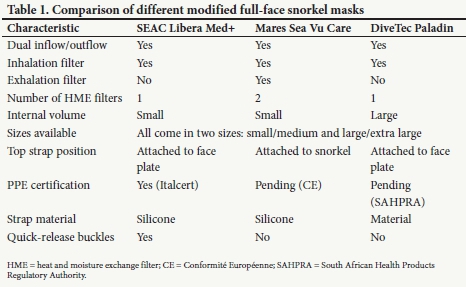
In SA, three modified FFSMs are available: SEAC Libera Med+, Mares SeaVu Care and DiveTec Paladin, with significant differences between the masks (Table 1). The polycarbonate design allows for easy cleaning with quaternary ammonium or 0.01% hypochlorite solution. Alcohol and chlorohexidine should be avoided as micro-fissuring would ensue, leading to polycarb and visual field degradation and eventual loss of protective function of the mask. In the clinical environment, the silicone straps may be preferable for hygiene and cleaning purposes. Masks without exhalation filters would not offer protection for patients from pathogens carried by HCWs themselves.
HCWs should receive training in donning, doffing and decontamination of the masks, as well as how to 'safety check' the mask at each use. The HCW should ensure a proper fit before using the mask: the crown strap should be on the occiput of the head, with the straps below the pinnas of the ears. To ensure a proper seal, hair, head scarves and scrub caps should remain on the outside of the silicone skirt of the mask, and men with beards should keep them neatly trimmed. HCWs wearing spectacles need to switch to contact lenses or use 'stick-on' diving lenses. Verbal communication is mildly impaired, requiring slower, slightly louder and properly articulated speech.[5]
Mask seal should be tested using the modified quantitative negative-pressure test prior to entry into the clinical environment.[5] A hand (or two) is placed on the HME filter(s) and a deep breath is taken. If the mask seals adequately, a vacuum is created inside the mask and a sensation of stifling is experienced. Additionally, a visual check for condensation of the mask's eye plate should be performed, as this is a warning sign of a leak or CO2 build-up.[5] The mushroom valves at the mask base should be properly cleaned, as they may be difficult to access in certain masks.
Modified FFSMs can be adapted for use as PPE by HCWs. However, the importance of proper fit testing is strongly emphasised. It is strongly recommended that these modified FFSMs, adapted as PPE, be fitted to each HCW's face, that the seal be tested at each use, that the HCW receive training in use of the mask, and that each mask be used by an individual HCW and not shared. Dedicated donning, doffing and decontamination procedures should be developed at each institution.
L van Wyk, P Goussard
Department of Paediatrics and Child Health, Faculty of Medicine and Health Sciences, Stellenbosch University, Cape Town, South Africa,
W A J Meintjes
Department of Global Health, Division of Health Systems and Public Health, Faculty of Medicine and Health Sciences, Stellenbosch University, Cape Town, South Africa
References
-
1. Dramowski A, Zunza M, Dube K, Parker M, Slogrove A. South African healthcare workers and COVID-19: A shared responsibility to protect a precious and limited resource. S Afr Med J 2020;110(7):567-568. https://doi.org/10.7196/SAMJ.2020.v110i7.14903
» https://doi.org/10.7196/SAMJ.2020.v110i7.14903 -
2. Wang J, Zhou M, Liu F. Reasons for healthcare workers becoming infected with novel coronavirus disease 2019 (COVID-19) in China. J Hosp Infect 2020;105:100-101. https://doi.org/10.1016/j.jhin.2020.03.002
» https://doi.org/10.1016/j.jhin.2020.03.002 -
3. Le Roux C, Dramowski A. Personal protective equipment (PPE) in a pandemic: Approaches to PPE preservation for South African healthcare facilities. S Afr Med J 2020;110(6):466-468. https://doi.org/10.7196/SAMJ.2020.v110i6.14831
» https://doi.org/10.7196/SAMJ.2020.v110i6.14831 -
4. Kechli MK, Lerman J, Ross MM. Modifying a full-face snorkel mask to meet N95 respirator standards for use with coronavirus disease 2019 patients. A&A Pract 2020;14(7):e01237. https://doi.org/10.1213/XAA.0000000000001237
» https://doi.org/10.1213/XAA.0000000000001237 -
5. Germonpre P, van Rompaey D, Balestra C. Evaluation of protection level, respiratory safety and practical aspects of commercially available snorkel masks as personal protective devices against aerosolised contaminants and SARS-CoV2. Int J Environ Res Public Health 2020;17(12):4347. https://doi.org/doi.org/10.3390/ijerph17124347
» https://doi.org/doi.org/10.3390/ijerph17124347 -
6. Veit C. Stanford researchers turn thousands of full-face snorkel masks into reusable PPE for hospital employees. Stanford Daily, 13 May 2020. https://www.stanforddaily.com/2020/05/13/stanford-researchers-turn-thousands-of-full-face-snorkel-masks-into-reusable-ppe-for-hospital-employees (accessed 10 August 2020).
» https://www.stanforddaily.com/2020/05/13/stanford-researchers-turn-thousands-of-full-face-snorkel-masks-into-reusable-ppe-for-hospital-employees -
7. Doradea K. A Toronto hospital is turning to snorkels because PPE supplies are so low. Narcity, n.d. https://www.narcity.com/news/ca/on/toronto/sunnybrook-hospital-is-making-face-masks-from-snorkels-to-combat-ppe-shortage (accessed 10 August 2020).
» https://www.narcity.com/news/ca/on/toronto/sunnybrook-hospital-is-making-face-masks-from-snorkels-to-combat-ppe-shortage -
8. Reuters. European researchers retrofit snorkel masks for coronavirus fight. 30 March 2020. https://www.reuters.com/article/us-health-coronavirus-czech-snorkel-mask/european-researchers-retrofit-snorkel-masks-for-coronavirus-fight-idUSKBN21H2Z5 (accessed 10 August 2020).
» https://www.reuters.com/article/us-health-coronavirus-czech-snorkel-mask/european-researchers-retrofit-snorkel-masks-for-coronavirus-fight-idUSKBN21H2Z5 -
9. Davis C. Spike in snorkel-related deaths again highlights potential danger of full-face masks. Hawaii News Now, 17 September 2019. https://www.hawaiinewsnow.com/2019/09/18/spike-snorkel-related-deaths-again-highlights-potential-danger-full-face-masks/ (accessed 4 September 2020).
» https://www.hawaiinewsnow.com/2019/09/18/spike-snorkel-related-deaths-again-highlights-potential-danger-full-face-masks/