Tackling the climate targets set by the Paris Agreement (COP 21): Green leadership empowers public hospitals to overcome obstacles and challenges in a resource-constrained environment
Abstract
The healthcare sector itself contributes to climate change, the creation of hazardous waste, use of toxic metals such as mercury, and water and air pollution. To mitigate the effect of healthcare provision on the deteriorating environment and avoid creating further challenges for already burdened health systems, Global Green Hospitals was formed as a global network. Groote Schuur Hospital (GSH), as the leading academic hospital in Africa, joined the network in 2014. Since then, several projects have been initiated to reduce the amount of general waste, energy consumption and food waste, and create an environmentally friendlier and more sustainable hospital in a resource-constrained public healthcare setting. We outline the various efforts made to reduce the carbon footprint of GSH and reduce waste and hazardous substances such as mercury and polystyrene, and elaborate how obstacles and resistance to change were overcome. The hospital was able to halve the amount of coal and water used, increase recycling by 50% over 6 months, replace polystyrene cups and packaging with Forest Stewardship Council recyclable paper-based products, reduce the effect of food wastage by making use of local farmers, and implement measures to reduce the amount of expired pharmaceutical drugs. To improve commitment from all involved roleplayers, political leadership, supportive government policies and financial funding is mandatory, or public hospitals will be unable to tackle the exponentially increasing costs related to climate change and its effects on healthcare.
2. Introducing recycle bins and improvement in waste management
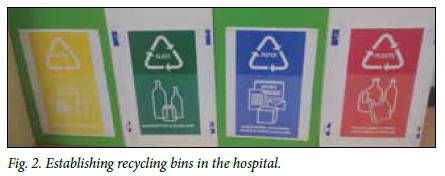
Staff members from different areas of the hospital are continually trained in proper triaging and waste separation. In addition, presentations are given at staff meetings and the correct procedures are explained. Several departments have introduced recycling bins in their areas, including the management suites, GSH Healthcare Innovation Hub, the hospital facility board, and the Departments of Radiation Medicine and Medicine (Fig. 2). The University of Cape Town (UCT) Private Academic Hospital, which is located in the Groote Schuur building, has joined our effort by introducing recycling bins and adhering to improved waste management. Another effort is that departments install printers that print double-sided, to save paper. The total tonnage of recycled waste increased by 23% in 2015 and by 50% in the first 6 months of 2016; the total amount of recycling removed in 2015 was 144 tons, in contrast to 110.7 tons in 2014. In 2015, we generated ZAR106 174 from recycling alone.
Additionally, food waste from the GSH kitchen is collected on a regular basis by a local farmer, for use as pig feed.
3.
Creating a polystyrene-free hospitalPolystyrene is known as a major health and environmental hazard. It creates a major litter problem and is the fifth-largest creator of harmful waste worldwide. It is non-degradable and stays in the environment for hundreds of years, and toxic chemicals released by polystyrene are ingested, becoming part of marine life and the food chain.[15] Polystyrene is suspected of causing cancer and leading to hormonal disturbances.[16] In addition, polystyrene production contributes considerably to the depletion of the ozone layer. In spite of these well-established facts, polystyrene is still widely used in the environment by retailers and in the food processing industry, although alternative Forest Stewardship Council (FSC) paper-based products exist. At GSH, polystyrene cups and packaging were used for water dispensing and in the canteens. We engaged in finding suppliers who provide FSC-based paper cups and packaging. The UCT Private Academic Hospital also changed their procurement policy and introduced an FSC paper-based system. As the amount of paper that is recycled in SA is low, recycled paper needs to be imported from other countries. To achieve buy-in from the various roleplayers, meetings, discussions and presentations took place to provide the reasoning for replacing waste-intensive polystyrene packaging with biodegradable paper and gelatine-based bioplastic. This new strategy was rolled out in the hospital to reduce greenhouse gas emissions, and to limit the amount of waste and well-established health hazards created by the use of polystyrene cups. The hospital supply chain policy was therefore amended accordingly. As there was resistance to changing current habits, active change management processes were used. Finally, the canteens (outsourced to Feedem), GSH Private Academic Hospital (which belongs to the Netcare hospital group) and GSH hospital management agreed to dispense with polystyrene and use biodegradable paper packaging instead, enabling us to create the first polystyrene-free hospital in SA.
4.
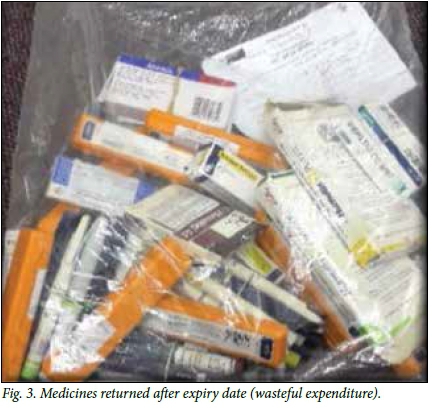
Reducing the amount of pharmaceutical wastePharmaceutical waste is a major problem, as it is toxic to the environment. Medicines prescribed unnecessarily in a resource-constrained environment add to the quantity of waste.[17] We are therefore working towards reducing polypharmacy and the amount of expired drugs.[17] Currently, waste by medicine expiry is <1% of total pharmaceutical procurement, although in a tertiary care facility this can amount to ZAR500 000 per year (Fig. 3). The GSH pharmacy has implemented measures to use or redistribute medicines before they expire, to reduce the amount of expired drugs and hence the waste. In addition, patients are asked, when they collect their prescribed medicines, what they do not need or still have in stock. Targets are set for the forthcoming year to use prescribed medicine more efficiently and economically.
Discussion
The GSH Green Hospital Leadership projects have demonstrated green leadership and environmental responsibility. We were able to engage staff from various levels of the hospital hierarchy to take ownership and drive the project in their areas. The effect and results are regularly disseminated throughout the hospital. In addition, the UCT Private Academic Hospital has joined our going-green projects, in particular by improving recycling and replacing polystyrene with FSC paper-based products. As we aim to engage staff members to work as a team to find solutions to existing problems, we implement sustainability with this approach as changes and new measures are taken up by the staff and are used in the everyday life of the hospital. In this way, a shift of mindset and thinking towards a culture of continuous improvement will occur. With the success of this project, we hope that the green leadership concept can be rolled out to other public healthcare facilities and schools in the country, and that combined green solutions can be initiated and implemented through the GSH Healthcare Innovation Hub, which the hospital created as a space where such creative thinking could be encouraged. This hub is the first of its kind in the public sector and several of the initiatives involving the changing of mindset and creation of awareness are happening there.
This project's innovation is addressing the daily challenges of reducing the carbon footprint, saving energy and minimising the amount of hazardous waste in a public hospital by generating profits through our actions. Our data clearly show that the Green Hospital projects are sustainable and revenues are growing. The successful project rollout has created enthusiasm among the staff to act as climate change agents and environmental activists and has generated innovative solutions from within. The teams working on the projects had a sense of ownership over and pride in the accomplishments and in the difference made towards achieving an environmentally friendly and greener hospital. Additionally, the projects were designed in such a way that the innovations can be rolled out in other health facilities.
The Green Hospital projects could prosper from the support of governmental funding. Some countries (e.g. the USA, the UK, European countries) provide governmental support and therefore enhance green leadership initiatives. Healthcare facilities could become more energy independent by installing green energy solutions such as solar, thermal and wind energy. In addition, the carbon and waste footprint of each healthcare facility could be calculated and advertised on a regular basis to encourage competition between facilities. By creating a governmental green healthcare platform, different green teams would be able to cross-pollinate and inspire each other.
Acknowledgements. R de Jager is in charge of waste management at GSH and we acknowledge his engagement in the Green Leadership projects. D Smith, head of the engineering department at GSH, kindly provided input on water, energy and coal consumption. V Naicker, head of the pharmacy, drives the project to reduce pharmaceutical waste. We commend the support for polystyrene-free canteens received by S Esterhuizen and her team from Feedem at GSH. L Shield, executive hospital manager at Netcare UCT Private Academic Hospital, joined our green projects and implemented a polystyrene-free policy, recycling bins and improved waste management at the hospital facility. We appreciate her commitment. We recognise the input of the Western Cape Provincial Climate and Health Committee and the Global Green and Healthy Hospitals Initiative.
REFERENCES
-
1. Haines A. Climate Change and Health. Am J Prev Med 2008;35(Sept):1-5. http://dx.dolorg/10.1016/j.amepre.2008.08.003
» http://dx.dolorg/10.1016/j.amepre.2008.08.003 -
2. McMichael AJ, Friel S, Nyong A, Corvalan C. Global environmental change and health: Impacts, inequalities, and the health sector. BMJ 2008;336(7637):191-194. http://dx.doi.org/10.1136/bmj.39392.473727.AD
» http://dx.doi.org/10.1136/bmj.39392.473727.AD -
3. Watts N, Adger WN, Agnolucci P, et al. Health and climate change: Policy responses to protect public health. Lancet 2015;386(10006):1861-1914. http://dx.doi.org/10.1016/S0140-6736(15)60854-6
» http://dx.doi.org/10.1016/S0140-6736(15)60854-6 -
4. Costello A, Mustafa Abbas M, Allen A, et al Managing the health effects of climate change. Lancet 2009;373(9672):1659-1733. http://dx.doi.org/10.1016/S0140-6736(09)60935-1
» http://dx.doi.org/10.1016/S0140-6736(09)60935-1 -
5. Government of the Republic of South Africa.The South African Climate Change Response Strategy. 2001. http://www.climateresponse.co.za/home/gp/1 (accessed 19 November 2016).
» http://www.climateresponse.co.za/home/gp/1 -
6. Department of Science and Technology, South Africa. South African Risk and Vulnerabilty Atlas. http://sarva.dirisa.org/ (accessed 19 November 2016).
» http://sarva.dirisa.org/ -
7. Department of Environmental Affairs, South Africa. Long Term Adapation Scenarios (LTAS). https://www.environment.gov.za/longterm_adaptationscenarios (accessed 19 November 2016).
» https://www.environment.gov.za/longterm_adaptationscenarios -
8. Kearney PM, Whelton M, Reynolds K, Muntner P, Whelton PK, He J. Global burden of hypertension: Analysis of worldwide data. Lancet 2005;365(9455):217-223. http://dx.doi.org/10.1016/S0140-6736(05)17741-1
» http://dx.doi.org/10.1016/S0140-6736(05)17741-1 -
9. Weimann E. Blue Flag beaches - bathers at risk for thalassogenic diseases. J Environ Ecol 2014;5(1):38- 45. http://dx.doi.org/10.5296/jee.v5i1.5773
» http://dx.doi.org/10.5296/jee.v5i1.5773 -
10. Weimann E. Improved waste water treatment could create jobs and reduce health care costs. Cape Times, 9 January 2015. https://www.pressreader.com/south-africa/cape-times/20150109/281809987272483 (accessed 27 August 2016).
» https://www.pressreader.com/south-africa/cape-times/20150109/281809987272483 -
11. World Bank. Data. South Africa. 2016. http://data.wordbank.org/country/south-africa (accessed 17 June 2016).
» http://data.wordbank.org/country/south-africa -
12. Weimann E, Stuttaford MC. Consumers' perspectives on National Health Insurance in South Africa: Using a mobile health approach. JMIR mHealth uHealth. 2014;2(4):1-14. http://dx.doi.org/10.2196/mhealth.3533
» http://dx.doi.org/10.2196/mhealth.3533 -
13. Western Cape Provincial Government. Guideline on greening procurement of goods or services in the Western Cape Government. 2013. http://www.sa-tenders.co.za/content/green-procurement-policy-guidelines-part-sustainable-public-procurement-delivery-state (accessed 24 June 2016).
» http://www.sa-tenders.co.za/content/green-procurement-policy-guidelines-part-sustainable-public-procurement-delivery-state -
14. Duvivier RJ, Watts NR, Rukavina, S, Kaduru C. Doctors talk climate change - students take action. Lancet 2011;377(9770):995. http://dx.doi.org/10.1016/S0140-6736(11)60384-X
» http://dx.doi.org/10.1016/S0140-6736(11)60384-X -
15. Koelmans AA, Besseling E, Shim WJ. Marine anthropogenic litter. 2015. http://dx.doi.org/10.1007/978-3-319-16510-3
» http://dx.doi.org/10.1007/978-3-319-16510-3 -
16. Yang CZ, Yaniger SI, Jordan VC, Klein DJ, Bittner GD. Most plastic products release estrogenic chemicals: A potential health problem that can be solved. Environ Health Perspect 2011;119(7):989-996. http://dx.doi.org/10.1289/ehp.1003220
» http://dx.doi.org/10.1289/ehp.1003220 -
17. Kreisberg J, Zheng C. Managing unused pharmaceuticals in a hospice setting: A pilot study. Am J Hosp Palliat Care 2011;28(8):536-538. http://dx.doi.org/10.1177/1049909111405788
» http://dx.doi.org/10.1177/1049909111405788