Comparing tumour site and overall survival in colon v. rectal cancer in a longitudinal cohort study in Johannesburg, South Africa
BACKGROUND. Colorectal cancer (CRC) incidence is increasing globally, with disproportionately high mortality in low- and middle-income countries. Although colon and rectal cancers are often grouped together, anatomical, molecular and clinical differences suggest they may be distinct entities, warranting unique work-up, management and diagnosis. Data from sub-Saharan Africa comparing clinical presentation and mortality outcomes among those with colon and rectal cancer remain limited. This study aimed to address this knowledge gap. OBJECTIVES. To compare the clinicopathological features, associated risk factors and overall survival (OS) of patients with colon and rectal cancers in the cohort from the Colorectal Cancer in South Africa Study in Johannesburg, South Africa (SA). METHODS. The cohort eligible for inclusion in this study comprised 325 patients, recruited from 2016 to 2019, with follow-up to January 2023. Sociodemographic, clinical, treatment and OS data were analysed. Comparison by tumour location was made using t-tests and ANOVA. Cox proportional hazards regression models assessed associations with OS. Kaplan-Meier analysis was used for survival estimation. RESULTS. Rectal cancers accounted for 52.3% of cases, right-sided colon cancers 26.2% and left-sided colon cancers 21.5%. When comparing those who presented with colon v. rectal cancers, no significant differences were observed in self-reported ethnicity, socioeconomic status (SES), family history of cancer, tobacco use, body mass index, or presence of comorbidities. Alcohol use was more common among those with colon cancer (p=0.035), and treatment differed significantly by tumour site (p<0.0001). Male sex (hazard ratio (HR) 1.81, 95% confidence interval (CI) 1.25 - 2.61, p=0.0017), low SES (HR 3.24, CI 1.86 - 5.65, p<0.0001) and distant disease at presentation (HR 3.85, CI 2.26 - 6.57, p<0.0001) were most strongly associated with poorer OS. The tumour site had no impact on OS. CONCLUSION. In this SA cohort of patients with CRC, tumour site did not affect overall survival. However, male sex, advanced stage at diagnosis and low socioeconomic status were associated with poorer OS.
colon; rectum; colorectal cancer; overall survival; South Africa
Comparing tumour site and overall survival in colon v. rectal cancer in a longitudinal cohort study in Johannesburg, South Africa
A PincusI, *; Y MoodleyI, *; L CampbellII; P GaylardII; D KrugerIII; V SoldatiIV; J FabianV; T K MarumoVI, VII; L ProdehlVI, VII; N HarranVIII; B BebingtonIX, X; P RuffXI
IFinal-year medical student; School of Clinical Medicine, Faculty of Health Sciences, University of the Witwatersrand, Johannesburg, South Africa
IIPhD; Wits Donald Gordon Medical Research Institute, Faculty of Health Sciences, University of the Witwatersrand, Johannesburg, South Africa
IIIPhD; Department of Surgery, School of Clinical Medicine, Faculty of Health Sciences, University of the Witwatersrand, Johannesburg, South Africa
IVMMed (Surg), Cert Gastroenterology (SA) Surg; Wits Donald Gordon Medical Research Institute, Faculty of Health Sciences, University of the Witwatersrand, Johannesburg, South Africa
VCert Nephro (SA), PhD; Wits Donald Gordon Medical Research Institute, Faculty of Health Sciences, University of the Witwatersrand, Johannesburg, South Africa
VIPCS (SA), Cert Gastroenterology (SA); School of Clinical Medicine, Faculty of Health Sciences, University of the Witwatersrand, Johannesburg, South Africa
VIIPCS (SA), Cert Gastroenterology (SA); Department of Surgery, Charlotte Maxeke Johannesburg Academic Hospital, University of the Witwatersrand, Johannesburg, South Africa
VIIIMMed (Surg), Cert Gastroenterology (SA) Surg; Wits Donald Gordon Medical Research Institute, Faculty of Health Sciences, University of the Witwatersrand, Johannesburg, South Africa
IXPCS (SA); Wits Donald Gordon Medical Research Institute, Faculty of Health Sciences, University of the Witwatersrand, Johannesburg, South Africa
XPCS (SA); Department of Surgery, School of Clinical Medicine, Faculty of Health Sciences, University of the Witwatersrand, Johannesburg, South Africa
XIPCP (SA), MMed (Int Med); School of Clinical Medicine, Faculty of Health Sciences, University of the Witwatersrand, Johannesburg, South Africa
BACKGROUND. Colorectal cancer (CRC) incidence is increasing globally, with disproportionately high mortality in low- and middle-income countries. Although colon and rectal cancers are often grouped together, anatomical, molecular and clinical differences suggest they may be distinct entities, warranting unique work-up, management and diagnosis. Data from sub-Saharan Africa comparing clinical presentation and mortality outcomes among those with colon and rectal cancer remain limited. This study aimed to address this knowledge gap.
OBJECTIVES. To compare the clinicopathological features, associated risk factors and overall survival (OS) of patients with colon and rectal cancers in the cohort from the Colorectal Cancer in South Africa Study in Johannesburg, South Africa (SA).
METHODS. The cohort eligible for inclusion in this study comprised 325 patients, recruited from 2016 to 2019, with follow-up to January 2023. Sociodemographic, clinical, treatment and OS data were analysed. Comparison by tumour location was made using t-tests and ANOVA. Cox proportional hazards regression models assessed associations with OS. Kaplan-Meier analysis was used for survival estimation.
RESULTS. Rectal cancers accounted for 52.3% of cases, right-sided colon cancers 26.2% and left-sided colon cancers 21.5%. When comparing those who presented with colon v. rectal cancers, no significant differences were observed in self-reported ethnicity, socioeconomic status (SES), family history of cancer, tobacco use, body mass index, or presence of comorbidities. Alcohol use was more common among those with colon cancer (p=0.035), and treatment differed significantly by tumour site (p<0.0001). Male sex (hazard ratio (HR) 1.81, 95% confidence interval (CI) 1.25 - 2.61, p=0.0017), low SES (HR 3.24, CI 1.86 - 5.65, p<0.0001) and distant disease at presentation (HR 3.85, CI 2.26 - 6.57, p<0.0001) were most strongly associated with poorer OS. The tumour site had no impact on OS.
CONCLUSION. In this SA cohort of patients with CRC, tumour site did not affect overall survival. However, male sex, advanced stage at diagnosis and low socioeconomic status were associated with poorer OS.
Keywords: colon, rectum, colorectal cancer, overall survival, South Africa
Globally, the incidence of colorectal cancer (CRC) continues to rise, particularly among those aged <50 years. Along with increasing incidence, disproportionate mortality has been reported in low-and middle-income countries (LMICs), including sub-Saharan Africa and South Africa (SA).[1-3] Colon and rectal cancers are often considered a single entity, and reported as such in most clinical and epidemiological studies. However, differences in embryological origin, function, histological features and associated risk factors have prompted many to support the distinction between colon cancers, specifically left- and right-sided, and rectal cancers, with some suggesting these should be considered separate malignant entities.[4-7] Rectal cancers are less influenced by family history and lifestyle factors such as physical activity, smoking and diet, which are more relevant to colon cancers.[8-12] From a molecular perspective, rectal tumours more frequently exhibit chromosomal instability, whereas right-sided colon cancers are often microsatellite instability-high.[13-14] Additionally, there appear to be distinct (and sometimes conflicting) differences in responses to treatment and survival outcomes, with some studies showing poorer survival with rectal cancers,[15-17] while others report worse survival with colon cancers, particularly at advanced stages of disease.[18-20]
Among continental Africans, isolated studies from west and southern Africa describe heterogeneous patterns of tumour distribution, with rectal cancers occurring more frequently, but few studies report whether tumour site influences mortality risk.[21-25] In this study, we aimed to compare clinicopathological features, associated risk factors and survival outcomes of left- and right-sided colon and rectal cancers in a multi-ancestry cohort in Johannesburg, South Africa (SA).
Methods
Study sample selection and clinical characteristics
This retrospective sub-study accessed available data from the Colorectal Cancer in South Africa (CRCSA) Study. Details of the CRCSA study design and methodology have previously been published.[26] In summary, the study recruited adults presenting with CRC to four urban referral hospitals in the University of the Witwatersrand (Wits) Academic Teaching Hospital Complex: Charlotte Maxeke Johannesburg Academic Hospital, Chris Hani Baragwanath Academic Hospital, the Wits Donald Gordon Medical Centre (WDGMC) and Edenvale Hospital. Eligible participants who provided consent were recruited from 1 November 2016 to 31 December 2019, with overall survival follow-up to 31 January 2023. Baseline clinical and follow-up data for each participant were collected using Research Electronic Data Capture (REDCap), a secure, web-based platform hosted by the Faculty of Health Sciences at Wits.[27,28]
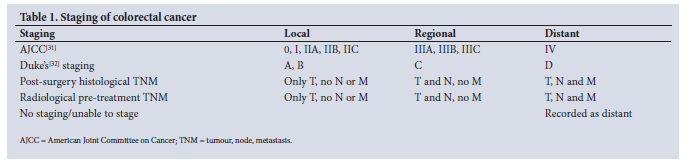
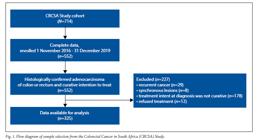
For this sub-study, patients were excluded if they had anal carcinoma or carcinoma-in-situ, synchronous lesions, or CRC diagnosed >12 months previously, or if treatment intent was not curative, or treatment was refused. Patients presenting with metastatic disease at the time of diagnosis were reviewed at oncology multidisciplinary team meetings to determine eligibility for curative treatment. The following clinical data were accessed: age at diagnosis; sex; self-reported ethnicity; socioeconomic status (SES); first-degree family history of CRC; comorbidities; current smoking status; current or previous alcohol use; body mass index (BMI); location of malignancy (left colon, right colon, rectum); staging of malignancy at presentation; treatment information; histology post surgery; and survival data (date of death (all-cause mortality) or date last seen). The assessment of SES used employment status, number of people in the household, assets score and highest level of education, from which an overall composite score was derived using principal component analysis. The first component was used as the SES score, which was then categorised as follows: the lowest 40% of households as 'poor'; the highest 20% as 'wealthy'; and the remaining as the 'intermediate' group.[29] Comorbidity was assessed using a modified Charlson comorbidity index (CCI), the details of which have been published for this cohort.[30] In summary, the CCI was calculated based on whether participants had any history of myocardial infarction, congestive heart failure, peripheral vascular disease, cerebrovascular disease, chronic obstructive pulmonary disease, connective tissue disorders, dementia, peptic ulcer disease, diabetes mellitus, moderate to severe renal disease, hemiplegia, leukaemia, malignant lymphoma, solid malignancies (non-CRC), or hepatic disease. For staging of malignancy, the American Joint Committee on Cancer (AJCC) system[31] was used preferentially, followed by Duke's[32] staging if AJCC data were unavailable. If neither of these systems was available, post-surgical histological tumour, node, metastasis (TNM) staging was used to infer AJCC staging, followed by radiological TNM staging.[33] Staging was then classified as local, regional, or distant (Table 1). Time delays between diagnosis and staging were not considered for this analysis.
Statistical analysis
For sample size estimation, equally sized malignancy groups (colon v. rectal cancer) were assumed, with accrual and final follow-up periods of 2.5 years and 3.5 years, respectively, and a 40% survival rate at 6 years.[34] Detecting a hazard ratio of at least 1.6 with 80% power at p<0.05 significance level required a minimum sample size of 284 patients.[29] Comparison between location of the malignancies for continuous variables was done using the independent samples t-test (for two groups) or the Wilcoxon rank sum test if the assumptions of this test were not met; one-way analysis of variance (ANOVA) was used for comparing three groups, or the Kruskal-Wallis test if the assumptions of this test were not met. Overall survival (OS) was defined as the time from the date of diagnosis to the date of death from any cause, or the date the participant was last seen. OS was then illustrated by the Kaplan-Meier method. The effect of each of the selected study variables on OS was determined univariately using Cox proportional hazards (PH) regression. Significant variables, plus location of malignancy and variable interactions with location of malignancy, were combined into a multivariable Cox PH model. Prior to this, confounding between significant variables was explored: variables with Cramer's V >0.50 were not included together in the multivariable model. In the multivariable model, non-significant interactions and main effects were removed sequentially for model parsimony. The PH assumption was checked by examination of the Schoenfeld residuals. Data analysis was carried out using SAS version 9.4 for Windows (SAS Institute, USA). A significance level of p<0.05 was used.
Ethical approval
The CRCSA study was approved by the Wits Medical Human Research Ethics Committee (ref. no. M141027).
Results
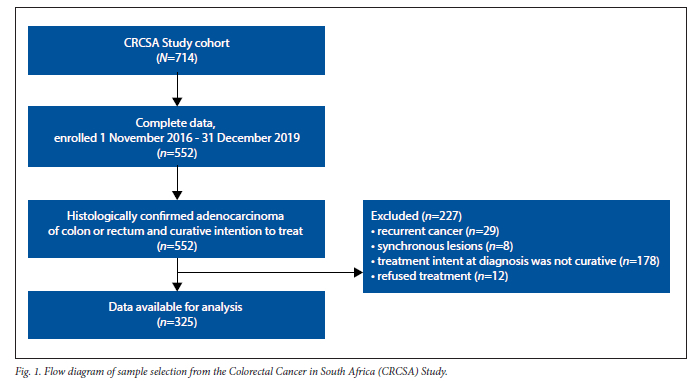
The cohort for this sub-study comprised 325 participants. Derivation of this sub-study cohort is summarised in Fig. 1.
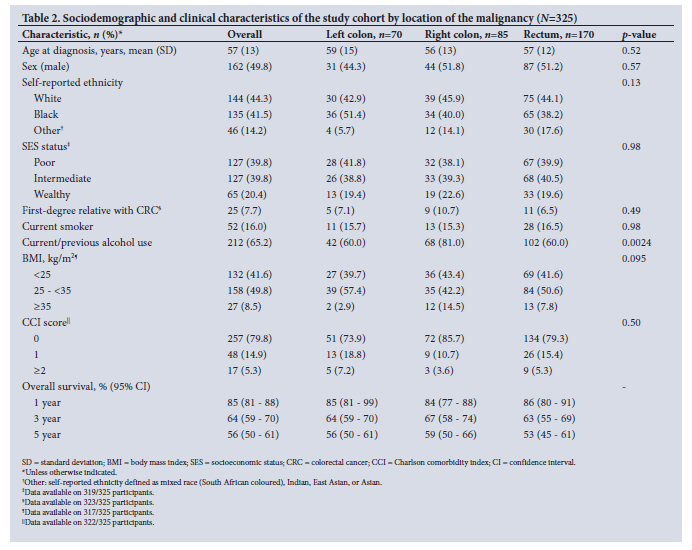
The sociodemographic and clinical characteristics of the study cohort are summarised in Table 2. More than half (170/325; 52.3%) of the cancers occurred in the rectum. Of the cancers occurring in the colon (155/325), 45.2% (70/155) were in the left and 54.8% (85/155) in the right colon. When comparing features between those with colon or rectal cancer, there were no statistically significant differences in self-reported ethnicity, SES status, family history of cancer, tobacco use, BMI, or presence of comorbidities. The only significant difference identified was that current or previous use of alcohol was associated with colonic malignancies (p=0.035), in particular, right-sided colonic malignancies (p=0.024).
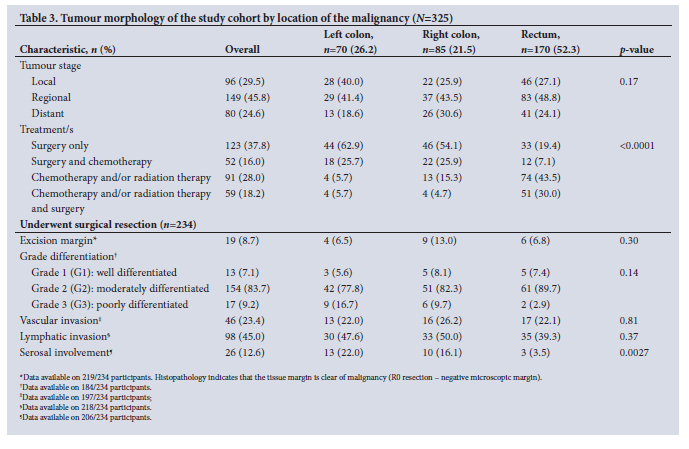
The treatment approach differed significantly between participants with colon and rectal malignancies (p<0.0001; Table 3). Those with colon cancer were more likely to be treated with surgery alone, contrasting with rectal cancer, where treatment was more likely to include chemotherapy, radiotherapy, or combination chemo- and radiotherapy, with or without surgery (Table 3). Among those who had surgical resections (234/325, 72.0%), histologically confirmed serosal involvement was significantly lower in those with rectal cancer compared with those with left or right colonic malignancies (p=0.0027).
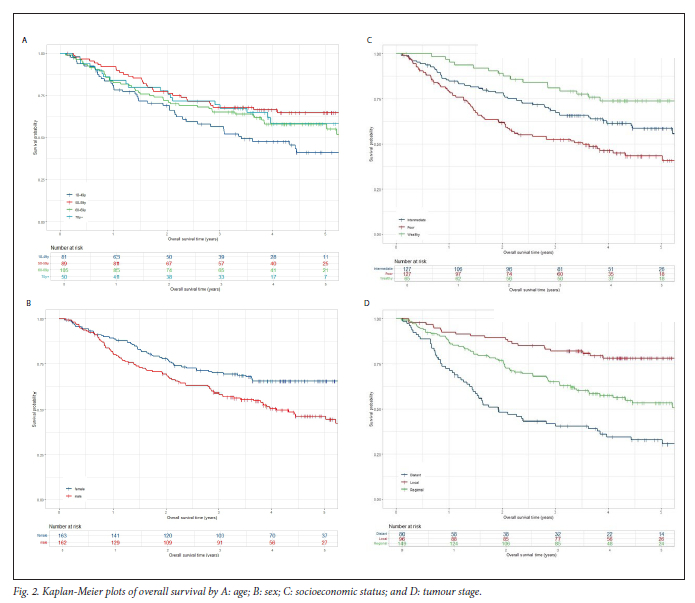
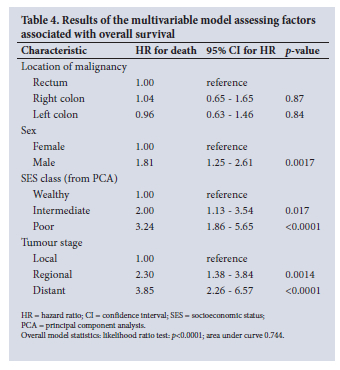
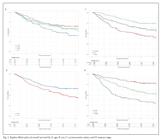
The median follow-up time for the study cohort was 3.5 years. We presented the OS as hazard ratios (HRs) and 95% confidence intervals (CIs). Univariate analysis to determine the effect of clinical characteristics on OS showed that the following variables significantly contributed to poorer survival: age <50 years v. 50 - 59 years (HR (95% CI) 1.80 (1.13 - 2.87)), male sex (1.71 (1.21 - 2.42)), black v. white ethnicity (2.05 (1.43 - 2.94)), intermediate (1.84 (1.05 - 3.24)) and poor SES (2.98 (1.73 - 5.15)), current smoking (1.64 (1.08 - 2.48)), BMI category of 25 - 35 (v. <25) kg/m2 Fig. 2A - D; Appendix Fig. S1 A - D; Appendix Table S1). Treatment type and tumour site were confounded, and thus treatment type was excluded from the multivariable model. In the final multivariable model, male sex, intermediate and poor SES, and regional and distant tumour status were significantly associated with poorer OS. The effect of tumour site on OS was not significant, whether assessed by colon v. rectum; or right-sided colon v. left-sided colon v. rectum (Table 4, Fig. 2A - D; Appendix Fig. S1A - D). Of note, 24.6% of patients with distant disease were treated with curative intent.
Discussion
In our longitudinal cohort of CRC patients recruited in Johannesburg, SA, rectal cancers represented more than half of all tumours, consistent with prevalence rates reported by the SA National Cancer Registry, and those of other African countries, namely Nigeria, Ghana, Zambia and Zimbabwe.[21-23,35,36] This relatively high regional prevalence of rectal cancer contradicts that reported from high-income, predominantly European-ancestry populations in the USA and UK, where colon cancers occur more frequently.[37,38] While the tumour site did not significantly affect overall survival, male sex, lower SES, and more advanced disease at the time of presentation were risk factors associated with a higher mortality risk, consistent with published studies.[45,46] These findings were somewhat unexpected by the clinical team, who hypothesised that variables such as tumour biology and location, African ancestry and BMI would play a significant role in overall survival. In the SA context, the impact of self-identified ancestry and SES were confounded, making the interpretation of risk difficult.
The impact of age at diagnosis on tumour location has been debated in local and international literature, with some studies reporting an association between younger age at diagnosis and rectal cancers.[17,18,39] However, as seen in our cohort, there was no significant association between age of diagnosis and tumour location.[16] In our study, the lack of male predominance in rectal cancer, as well as the absence of expected links between colon cancer and smoking or obesity, challenge prevailing assumptions, and highlight the need for population-specific studies.[9,11,12,17,18,39] The only characteristic significantly associated with tumour site was alcohol consumption, with a greater prevalence among right-sided colon cancers. Still, the literature remains inconclusive regarding the differential effect of alcohol by anatomical site, with conflicting conclusions in several meta-analyses.[40,41] It is noteworthy that most in this cohort presented with advanced-stage disease (regional and/or distant tumours), a finding likely reflective of delayed symptom recognition and diagnosis (particularly in younger people), the absence of national CRC awareness and screening programmes, as well as possible difficulties in accessing appropriate specialist healthcare services.
Histopathological features, including margin status, grade of differentiation and lymphovascular invasion, showed no significant differences between colon and rectal tumours in our cohort, also consistent with previous comparative analyses.[16] Studies in other populations have reported rectal cancers to be smaller and less invasive, suggesting possible population-level variability.[17] While serosal involvement was significantly lower in rectal cancers in our cohort, this was an expected finding considering the anatomical differences between these sites, and potential reductions in tumour size and staging following neoadjuvant therapy.[42-44]
Study strengths and limitations
This study has both strengths and limitations. The strengths lie in the sample size, the multicentre design, the depth and scope of the multi-ancestry cohort, and the 3-year follow-up period to ascertain overall survival. Regarding the limitations, all participants were recruited from tertiary academic referral centres where the spectrum of CRC pathology may reflect inherent referral biases. For example, those with rectal cancer are more likely to be referred due to the complexity of their treatment regimens, compared with resectable colon cancers that can be managed by general surgeons in more peripheral hospital settings. Because all recruitment occurred in the large urban metropolis of Johannesburg, our findings may not be generalisable to other urban centres, nor to rural SA sites, given the unique demographic, environmental and health system factors known to impact CRC. Although longitudinal follow-up for evaluation of OS provided valuable insights, we were unable to determine more nuanced outcomes based on treatment regimens (including chemotherapy and radiotherapy), the site of metastatic disease and the cause of death.
Conclusion
This study provides a comparative analysis of colon and rectal cancers within a longitudinal cohort recruited in Johannesburg, SA, contributing to the limited literature on CRC in LMIC settings. Despite known differences in epidemiology, risk factors and tumour biology, most clinicopathological and survival outcomes did not significantly differ between colon and rectal cancers in this study. Serosal involvement and alcohol consumption were the only site-specific variables with significant associations. These findings underscore the influence of anatomical features on tumour behaviour, and highlight the evolving landscape of CRC prognosis in the context of improved treatment strategies. Future research should focus on larger, prospective and multi-centre cohorts to better characterise site-specific CRC patterns in sub-Saharan Africa, and inform tailored screening and treatment protocols.
Data availability. The data used for this study are available on request.
Declaration. None.
Acknowledgements. None.
Author contributions: AP and YM: primary authors, conceptualised the study, wrote the first draft of the article, incorporated edits and redrafted the article to its final format, and submitted the article; BB, JF, LC and NH: conceptualised the study and revised the final draft of the article; PG: performed statistical analysis of the study data and revised the final draft of the article; DK, VS, TKM and LP: all contributed to patient recruitment and management and data collection, and revised the final draft of the article; PR: principal investigator on the study and the grant holder.
Funding. The CRCSA study was funded by the South African Medical Research Council (SAMRC), through the Wits/SAMRC Common Epithelial Cancer Research Centre (CECRC) grant (Paul Ruff, principal investigator). WDGMC funded the biostatistical analysis.
Conflicts of interest. None.
References
-
1. Bray F, Ferlay J, Soerjomataram I, Siegel RL, Torre LA, Jemal A. Global cancer statistics 2018: GLOBOCAN estimates of incidence and mortality worldwide for 36 cancers in 185 countries. Cancer J Clinicians 2018;68(6):394-424. https://doi.org/10.3322/caac.21492
» https://doi.org/10.3322/caac.21492 -
2. Moen L, Liu B, Bukirwa P, et al. Trends in the incidence of colorectal cancer in sub-Saharan Africa: A population-based registry study. Inttl J Cancer 2024;155(4):675-682. https://doi.org/10.1002/ijc.34942
» https://doi.org/10.1002/ijc.34942 -
3. Motsuku L, Chen WC, Muchengeti MM, et al. Colorectal cancer incidence and mortality trends by sex and population group in South Africa: 2002 - 2014. BMC Cancer 2021;21(1):129. https://doi.org/10.1186/s12885-021-07853-1
» https://doi.org/10.1186/s12885-021-07853-1 -
4. Paschke S, Jafarov S, Staib L, et al. Are colon and rectal cancer two different tumor entities? A proposal to abandon the term colorectal cancer. IJMS 2018;19(9):2577. https://doi.org/10.3390/ijms19092577
» https://doi.org/10.3390/ijms19092577 -
5. Li F, Lai M. Colorectal cancer, one entity or three. J Zhejiang Univ Sci B 2009;10(3):219-229. https://doi.org/10.1631/jzus.B0820273
» https://doi.org/10.1631/jzus.B0820273 -
6. Lacopetta B. Are there two sides to colorectal cancer? Int J Cancer 2002;101(5):403-408. https://doi.org/10.1002/ijc.10635
» https://doi.org/10.1002/ijc.10635 -
7. Benedix F, Kube R, Meyer F, et al. Comparison of 17,641 patients with right- and left-sided colon cancer: Differences in epidemiology, perioperative course, histology, and survival. Dis Colon Rectum 2010;53(1):57-64. https://doi.org/10.1007/DCR.0b013e3181c703a4
» https://doi.org/10.1007/DCR.0b013e3181c703a4 -
8. Hemminki K, Chen B. Familial association of colorectal adenocarcinoma with cancers at other sites. Euro J Cancer 2004;40(16):2480-2487. https://doi.org/10.1016/j.ejca.2004.07.016
» https://doi.org/10.1016/j.ejca.2004.07.016 -
9. Wei EK, Giovannucci E, Wu K, et al. Comparison of risk factors for colon and rectal cancer. Intl J Cancer 2004;108(3):433-442. https://doi.org/10.1002/ijc.11540
» https://doi.org/10.1002/ijc.11540 -
10. Samad AKA, Taylor RS, Marshall T, Chapman MS. A meta-analysis of the association of physical activity with reduced risk of colorectal cancer. Colorectal Dis 2005;7(3):204-213. https://doi.org/10.1111/j.1463-1318.2005.00747.x
» https://doi.org/10.1111/j.1463-1318.2005.00747.x -
11. Harriss DJ, Atkinson G, Batterham A, et al. Lifestyle factors and colorectal cancer risk (2): A systematic review and meta-analysis of associations with leisure-time physical activity. Colorectal Dis 2009;11(7):689-701. https://doi.org/10.1111/j.1463-1318.2009.01767.x
» https://doi.org/10.1111/j.1463-1318.2009.01767.x -
12. Doubeni CA, Major JM, Laiyemo AO, et al. Contribution of behavioral risk factors and obesity to socioeconomic differences in colorectal cancer incidence. J Natl Cancer Inst 2012;104(18):1353-1362. https://doi.org/10.1093/jnci/djs346
» https://doi.org/10.1093/jnci/djs346 -
13. Nilbert M, Planck M, Fernebro E, Borg A, Johnson A. Microsatellite instability is rare in rectal carcinomas and signifies hereditary cancer. Euro J Cancer 1999;35(6):942-945. https://doi.org/10.1016/S0959-8049(99)00045-3
» https://doi.org/10.1016/S0959-8049(99)00045-3 -
14. Fratttini M, Balestra D, Suardi S, et al. Different genetic features associated with colon and rectal carcinogenesis. Clin Cancer Res 2004;10(12):4015-4021. https://doi.org/10.1158/1078-0432.CCR-04-0031
» https://doi.org/10.1158/1078-0432.CCR-04-0031 -
15. Rosenberg R, Maak M, Schuster T, Becker K, Friess H, Gertler R. Does a rectal cancer of the upper third behave more like a colon or a rectal cancer? Dis Colon Rectum 2010;53(5):761-770. https://doi.org/10.1007/DCR.0b013e3181cdb25a
» https://doi.org/10.1007/DCR.0b013e3181cdb25a -
16. Li M, Li JY, Zhao AL, Gu J. Colorectal cancer or colon and rectal cancer? Oncology 2007;73(1-2):52-57. https://doi.org/10.1159/000120628
» https://doi.org/10.1159/000120628 -
17. Duraes LC, Steele SR, Valente MA, Lavryk OA, Connelly TM, Kessler H. Right colon, left colon, and rectal cancer have different oncologic and quality of life outcomes. Int J Colorectal Dis 2022;37(4):939-948. https://doi.org/10.1007/s00384-022-04121-x
» https://doi.org/10.1007/s00384-022-04121-x -
18. Lee YC, Lee YL, Chuang JP, Lee JC. Differences in survival between colon and rectal cancer from SEER data. PLoS ONE 2013;8(11):e78709. https://doi.org/10.1371/journal.pone.0078709
» https://doi.org/10.1371/journal.pone.0078709 -
19. Van der Sijp MPL, Basttiaannet E, Mesker WE, et al. Differences between colon and rectal cancer in complications, short-term survival and recurrences. Int J Colorectal Dis 2016;31(10):1683-1691. https://doi.org/10.1007/s00384-016-2633-3
» https://doi.org/10.1007/s00384-016-2633-3 -
20. Buchwald P, Hall C, Davidson C, et al. Improved survival for rectal cancer compared to colon cancer: The four-cohort study. ANZ J Surg 2018;88(3):E114-E117. https://doi.org/10.1111/ans.13730
» https://doi.org/10.1111/ans.13730 -
21. Alattise OI, Knapp GC, Sharma A, et al. Molecular and phenottypic profiling of colorectal cancer patients in West Africa reveals biological insights. Nat Commun 2021;12(1):6821. https://doi.org/10.1038/s41467-021-27106-w
» https://doi.org/10.1038/s41467-021-27106-w -
22. Amer A, Boutall AB, Coetzee ED, et al. Epidemiology and anatomic distribution of colorectal cancer in South Africa. S Afr J Surg 2024;62(4):30-34. https://doi.org/10.36303/SAJS.00255
» https://doi.org/10.36303/SAJS.00255 -
23. Katsidzira L, Vorster A, Gangaidzo IT, et al. Investigation on the hereditary basis of colorectal cancers in an African population with frequent early onset cases. PLoS ONE 2019;14(10):e0224023. https://doi.org/10.1371/journal.pone.0224023
» https://doi.org/10.1371/journal.pone.0224023 -
24. McCabe M, Perner Y, Magobo R, Magangane P, Mirza S, Penny C. Microsatellite instability assessment in black South African colorectal cancer patients reveal an increased incidence of suspected Lynch syndrome. Sci Rep 2019;9(1):15019. https://doi.org/10.1038/s41598-019-51316-4
» https://doi.org/10.1038/s41598-019-51316-4 -
25. Wenttink MQ, Räkers M, Stupart DA, Algar U, Ramesar R, Goldberg PA. Incidence and histological features of colorectal cancer in the Northern Cape Province, South Africa. S Afr J Surg 2010;48(4):109-113. https://pubmed.ncbi.nlm.nih.gov/21542398/ (accessed 26 June 2026).
» https://pubmed.ncbi.nlm.nih.gov/21542398/ -
26. Bebington B, Singh E, Fabian J, et al. Design and methodology of a study on colorectal cancer in Johannesburg, South Africa. JGH Open 2018;2(4):139-143. https://doi.org/10.1002/jgh3.12061
» https://doi.org/10.1002/jgh3.12061 -
27. Harris PA, Taylor R, Minor BL, et al. The REDCap consortium: Building an international community of software platform partners. J Biomedical Informatics 2019;95:103208. https://doi.org/10.1016/j.jbi.2019.103208
» https://doi.org/10.1016/j.jbi.2019.103208 -
28. Harris PA, Taylor R, Thielke R, Payne J, Gonzalez N, Conde JG. Research electronic data capture (REDCap) - a metadata-driven methodology and workflow process for providing translational research informatics support. J Biomedical Informatics 2009;42(2):377-381. https://doi.org/10.1016/j.jbi.2008.08.010
» https://doi.org/10.1016/j.jbi.2008.08.010 -
29. Filmer D, Pritchett LH. Estimating wealth effects without expenditure data - or tears: An application to educational enrollments in states of India. Demography 2001;38(1):115-132. https://doi.org/10.1353/dem.2001.0003
» https://doi.org/10.1353/dem.2001.0003 -
30. Bouter C, Bebington B, Maphosa S, et al. It's contrary - comorbidity does not affect survival of South Africans with colorectal cancer: An analysis from the Colorectal Cancer in South Africa cohort. S Afr Med J 2020;110(5):382. https://doi.org/10.7196/SAMJ.2020.v110i5.14252
» https://doi.org/10.7196/SAMJ.2020.v110i5.14252 -
31. Amin MB, Greene FL, Edge SB, et al. The Eighth Edition AJCC Cancer Staging Manual: Continuing to build a bridge from a population-based to a more 'personalised' approach to cancer staging. CA Cancer J Clin 2017;67(2):93-99. https://doi.org/10.3322/caac.21388
» https://doi.org/10.3322/caac.21388 -
32. Dukes CE. The classification of cancer of the rectum. J Pathol 1932;35(3):323-332. https://doi.org/10.1002/path.1700350303
» https://doi.org/10.1002/path.1700350303 - 33. Brierley J, Gospodarowicz MK, Witttekind C, Brierley J. TNM Classification of Malignant Tumours. 8th ed. Chichester: John Wiley & Sons, Incorporated, 2017.
-
34. Brand M, Gaylard P, Ramos J. Colorectal cancer in South Africa: An assessment of disease presentation, treatment pathways and 5-year survival. S Afr Med J 2018;108(2):118. https://doi.org/10.7196/SAMJ.2018.v108i2.12338
» https://doi.org/10.7196/SAMJ.2018.v108i2.12338 -
35. Agyemang-Yeboah F, Yorke J, Obirikorang C, et al. Colorectal cancer survival rates in Ghana: A retrospective hospital-based study. PLoS ONE 2018;13(12):e0209307. https://doi.org/10.1371/journal.pone.0209307
» https://doi.org/10.1371/journal.pone.0209307 -
36. Asombang AW, Madsen R, Simuyandi M, et al. Descriptive analysis of colorectal cancer in Zambia, Southern Africa using the National Cancer Disease Hospital Database. Pan Afr Med J 2018;30:248. https://doi.org/10.11604/pamj.2018.30.248.12464
» https://doi.org/10.11604/pamj.2018.30.248.12464 -
37. Siegel RL, Kratzer TB, Giaquinto AN, Sung H, Jemal A. Cancer statistics, 2025. Cancer J Clinicians 2025;75(1):10-45. https://doi.org/10.3322/caac.21871
» https://doi.org/10.3322/caac.21871 -
38. Exarchakou A, Donaldson LJ, Girardi F, Coleman MP. Colorectal cancer incidence among young adults in England: Trends by anatomical sub-site and deprivation. PLoS ONE 2019;14(12):e0225547. https://doi.org/10.1371/journal.pone.0225547
» https://doi.org/10.1371/journal.pone.0225547 -
39. Salem ME, Weinberg BA, Xiu J, et al. Comparative molecular analyses of left-sided colon, right-sided colon, and rectal cancers. Oncotarget 2017;8(49):86356-86368. https://doi.org/10.18632/oncotarget.21169
» https://doi.org/10.18632/oncotarget.21169 -
40. Moskal A, Norat T, Ferrari P, Riboli E. Alcohol intake and colorectal cancer risk: A dose-response meta-analysis of published cohort studies. Intl J Cancer 2007;120(3):664-671. https://doi.org/10.1002/ijc.22299
» https://doi.org/10.1002/ijc.22299 -
41. Fedirko V, Tramacere I, Bagnardi V, et al. Alcohol drinking and colorectal cancer risk: an overall and dose-response meta-analysis of published studies. Ann Oncol 2011;22(9):1958-1972. https://doi.org/10.1093/annonc/mdq653
» https://doi.org/10.1093/annonc/mdq653 -
42. Stewart CJR, Hillery S, Platell C, Puppa G. Assessment of serosal invasion and criteria for the classificattion of pathological (p) T4 staging in colorectal carcinoma: Confusions, controversies and criticisms. Cancers 2011;3(1):164-181. https://doi.org/10.3390/cancers3010164
» https://doi.org/10.3390/cancers3010164 -
43. Gunderson LL, Jessup JM, Sargent DJ, Greene FL, Stewart AK. Revised TN categorisation for colon cancer based on national survival outcomes data. JCO 2010;28(2):264-271. https://doi.org/10.1200/JCO.2009.24.0952
» https://doi.org/10.1200/JCO.2009.24.0952 -
44. Gunderson LL, Jessup JM, Sargent DJ, Greene FL, Stewart A. Revised tumor and node categorisation for rectal cancer based on surveillance, epidemiology, and end results and rectal pooled analysis outcomes. JCO 2010;28(2):256-263. https://doi.org/10.1200/JCO.2009.23.9194
» https://doi.org/10.1200/JCO.2009.23.9194 -
45. García-Aranda M, Abitei C, Martín-García D, et al. Long-term prognostic value of apoptottic index in colorectal cancer: A 5-year multicentre cohort study. Pathology 2025;57(4):443-449. https://doi.org/10.1016/j.pathol.2024.11.009
» https://doi.org/10.1016/j.pathol.2024.11.009 -
46. Salem ME, Puccini A, Trufan SJ, et al. Impact of sociodemographic disparities and insurance status on survival of patients with early-onset colorectal cancer. Oncologist 2021;26(10):e1730-1741. https://doi.org/10.1002/onco.13908
» https://doi.org/10.1002/onco.13908

Accepted 31 October 2025