Routine cryptococcal antigen screening for HIV-infected patients with low CD4+ T-lymphocyte counts: time to implement in South Africa?
SAMJ FORUM
CLINICAL PRACTICE: POLICY
Routine cryptococcal antigen screening for HIV-infected patients with low CD4+ T-lymphocyte counts - time to implement in South Africa?
Joseph N Jarvis; Thomas S Harrison; Nelesh Govender; Stephen D Lawn; Nicky Longley; Tihana Bicanic; Gary Maartens; Francois Venter; Linda-Gail Bekker; Robin Wood; Graeme Meintjes
Cryptococcal meningitis (CM) is a major cause of death among HIV-infected individuals. It causes an estimated 957 900 cases and 624 700 deaths worldwide annually, the vast majority of them in sub-Saharan Africa.1 23 4,5 In 2009, in a routine care setting at an urban hospital in Johannesburg, 67% of patients had died or were lost to follow-up at 3 months (N Govender et al., unpublished data). Unfortunately almost half of South African patients still receive sub-optimal initial treatment with oral fluconazole rather than intravenous amphotericin B.3,6 Clearly, given the substantial mortality and morbidity associated with CM, preventive interventions should be prioritised.
As CM primarily affects patients with CD4+ T-cell counts < 100 cells/µl, the incidence should fall during scale-up of antiretroviral therapy (ART) programmes, as in the high-income countries.7 8 9 10 11
With expanding ART access, an increasing proportion of CM diagnoses occur among patients already receiving ART - 20% in a cohort of CM patients from Cape Town.12 12 9 13,14
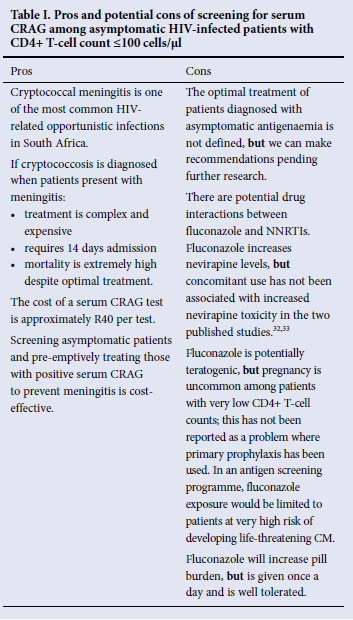
To date, preventive strategies have consisted of routine fluconazole primary prophylaxis for all patients with low CD4+ T-cell counts. Although this approach reduces the incidence of CM,15 16,17 it is not cost-effective;18-21 it is teratogenic; and fluconazole has potential interactions with both ART and tuberculosis (TB) medication (Table I). These issues have led to very limited uptake of fluconazole primary prophylaxis in HIV treatment programmes.
Fortunately, research has demonstrated that nearly all patients at risk of developing CM during ART could be identified on entry into ART programmes by screening for sub-clinical infection using cheap (ZAR38.95), simple and highly sensitive cryptococcal antigen (CRAG) blood tests.22 <100 cells/µl tested positive for CRAG in a retrospective analysis. Prospective screening for CRAG in this cohort would have been 100% predictive of subsequent development of CM within the first year of treatment.22
Cape Town data also show that 73% of ART-naïve patients presenting with CM have already been diagnosed with HIV, a median of 4 months before CM, but developed disease before starting ART.23 24-26 If all patients who had previously tested HIV-positive (both those on ART and the 73% who were known to be HIV-positive but not on ART) had been screened, and effective interventions given, up to 78% of cases of CM could have been prevented.
CRAG screening directed at all newly diagnosed HIV-positive patients with CD4+ T-cell counts <100 cells/µl is likely to detect most cases. At a programmatic level, plasma from ethylenediaminetetraacetic acid (EDTA) samples sent for CD4 count testing could automatically be tested for CRAG at the laboratory if the CD4+ T-cell count was <100 cells/µl for the first time in that individual, and in the future, development of point-of-care CRAG tests could allow testing at the clinic level, greatly simplifying the process.
The optimal treatment of asymptomatic CRAG-positive patients has not been studied. Natural history data from Cape Town suggest that ART alone is sufficient to clear asymptomatic antigenaemia in around 50% of cases.22 27
The reduction in morbidity and mortality, and the potential economic benefits of a screen-and-treat prevention strategy, are substantial.28 29 30 31 22 22
Further studies are planned to clarify these unresolved questions. However, we believe that the strength of the available evidence, coupled with the high ongoing mortality secondary to CM among South African HIV-positive patients, justifies implementation of CRAG screening in the South African HIV programme. This should involve a CRAG test on all patients diagnosed with HIV with a CD4+ T-cell count <100 cells/µl and treating all antigenaemic patients with fluconazole.
JNJ, SDL and GM are funded by the Wellcome Trust, London, UK.
References
- 1. Park BJ, Wannemuehler KA, Marston BJ, Govender N, Pappas PG, Chiller TM. Estimation of the current global burden of cryptococcal meningitis among persons living with HIV/AIDS. AIDS 2009;23(4):525-530.
- 2. Jarvis JN, Meintjes G, Williams A, Brown Y, Crede T, Harrison TS. Adult meningitis in a setting of high HIV and TB prevalence: findings from 4961 suspected cases. BMC Infect Dis 2010;10(1):67.
- 3. Lessells R, Mutevedzi P, Heller T, Newell ML. Poor long-term outcomes from cryptococcal meningitis in rural South Africa. S Afr Med J 2011;101:251-252 (this issue).
- 4. Bicanic T, Meintjes G, Wood R, et al. Fungal burden, early fungicidal activity, and outcome in cryptococcal meningitis in antiretroviral-naive or antiretroviral-experienced patients treated with amphotericin B or fluconazole. Clin Infect Dis 2007;45(1):76-80.
- 5. Bicanic T, Wood R, Meintjes G, et al. High-dose amphotericin B with flucytosine for the treatment of cryptococcal meningitis in HIV-infected patients: a randomized trial. Clin Infect Dis 2008;47(1):123-130.
- 6. Govender N, Cohen C, Meiring S, et al. Trends in treatment of adults with incident cryptococcosis, South Africa, 2005 to 2008. 17th Conference on Retroviruses and Opportunistic Infections, San Francisco, 6-19 February 2010 (abstract 800).
- 7. Mirza SA, Phelan M, Rimland D, et al. The changing epidemiology of cryptococcosis: an update from population-based active surveillance in 2 large metropolitan areas, 1992-2000. Clin Infect Dis 2003;36(6):789-794.
-
8. World Health Organization. Towards universal access: scaling up priority HIV/AIDS interventions in the health sector: progress report. Geneva 2007 (April). http://www.who.int/hiv/toronto2006/towardsuniversalaccess.pdf (accessed 25 January 2011).
» http://www.who.int/hiv/toronto2006/towardsuniversalaccess.pdf - 9. Lawn S, Harries A, Anglaret X, Myer L, Wood R. Early mortality among adults accessing antiretroviral treatment programmes in sub-Saharan Africa. AIDS 2008;22(15):1897-1908.
- 10. Jarvis JN, Boulle A, Loyse A, et al. High ongoing burden of cryptococcal disease in Africa despite antiretroviral roll out. AIDS 2009;23:1181-1185.
-
11. Govender N, Cohen C, eds. Group for Enteric, Respiratory and Meningeal disease Surveillance in South Africa. GERMS-SA. Annual Report 2009. http://www.nicd.ac.za/units/germs/germs.htm (accessed 8 January 2011).
» http://www.nicd.ac.za/units/germs/germs.htm - 12. Jarvis JN, Meintjes G, Harrison TS. Outcomes of cryptococcal meningitis in antiretroviral naive and experienced patients in South Africa. J Infect 2010;60(6):496-498.
- 13. Lawn SD, Bekker LG, Myer L, Orrell C, Wood R. Cryptococcocal immune reconstitution disease: a major cause of early mortality in a South African antiretroviral programme. AIDS 2005;19(17):2050-2052.
- 14. Haddow LJ, Colebunders R, Meintjes G, et al. Cryptococcal immune reconstitution inflammatory syndrome in HIV-1-infected individuals: proposed clinical case definitions. Lancet Infect Dis 2010;10(11):791-802.
- 15. Chang LW, Phipps WT, Kennedy GE, Rutherford GW. Antifungal interventions for the primary prevention of cryptococcal disease in adults with HIV. Cochrane Database Syst Rev 2005(3):CD004773.
- 16. Goldman M, Cloud GA, Smedema M, et al. Does long-term itraconazole prophylaxis result in in vitro azole resistance in mucosal Candida albicans isolates from persons with advanced human immunodeficiency virus infection? The National Institute of Allergy and Infectious Diseases Mycoses Study Group. Antimicrob Agents Chemother 2000;44(6):1585-1587.
- 17. Apisarnthanarak A, Mundy LM. The impact of primary prophylaxis for cryptococcosis on fluconazole resistance in Candida species. J Acquir Immun Defic Syndr 2008;47(5):644-645.
- 18. John L, Nelson M. Primary prophylaxis for cryptococcal meningitis. HIV Med 2004;5(3):131-132.
- 19. Scharfstein JA, Paltiel AD, Freedberg KA. The cost-effectiveness of fluconazole prophylaxis against primary systemic fungal infections in AIDS patients. Med Decis Making 1997;17(4):373-381.
- 20. Yazdanpanah Y, Goldie SJ, Paltiel AD, et al. Prevention of human immunodeficiency virus-related opportunistic infections in France: a cost-effectiveness analysis. Clin Infect Dis 2003;36(1):86-96.
- 21. Freedberg KA, Scharfstein JA, Seage GR, 3rd, et al. The cost-effectiveness of preventing AIDS-related opportunistic infections. JAMA 1998;279(2):130-136.
- 22. Jarvis JN, Lawn SD, Vogt M, Bangani N, Wood R, Harrison TS. Screening for cryptococcal antigenemia in patients accessing an antiretroviral treatment program in South Africa. Clin Infect Dis 2009;48(7):856-862.
- 23. Jarvis JN, Meintjes G, Wood R, Harrison TS. Testing but not treating: missed opportunities and lost lives in the South African antiretroviral therapy programme. AIDS 2010;24(8):1233-1235.
- 24. Lawn SD, Myer L, Orrell C, Bekker LG, Wood R. Early mortality among adults accessing a community-based antiretroviral service in South Africa: implications for programme design. AIDS 2005;19(18):2141-2148.
- 25. Fairall LR, Bachmann MO, Louwagie GM, et al. Effectiveness of antiretroviral treatment in a South African program: a cohort study. Arch Intern Med 2008;168(1):86-93.
- 26. Ingle SM, May M, Uebel K, et al. Outcomes in patients waiting for antiretroviral treatment in the Free State Province, South Africa: prospective linkage study. AIDS 2010;24(17):2717-2725.
- 27. Longley N, Muzoora C, Taseera K, et al. Dose response effect of high-dose fluconazole for HIV-associated cryptococcal meningitis in southwestern Uganda. Clin Infect Dis 2008;47(12):1556-1561.
- 28. Micol R, Tajahmady A, Lortholary O, et al. Cost-effectiveness of primary prophylaxis of AIDS associated cryptococcosis in Cambodia. PLoS ONE 2010;5(11):e13856.
- 29. Harling G, Orrell C, Wood R. Healthcare utilization of patients accessing an African national treatment program. BMC Health Serv Res 2007;7:80.
- 30. Haile B, Maartens G, Wood R. Economic evaluation of cryptococcal meningitis and inpatient tuberculosis treatment for HIV-infected adults in South Africa. American Public Health Association 129th Annual Meeting, Atlanta, Georgia, 21-25 October 2001(abstract 25431).
- 31. Meya DB, Manabe YC, Castelnuovo B, et al. Cost-effectiveness of serum cryptococcal antigen screening to prevent deaths among HIV-infected persons with a CD4+ cell count < or = 100 cells/microL who start HIV therapy in resource-limited settings. Clin Infect Dis 2010;51(4):448-455.
- 32. Manosuthi W, Athichathanabadi C, Uttayamakul S, Phoorisri T, Sungkanuparph S. Plasma nevirapine levels, adverse events and efficacy of antiretroviral therapy among HIV-infected patients concurrently receiving nevirapine-based antiretroviral therapy and fluconazole. BMC Infect Dis 2007;7:14.
- 33. Wakeham K, Parkes-Ratanshi R, Watson V, Ggayi AB, Khoo S, Lalloo DG. Co-administration of fluconazole increases nevirapine concentrations in HIV-infected Ugandans. J Antimicrob Chemother 2010;65(2):316-319.