Tolerance of chemotherapy in breast cancer patients in different age groups: A single-centre South African study
BACKGROUND. Tolerance of chemotherapy is a special concern in older patients, owing to comorbidities and lower physical reserves compared with younger patients. There has been no substantial research done locally regarding chemotherapy tolerance. OBJECTIVE. To establish tolerance of chemotherapy in different age groups, as well as outcomes. METHODS. This was a single-centre, retrospective, descriptive analysis of prospectively collected data at Grey's Hospital (KwaZulu-Natal, South Africa). It included all patients who received chemotherapy as part of their breast cancer management from January 2016 to December 2018, stratified into three age groups. RESULTS. The 463 patients were divided into three age groups; <60 years (n=306; 66.1%), 60 - 64 years (n=48; 10.4%) and >65 years (n=109; 23.8%). Of these patients, 247 (53.3%) had comorbidities. Most patients (357 (77.1%)) had an Eastern Corporate Oncology Group performance status of 0. No difference was noted in the age groups for tumour stage and receptor status. The majority of patients had stage 3 disease (42.1%). Most patients received an anthracycline-based regimen (78.2%). An anthracycline-free regimen was more frequently given with advancing age. Regarding standard dosing, 452 patients (98.7%) received this, while 41 patients (8.9%) had dose delays, reduction and early discontinuation, with no significant difference across age groups. Haematological adverse events occurred in 25.7%, and 4.3% had non-haematological adverse events. There was no significant difference between the age groups for adverse events. CONCLUSION. No statistically significant difference in tolerance to chemotherapy was found across different age groups, even when comorbidities were factored in.
Tolerance of chemotherapy in breast cancer patients in different age groups: A single-centre South African study
A M ZwaneI, II; G OosthuizenIII; L StopforthIV; M JoffeV; L MartinVI; S ČačalaVII
IMB ChB, FCS (SA); Department of Surgery, Grey's Hospital, Pietermaritzburg, South Africa
IIMB ChB, FCS (SA); Department of Surgery, School of Health Sciences, University of KwaZulu-Natal, Durban, South Africa
IIIFCS (SA), PhD; Department of Surgery, School of Health Sciences, University of KwaZulu-Natal, Durban, South Africa
IVMB ChB, FC (Rad One); Radiation Oncology and Department of Oncology, Grey's Hospital, University of KwaZulu-Natal, Pietermaritzburg, South Africa
VBSc, PhD; Strengthening Oncology Services Research Unit, University of the Witwatersrand, Johannesburg, South Africa
VIMA, PhD; Department of Surgical Sciences, Faculty of Medicine and Health Sciences, Stellenbosch University, Cape Town, South Africa
VIIMB ChB, FRACS; Department of Surgery, School of Health Sciences, University of KwaZulu-Natal, Durban, South Africa
BACKGROUND. Tolerance of chemotherapy is a special concern in older patients, owing to comorbidities and lower physical reserves compared with younger patients. There has been no substantial research done locally regarding chemotherapy tolerance.
OBJECTIVE. To establish tolerance of chemotherapy in different age groups, as well as outcomes.
METHODS. This was a single-centre, retrospective, descriptive analysis of prospectively collected data at Grey's Hospital (KwaZulu-Natal, South Africa). It included all patients who received chemotherapy as part of their breast cancer management from January 2016 to December 2018, stratified into three age groups.
RESULTS. The 463 patients were divided into three age groups; <60 years (n=306; 66.1%), 60 - 64 years (n=48; 10.4%) and >65 years (n=109; 23.8%). Of these patients, 247 (53.3%) had comorbidities. Most patients (357 (77.1%)) had an Eastern Corporate Oncology Group performance status of 0. No difference was noted in the age groups for tumour stage and receptor status. The majority of patients had stage 3 disease (42.1%). Most patients received an anthracycline-based regimen (78.2%). An anthracycline-free regimen was more frequently given with advancing age. Regarding standard dosing, 452 patients (98.7%) received this, while 41 patients (8.9%) had dose delays, reduction and early discontinuation, with no significant difference across age groups. Haematological adverse events occurred in 25.7%, and 4.3% had non-haematological adverse events. There was no significant difference between the age groups for adverse events.
CONCLUSION. No statistically significant difference in tolerance to chemotherapy was found across different age groups, even when comorbidities were factored in.
In many areas of South Africa (SA), including the centre used in the present study, the majority of patients with breast cancer (BC) present late, with locally advanced and inoperable disease.[1,2] This, along with certain molecular subtypes, are indications for chemotherapy as initial treatment. Adjuvant chemotherapy may also be offered post BC surgery based on the final histology. Therefore, many BC patients of varying ages, including the elderly, may require chemotherapy as part of their cancer management.
The factors affecting tolerance to chemotherapy across all age groups include overall performance status and pre-existing conditions, the type and intensity of the chemotherapy regimen, supportive care measures, psychosocial support and coping mechanisms.[2]
Conventionally, 'elderly' has been defined as a chronological age >65 years; however, the evidence on which this definition is based is unknown.[3]
Chronological age is a convenient way to assess data, but it does not account for the heterogeneity of the older patient group.[4] Also, standard oncology work-ups may not always help to stratify the risk of treatment-related complications.[5] Consequently, patient age is often taken into consideration during chemotherapy decision-making.
The elderly often have more comorbidities and lower physiological reserve than their younger counterparts,[6,7] raising the concern that chemotherapy may be poorly tolerated in this group. This may prompt a de novo dose reduction, or a decision to use a less dose-dense or better tolerated regimen, which may be less effective.[8] Poor compliance due to toxicity may also result in suboptimal outcomes.
The incidence of BC is rising in the ageing population, and the consensus is that elderly patients on chemotherapy need special attention. What this special attention involves and how best to provide it requires further research.[9,10] Many uncertainties remain regarding the utilisation of chemotherapy in different age groups, particularly in the elderly. This has been attributed to the under-representation of the elderly population in randomised trials investigating adjuvant chemotherapy.[11]
In SA, there are limited data on the tolerance of chemotherapy in BC patients. The aim of this study was to address this deficit by analysing BC chemotherapy tolerance in different age groups, considering additionally patient comorbidities, stage of disease and chemotherapy regimen.
Methods
This was a single-centre, retrospective, descriptive analysis of prospectively collected data on patients who received chemotherapy as part of their BC treatment at Grey's Hospital Oncology department over a 3-year period, January 2016 to December 2018. Grey's Hospital, in KwaZulu-Natal Province, SA, is a tertiary institution that services 27 referral hospitals and a largely black, rural and low socioeconomic-status population of ~4 million.
Data were obtained from the SA Breast Cancer and HIV Outcomes (SABCHO) study for the Grey's Hospital site, and from patient files. The present study included females aged >18 years. Male BC patients, patients with lymphoma of the breast, BC recurrence or patients with synchronous non-breast cancers were excluded.
Demographic data included age and ethnicity. Clinical information on comorbidities, HIV status, stage of disease and BC receptor status were recorded. Neo-adjuvant or adjuvant chemotherapy, radical or palliative intent, the regimen administered (anthracycline containing or anthracycline free) and toxicities were among the treatment data collected. The outcome was assessed as survival at 1, 3 or 5 years. For the purpose of this study, intolerance to chemotherapy was defined as a patient's inability to tolerate the side-effects or toxicities of chemotherapy drugs to the extent that the treatment had to be reduced, delayed, changed, or discontinued. This may have resulted from severe or unmanageable side-effects (including severe nausea or diarrhoea, myelosuppression, neurotoxicity, cardiotoxicity, or allergic reactions) or cumulative toxicity with worsening side-effects with successive cycles. A delay in chemotherapy was considered as an interval greater than expected between cycles (usually 3 weeks), due to side-effects or toxicity. Discontinuation of chemotherapy was defined as the failure to complete the planned number of cycles due to severe side-effects or toxicity.
Patients were divided into three age groups: <60 years, 60 - 64 years and >65 years. De-identified data were entered into an Excel (Microsoft, USA) spreadsheet in a comma-separated values format, and stored on a password-protected computer.
Statistical analysis
Basic descriptive and categorical variables were expressed as counts and percentages. Clinical characteristics were compared among age groups using χ2p<0.05). Chi-squared tests were also used to compare survival status at 1, 3 and 5 years. Time to event was calculated as the time from initiation of chemotherapy to the date of death. Kaplan-Meier curves were used to display the time to death. A log-rank test was used to compare time to death among age groups. SPSS version 17 (IBM, USA) was used for statistical analysis.
Ethical approval
Ethics approval was obtained from the Biomedical Research Ethics Committee of the University of KwaZulu-Natal (ref. no. BREC/00005016/2022).
Results
Patient characteristics
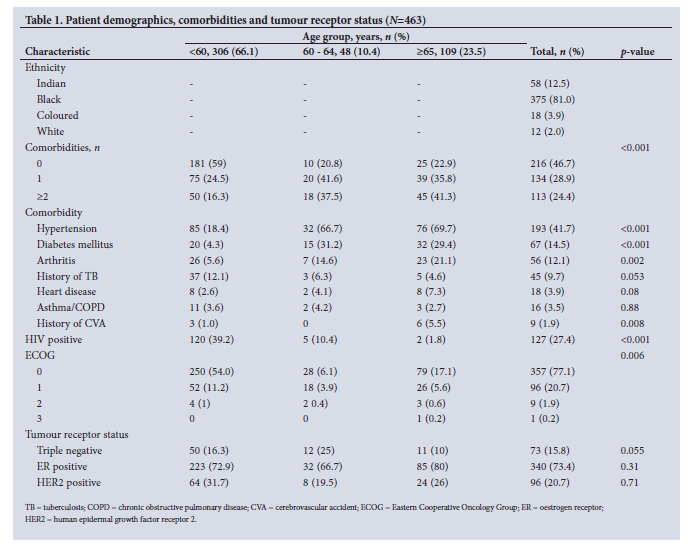
Data were collected on 463 patients who had chemotherapy as part of their BC treatment. Patient demographics, comorbidities and tumour receptor status are presented in Table 1. The majority (n=306, 66.1%) of patients were aged <60 years, 48 (10.4%) were aged between 60 and 64 years and 109 (23.5%) >65 years. Ages ranged from 28 to 85 (mean 54) years, with 13.2% (61 patients) diagnosed as young BC (<40 years), and 6.0% (28 patients) aged >75 years.
Nearly half (n=216, 46.7%) of patients had no comorbidities, and the <60-year age group had fewer comorbidities than the older groups (p<0.01). Hypertension was the most common comorbidity, followed by diabetes mellitus, both of which were more prevalent in the older age groups. Nearly one-quarter (24.4%) of women had >2 comorbidities. Twenty-seven percent of patients were HIV positive, and nearly all of these (95%) were <60 years of age, while 39.2% of women aged <60 years were HIV positive (p<0.001).
The majority of patients had good performance status on initial assessment: 357 (77.1%) had an Eastern Cooperative Oncology Group (ECOG) score of 0, with most of these patients (81.7%) in the <60-year age group.
Cancer characteristics
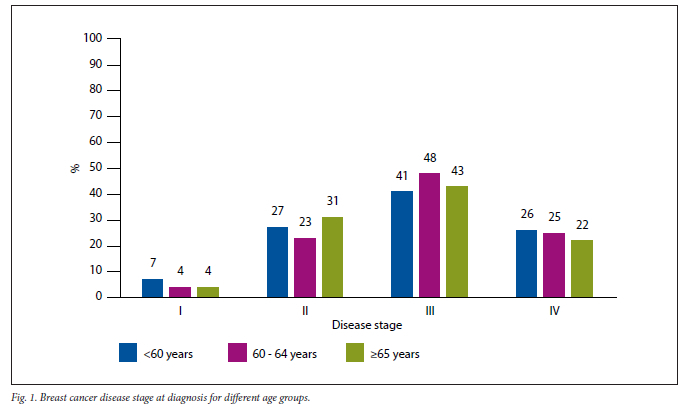
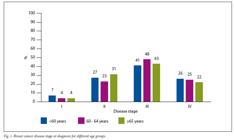
Overall, 15.8% of patients had triple negative BC (TNBC), nearly three-quarters (73.4%) were oestrogen receptor positive and 20.7% were human epidermal growth factor receptor 2 (HER2) positive. No significant difference was identified with respect to receptor status and age group, and with further subdivision of age groups into decades, there was still no difference in receptor status (p=0.1). The majority of patients (42.1%) who had chemotherapy had stage III disease at the time of diagnosis, 5.6% had stage I, 27.7% had stage II and 24.6% had stage IV (metastatic). There was no difference in the stage of cancer at presentation between the age groups (p>0.05) (Fig. 1).
Chemotherapy
Chemotherapy was started with either curative (neo-adjuvant and adjuvant) or palliative intent (33.9%, 47.5% and 18.6%, respectively). Twenty-eight (6%) patients were found to be metastatic after initiating chemotherapy, and treatment intent was then amended to palliative. Approximately one-third of patients in each age group received neo-adjuvant chemotherapy: 33.3%, 35.4% and 32.0% for the <60, 60 - 64 and >65-year age groups, respectively.
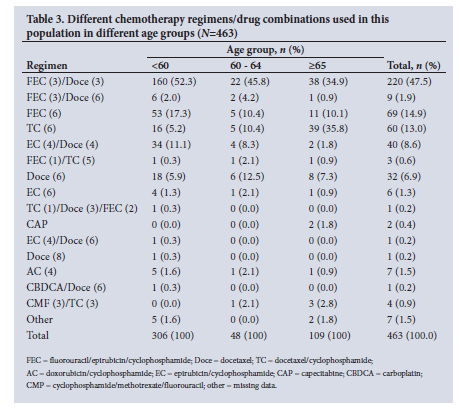
An anthracycline-based regimen was administered to 362 (78.2%) patients. Older patients >65 years were more likely to receive an anthracycline-free regimen, a statistically significant finding, as highlighted in Table 2. Only one-third of patients aged >70 years and no patients >80 years received anthracycline chemotherapy.
The majority of the patients who received an anthracycline-based regimen also received a taxane chemotherapy agent. Chemotherapy regimens are detailed in Table 3.
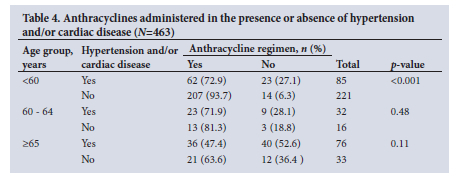
An anthracycline regimen was more often given to younger patients (<60 years) with hypertension and/or cardiac disease than to older age groups with these comorbidities. This was also a statistically significant finding (p<0.001) (Table 4).
Intolerance to chemotherapy
Of the 463 patients, 452 (97.8%) were initiated on standard-dose chemotherapy. Ten patients were started on a lower dose: 5 were aged <60 years, 1 was in the 60 - 64 age group and 4 were >65 years. Forty-one (8.9%) patients required dose delays, dose reductions and/or early discontinuation of chemotherapy (7.8%, 8.3% and 11.9% of the three age groups, respectively), with no statistically significant difference noted between the age groups (p=0.43).
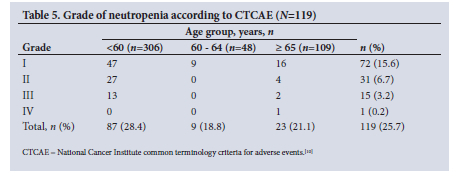
Neutropenia was the most common haematological adverse event. It was noted in 119 (25.7%) patients, with no significant difference between the age groups for incidence or grade of severity (p=0.16) (Table 5). Neutropenia occurred more frequently in HIV-infected patients (33%) compared with HIV-negative patients (22.9%), and this was statistically significant (p=0.026).
Four (0.9%) patients had significant anaemia requiring transfusion (grade III common terminology criteria for adverse events (CTCAE)),[10] and 2 patients had thrombocytopaenia.
Twenty patients had adverse skin events: 4.9% (15), 6.3% (3) and 1.8% (2) of the respective age groups; p=0.75. Severe nausea and vomiting (n=8) and significant peripheral neuropathy (n=8) were not age-group-specific. Four patients had drip infiltration/ thrombophlebitis that did not require surgical intervention.
Survival analysis
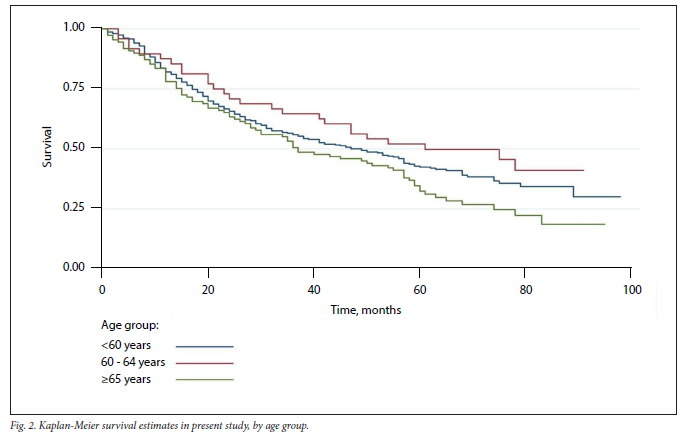
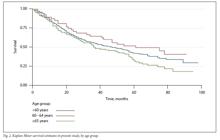
The patients were followed up at year 1, 3 and 5. The 5-year survival rates were 34.3%, 47.9% and 28.4% for the <60 year, 60 - 64 year and >65-year age groups, respectively (Table 6). Fig. 2 depicts the Kaplan-Meier survival estimates for the different age groups.
Discussion
BC is the most common cancer in women in SA, accounting for 25% of all cancers, and 16% of cancer mortality.[13] Due to late presentation, inoperability, disease stage and molecular subtypes, chemotherapy is frequently administered to patients of varying ages as neo-adjuvant, adjuvant and palliative treatment in our setting.
Included in this study were 463 BC patients who received chemotherapy during a 3-year period, to assess tolerance to treatment. Within the three age groups, noted to have similar tumour stage, molecular profile and ECOG performance status, we did not identify any correlation between chemotherapy tolerance and age group or comorbidities.
The population of elderly patients with BC is increasing. How 'elderly' is defined chronologically varies among different authors, and many clinical practice guidelines do not define elderly in any way,[14] which complicates comparisons between studies. We used age >65 years as elderly, which is the most accepted definition and accounted for 23% of our study population.
The overall findings in the literature point towards an association between chemotherapy intolerance and increasing age, and higher risk of toxicity.[6,8,15]
Multiple factors, including physiological changes and pharmacodynamics, render the elderly more susceptible to chemotherapy intolerance.[7] To assess tolerance, various measures may be assessed, such as toxicity (constitutional, severe, life-threatening, lethal), early cessation, dose reduction and dose delay, hospitalisation and effect on quality of life.[6,8]
Recent studies show that treatment decisions should not be based on chronological age but on individualised assessment.[5] The American Society of Clinical Oncology (ASCO) Guidelines for Geriatric Oncology[5] advocate for the geriatric assessment of patients aged >65 years, which is a multifaceted, comprehensive assessment. Most assessments include the consideration of underlying comorbidities, which may also contribute to poor tolerance/intolerance of chemotherapy in the elderly.
A study in Soweto, SA, found that two-thirds of black women with and without BC had >2 comorbidities.[16] Fifty-three percent of our study patients had at least one comorbidity, and about half (24.4%) of these had >2. As would be expected, comorbidities were more common in the elderly, and hypertension and diabetes mellitus were the most frequently noted. However, we did not find poorer chemotherapy tolerance in any age group, despite the presence of comorbidities.
In contrast to our findings, Barcenas et al.[17] showed that adjuvant chemotherapy was associated with significant rates of hospitalisation in women aged >65 years, with age and comorbidities constituting significant independent risk factors, even when accounting for regimen use. However, we use conventional cycling of chemotherapy due to logistical constraints in our resource-constrained environment, rather than dose-dense regimens, as used by Barcenas et al.[17] Other studies have demonstrated that older patients with no significant comorbidities can tolerate chemotherapy as well as younger patients,[18,19] but with greater toxicity.[20]
Chemotherapy-related toxicities in BC patients aged >65 years were studied by Du et al.,[21] who showed that ~20% of patients required hospitalisation. A greater number of comorbidities and higher tumour stage increased the hospitalisation rate but were not associated with age in their cohort.
This supports our findings that age alone cannot be used as a determining factor for chemotherapy, but rather the decision must be based on the outcome of a multifaceted comprehensive assessment, which may entail the patient's physiological reserve, underlying comorbidities and tumour burden. We did not identify any difference in age groups with respect to dose delays, dose reductions or early chemotherapy discontinuation.
Haematological toxicity is a common complication of chemotherapy. A Cancer and Leukaemia Group B group trial reported a 66% increase in the likelihood of developing grade 4 haematologic toxicity in patients aged >65 years compared with patients <50 years (p<0.001).[19]
Although we did not find any age group difference for chemotherapy-induced neutropenia or anaemia, neutropenia was a more common complication in patients with HIV infection. KwaZulu-Natal Province has SA's second-highest burden of HIV,[22] and 127 (27%) of our study group were women living with HIV (WLWH). This subset was notably young: nearly 40% of study patients aged <60 years were HIV positive. This concurs with the findings of a larger study from the SABCHO group, which found that WLWH were more prone than others to dose-limiting myelotoxicities, and to requiring granulocyte colony-stimulating factor support during their treatment.[23]
Some chemotherapy drugs are found to be less well tolerated than others. Anthracycline and taxane-containing regimens may be associated with a higher risk of hospitalisation and other side-effects.[17,24] Anthracyclines, some of the most potent cytotoxic drugs, were administered to nearly 80% (78.2%) of our study patients, with a noticeable decrease in their use with advancement of age (p<0.001). In patients aged >65 years, ~50% received an anthracycline, compared with 82% of women aged <60 years. In the 50% of patients aged >65 years who did not receive an anthracycline, a taxane-containing regimen was predominantly used (45.9%). This may reflect ongoing concern in clinical settings around the toxicity of anthracyclines, and the limited support from the literature to inspire confidence in their use in elderly patients.[25,26] Anthracyclines were less frequently used in patients with hypertension and/or cardiac disease, but this was only statistically significant for patients aged <60 years, which may reflect careful individualised holistic assessment of patients.
Delgado-Ramos et al.[6] found that older age was associated with early chemotherapy cessation, and the use of anthracyclines, chemotherapy combinations containing anti-HER2 drugs and higher performance scores were independently associated with higher toxicities. Likewise, Du et al.[21] showed that the use of anthracycline-containing chemotherapy was associated with greater odds of toxicities. In our study, older patients had less anthracycline-based chemotherapy, which may be the reason for the similar percentage of toxicities observed across the three age groups analysed.
These findings seem to be contrary to the prevailing literature on this subject, which shows both decreasing compliance and increasing toxicities in the elderly who receive chemotherapy.[6,24,27]
A significant difference in survival was found among the three age groups in this study, with patients aged 60 - 64 years performing best. In the literature, younger patients demonstrate more advanced and aggressive disease characteristics, contributing to their decreased survival. Additionally, African American women have been found to be at higher risk of TNBC, and to have a worse prognosis compared with other ethnic groups.[28] We did not find this in our study, where >80% of patients were of black African ethnicity, and ~16% of all patients had TNBC. In the subset age review, only 5% aged >70 years had TNBC, and those aged 60 - 64 years had the highest incidence, at 25%.
The number and severity of comorbidities usually increase with age, and this alone can have a detrimental effect on survival in patients with BC.[6,29] Satariano et al.[29] demonstrated that the presence of >3 comorbidities was a strong predictor of poor survival.[30] Elderly patients (>80 years) also tended to have higher rates of metastatic disease.[31] Older patients in the present study had more comorbidities, but not more stage IV disease, so this may have played a role in survival.
Limitations of this study include the lack of review of hospitalisation as an independent outcome of poor tolerance, and the low representation of elderly patients (23%) in the study population, along with the single-centre status, albeit at a large referral centre. The retrospective nature of the study, and potential bias, also are limitations. Additional analysis using multivariate regression would have strengthened the findings.
Continuing research on chemotherapy tolerance in SA presents a potential gap for unveiling new knowledge as it relates to the local population. Much of the literature on this subject originates from higher-income countries with sociodemographic characteristics different from those of the population relying on public sector healthcare in SA. Further studies are warranted.
Conclusion
With an ageing population and increasing incidence of BC, increasing numbers of elderly patients, in SA and worldwide, are offered chemotherapy as a treatment modality. Despite higher numbers of comorbidities in the elderly, no difference in chemotherapy tolerance or associated toxicities was noted in different age groups (which had similar stages of BC and tumour receptor status) in our study. The elderly received fewer anthracycline-based regimens. More research is needed to further evaluate chemotherapy tolerance in our unique, largely African, and low-socioeconomic-status population.
Data availability. The data used for this study are available on request from the corresponding author.
Declaration. The publication of this article was required for completion of AMZ's MMed in general surgery at the University of KwaZulu-Natal.
Acknowledgements. AMZ is grateful for his wife Dr Lungile Zwane's support.
Author contributions. Conception and design: AMZ and SC; provision of study material or patients: AMZ, SC, GO, LS and MJ; collection and assembly of data: AMZ and SC; data analysis and interpretation: AMZ and SC; manuscript writing: AMZ; final approval of manuscript: all authors approved the final manuscript. All authors have read and agreed to the published version of the manuscript.
Funding. None.
Conflicts of interest. None.
References
-
1. Joffe M, Ayeni O, Norris SA, et al. Barriers to early presentation of breast cancer among women in Soweto, South Africa. PLoS ONE 2018;13(2):e0192071. https://doi.org/10.1371/journalpone.0192071
» https://doi.org/10.1371/journalpone.0192071 -
2. Cacala SR, Gilart J. Factors relating to late presentation ofpatients with breast cancer in Area 2 KwaZulu-Natal, South Africa. J Globl Oncol 2017;3(5):497-501. https://doi.org/10.1200/jgo.2016.008060
» https://doi.org/10.1200/jgo.2016.008060 -
3. Orimo H, Ito H, Suzuki T, Araki A, Hosoi T, Sawabe M. Reviewing the definition of 'elderly'. Geriatr Gerontol Int 2006;6(3):149-158. https://doi.org/10.1111/j.1447-594.2006.00341.x
» https://doi.org/10.1111/j.1447-594.2006.00341.x -
4. Kim J, Hurria A. Cancer and aging: Considerations for chemotherapy in older patients. J Natl Compr Canc Network 2013;11(12):1494-1502. https://doi.org/10.6004/jnccn.2013
» https://doi.org/10.6004/jnccn.2013 -
5. Mohile SG, Dale W, Somerfield MR, et al. Practical assessment and management of vulnerabilities in older patients receiving chemotherapy: ASCO guideline for geriatric oncology. J Clin Oncol 2018;36(22):2326-2347. https://doi.org/10.1200/JCO.2018.78.8687
» https://doi.org/10.1200/JCO.2018.78.8687 -
6. Delgado-Ramos GM, Nasir SS, Wang J, Schwartzberg LS. Real-world evaluation of effectiveness and tolerance of chemotherapy for early-stage breast cancer in older women. Breast Cancer Res Treat 2020;182(2):247-258. https://doi.org/10.1200/JCO.2018.36.15_suppl.e12509
» https://doi.org/10.1200/JCO.2018.36.15_suppl.e12509 -
7. Hurria A, Lichtman SM. Pharmacokinetics of chemotherapy in the older patient. Cancer Control 2007;14(1):32-43. https://doi.org/10.1177/107327480701400105
» https://doi.org/10.1177/107327480701400105 -
8. Battisti NML, Reed MW, Herbert E, et al. Bridging the age gap in breast cancer: Impact of chemotherapy on quality of life in older women with early breast cancer. Eur J Cancer 2021;1441:269-280. https://doi.org/10.1016/j.ejca.2020.11.022
» https://doi.org/10.1016/j.ejca.2020.11.022 -
9. Fietz T, Zahn M-O, Köhler A, et al. Routine treatment and outcome of breast cancer in younger versus elderly patients: Results from the SENORA project of the prospective German TMK cohort study. Breast Cancer Res Treat 2018;167(2):567-578. https://doi.org/10.1007/s10549-017-4534-8
» https://doi.org/10.1007/s10549-017-4534-8 -
10. Meresse M, Bouhnik AD, Bendiane MK, et al. Chemotherapy in old women with breast cancer: Is age still a predictor for under treatment? Breast J 2017;23(3):256-266. https://doi.org/10.1111/tbj.12726
» https://doi.org/10.1111/tbj.12726 -
11. Lewis JH, Kilgore ML, Goldman DP, et al. Participation of patients 65 years of age or older in cancer clinical trials. J Clin Oncol 2003;21(7):1383-1389. https://doi.org/10.1200/JCO.2003.08.010
» https://doi.org/10.1200/JCO.2003.08.010 -
12. United States Department of Health and Human Services. Common Terminology Criteria for Adverse Events (CTCAE). Version 5.0, 2017. https://ctep.cancer.gov/protocolDevelopment/electronic_applications/ctc.htm (accessed 6 August 2025).
» https://ctep.cancer.gov/protocolDevelopment/electronic_applications/ctc.htm -
13. National Cancer Registry, South Africa. Cancer in South Africa 2022: Full report. pretoria: National Health Laboratory Service, 2022. https://www.nicd.ac.za/centres/national-cancer-registry/ (accessed 6 August 2025).
» https://www.nicd.ac.za/centres/national-cancer-registry/ -
14. Singh S. Rational use of medicines: Achievements and challenges. Pharm Pract 2014;12(4):489. https://doi.org/10.4321/s1886-36552014000400007
» https://doi.org/10.4321/s1886-36552014000400007 -
15. Leinert E, Singer S, Janni W, et al. The impact of age on quality oflife in breast cancer patients receiving adjuvant chemotherapy: A comparative analysis from the prospective multicenter randomised ADEBAR trial. Clin Breast Cancer 2017;17(2):100-106. https://doi.org/10.1016/j.clbc.2016.10.008
» https://doi.org/10.1016/j.clbc.2016.10.008 -
16. Ayeni O, Joffe M, Cubasch H, et al. Prevalence of comorbidities in women with and without breast cancer in Soweto, South Africa: Results from the SABC study. S Afr Med J 2019;109(4):264-271. https://doi.org/10.7196/SAMJ.2019.v109i4.13465
» https://doi.org/10.7196/SAMJ.2019.v109i4.13465 -
17. Barcenas CH, Niu J, Zhang N, et al. Risk of hospitalisation according to chemotherapy regimen in early-stage breast cancer. J Clinical Oncol 2014;32(19):2010-2017. https://doi.org/10.1200/JCO.2013.49.3676
» https://doi.org/10.1200/JCO.2013.49.3676 -
18. Christman K, Muss HB, Case LD, Stanley V. Chemotherapy of metastatic breast cancer in the elderly the piedmont oncology association experience. JAMA 1992;268(1):57-62. https://doi.org/10.1001/jama.1992.03490010059030
» https://doi.org/10.1001/jama.1992.03490010059030 -
19. Ibrahim NK, Frye DK, Buzdar AU, Walters RS, Hortobagyi GN. Doxorubicin-based chemotherapy in elderly patients with metastatic breast cancer: Tolerance and outcome. Arch Intern Med 1996;156(8):882-888. https://doi.org/10.1023/A:1011634519441
» https://doi.org/10.1023/A:1011634519441 -
20. Muss HB, Berry DA, Cirrincione C, et al. Toxicity of older and younger patients treated with adjuvant chemotherapy for node-positive breast cancer: The Cancer and Leukaemia Group B experience. J Clin Oncol 2007;25(24):3699-3704. https://doi.org/10.1200/JCO.2007.10.9710
» https://doi.org/10.1200/JCO.2007.10.9710 -
21. Du XL, Osborne C, Goodwin JS. Population-based assessment of hospitalisations for toxicity from chemotherapy in older women with breast cancer. J Clin Oncol 2002;20(24):4636-4642. https://doi.org/10.1200/JCO.2002.05.088
» https://doi.org/10.1200/JCO.2002.05.088 -
22. Human Sciences Research Council. Sixth South African HIV Prevalence, Incidence and Behaviour Survey (SABSSM VI), KwaZulu-Natal. Durban, HSRC, 23 September 2024. https://hsrc.ac.za/press-release/phsb/Kwazulu-natal-reports (accessed 12 December 2024).
» https://hsrc.ac.za/press-release/phsb/Kwazulu-natal-reports -
23. O'Neil DS, Ayeni OA, Farrow HA, et al. The impact of HIV infection on neoadjuvant and adjuvant chemotherapy relative dose intensity in South African patients with breast cancer. Oncologist 2023;28(10):e921-e929. https://doi.org/10.1093/oncolo/oyad056
» https://doi.org/10.1093/oncolo/oyad056 -
24. Reinisch M, von Minckwitz G, Harbeck N, et al. Side effects of standard adjuvant and neoadjuvant chemotherapy regimens according to age groups in primary breast cancer. Breast Care 2013;8(1):60-66. https://doi.org/10.1159/000346834
» https://doi.org/10.1159/000346834 -
25. Aapro M, Bernard-Marty C, Brain EGC, et al. Anthracycline cardiotoxicity in the elderly cancer patient: A SIOG expert position paper. Ann Oncol 2011;22(2):257-267. https://doi.org/10.1093/annonc/mdq609.
» https://doi.org/10.1093/annonc/mdq609 -
26. Barcenas CH, Zhang N, Zhao H, et al. Anthracycline regimen adherence in older patients with early breast cancer. Oncologist 2012;17(3):303-311. https://doi.org/10.1634/theoncologist.2011-0316
» https://doi.org/10.1634/theoncologist.2011-0316 -
27. Rossi A, Colantuoni G, Maione P, et al. Chemotherapy of breast cancer in the elderly. Curr Medicinal Chem 2005;12(3):297-310. https://doi.org/10.2174/0929867053363261
» https://doi.org/10.2174/0929867053363261 -
28. Reynolds S. Triple-negative breast cancer disproportionately affects African American and Hispanic women. Cancer Bull 2007;4(1):1-2. https://doi.org/10.1037/e458842008-005
» https://doi.org/10.1037/e458842008-005 -
29. Hurria A, Brogan K, Panageas KS, et al. Patterns of toxicity in older patients with breast cancer receiving adjuvant chemotherapy. Breast Cancer Res Treat 2005;92(2):151-156. https://doi.org/10.1007/s10549-005-1410-8
» https://doi.org/10.1007/s10549-005-1410-8 -
30. Satariano WA, Ragland DR. The effect of comorbidity on 3-year survival of women with primary breast cancer. Ann Intern Med 1994;120(2):104-110. https://doi.org/10.7326/0003-4819-120-2-199401150-00002
» https://doi.org/10.7326/0003-4819-120-2-199401150-00002 -
31. Jackson EB, Gondara L, Speers C, et al. Does age affect outcome with breast cancer? Breast 2023;70(1):25-31. https://doi.org/10.1016/j.breast.2023.06.001
» https://doi.org/10.1016/j.breast.2023.06.001

Accepted 11 August 2025