Hepatocellular carcinoma: Epidemiology, pathogenesis and surveillance - implications for sub-Saharan Africa
Hepatocellular carcinoma (HCC) originates from hepatocytes usually secondary to chronic inflammation and cirrhosis. It is an important disease of global significance with a high incidence and mortality. It is the fifth and eighth most common cancer in males and females, respectively. HCC is also extremely lethal; in 2015 it was the second and sixth most common cause of death from cancer in males and females, respectively. Chronic viral hepatitis B and C are the most frequent risk factors for the development of HCC, and the global distribution of HCC largely mirrors that of chronic viral hepatitis. More recently, there has been a notable increase in the incidence of HCC as a result of obesity-related fatty liver disease. Here, we review the epidemiology of HCC, examine recent advances in our understanding of the pathogenesis of HCC, discuss the implications for identification of potential therapeutic targets, and provide the most updated recommendations on surveillance for HCC, with particular attention to the unique challenges and potential opportunities to reduce the burden of illness and death from HCC in sub-Saharan Africa.
Hepatocellular carcinoma: Epidemiology, pathogenesis and surveillance - implications for sub-Saharan Africa
K ZakhariaI, II, III; C A LutherIV; H AlsabbakI; L R RobertsV
IMD; Internal Medicine Residency Program, Department of Medical Education, Beaumont Health, Dearborn, Michigan, USA
IIMD; Division of Gastroenterology, University of Michigan, Ann Arbor, Michigan, USA
IIIMD; Division of Gastroenterology and Hepatology, Mayo Clinic, Rochester, Minnesota, USA
IVMD; Department of Dermatology, Henry Ford Health System, Detroit, Michigan, USA
VMB ChB, PhD; Division of Gastroenterology and Hepatology, Mayo Clinic, Rochester, Minnesota, USA
Hepatocellular carcinoma (HCC) originates from hepatocytes usually secondary to chronic inflammation and cirrhosis. It is an important disease of global significance with a high incidence and mortality. It is the fifth and eighth most common cancer in males and females, respectively. HCC is also extremely lethal; in 2015 it was the second and sixth most common cause of death from cancer in males and females, respectively. Chronic viral hepatitis B and C are the most frequent risk factors for the development of HCC, and the global distribution of HCC largely mirrors that of chronic viral hepatitis. More recently, there has been a notable increase in the incidence of HCC as a result of obesity-related fatty liver disease. Here, we review the epidemiology of HCC, examine recent advances in our understanding of the pathogenesis of HCC, discuss the implications for identification of potential therapeutic targets, and provide the most updated recommendations on surveillance for HCC, with particular attention to the unique challenges and potential opportunities to reduce the burden of illness and death from HCC in sub-Saharan Africa.
Hepatocellular carcinoma (HCC) is a cancer of global significance owing to its high incidence and extremely high mortality. It is the sixth most common cancer worldwide, with 854 000 new cases estimated to occur in 2015. Moreover, because of its high mortality, HCC is estimated to be the second, third or fourth most common cause of cancer deaths, causing ~810 000 deaths in 2015.1 234 5
Methods
We reviewed the published data comprehensively using PubMed and Google Scholar. Keywords used include: HCC, viral hepatitis, HBV, HCV, pathogenesis, primary and secondary prevention, and challenges in Africa. The quality of the evidence is indicated in parenthesis after each recommendation.
Results
Epidemiology and association with viral hepatitis
Viral hepatitis is a leading cause of disability and mortality worldwide, with a gradual increase in the number of deaths over the last few decades. The global yearly estimate of deaths due to viral hepatitis has increased from 0.89 million in 1990 to 1.45 million in 2013, higher than the estimated number of deaths from HIV, tuberculosis, or malaria.667,8 Most countries in Africa have high (>8%) or higher-intermediate (5 - 7.99%) prevalence of chronic HBV infection, with the exception of Algeria, Eritrea, Madagascar and the Seychelles, which have low (<2%) to lower-intermediate (2 - 4.99%) prevalence.9101011
There is substantial global variation in the prevalence of chronic HCV infection. In Africa, the prevalence of chronic HCV infection is highest in Egypt, which has anti-HCV and viraemic prevalences of 14.7% and 10.0%, respectively, rates that are higher than in almost all other countries. The high infection rates in Egypt are likely due to extensive iatrogenic transmission during national campaigns for the eradication of schistosomiasis.12131313
Given the substantial global variations in prevalence of the major risk factors, the epidemiology of HCC varies between regions and countries. The highest incidences of HCC are seen in regions with high prevalences of chronic HBV and HCV. In the most recent Global Burden of Disease Study, HCC is ranked first in cancer incidence in four countries (including Mongolia and three SSA countries: the Republic of the Gambia, Guinea, and Mali) and first in cancer mortality in 30 countries (including Egypt, Djibouti, Mozambique, and 24 other countries in central and western SSA).1111
The incidence and mortality of HCC is generally higher in males than in females, with an incidence ratio of 2:1 to 6:1, depending on the region. In males, HCC is the most commonly diagnosed cancer in 10 SSA countries (Mauritania, Republic of the Gambia, Mali, Burkina Faso, Cameroon, South Sudan, Democratic Republic of the Congo, Angola, Mozambique) and the most common cause of cancer deaths in most countries of western, eastern and central SSA.1111212121
The age at the time of HCC diagnosis also varies based on aetiology of HCC and by region. In Africa, patients with HCC present at a younger age than in other regions of the world; therefore, surveillance of Africans with chronic HBV who are at risk for HCC is recommended from the age of 20 years.2,14 In a study of a 1 552 HCC patients from 7 African countries, i.e. Nigeria, Ghana, Uganda, Malawi, Côte D'Ivoire, Sudan and Tanzania, the median age at the time of diagnosis was 42 years in patients with HBV, and 43 years in patients with co-infection (HBV and HCV), 47 years in those with HCC of unknown aetiology, and 55 years in patients with HCV.141414-18 In a recently published US population-based study, country of birth (rather than race or ethnicity) had the largest impact on the age of diagnosis of HCC in the US population. The highest percentages of patients diagnosed with early onset HCC (younger than 50 years) were observed in patients born in West Africa (57%) followed by patients born in Oceania (24%) compared with 10 - 15% and <5% of patients born in Asia and Europe, respectively.181818
The underlying reasons for the young onset of HBV-induced HCC in Africa are incompletely understood. Potential causes of bias such as the younger population age distribution in Africa appear not to account entirely for the observed phenomenon. Data from Asia suggests that particular HBV genotypes and sub-genotypes are associated with increased viral replication, which in turn is associated with an increased risk of HCC. However, HBV-induced HCC in Africa is associated with different HBV genotypes and appears to occur in individuals with relatively low viral loads. The extent of the contribution of dietary Aflatoxin B1 exposure to the younger onset of HCC in Africa is also not clear.
Increasingly, non-alcoholic fatty liver disease (NAFLD) is recognised as an important contributor to liver carcinogenesis. While this is now most fully appreciated in North America, where fatty liver disease and the metabolic syndrome are now the largest single contributor to the burden of HCC, it is unclear how NAFLD may interact with HBV or HCV in determining the risk of HCC in Africa.19
Survival of patients with HCC also varies between countries. In the Global HCC BRIDGE study820
Pathogenesis of HCC
The molecular pathogenesis of HCC varies nearly as much as the epidemiology of this devastating disease. Fortunately, continual progress in genetic and molecular analyses is yielding rapidly increasing amounts of data on the genetic and molecular alterations associated with development and progression of HCC. HCCs contain, on average, 20 - 100 mutations per genome, which is similar to the majority of solid tumours.21
The aetiology of HCC influences the genetic aberrations found in HCCs. HBV is a DNA virus that can induce HCC through several potential mechanisms: viral genome integration into the host genome; immune-mediated destruction and concomitant regeneration of HBV-infected hepatocytes; and the activity of HBV X (HBx) protein, a key regulatory protein in HBV replication that acts as a cofactor in the development of HCC.222324
The most significant mutations associated with hepatocellular carcinoma include mutations in the telomerase reverse transcriptase (TERT) promoter (30 - 60%), tumor protein p53 (TP53) (18 - 50%), and β-catenin (CTNNB1) (18 - 40%).25TERT mutations occur early in premalignant cells, CTNNB1 and TP53 mutations occur only in progressed HCC.26CTNNB1 mutations predispose cells to malignant transformation, and TERT promotor mutations appear to occur as a second hit for full transformation.26,27 Patients with HCC due to TERT promotor mutation tend to be older males and are more likely to be HCV-positive.2829TERT promoter mutations in mediating TERT reactivation.30TERT mutations and CTNNB1 mutations are more frequent in alcohol associated HCC, whereas HBV-induced HCC harbors more TP53 mutations.31TERT promoter mutation frequency can also differ geographically, with mutation frequencies twice as high in African (53%) v. non-African (24%) tumours.32
Mutations associated with the tumour suppressor gene, TP53, are the second most common genetic alteration in HCC. The mutational spectrum of p53 in HCC also varies across geographical regions.33TERT mutations, in contrast to those without TERT mutations (41% v. 21%).2734CDKN2A) is frequently inactivated by hypermethylation in HCC, while upregulation of miR-210, miR-221, miR-224, and miR-519d promotes HCC tumorigenesis by targeting specific genes and promoting cell cycle progression.35-37
Primary and secondary prevention of HCC
Primary and secondary prevention of HCC are particularly important in resource-limited countries, including most SSA countries, where imaging technology to identify early-stage disease and effective treatment options are both lacking. In these countries, the main focus should be on primary prevention in order to decrease risk factors such as viral hepatitis and cirrhosis, and secondary prevention through identification of patients with established risk factors and enrolling them in surveillance programmes for HCC, which are more cost effective and require more basic measures. Community and patient education by national education campaigns and through primary care providers on the most common causes of HCC, including viral hepatitis, alcohol abuse, aflatoxin exposure and metabolic syndrome, is an important strategy for primary prevention. Communities should be educated about routes of transmission and methods of protection against viral hepatitis, alcohol abuse screening and prevention, proper storage of grains and other harvested foods in hot, humid climates to prevent aflatoxin exposure, and obesity-associated liver disease. Given the strong association with viral hepatitis, prevention of new infections through applying universal precautions and avoiding unsafe medical procedures and injections,38
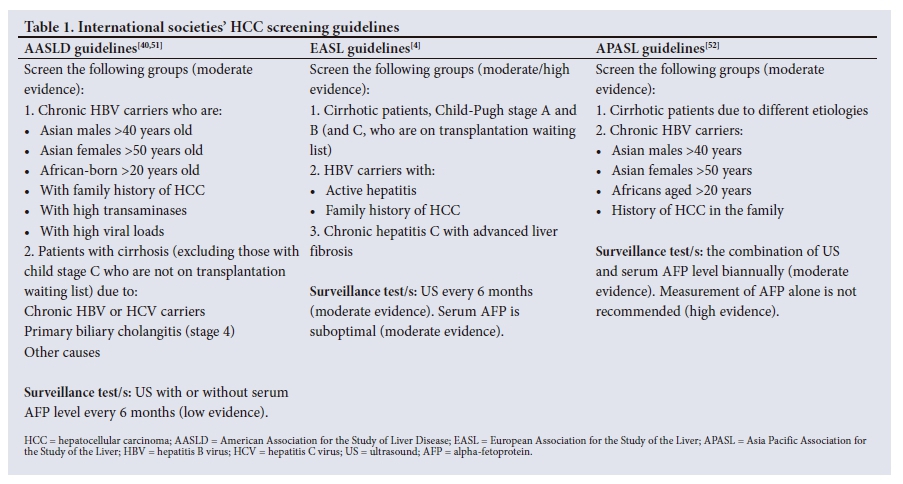
Secondary prevention or screening tests are applied in a continuous programme of ongoing surveillance to enhance detection of cancer at early stages during which treatment is more likely to be curative. The decision to enroll a patient in a surveillance programme for HCC is dependent on the estimated risk for HCC and the likelihood of benefit from therapy if HCC is discovered at an early stage. The American Association for the Study of Liver Diseases (AASLD), European Association for the Study of the Liver (EASL), and Asian Pacific Association for the Study of the Liver (APASL) guidelines consensually agree on surveillance for HCC in high risk patients (moderate/high evidence) (Table 1) using abdominal ultrasound with or without alpha fetoprotein measurement. High-risk patients include those with cirrhosis due to any aetiology (excluding those with Child-Pugh stage C who are not on a transplant waiting list given the low anticipated survival for these patients) and those with chronic viral HBV without cirrhosis if they were born in Africa or Asia and are over 20 years of age for Africans, over 40 years of age for Asian males, and over 50 years of age for Asian females. Individuals with a family history of HCC or with chronic active hepatitis are at particularly increased risk.39Table 1), given its low sensitivity for diagnosis of early-stage disease and difficulties with specificity in individuals with active liver inflammation and regeneration. However, since US is insensitive in patients with central obesity and for those with infiltrative HCCs that do not have a nodular component, there is increasing consensus that the use of AFP in addition to US is warranted. In SSA and Asia, where many patients are diagnosed with intermediate or advanced stage disease, almost all centres employ the AFP test and the World Gastroenterology Organization recommends its use for HCC surveillance.34041-44 which incorporates patient Gender and Age in combination with the AFP-L3%, total AFP, and DCP may facilitate HCC diagnosis if it can be provided at low cost in SSA (GALAD Score Calculator: http://www.mayoclinic.org/medical-professionals/model-end-stage-liver-disease/galad). The recommended surveillance interval is 6 months for suitable candidates.408
Challenges in SSA countries
Since HBV is the most common cause of HCC worldwide, a full appreciation of the current status and secular trends in rates of chronic HBV infection, the consequent development of cirrhosis, end-stage liver disease, and HCC, as well as the outcomes of these complications is important for the development of a sound global health policy. With the recent publications of WHO Guidelines for evaluation and management of chronic HBV and chronic HCV, and resolutions by the World Health Assembly promoting the global eradication of chronic HBV and HCV, chronic viral hepatitis finally appears to be attracting the attention of the global health community.45-47 However, large gaps remain, as major funders of global public health efforts still do not have robust programmes or a significant focus on eradication of chronic viral hepatitis and its sequelae.
Several limitations present in SSA countries lead to inadequate primary prevention in these countries. The majority of chronic HBV infections in Africa are due to perinatal or early childhood transmission, which can be successfully prevented by HBV vaccination within 24 hours of birth followed by two additional doses, as recommended by WHO.484848 49 385050
Despite the proven benefit for patients who are at risk of developing HCC, comprehensive surveillance programmes are lacking in SSA due to several challenges. Surveillance requires relatively expensive US machines and well-trained personnel. Lack of regional guidelines that take into consideration the limited resources in most SSA countries is another important challenge. Efforts should be spent to adapt the international guidelines (Table 1) and make them more applicable to SSA countries. Patient education about the importance of surveillance through national campaigns, primary care health workers, physicians and/or hepatologists, engaging health policy decision makers, finding financial resources in country budgets, and establishing training programs and documentation registries to monitor surveillance are all suggested strategies for improving HCC surveillance in SSA countries.
Once HCC is diagnosed, there is also a critical need for local capability for the key curative and palliative treatments used for HCC, including surgical resection, local ablation, and locoregional chemoembolisation. There is a need to establish regional centers of excellence, to which patients with early and intermediate stage disease can be referred for treatment. There is also an urgent need for countries governments to approve treatments for advanced stage disease, and to negotiate lower costs for these often-expensive therapies. The recent advances in the development of targeted anticancer therapies, including sorafenib, regorafenib, lenvatinib and the immune checkpoint inhibitor nivolumab can only be deployed to reduce the burden of morbidity and mortality from HCC in sub Saharan Africa if there are ardent efforts to ensure their availability at prices that are within the reach of patients in this region.
Conclusion
HCC incidence correlates closely with the incidence of viral hepatitis B and C, which are the most important risk factors for HCC worldwide. The pathogenic mechanisms underlying HCC development, progression and metastasis are being actively deciphered, and novel discoveries hold promise for the development of effective systemic therapies for patients with intermediate and advanced stage disease. Primary prevention is an important strategy to control HCC in the resource-limited settings of most SSA countries. Finally, screening for HCC in high risk patients leads to detection of HCC at early curative stages, which in turn leads to improvement in overall survival. There is a critical need to build local capability in surgical resection, local ablation, and locoregional chemoembolisation, as well as a major need to address the cost of pharmaceutical treatments for patients with advanced stage disease.
Acknowledgements. We gratefully acknowledge administrative support from Lisa M. Price.
Author contributions. All authors contributed equally to the preparation of the manuscript for publication.
Funding. Mayo Clinic Center for Clinical and Translational Science (CCATS), No. NCATS 1UL1TR002377-01; Mayo Clinic Center for Cell Signaling in Gastroenterology, No. NIDDK P30DK084567-09.
Conflicts of interest. LR has received grant funding from Ariad Pharmaceuticals, Bayer, BTG International, Gilead Sciences, RedHill Biopharma, TARGET PharmaSolutions and Wako Life Sciences. LR also served on advisory boards for Bayer, Exact Sciences and TAVEC.
References
-
1. Fitzmaurice C, Allen C, Barber RM, et al. Global, regional, and national cancer incidence, mortality, years of life lost, years lived with disability, and disability-adjusted life-years for 32 cancer groups, 1990 to 2015: A systematic analysis for the global burden of disease study. JAMA oncology 2017;3(4):524-548. https://doi.org/10.1001/jamaoncol.2016.5688
» https://doi.org/10.1001/jamaoncol.2016.5688 -
2. Sartorius K, Sartorius B, Aldous C, Govender PS, Madiba TE. Global and country underestimation of hepatocellular carcinoma (HCC) in 2012 and its implications. Cancer Epidemiol 2015;39(3):284-290. https://doi.org/10.1016/j.canep.2015.04.006
» https://doi.org/10.1016/j.canep.2015.04.006 -
3. Ladep NG, Lesi OA, Mark P, et al. Problem of hepatocellular carcinoma in West Africa. World J Hep 2014;6(11):783-792. https://doi.org/10.4254/wjh.v6.i11.783
» https://doi.org/10.4254/wjh.v6.i11.783 -
4. European Association For The Study Of The Liver, European Organisation For Research And Treatment Of Cancer. EASL-EORTC clinical practice guidelines: Management of hepatocellular carcinoma. J Hepatol 2012;56(4):908-943. https://doi.org/10.1016/j.jhep.2011.12.001
» https://doi.org/10.1016/j.jhep.2011.12.001 - 5. Ferlay J, Soerjomataram I, Dikshit R, et al. Cancer incidence and mortality worldwide: Sources, methods and major patterns in GLOBOCAN 2012. Int J Cancer 2015;136(5):E359-386.
-
6. Stanaway JD, Flaxman AD, Naghavi M, et al. The global burden of viral hepatitis from 1990 to 2013: Findings from the Global Burden of Disease Study 2013. Lancet 2016;388(10049):1081-1088. https://doi.org/10.1016/S0140-6736(16)30579-7
» https://doi.org/10.1016/S0140-6736(16)30579-7 -
7. Kew MC. Hepatocellular carcinoma: Epidemiology and risk factors. J Hepatocell Carcinoma 2014;1:115-125. https://doi.org/10.2147/JHC.S44381
» https://doi.org/10.2147/JHC.S44381 -
8. Park JW, Chen M, Colombo M, et al. Global patterns of hepatocellular carcinoma management from diagnosis to death: The BRIDGE Study. Liver Int 2015;35(9):2155-2166. https://doi.org/10.1111/liv.12818
» https://doi.org/10.1111/liv.12818 -
9. Schweitzer A, Horn J, Mikolajczyk RT, Krause G, Ott JJ. Estimations of worldwide prevalence of chronic hepatitis B virus infection: A systematic review of data published between 1965 and 2013. Lancet 2015;386(10003):1546-1555. https://doi.org/10.1016/S0140-6736(15)61412-X
» https://doi.org/10.1016/S0140-6736(15)61412-X -
10. Kew MC. Hepatitis B virus infection: The burden of disease in South Africa. South Afr J Epidemiol Infect 2008;23(1):4-8. https://doi.org/10.1080/10158782.2008.11441293
» https://doi.org/10.1080/10158782.2008.11441293 -
11. Vermeulen M, Swanevelder R, Chowdhury D, et al. Use of Blood Donor Screening to Monitor Prevalence of HIV and Hepatitis B and C Viruses, South Africa. Emerg Infect Dis 2017;23(9):1560-1563. https://doi.org/10.3201/eid2309.161594
» https://doi.org/10.3201/eid2309.161594 -
12. Strickland GT. Liver disease in Egypt: Hepatitis C superseded schistosomiasis as a result of iatrogenic and biological factors. Hepatology 2006;43(5):915-922. https://doi.org/10.1002/hep.21173
» https://doi.org/10.1002/hep.21173 -
13. Gower E, Estes C, Blach S, Razavi-Shearer K, Razavi H. Global epidemiology and genotype distribution of the hepatitis C virus infection. J Hepatol 2014;61(1 Suppl):S45-57. https://doi.org/10.1016/j.jhep.2014.07.027
» https://doi.org/10.1016/j.jhep.2014.07.027 -
14. Yang JD, Gyedu A, Afihene MY, et al. Hepatocellular carcinoma occurs at an earlier age in Africans, particularly in association with chronic hepatitis B. Am J Gastroenterol 2015;110(11):1629-1631. https://doi.org/10.1038/ajg.2015.289
» https://doi.org/10.1038/ajg.2015.289 - 15. El-Serag HB. Epidemiology of viral hepatitis and hepatocellular carcinoma. Gastroenterology 2012;142(6):1264-1273.e1261.
-
16. Ohira H, Abe K, Takahashi A, Zeniya M, Ichida T. Clinical features of hepatocellular carcinoma in patients with autoimmune hepatitis in Japan. J Gastroenterol 2013;48(1):109-114. https://doi.org/10.1007/s00535-012-0616-x
» https://doi.org/10.1007/s00535-012-0616-x -
17. Park C-H, Jeong S-H, Yim H-W, et al. Family history influences the early onset of hepatocellular carcinoma. World J Gastroenterol 2012;18(21):2661-2667. https://doi.org/10.3748/wjg.v18.i21.2661
» https://doi.org/10.3748/wjg.v18.i21.2661 -
18. Yang JD, Altekruse SF, Nguyen MH, Gores GJ, Roberts LR. Impact of country of birth on age at the time of diagnosis of hepatocellular carcinoma in the United States. Cancer 2017;123(1):81-89. https://doi.org/10.1002/cncr.30246
» https://doi.org/10.1002/cncr.30246 -
19. Makarova-Rusher OV, Altekruse SF, McNeel TS, et al. Population attributable fractions of risk factors for hepatocellular carcinoma in the United States. Cancer 2016;122(11):1757-1765. https://doi.org/10.1002/cncr.29971
» https://doi.org/10.1002/cncr.29971 -
20. Yang JD, Mohamed EA, Aziz AOA, et al. Characteristics, management, and outcomes of patients with hepatocellular carcinoma in Africa: A multicountry observational study from the Africa Liver Cancer Consortium. Lancet Gastroenterol Hepatol 2017;2(2):103-111. https://doi.org/10.1016/S2468-1253(16)30161-3
» https://doi.org/10.1016/S2468-1253(16)30161-3 -
21. Li S, Mao M. Next generation sequencing reveals genetic landscape of hepatocellular carcinomas. Cancer Lett 2013;340(2):247-253. https://doi.org/10.1016/j.canlet.2012.09.027
» https://doi.org/10.1016/j.canlet.2012.09.027 -
22. Lamontagne RJ, Bagga S, Bouchard MJ. Hepatitis B virus molecular biology and pathogenesis. Hepatoma Res 2016;2:163-186. https://doi.org/10.20517/2394-5079.2016.05
» https://doi.org/10.20517/2394-5079.2016.05 -
23. De Oliveria Andrade LJ, D'Oliveira A, Melo RC, De Souza EC, Costa Silva CA, Paraná R. Association between hepatitis C and hepatocellular carcinoma. J Glob Infect Dis 2009;1(1):33-37. https://doi.org/10.4103%2F0974-777X.52979
» https://doi.org/10.4103%2F0974-777X.52979 -
24. Goossens N, Hoshida Y. Hepatitis C virus-induced hepatocellular carcinoma. Clin Mol Hepatol 2015;21(2):105-114. https://doi.org/10.3350%2Fcmh.2015.2L2.105
» https://doi.org/10.3350%2Fcmh.2015.2L2.105 -
25. Dhanasekaran R, Bandoh S, Roberts LR. Molecular pathogenesis of hepatocellular carcinoma and impact of therapeutic advances. F1000Res 2016;5:F1000 Faculty Rev 879. https://doi.org/10.12688%2Ff1000research.6946.1
» https://doi.org/10.12688%2Ff1000research.6946.1 -
26. Nault JC, Zucman-Rossi J. TERT promoter mutations in primary liver tumors. Clin Res Hepatol Gastroenterol 2016;40(1):9-14. https://doi.org/10.1016/j.clinre.2015.07.006
» https://doi.org/10.1016/j.clinre.2015.07.006 -
27. Pinyol R, Tovar V, Llovet JM. TERT promoter mutations: gatekeeper and driver of hepatocellular carcinoma. J Hepatol 2014;61(3):685-687. https://doi.org/10.1016/j.jhep.2014.05.028
» https://doi.org/10.1016/j.jhep.2014.05.028 -
28. Cancer Genome Atlas Research Network. Comprehensive and integrative genomic characterization of hepatocellular carcinoma. Cell 2017;169(7):1327-1341.e1323. https://doi.org/10.1016/j.cell.2017.05.046
» https://doi.org/10.1016/j.cell.2017.05.046 -
29. Nault JC, Mallet M, Pilati C, et al. High frequency of telomerase reverse-transcriptase promoter somatic mutations in hepatocellular carcinoma and preneoplastic lesions. Nat Commun 2013;4:2218. https://doi.org/10.1038/ncomms3218
» https://doi.org/10.1038/ncomms3218 -
30. Ferber MJ, Montoya DP, Yu C, et al. Integrations of the hepatitis B virus (HBV) and human papillomavirus (HPV) into the human telomerase reverse transcriptase (hTERT) gene in liver and cervical cancers. Oncogene 2003;22(24):3813-3820. https://doi.org/10.1038/sj.onc.1206528
» https://doi.org/10.1038/sj.onc.1206528 -
31. Schulze K, Nault JC, Villanueva A. Genetic profiling of hepatocellular carcinoma using next-generation sequencing. J Hepatol 2016;65(5):1031-1042. https://doi.org/10.1016/j.jhep.2016.05.035
» https://doi.org/10.1016/j.jhep.2016.05.035 -
32. Cevik D, Yildiz G, Ozturk M. Common telomerase reverse transcriptase promoter mutations in hepatocellular carcinomas from different geographical locations. World J Gastroenterol 2015;21(1):311-317. https://doi.org/10.3748/wjg.v21.i1.311
» https://doi.org/10.3748/wjg.v21.i1.311 -
33. Hussain SP, Schwank J, Staib F, Wang XW, Harris CC. TP53 mutations and hepatocellular carcinoma: Insights into the etiology and pathogenesis of liver cancer. Oncogene 2007;26(15):2166-2176. https://doi.org/10.1038/sj.onc.1210279
» https://doi.org/10.1038/sj.onc.1210279 -
34. Inokawa Y, Inaoka K, Sonohara F, Hayashi M, Kanda M, Nomoto S.Molecular alterations in the carcinogenesis and progression of hepatocellular carcinoma: Tumor factors and background liver factors. Oncol Lett 2016;12(5):3662-3668. https://doi.org/10.3892/ol.2016.5141
» https://doi.org/10.3892/ol.2016.5141 -
35. Gramantieri L, Fornari F, Callegari E, et al. MicroRNA involvement in hepatocellular carcinoma. J Cell Mol Med 2008;12(6A):2189-2204. https://doi.org/10.1111/j.1582-4934.2008.00533.x
» https://doi.org/10.1111/j.1582-4934.2008.00533.x -
36. Kgatle MM, Setshedi M, Hairwadzi HN. Hepatoepigenetic alterations in viral and nonviral-induced hepatocellular carcinoma. BioMed Res Int 2016;2016:3956485. https://doi.org/10.1155/2016/3956485
» https://doi.org/10.1155/2016/3956485 -
37. Wang Y, Toh HC, Chow P, et al MicroRNA-224 is up-regulated in hepatocellular carcinoma through epigenetic mechanisms. FASEB J 2012;26(7):3032-3041. https://doi.org/10.1096/fj.11-201855
» https://doi.org/10.1096/fj.11-201855 -
38. Lemoine M, Nayagam S, Thursz M. Viral hepatitis in resource-limited countries and access to antiviral therapies: current and future challenges. Future Virol 2013;8(4):371-380. https://doi.org/10.2217/fvl.13.11
» https://doi.org/10.2217/fvl.13.11 - 39. Bolondi L, Sofia S, Siringo S, et al. Surveillance programme of cirrhotic patients for early diagnosis and treatment of hepatocellular carcinoma: a cost effectiveness analysis. Gut 2001;48(2):251-259.
-
40. Bruix J, Sherman M, American Association for the Study of Liver Diseases. Management of hepatocellular carcinoma: An update. Hepatol 2011;53(3):1020-1022. https://doi.org/10.1002/hep.24199
» https://doi.org/10.1002/hep.24199 -
41. Berhane S, Toyoda H, Tada T, et al. Role of the GALAD and BALAD-2 serologic models in diagnosis of hepatocellular carcinoma and prediction of survival in patients. Clinic Gastroenterol Hepatol 2016;14(6):875-886.e876. https://doi.org/10.1016/j.cgh.2015.12.042
» https://doi.org/10.1016/j.cgh.2015.12.042 -
42. Best J, Bilgi H, Heider D, et al The GALAD scoring algorithm based on AFP, AFP-L3, and DCP significantly improves detection of BCLC early stage hepatocellular carcinoma. Z Gastroenterol 2016;54(12):1296-1305. https://doi.org/10.1055/s-0042-119529
» https://doi.org/10.1055/s-0042-119529 -
43. Caviglia GP, Abate ML, Petrini E, Gaia S, Rizzetto M, Smedile A. Highly sensitive alpha-fetoprotein, Lens culinaris agglutinin-reactive fraction of alpha-fetoprotein and des-gamma-carboxyprothrombin for hepatocellular carcinoma detection. Hepatol Res 2016;46(3):E130-135. https://doi.org/10.1111/hepr.12544
» https://doi.org/10.1111/hepr.12544 -
44. Johnson PJ, Pirrie SJ, Cox TF, et al. The detection of hepatocellular carcinoma using a prospectively developed and validated model based on serological biomarkers. Cancer Epidemiol Biomarkers Prev 2014;23(1):144-153. https://doi.org/10.1158/1055-9965.EPI-13-0870
» https://doi.org/10.1158/1055-9965.EPI-13-0870 -
45. Kyei-Nimakoh M, Carolan-Olah M, McCann TV. Millennium development Goal 5: Progress and challenges in reducing maternal deaths in Ghana. BMC Pregnancy Childbirth 2016;16(1):51. https://doi.org/10.1186/s12884-016-0840-0
» https://doi.org/10.1186/s12884-016-0840-0 - 46. World Health Organisation. Guidelines for the Prevention Care and Treatment of Persons with Chronic Hepatitis B Infection. Geneva: WHO, 2015.
-
47. Shiferaw F, Letebo M, Bane A. Chronic viral hepatitis: policy, regulation, and strategies for its control and elimination in Ethiopia. BMC Pub Health 2016;16(1):769. https://doi.org/10.1186/s12889-016-3459-1
» https://doi.org/10.1186/s12889-016-3459-1 -
48. Breakwell L, Tevi-Benissan C, Childs L, Mihigo R, Tohme R. The status of hepatitis B control in the African region. Pan Afr Med J 2017;27(Suppl 3):17. https://doi.org/10.11604/pamj.supp.2017.27.3.11981
» https://doi.org/10.11604/pamj.supp.2017.27.3.11981 -
49. Lingwood RJ, Boyle P, Milburn A, et al. The challenge of cancer control in Africa. Nature Rev Cancer 2008;8(5):398-403. https://doi.org/10.1038/nrc2372
» https://doi.org/10.1038/nrc2372 -
50. Borresen ML, Koch A, Biggar RJ, et al Effectiveness of the targeted hepatitis B vaccination program in Greenland. Am J Public Health 2012;102(2):277-284. https://doi.org/10.2105/AJPH.2011.300239
» https://doi.org/10.2105/AJPH.2011.300239 -
51. Heimbach J, Kulik LM, Finn R, et al. AASLD guidelines for the treatment of hepatocellular carcinoma. Hepatol 2017;67(1):358-380. https://doi.org/10.1002/hep.29086
» https://doi.org/10.1002/hep.29086 -
52. Omata M, Cheng AL, Kokudo N, et al Asia-Pacific clinical practice guidelines on the management of hepatocellular carcinoma: A 2017 update. Hepatol Int 2017;11(4):317-370. https://doi.org/10.1007/s12072-017-9799-9
» https://doi.org/10.1007/s12072-017-9799-9