The partogram: a missed opportunity
Jayati Kusari BasuI, *; S HoosainII; G LeballoII; E LeistnerII; D MasangoII; M MercerII; M MohapiII; S PetkarII; N A TshiovheII
IMSc Med, FCOG (SA), MMed, Department of Obstetrics and Gynaecology, Charlotte Maxeke Johannesburg Academic Hospital and University of the Witwatersrand, Johannesburg
IIGEMP III students group, Charlotte Maxeke Johannesburg Academic Hospital and University of the Witwatersrand
To the Editor: The maternal mortality rate (MMR) in South Africa was 400/100 000 births in 2005123,4 We did a retrospective record review of all partograms for 1 week (5 - 11 August 2008) in the labour ward at Johannesburg Hospital. The Committee for Ethics on Human Research at the University of the Witwatersrand approved the study.
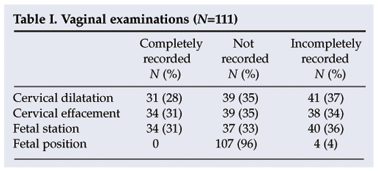
The quantity of recording (%) was calculated depending on the numbers of observations of a specific parameter done out of total requirements of observations of that parameter during the duration of labour. Information was observed as recorded, not recorded and incompletely recorded. The blood pressure, pulse and temperature were documented completely in 50 women (45%), 29 (26%) and 41 (37%), respectively, not recorded in 29 (26%), 40 (36%) and 42 (38%), and infrequently recorded in the remainder. Uterine contractions were recorded completely in 47 women (42%), incompletely in 34 (31%) and not recorded in 30 (27%). Fetal descent as assessed by examination of the abdomen was recorded completely in 12 women (11%), incompletely in 8 (7%) and not recorded in 91 (82%). Vaginal examinations were recorded as number of observations done out of the total required during the time in labour (Table I).
Fetal heart rates were recorded completely in 30 women (27%), infrequently in 51 (46%) and not recorded in 30 (27%).
The partogram is a poorly used monitoring tool at the Charlotte Maxeke Johannesburg Hospital. We assume that inadequate recording of the partogram is one of the factors contributing to maternal mortality and morbidity at this hospital. Observations also showed that health care workers frequently documented the condition of the fetus and the findings on vaginal examination elsewhere in the patient's obstetric file and managed her accordingly, but omitted to record it in the partogram, which would have been ideal. A study focusing on the direct effect of inadequate recording of the partogram on mortality and morbidity is necessary, as a limitation of this study was that it did not assess the outcome of inadequately documented partograms. The results might not represent all hospitals in South Africa.
This study was undertaken as part of a MB BCh V research project at the University of the Witwatersrand.
References
- 1. World Health Organization. Maternal Mortality in 2005 Estimates. Geneva: WHO, 2005.
- 2. Lester B. The partogram: a useful assessment tool. Africa Journal of Nursing and Midwifery 2000; Nov: 4(2): 55-57.
- 3. Maternal, Child and Women's Health Directorate, Department of Health. Saving Mothers: Second Report on Confidential Enquiries into Maternal Deaths in South Africa. Pretoria: Department of Health, 2002.
- 4. McInerney P, Lester B, Rapetswa L, et al. An audit of care given to mothers in a maternity unit of a large maternity unit of a large academic hospital. Africa Journal of Nursing and Midwifery 2000; 2(1, May): 35-39.