Pleuro-pulmonary disease in central South Africa: a thoracicsurgical deficiency
Background
Public health service delivery in SA is in crisis, making health reform at every level a complex issue of national importance.1
The study was undertaken in response to the evident performance gap between the high burden of thoracic disease and the level of thoracic surgery service provision in the region. Inflammatory pleuro-pulmonary disease in the study includes pulmonary tuberculosis (PTB), bronchiectasis, destructive pneumonia and pyogenic empyema.
Poverty, lack of opportunities and inadequate health care are major problems facing the central SA community, where 57% of people live below the poverty line, and 43% of those between 15 and 64 years old are unemployed.2,3
We aimed to estimate the performance gap between thoracic surgical service provision and the burden of thoracic surgical disease in central SA.
Method
Data were collected for the period 2004 - 2006. Burden of disease data were obtained from publications originating from: (i) the Burden of Disease Unit of the Medical Research Council of SA; (ii) the SA National Department of Health (DoH), Statistics SA and the Health Systems Trust; and (iii) the National Cancer Registry (NCR) of 1999.
Thoracic surgical activity was quantified from the operation records of: (i) the Departments of Cardiothoracic Surgery and General Surgery at Universitas Hospital (University of the Free State); and (ii) the Departments of General Surgery at the 7 regional hospitals in central SA.
Actual service provision by surgeons was calculated in terms of whole time equivalents (WTEs), defined as the percentage of working time spent by each cardiothoracic surgeon on thoracic surgery. Approval for the study was obtained from the Ethics Committee of the University of the Free State (ETOVS 206/06).
Results
The study population
The population of central SA is approximately 4.6 million people, of whom 4.2 million depend on state health care provision. The age group pyramid is typical of a young developing country, with 86% <49 years old.4 5
Burden of disease in non-tuberculous pleuropulmonary disease
Non-tuberculous lower respiratory tract infections are a leading cause of death in SA, accounting for 6% of all deaths in the FS annually.6 7
Burden of disease in PTB
The reported incidence of sputum-positive PTB in the FS during 2006 was 322 per 100 000 of the population, and is steadily increasing; 125 496 new cases of sputum-positive PTB are reported in SA annually, of which approximately 15 272 are in central SA.8,9
PTB presents to the thoracic surgeon in its active and sequela forms. Sequela manifestations include bronchiectasis, destroyed lung, aspergilloma and chronic pyogenic empyema in the presence of broncho-pleural fistula with thick visceral pleural peel and entrapped lung. Patients with complicated expressions of the disease usually present late in the course of their disease, are frequently generally debilitated, and are often HIV positive.
PTB surgery represented 9% of the operation load at Universitas Hospital during the study. Despite the high incidence and severity of this disease, a systematic review of the SA thoracic surgical literature between 1955 and 2006, revealed only 12 publications.10
Estimated number of resections in primary lung carcinoma
The National Cancer Registry (NCR)11
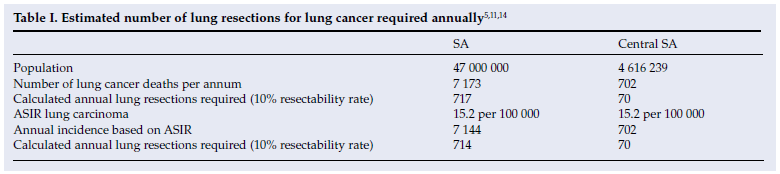
The resectability rate in lung cancer is 10 - 20%.12,13 Based on a resectability rate of 10%, and the estimated annual mortality rate for lung cancer,5,6,14 the annual potential number of lung resections was calculated for central SA (Table I).
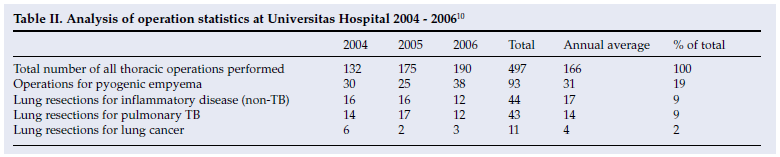
NCR data11 Table I). This figure concurred with calculations based on the ASIR. An average of 4 lung resections for lung cancer were performed annually during the study (Table II).
Thoracic surgeon provision in central SA
There were 4 registered cardiothoracic surgeons in state practice in central SA during the study; 3 surgeons each spent 10% of their time on thoracic surgery. The WTE allocation to thoracic surgery by cardiothoracic surgeons was therefore 0.3 surgeons per 4.2 million people, which equates to 0.07 surgeons per million of population.
Thoracic surgical activity in central SA
Universitas Hospital was the only hospital in central SA where lung resections were performed. No lung resections were performed by non-thoracic surgeons. Open drainage of empyemata was rarely performed by general surgeons at regional hospitals.
Universitas Hospital theatre records showed an average of 166 thoracic operations per year during the study. Of these, inflammatory pleuro-pulmonary disease including TB represented the largest single portion (40%); pyogenic empyema and PTB were 9% each; and therapeutic resections for lung cancer (N=11) represented only 2% of all operations (Table II).
The performance gap
The performance gap in lung cancer was quantified to be a factor of approximately 20. It was not possible to numerically quantify the performance gap in inflammatory pleuro-pulmonary disease.
Discussion
The average of 166 operations per annum represents 40 operations per million of population, which compares poorly with 91 operations per million in the teaching departments of cardiothoracic surgery in SA,10 15 16 10
The estimated annual burden of 70 lung cancer resections underestimates the surgical workload. Furthermore, the diagnostic, staging and palliative interventional workload is much larger than that for the lung resections, of which there is little in central SA.
The lack of important clinical data made it impossible to quantify the thoracic surgical performance gap between burden of disease and service delivery for tuberculous and non-tuberculous inflammatory pleuro-pulmonary diseases. However, based on the few operations performed annually relative to the size of the population and the severe burden of thoracic disease, it is reasonable to assume that the performance gap extending to all thoracic surgery pathologies is significant. It is unlikely that thoracic surgery in central SA provides for more than 10% of the probable workload. The performance gap was calculated to be approximately 1:20 for lung cancer and 1:34 for oesophageal cancer.10
National health reform policy redirecting funding to primary health care facilities has been detrimental to academic units. Poor medical capacity at peripheral facilities and logistical limitations in the referral chain result in many patients being denied timeous specialist care. Furthermore, the understaffing and underfunding of academic units has limited their capacity to assist with meaningful health reforms.
References
- 1. Gevers W. Clinical research in South Africa: a core asset under pressure. Lancet 2009; 374: 760-762.
- 2. Statistics SA. Primary Tables Free State: Census 1996 and 2001 compared. Pretoria: Statistics South Africa, 2005 (accessed 12 February 2008).
-
3. Human Sciences Research Council. Fact Sheet Poverty in South Africa 2004. Pretoria: Human Sciences Research Council, 2004. http://www.sarpn.org.za. (accessed 12 November 2007).
» http://www.sarpn.org.za -
4. Statistics SA. Census 2001. Pretoria: Statistics SA, 2004. http://www.statssa.gov.za/census01/html/default.asp (accessed 23 November 2007).
» http://www.statssa.gov.za/census01/html/default.asp -
5. Bradshaw D, Nannan N, Laubscher R, et al. Mortality Estimates for Free State, 2000. South African National Burden of Disease Study. Cape Town: Medical Research Council, 2004. http://www.mrc.ac.za/bod/reports.htm (accessed 20 November 2006).
» http://www.mrc.ac.za/bod/reports.htm -
6. Bradshaw D, Nannan N, Laubscher R, et al. South African Burden of Disease Study 2000. Estimates of Provincial Mortality. Cape Town: Medical Research Council, 2004. http://www.mrc.ac.za/bod/reports.htm (accessed 17 November 2006).
» http://www.mrc.ac.za/bod/reports.htm - 7. Linegar AG, Smit F, Goldstraw P, Van Zyl G. Fifty years of thoracic surgery research in South Africa. S Afr Med J 2009; 99: 592-595.
-
8. Health Systems Trust. Incidence of TB (PTB new Sm+) (per 100 000). Durban: Health Systems Trust, 2006. http://www.hst.org.za/healthstats/163/data (accessed 4 June 2008).
» http://www.hst.org.za/healthstats/163/data - 9. Bradshaw D, Groenewald P, R. L, Nannan N, et al. Initial burden of disease estimates for South Africa, 2000. S Afr Med J 2003; 93:682-688.
- 10. Linegar AG. A model for the development of thoracic surgery in central South Africa. PhD thesis, University of the Free State, 2008.
-
11. Mqoqi N, Kellett P, Sitas F, Jula M. Incidence of histologically diagnosed cancer in South Africa, 1989 - 1999. www.nhls.ac.za/Updated%20cancer98_ALL.pdf (accessed 4 June 2008).
» www.nhls.ac.za/Updated%20cancer98_ALL.pdf - 12. Willcox PA, O'Brien JA, Abratt RP. Lung cancer at Groote Schuur Hospital - a local perspective. S Afr Med J 1990; 78(12): 716-720.
- 13. Linegar AG. The importance of staging in non-small cell lung cancer. SA Resp J 2001; 7: 144-148.
- 14. Bradshaw D, Groenewald P, Laubscher R, et al. Initial Burden of Disease Estimates for South Africa, 2000. Cape Town: Medical Research Council, 2004. http://www.mrc.ac.za/bod/initialbodestimates.pdf (accessed 16 November 2006).
-
15. Page R, Roxburgh J, Keogh B. Thoracic Surgical Register 2005 - 6. London: Society for Cardiothoracic Surgery in Great Britain and Ireland. http://www.scts.org (accessed 16 November 2007).
» http://www.scts.org - 16. Toomes H. General thoracic surgery as a monospecialty - a realistic vision? Eur J Cardiothor Surg 2002; 21: 1-4.