What do the xenophobic attacks reveal about the health of South African society?
Chris Kenyon
Division of Infectious Diseases and HIV Medicine Department of Medicine Groote Schuur Hospital Cape Town
Correspondence
The measure of a civilization/society is how it treats its weakest members.
Javier Perez de Cuellar
If we judge South African society by this measure, the brutal beatings, burnings and displacements of our emigrant communities over the past few weeks must suggest that we are still a sick society. Responsibility for the wave of xenophobia sweeping across South Africa has been laid at the feet of various factors and actors: criminal groups, our present and past governments for lack of service delivery, and institutions responsible for law and order.
While there is certainly considerable truth in many of these perspectives, it is important that our response as health professionals to all epidemics (be they of violence or plague) should be determined by appraising all the aetiological evidence available from both upstream (root causes) and downstream factors. A useful starting point in elucidating the causes of this xenophobic pandemic is to map out the pattern of the violence. This could be broadly characterised as South Africans in poor communities attacking persons they defined as foreigners in a wave of violence that rapidly engulfed every province in the land. This pattern suggests that individual level factors (such as Ebrahim Rasool's contention that it was merely the acts of criminals) were less important than social forces (acting at a population level) that had turned poor communities across the country into a dry tinderbox waiting for a spark. What might constitute these social forces? The first thing to recognise is that these violent attacks on foreigners erupted not out of the (tranquil) blue, but rather from a baseline rate of violent crime that is one of the highest in the world (Human Development Report 2007/2008,1
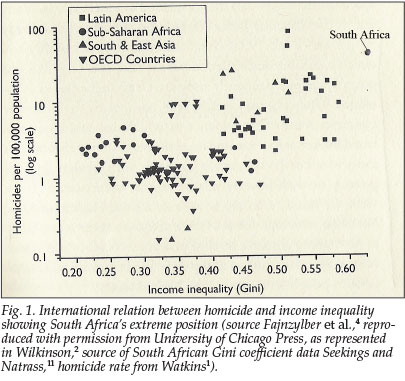
The rapidly growing field of Social Epidemiology has examined the evidence and has now produced a vast and convincing array of evidence as to the key role that economic inequality plays in determining population levels of violent crime. There are now over 50 papers23456
How do we explain this relationship, and in particular the fact that the evidence shows such a strong relationship between violence and inequality but little if any relationship between violence and poverty? Richard Wilkinson, who has pioneered much of the research in this field, explains it as follows. Greater income inequality leads to increased social distance between income groups and less of a sense of common identity.2per se, as communities where most of the population is poor but there are few (or no) wealthy persons (to compare oneself to) are characterised by low levels of violence.
This increased violence in unequal societies is not directed predominantly against the rich, but generally disproportionately affects the poor. Sociologists have explained this in terms of 'displaced aggression', whereby increased inequality and dominance relations lead to increased discrimination against any more vulnerable group - be they emigrants, women, or minorities. This master-kicks-the-servant-servant-kicks-the-dog phenomenon explains why people (and other socially hierarchical primates728
There is good evidence linking increased inequality to reduced levels of trust,92
This co-variation of levels of trust, violence, social capital and inequality leads Wilkinson2
Different societies then, can have vast differences in the quality of their social relations, and these differences translate into large differences in homicide rates, racism and overall health.10
Devastating events such as those that have displaced and killed so many residents of South Africa over the past few weeks call attention to an unhealthy society. It is incumbent on us, as health workers, to analyse at all levels what the causal factors are, and use the window of opportunity provided to address them. In our case one of the most important conclusions seems to be one of the hardest to digest. We live in one of the most violent societies in the world,1Fig. 1) and this inequality has increased since 1994.1112
References
- 1. Watkins K, ed. Human Development Report 2007/2008: Fighting Climate Change: Human Solidarity in a Divided World. New York: Palgrave Macmillan, 2007.
- 2. Wilkinson R. 2005. The Impact of Inequality. New York: The New Press, 2005.
- 3. Hsieh CC, Pugh MD. Poverty, income inequality, and violent crime: A meta-analysis of recent aggregate data studies. Criminal Justice Review 1993; 18: 182-202.
- 4. Fajnzylber P, Lederman D, Loayza N. Inequality and violent crime. Journal of Law and Economics 2002; 45(1): 1-40.
- 5. Daly M, Wilson M, Vasdev S. Income inequality and homicide rates in Canada and the United States. Canadian Journal of Criminology 2001; 43: 219-236.
- 6. Neapolitan JL. A comparative analysis of nations with low and high levels of violent crime. Journal of Criminal Justice 1999; 27(3): 259-274.
- 7. Salpolsky RM. Why Zebras Don't Get Ulcers: A Guide to Stress, Stress-Related Disease and Coping. 2nd ed. New York: WH Freeman, 1998.
- 8. Jackson JS, Inglehart MR. Reverberation Theory: Stress and racism in hierarchically structured communities. In: Hobfol SE, De Vries MW, eds. Extreme Stress and Communities: Impact and Intervention. Dordrecht: Kluwer Academic Publishers, 1994.
- 9. Kawachi I, Kennedy BP, Lochner K. Social capital, income inequality and mortality. Am J Public Health 1997; 87: 1491-1498.
- 10. Wilkinson R, Kawachi I, Kennedy BP. Mortality, the social environment, crime and violence. Sociology of Health and Illness 1998; 20(5): 578-597.
- 11. Seekings J, Natrass N. Class, Race and Inequality in South Africa. New Haven: Yale University Press, 2005.
- 12. Rousseau JJ. Quoted in: Farmer P. Infections and Inequalities: The Modern Plagues. Berkley University of California Press, 1999.
 Correspondence:
C Kenyon
(