Multiple primary small-bowel carcinomas presenting with anaemia and intussusception
Tuen Bisetty; Sandie R Thomson
Correspondence
This case is unique because of the patient's presentation with multiple polypoidal high-grade primary adenocarcinomas. It highlights the role of computed tomography (CT) scanning in the diagnosis of recurrent intussusception presenting with sub-acute obstruction.
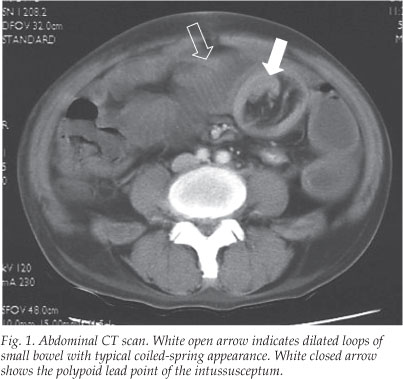
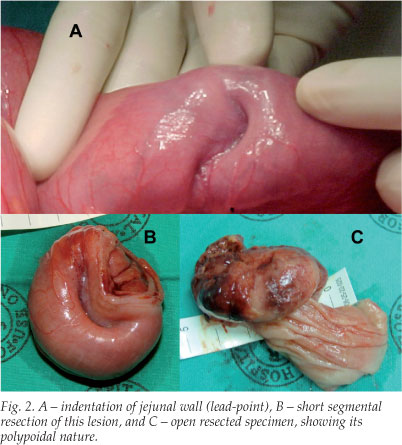
A 53-year-old man presented with a 2-week history of colicky upper abdominal pain and nausea. He had experienced constitutional symptoms and general malaise for 2 months. He had microcytic-hypochromic anaemia and left upper quadrant tenderness. Abdominal X-rays showed small-bowel fluid levels and colonic gas. A CT scan of the abdomen revealed an entero-enteral intussusception with presence of contrast in the large bowel (Fig. 1). His symptoms subsided and the small-bowel obstruction resolved, but in view of the CT scan findings it was decided to proceed to laparotomy. The findings at operation are depicted in Figs 2 and 3. Eight mucosal lesions involved the proximal jejunum, extending from the ligament of Treitz to approximately 80 cm distally. These were resected and a primary anastomosis performed. Histopathological examination confirmed a high-grade undifferentiated adenocarcinoma, surprisingly without lymph node involvement.

Small-bowel tumours are notoriously silent until they present with symptoms of subacute bowel obstruction, anaemia or a mass. Metastatic tumours from large-bowel or ovarian sources resulting from transcoelomic spread to the small-bowel serosa are by far the commonest small-bowel tumours.11,2 Primary small-bowel carcinoma is an uncommon cause of small-bowel obstruction, lymphoma and benign neoplasms being more common.3,4 The median age of presentation is 55 years, with a 61% male predominance. Most tumours originate in the duodenum (52%), followed by the jejunum (25%) and ileum (15%).1,2 Primary small-bowel primary adenocarcinomas are usually solitary, but over 70% have metastasised at the time of presentation.15,6 In this age group malignant causes are more likely than in younger patients, so CT is useful to stage the disease accurately. In our patient it demonstrated one of the tumours as the cause of the obstruction with the tumour as the lead point (Fig. 1).
In adults with intussusception pathological lead points are present in over 80% of cases.3,5 The correct technical approach is a limited segmental resection to remove the unreduced intussusception. The treatment for malignant neoplasms of the small bowel is wide resection including regional lymph nodes.1,2 Curative resection is not always possible owing to the extent of the disease at presentation, and the focus of surgery may be simply to relieve the obstruction.
Referencias bibliográficas
- 1. Dabaja BS, Suki D, Pro B, et al. Adenocarcinoma of the small bowel: presentation, prognostic factors, and outcome of 217 patients. Cancer 2004; 101: 518-526.
- 2. Kam MH, Barben CP, Eu KW, et al. Small bowel malignancies: a review of 29 patients at a single centre. Colorectal Dis 2004; 6: 195-197.
- 3. Takeuchi K, Ohno Y, Tsuzuki Y, ei al. Helicobacter pylori infection and early gastric cancer. J Clin Gastroenterol 2003; 36: 321-324.
- 4. Zhan J, Xia ZS, Zhong YQ, ei al. Clinical analysis of primary small intestinal disease: A report of 309 cases. World J Gastroenterol 2004; 10: 2585-2587.
- 5. Eisen LK, Cunningham JD, Aufses AH, Jr. Intussusception in adults: institutional review. J Am Coll Surg 1999; 188: 390-395.
- 6. Kim YH, Blake MA, Harisinghani MG, et al. Adult intestinal intussusception: CT appearances and identification of a causative lead point. Radiographics 2006; 26: 733-744.
 Corresponding author:
S R Thomson
(