Is diabetic screening really feasible in South African urban primary care?
CORRESPONDENCE
BRIEWE
Is diabetic screening really feasible in South African urban primary care?
J C Rice; K S T Suttle; K A Lecuona
Department of Ophthalmology Groote Schuur Hospital and University of Cape Town
To the Editor: We congratulate Mash and co-authors on their study on screening for diabetic retinopathy with a mobile fundus camera.1
Screening for diabetic retinopathy and referral for laser treatment is a form of secondary prevention: treating a disease before it causes permanent loss of function. The high prevalence of diabetic retinopathy raises questions regarding the implementation of the primary prevention of diabetic retinopathy. Careful control of hyperglycaemia, hypertension and hyperlipidaemia delays the onset of diabetic retinopathy and improves established retinopathy.2,3 Retinal laser treatment can preserve vision but is a destructive procedure with many side-effects. The best treatment to prevent visual loss is systemic control of diabetes. If there is no progress in improving primary-level diabetic care, the number of patients referred for further treatment of eye disease will continue to increase.
Secondly, it would be unethical to identify patients requiring treatment if such treatment was not available or accessible. Note that a dedicated laser treatment service was established to manage the cases identified as needing treatment. This was necessary to avoid further referrals to the already overloaded tertiary level hospitals. This study helps to emphasise the severe shortage of infrastructure and human resources necessary to deal with patients with diabetic retinopathy.
Many patients were also identified requiring referral for cataracts and other conditions to secondary level ophthalmic services where capacity to manage them has yet to be developed. The limited secondary eye care services currently available therefore preclude the establishment of such a screening service as a mainstream programme.
Is diabetic screening really feasible in the South African urban primary care environment in the absence of sufficient higher levels of care?
1. Mash B, Powell D, du Plessis F, et al. Screening for diabetic retinopathy in primary care with a mobile fundal camera - evaluation of a South African pilot project. S Afr Med J 2007; 97: 1284-1288.
2. Diabetes Control and Complications Trial Research Group. The effect of intensive treatment of diabetes on the development and progression of long-term complications of insulin-dependent diabetes mellitus. N Engl J Med 1993; 329: 977-979.
3. UK Prospective Diabetes Study Group. Intensive blood group with sulphonylurea or insulin compared with conventional treatment and risk of complications in patients with type 2 diabetes (UKPDS 33). Lancet 1998; 352: 837-853.
Professor B Mash replies: Dr Rice and colleagues question whether the need for secondary prevention of retinopathy can be reduced by better control of diabetes and whether improved quality of care within district health services will increase the demand for preventive treatment at referral centres.
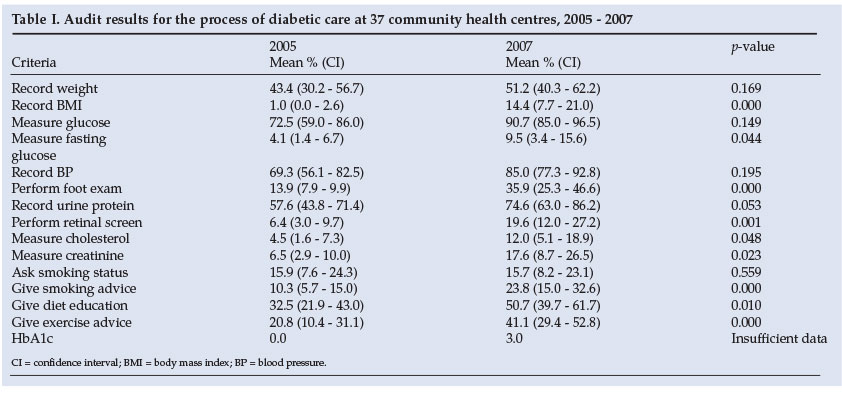
Health outcomes for diabetic patients partly relate to the quality of care offered in the district health services. Improved quality of care can therefore contribute to better outcomes, including lower rates and progression of retinopathy. Retinal screening was part of a broader initiative to improve the quality of care for diabetic patients in the Cape Town metropolitan area.1Table I).
Annual assessment for retinopathy is recommended by diabetic guidelines including the 2006 International Diabetes Federation's Type 2 Diabetes Clinical Practice Guidelines for Sub-Saharan Africa. However, it would be unethical to identify patients requiring treatment if this was either unavailable or inaccessible. Cataract surgery is included as a surgical procedure for district hospitals in the national norms and standards, recognising that secondary level support might be required.2
Improvement in quality of care for chronic disorders at the district level may not reduce the quantity of referrals to higher levels, but can change the nature of the referrals from urgent treatment of end-stage complications to elective preventive interventions.
References
- 1. Mash B, Levitt N, Van Vuuren U, Martell R. Improving the diabetic annual review in primary care: An appreciative inquiry in the Cape Town District Health Services. SA Family Practice (in press).
- 2. A District Hospital Service Package for South Africa: A Set of Norms and Standards. Pretoria: Department of Health, 2002.