
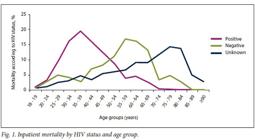
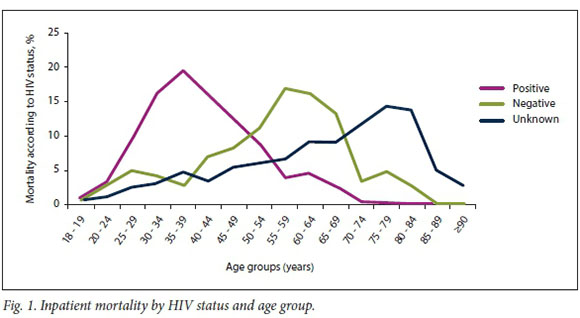
BACKGROUND. South Africa (SA) has one of the world's largest HIV treatment programmes, to which a dramatic increase in life expectancy has been attributed. However, there continue to be concerns regarding the reporting of HIV-related mortality in SA, which varies by source. As accurate HIV mortality estimates are key to measuring the success of the national programme as well as identifying areas for improvement, we propose a complementary approach to monitoring changes in HIV-related mortality using routine inpatient records to examine trends in causes of death and HIV status over time.OBJECTIVES. To investigate the feasibility of this approach by calculating mortality due to natural causes in the medical ward of a hospital during 2010 by HIV status.METHODS. We conducted a cross-sectional study of inpatient mortality at a regional hospital in Johannesburg, SA, analysing all deaths due to natural causes among adult medical ward inpatients. Cause of death was recorded from the mortuary register. HIV status was ascertained directly from the mortuary register or from laboratory tests specific for HIV diagnosis or monitoring.RESULTS. Of 1 167 inpatients who died, the majority were HIV-positive (58%). HIV positivity among males (55%) was slightly lower than that among females (61%), and HIV-positive patients were younger (median 40 years) than those who were HIV-negative (56 years) and of unknown HIV status (68 years). 'Infections and parasites' was the most common cause of natural death (29%). On average, HIV-positive patients were admitted for slightly longer (mean 10.5 days) than HIV-negative patients (9.6 days) and those of unknown HIV status (8.9 days), yet HIV-positive inpatient deaths accounted for the majority (62%) of the total bed days.CONCLUSIONS. Even with widespread access to antiretroviral therapy, the majority of inpatient natural deaths at a large public sector hospital in 2010 were of HIV-positive patients and were probably related to HIV. In view of the importance of accurate data on causes of death, both for the HIV programme and to track other diseases, large-scale expansion of this approach over a longer period should be considered.
Research • SAMJ, S. Afr. med. j. 108
(10)
• • https://doi.org/10.7196/samj.2018.v108i10.13002 linkcopy
 Can routine inpatient mortality data improve HIV mortality estimates? Inpatient mortality at an urban hospital in South Africa
- ,
- ,
- ,
- ,
- ,
- ,
About the authors
person
L C Long
school
University of the WitwatersrandFaculty of Health SciencesDepartment of Internal Medicine
Johannesburg
South AfricaUniversity of the WitwatersrandFaculty of Health SciencesSchool of Public Health
Johannesburg
South AfricaWits Health ConsortiumHealth Economics and Epidemiology Research Office
Johannesburg
South AfricaBoston UniversitySchool of Public HealthDepartment of Global Health
About the authors
person
D H Evans
school
University of the WitwatersrandFaculty of Health SciencesDepartment of Internal Medicine
Johannesburg
South AfricaUniversity of the WitwatersrandFaculty of Health SciencesSchool of Public Health
Johannesburg
South AfricaWits Health ConsortiumHealth Economics and Epidemiology Research Office
Johannesburg
South Africa
About the authors
person
S Rosen
school
University of the WitwatersrandFaculty of Health SciencesDepartment of Internal Medicine
Johannesburg
South AfricaWits Health ConsortiumHealth Economics and Epidemiology Research Office
Johannesburg
South AfricaBoston UniversitySchool of Public HealthDepartment of Global Health
About the authors
person
C Sauls
school
University of the WitwatersrandFaculty of Health SciencesDepartment of Internal Medicine
Johannesburg
South AfricaWits Health Consortium, JohannesburgHealth Economics and Epidemiology Research Office
Johannesburg
South Africa
About the authors
person
A T Brennan
school
University of the WitwatersrandFaculty of Health SciencesDepartment of Internal Medicine
Johannesburg
South AfricaWits Health ConsortiumHealth Economics and Epidemiology Research Office
Johannesburg
South AfricaBoston UniversitySchool of Public HealthDepartment of Global Health
About the authors
person
I M Sanne
school
University of the WitwatersrandFaculty of Health SciencesDepartment of Internal Medicine
Johannesburg
South AfricaUniversity of the WitwatersrandFaculty of Health SciencesSchool of Public Health
Johannesburg
South AfricaWits Health Consortium, JohannesburgHealth Economics and Epidemiology Research Office
Johannesburg
South AfricaBoston UniversitySchool of Public HealthDepartment of Global Health
About the authors
person
M P Fox
school
University of the WitwatersrandFaculty of Health SciencesDepartment of Internal Medicine
Johannesburg
South AfricaWits Health ConsortiumHealth Economics and Epidemiology Research Office
Johannesburg
South AfricaBoston UniversitySchool of Public HealthDepartment of Global HealthBoston UniversitySchool of Public HealthDepartment of Epidemiology
SCImago Institutions Rankings
University of the Witwatersrand, Faculty of Health Sciences, Department of Internal Medicine, Johannesburg, South AfricaUniversity of the WitwatersrandSouth AfricaJohannesburg, South AfricaUniversity of the Witwatersrand, Faculty of Health Sciences, Department of Internal Medicine, Johannesburg, South Africa
University of the Witwatersrand, Faculty of Health Sciences, School of Public Health, Johannesburg, South AfricaUniversity of the WitwatersrandSouth AfricaJohannesburg, South AfricaUniversity of the Witwatersrand, Faculty of Health Sciences, School of Public Health, Johannesburg, South Africa
Wits Health Consortium, Health Economics and Epidemiology Research Office, Johannesburg, South AfricaWits Health ConsortiumSouth AfricaJohannesburg, South AfricaWits Health Consortium, Health Economics and Epidemiology Research Office, Johannesburg, South Africa
Boston University, School of Public Health, Department of Global HealthBoston UniversityBoston University, School of Public Health, Department of Global Health
University of the Witwatersrand, Faculty of Health Sciences, Department of Internal Medicine, Johannesburg, South AfricaUniversity of the WitwatersrandSouth AfricaJohannesburg, South AfricaUniversity of the Witwatersrand, Faculty of Health Sciences, Department of Internal Medicine, Johannesburg, South Africa
University of the Witwatersrand, Faculty of Health Sciences, School of Public Health, Johannesburg, South AfricaUniversity of the WitwatersrandSouth AfricaJohannesburg, South AfricaUniversity of the Witwatersrand, Faculty of Health Sciences, School of Public Health, Johannesburg, South Africa
Wits Health Consortium, Health Economics and Epidemiology Research Office, Johannesburg, South AfricaWits Health ConsortiumSouth AfricaJohannesburg, South AfricaWits Health Consortium, Health Economics and Epidemiology Research Office, Johannesburg, South Africa
University of the Witwatersrand, Faculty of Health Sciences, Department of Internal Medicine, Johannesburg, South AfricaUniversity of the WitwatersrandSouth AfricaJohannesburg, South AfricaUniversity of the Witwatersrand, Faculty of Health Sciences, Department of Internal Medicine, Johannesburg, South Africa
Wits Health Consortium, Health Economics and Epidemiology Research Office, Johannesburg, South AfricaWits Health ConsortiumSouth AfricaJohannesburg, South AfricaWits Health Consortium, Health Economics and Epidemiology Research Office, Johannesburg, South Africa
Boston University, School of Public Health, Department of Global HealthBoston UniversityBoston University, School of Public Health, Department of Global Health
University of the Witwatersrand, Faculty of Health Sciences, Department of Internal Medicine, Johannesburg, South AfricaUniversity of the WitwatersrandSouth AfricaJohannesburg, South AfricaUniversity of the Witwatersrand, Faculty of Health Sciences, Department of Internal Medicine, Johannesburg, South Africa
Wits Health Consortium, Johannesburg, Health Economics and Epidemiology Research Office, Johannesburg, South AfricaWits Health Consortium, JohannesburgSouth AfricaJohannesburg, South AfricaWits Health Consortium, Johannesburg, Health Economics and Epidemiology Research Office, Johannesburg, South Africa
University of the Witwatersrand, Faculty of Health Sciences, Department of Internal Medicine, Johannesburg, South AfricaUniversity of the WitwatersrandSouth AfricaJohannesburg, South AfricaUniversity of the Witwatersrand, Faculty of Health Sciences, Department of Internal Medicine, Johannesburg, South Africa
University of the Witwatersrand, Faculty of Health Sciences, School of Public Health, Johannesburg, South AfricaUniversity of the WitwatersrandSouth AfricaJohannesburg, South AfricaUniversity of the Witwatersrand, Faculty of Health Sciences, School of Public Health, Johannesburg, South Africa
Wits Health Consortium, Johannesburg, Health Economics and Epidemiology Research Office, Johannesburg, South AfricaWits Health Consortium, JohannesburgSouth AfricaJohannesburg, South AfricaWits Health Consortium, Johannesburg, Health Economics and Epidemiology Research Office, Johannesburg, South Africa
Boston University, School of Public Health, Department of Global HealthBoston UniversityBoston University, School of Public Health, Department of Global Health
University of the Witwatersrand, Faculty of Health Sciences, Department of Internal Medicine, Johannesburg, South AfricaUniversity of the WitwatersrandSouth AfricaJohannesburg, South AfricaUniversity of the Witwatersrand, Faculty of Health Sciences, Department of Internal Medicine, Johannesburg, South Africa
Wits Health Consortium, Health Economics and Epidemiology Research Office, Johannesburg, South AfricaWits Health ConsortiumSouth AfricaJohannesburg, South AfricaWits Health Consortium, Health Economics and Epidemiology Research Office, Johannesburg, South Africa
Figures | Tables
 Thumbnail
 Thumbnail
 Thumbnail
imageopen_in_new
imageopen_in_new
imageopen_in_new
How to cite
location_on
South African Medical Association
South African Medical Association, Block F, Castle Walk Corporate Park, Nossob Street, Erasmuskloof Ext. 3, Pretoria, Gauteng, ZA, 0181, Tel: +27 12 481 2069 -
E-mail: publishing@samedical.org
rss_feed
Stay informed of issues for this journal through your RSS reader
PDF version for download
Related articles
Lista de links para artigos relacionados. Os links abrem em nova aba.
Versões e tradução automática
Escolha a versão original do texto ou utilize um serviço de tradução automática.
Versão original do texto
Como citar
Escolha um formato para exportar ou selecione um estilo de citação. O conteúdo abaixo pode ser atualizado após a seleção.