Non-accidental injury - 'the silent pandemic'
FORUM
CLINICAL IMAGES
Non-accidental injury - 'the silent pandemic'
Xolisa Mgele
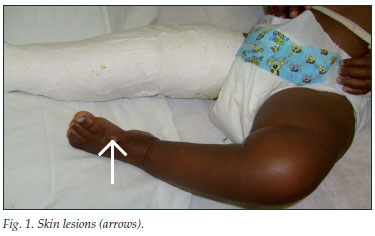
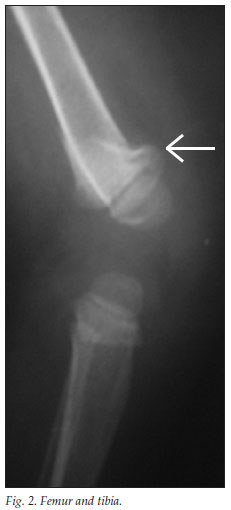
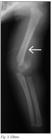
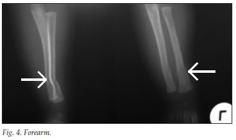
An 11-month-old child, brought to hospital by his 16-year-old mother, had allegedly fallen from a bed while unsupervised. He had multiple traumatic skin lesions (Fig. 1) and radiographs revealed multiple fractures (Figs 2 - 4). Retinoscopy and a computed tomography scan of the brain revealed no haemorrhages. The fractures were managed according to standard orthopaedic protocols and social workers were consulted.
Discussion
Non-accidental injury (NAI) manifests in many forms and accounts for more than 50 000 deaths annually worldwide.1 2 3 3 3
There is no pathognomonic fracture pattern in abuse, but multiple metaphyseal fractures are highly suggestive. The differential diagnosis includes osteogenesis imperfecta, metabolic disorders and accidental injury.2,4
Not all infants with fractures are investigated, raising the question, how often does this silent pandemic go unnoticed?
These vulnerable, voiceless children are at risk of repeated abuse or death.4
References
- 1. Rohrer T. Clinical assessment of suspected child physical abuse. Radiologe 2009; 49(10): 926-931.
- 2. van As AB, Garach SR. Femur fractures in infants. S Afr Med J 2008; 98(1): 23-24.
- 3. Fong CM, Cheung HM, Lau PY. Fractures associated with non-accidental injury - an orthopaedic perspective in a local regional hospital. Hong Kong Med J 2005; 11(6): 445-451.
- 4. Kocher MS, Kasser JR. Orthopaedic aspects of child abuse. J Am Acad Orthop Surg 2000; 8(1): 10-20.
No conflict of interest.