Heavy metal contamination in a school vegetable garden in Johannesburg
BACKGROUND: Feeding schemes based on school garden produce have been proposed as an effective solution to food insecurity and hunger among learners in South Africa. However, few studies have looked at the potential contamination of school food gardens when situated near mine tailing dams. OBJECTIVES: The aim of the study was to evaluate the potential heavy metal contamination in a school vegetable garden in Johannesburg. METHODS: Twenty soil samples were collected from the study school and a comparison school. Surface and deep (~10 cm beneath the surface) soil samples were analysed using X-ray fluorescence for levels of arsenic, chromium, copper, lead and zinc. Thirteen vegetables samples were collected from the school garden, and compared with six samples from a national retailer and four obtained from a private organic garden. The heavy metal concentrations of the vegetable samples were analysed in the laboratories of the South African Agricultural Research Council. RESULTS: High levels of arsenic were found in the school soil samples, and elevated concentrations of lead and mercury in the school vegetables. Calculation of the estimated daily intake for a child of 30 kg, however, indicated that levels of lead, mercury and arsenic in vegetables were within acceptable limits. However, the levels of lead in the vegetable samples were high across all three sites. CONCLUSION: Further investigation and research should be undertaken to assess the source/s and extent of public exposure to heavy metals in vegetables in South Africa.
Heavy metal contamination in a school vegetable garden in Johannesburg
T KootbodienI; A MatheeIII; N NaickerII; N MoodleyIV
IMB ChB, MPH. Environment and Health Research Unit, Medical Research Council, Johannesburg
IIMB ChB, MMed, FCPHM. Environment and Health Research Unit, Medical Research Council, Johannesburg
IIIMSc, PhD. Environment and Health Research Unit, Medical Research Council, Collaborating Centre for Urban Health, World Health Organization, and Faculty of Health Sciences, University of Johannesburg
IVMB ChB, DTM&H, MMed, FCPHM. School of Public Health, University of the Witwatersrand, Johannesburg
BACKGROUND: Feeding schemes based on school garden produce have been proposed as an effective solution to food insecurity and hunger among learners in South Africa. However, few studies have looked at the potential contamination of school food gardens when situated near mine tailing dams.
OBJECTIVES: The aim of the study was to evaluate the potential heavy metal contamination in a school vegetable garden in Johannesburg.
METHODS: Twenty soil samples were collected from the study school and a comparison school. Surface and deep (~10 cm beneath the surface) soil samples were analysed using X-ray fluorescence for levels of arsenic, chromium, copper, lead and zinc. Thirteen vegetables samples were collected from the school garden, and compared with six samples from a national retailer and four obtained from a private organic garden. The heavy metal concentrations of the vegetable samples were analysed in the laboratories of the South African Agricultural Research Council.
RESULTS: High levels of arsenic were found in the school soil samples, and elevated concentrations of lead and mercury in the school vegetables. Calculation of the estimated daily intake for a child of 30 kg, however, indicated that levels of lead, mercury and arsenic in vegetables were within acceptable limits. However, the levels of lead in the vegetable samples were high across all three sites.
CONCLUSION: Further investigation and research should be undertaken to assess the source/s and extent of public exposure to heavy metals in vegetables in South Africa.
To the Editor: School fruit and vegetable gardens promote healthy eating habits. Feeding schemes based on school-garden produce have been proposed as an effective solution to food insecurity and hunger among learners in South Africa, with the additional potential for income-generation.12
Methods
A total of 20 soil samples were collected from the study school and a comparison school situated approximately 1.4 km from the study school and 1.7 km from the gold-mine tailing dams. Surface and deep (±10 cm beneath the surface) soil samples were collected by the research team at each sampling point. To reduce the moisture content, soil samples were dried overnight at 90°C in a laboratory oven at the National Institute for Occupational Health. The samples were then crushed and sieved to a particle size of less than 250 µm. Each sample was analysed by the research team for 60 seconds using a handheld X-ray fluorescence spectrometer (Thermoscientific Niton XRF Analyzer - XLT 800 series) for levels of arsenic, chromium, copper, lead and zinc.
Thirteen samples of vegetables were collected from the school garden, including a selection of rooting vegetables (carrots, onions and potatoes), leafy vegetables (basil, cabbage and spinach) and fruiting vegetables (butternut, cherry tomatoes, peppers, pumpkin and tomatoes). Six vegetable samples (broccoli, butternut, carrots, potatoes, tomatoes and spinach) were purchased from a national retailer (control A). Four vegetable samples (carrots, eggplants, potatoes and tomatoes) were obtained from a private organic garden (control B). All vegetable samples were washed thoroughly with tap water, and leafy vegetables were oven dried at 70°C to reduce moisture content, and milled prior to analysis. The moisture content in rooting and fruiting vegetables was determined and the heavy metal concentrations were calculated on a dry basis using inductively coupled plasma-optical emission spectroscopy (ICP-OES) in the laboratories of the South African Agricultural Research Council. Non-normally distributed continuous variables are presented using median and interquartile range (IQR) and compared using Wilcoxon rank-sum (Mann-Whitney) test. The estimated daily intake (EDI) of heavy metals was calculated on an average intake of 100 g of school-garden vegetables consumed daily by a 30 kg child.
Results
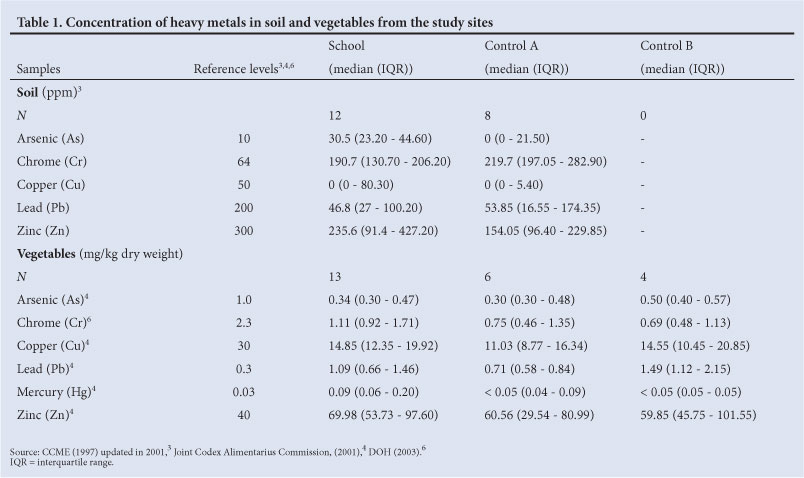
Table 1 lists median concentrations and IQRs of metals in soil (ppm) and in vegetables (mg/kg dry weight). The reference levels based on the Canadian Council of Ministers of the Environment3
Though higher median levels of chrome were found in soil in the comparison school relative to the study school, it was not significant (219.7 ppm v. 190.7 ppm, p=0.123).
The percentage of vegetable samples that exceeded the recommended limits for lead, zinc and mercury, based on the Joint Codex Alimentarius Commission4
The EDI levels of arsenic, lead, mercury and zinc were within normal limits. The EDI levels of chrome ranged from 0.003 mg/ kg/day to 0.005 mg/kg/day across the study sites and exceeded the acceptable daily intake limit of 0.001 mg/kg/day.55
Conclusion and recommendations
This study points to metal contamination of soil and vegetables at the study school garden and at the control sites. Of particular concern in the school garden were the high levels of arsenic found in the soil and the elevated concentrations of lead and mercury in the school vegetables. Calculation of the EDI of heavy metals for a child of 30 kg, however, indicated that levels of lead, mercury and arsenic in vegetables were within acceptable limits. However, chrome and copper levels exceeded the acceptable intake limits in the study and control school samples.
Children attending many South African schools require food supplementation, failing which malnutrition is likely to impact negatively on learning ability. However, at the same time there is a need to ensure their protection against exposure to harmful substances in the environment. Children are particularly vulnerable to environmental exposures and in line with the precautionary principle in children's environmental health, schools and education departments should adopt a differentiated approach to the promotion of school vegetable gardens. Risk assessments should pay particular attention to schools located in close proximity to potential sources of pollution, including mining, industrial and traffic pollution.
Of additional concern in this study are the elevated metal concentrations determined in vegetables sourced from further afield: organic vegetables from a major national retail store and a home-based, organic garden. Further investigation and research should be undertaken to assess the source/s and extent of public exposure to metals in vegetables in South Africa.
References
- 1. Department of Agriculture. The Integrated Food Security Strategy for South Africa (mimeo). Pretoria: Department of Agriculture, 2002: 1-47.
- 2. Mathee A. Indicators of Health, Environment and Development: A Longitudinal Study in Johannesburg 2006-2008. Johannesburg: World Health Organization Collaborating Centre for Urban Health, 2009.
- 3. Canadian Council of Ministers of the Environment (CCME). Recommended Canadian Soil Quality Guidelines for the Protection of Environmental and Human Health. Winnipeg: Canadian Council of Ministers of the Environment, 1997.
- 4. Joint Codex Alimentarius Commission (FAO/WHO). Food additives and contaminants. Food Standards Programme, 2001; ALINORM 01/12A:1-289.
-
5. Agency for Toxic Substances and Disease Registry (ATSDR). Minimal Risk Levels (MRLs) for Hazardous Substances. Agency for Toxic Substances and Disease Registry, 2010. http://www.atsdr.cdc.gov/mrls/ (accessed 31 August 2011).
» http://www.atsdr.cdc.gov/mrls/ - 6. Department of Health. Foodstuffs, Cosmetics and Disinfectants Act, 1972 (Act 54 of 1972); Regulation relating to maximum levels in foodstuffs: Amendment. Pretoria: DoH, 2003.