Flank pain, haematuria and poor patient compliance: beware the 'forgotten' JJ stent!
SAMJ FORUM
CLINICAL IMAGES
Flank pain, haematuria and poor patient compliance: beware the 'forgotten' JJ stent!
Yusuf Seedat; Ahmed Adam*
A 40-year-old man presented with right-sided flank pain of sudden onset and intermittent macroscopic haematuria that had been present for the past 3 months. He had had a hospital admission for a right ureteric stone 3 years previously, where some 'intervention' had been performed. He had been told to return for a follow-up visit, but had defaulted as he felt well after being discharged.
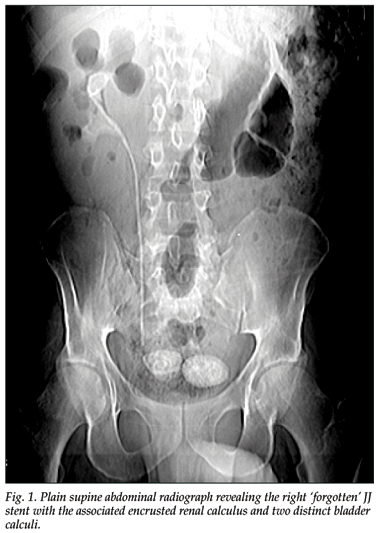
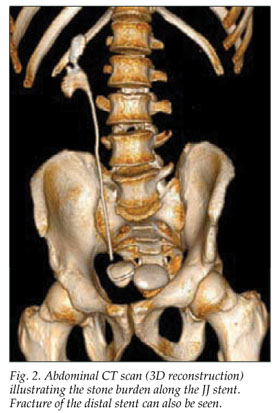
The patient was clearly distressed, with right-sided renal angle tenderness and severe suprapubic pain. A plain supine abdominal film (Fig. 1) and non-contrast computed tomography (CT) scan (Fig. 2) revealed an encrusted 'forgotten' JJ stent with a significant associated secondary stone burden.
A renogram confirmed that the right kidney had been severely affected by the subsequent stone burden, now contributing only 10.32% of the overall renal function.
Discussion
Ureteral JJ stents are invaluable in endo-urological practice, as they provide free drainage from the kidney to the bladder and are effective in relieving and preventing upper urinary tract obstruction.12,3 which most commonly include stent encrusation, stent migration, stent fracture and secondary stone formation.131
Treatment usually involves endoscopic removal of the retained stent. For stents with a high stone burden, the use of a combination of percutaneous nephrolithotripsy, extracorporeal shockwave lithotripsy, ureteroscopy, electrohydraulic lithotripsy, laser lithotripsy and percutaneous chemolysis may be necessary, with clearance rates of up to 100% being achieved.4
Careful selection of patients who stand to benefit most from JJ stent insertion is essential to prevent unnecessary complications.1
This is particularly relevant in settings with poor patient compliance, inadequate record keeping, language barriers, ineffective follow-up strategies and limited access to specialised health care. The presence of a 'forgotten' JJ stent in patients presenting with flank pain and haematuria should be considered, as it may have devastating consequences if left undetected.
We would like to thank Drs J van Heerden and R Roux of the Department of Radiology, Kalafong Hospital, for assisting with the images.
References
- 1. Memon NA, Talpur AA, Memon JM. Indications and complications of indwelling ureteral stenting at NMCH, Nawabshah. Pakistan Journal of Surgery 2007; 23(3): 187-191.
- 2. Ringel A, Richter S, Shalev M, Nissenkorn I. Late complications of ureteral stents. Eur Urol 2000; 38: 41-44.
- 3. Singh I, Singh S. Missed fractured 'trapped JJ stent' in a solitary functioning renal unit – Implications of management. Int Urol Nephrol 2003; 35: 247-249.
- 4. Park K, Jeon S, Park H, Kim HH. Clinical features determining the fate of a long-term, indwelling, forgotten double J stents. Urol Res 2004; 32: 416-412.
Ahmed Adam, MB BCh (Wits), Dip PEC (SA), is currently a registrar in the Department of Urology, University of Pretoria.
*Corresponding author: A Adam (