"I see you" - Gender representation and unconscious bias in images of surgeons: the South African Journal of Surgery
Sarah Rayne
Specialist Surgeon, Department of Surgery, Faculty of Health Sciences, University of the Witwatersrand. Johannesburg, South Africa
Over the last fifty years, changes in the demographics of the healthcare workforce worldwide has increased the volume of previously under-represented groups.12,3 and locally the number of women accepted for surgical specialist training is becoming more equal to men in faculties of health sciences throughout South Africa. Despite the advances made in introducing diversity into the health professions globally, there is a well-documented failure to mirror this increasing diversity at the higher levels of surgical academia, and this is evident in most countries,1,4-6 including South Africa. It is estimated in the USA that women will not achieve gender parity as Full Professors in surgery until 2136.7 22,8 Other reasons often mentioned as deterring women from surgery are lifestyle and family commitments.92,5,9,10 In addition, there is a notable gender pay gap in surgery, documented in the UK as 20% difference between male and female surgeons.111#ILookLikeASurgeon, highlighted the divide between the modern surgical workforce and the perception of surgeons that exists in the community (academic or lay). In this campaign, female surgeons and previously underrepresented groups documented occasions where their veracity as a surgeon was questioned because of social stereotypes that surgeons are usually white older men. It then highlighted the diversity of people and situations where any trained specialist might still say "#ILookLikeASurgeon".1213
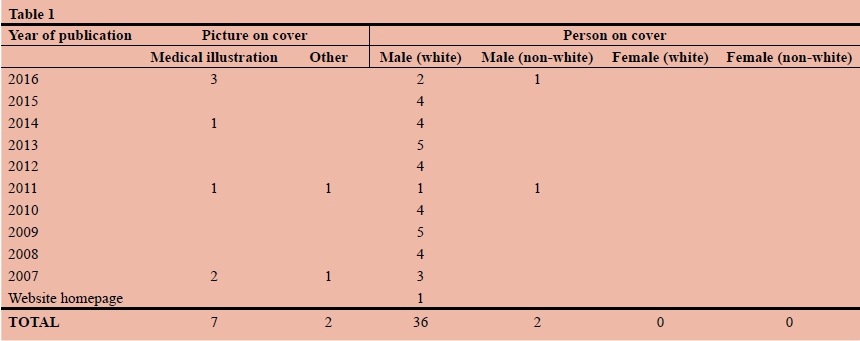
The South Africa Journal of Surgery is the journal of the Association of Surgeons of South Africa and is the premier journal of surgical research in South Africa. Through peerreview and international recognition, it informs and influences surgical practice and thinking in the country. It is available online and in paper format. The front-page images associated with the journal were evaluated from the last ten years to determine its most recent visual representation of surgeons and surgical care. Over this ten-year period, 47 illustrations were presented on the front page. These are summarised in Table 1.
The front page included 38 people of which 29 were deceased (in memoriam). Of the deceased, 97% (n = 28) were white males and of the living 89% (n = 8) were white males. There were five intraoperative photos of surgeons, three containing two surgeons and two containing three surgeons (12 surgical personnel) of which only one was not a white male. In addition to the front pages, the online content of the journal contains a banner on each page containing the name of the journal and a white male surgeon. There were no illustrations of any female surgeons, and only 5% of people represented were non-white.
The representation of surgeons made visible in the journal front cover remains predominantly male and white, either when viewed as individuals or as operating surgeons in group photos. Although not referenced in the journal information, there may be particular local reasons why this preponderance of white men is present which should be noted. Most of the images are of celebrated local surgeons, often deceased, and may act as an inspiration and tribute in memoriam. Whilst it would be wholly inappropriate to devalue these contributions or disrespect the surgeons who have gained the academic reputation to deserve such an honour, the continued predominance of male surgeons in this visible position can reinforce stereotypes in surgery. Readers (surgeons and trainees in surgery) have only one role-model made visible, that of a male (usually white) surgeon. This representation is present even where grouping of surgeons is represented operating in modern times, as well as through the photos of previous illustrious surgeons.
Improving the visibility of previously under-represented groups as surgeons is important. Consistently, studies show that lack of identification of role-models influences career choices, particularly in women. The lack of visibility of female surgeons discourages medical students and trainees from considering a career in surgery.14, 15 In addition, although there is a paucity of medical literature surrounding defining role-models from previously disadvantaged groups, the dialogue around transformation in South Africa highlights that visibility of diversity in senior staff in medicine and subsequent mentorship is integral to the process of change.16
As diversity and gender equity is welcomed into surgery and academic surgery in South Africa, the increased availability of role-models should be made visible to encourage consideration of the career by medical students and junior doctors. This could be achieved by placing diverse groups of surgeons, or surgical practices onto the front page, including collaborators or visual abstracts from articles within that issue. Through this practice, we can make visible and encourage the continued improvements in the diversity of our workforce at all levels in surgery, from first-year students upwards and through the glass-ceiling.
REFERENCES
-
1. Zhuge Y, Kaufman J, Simeone DM, Chen H, Velazquez OC. Is there still a glass ceiling for women in academic surgery? Ann Surg. 2011;253:637-43. doi:10.1097/SLA.0b013e3182111120
» https://doi.org/10.1097/SLA.0b013e3182111120 -
2. Burgos CM, Josephson A. Gender differences in the learning and teaching of surgery: a literature review. Int J Med Educ. 2014;5:110-24. doi:10.5116/ijme.5380.ca6b
» https://doi.org/10.5116/ijme.5380.ca6b -
3. Khan T, Thomas LS, Naidoo S. Analysing post-apartheid gender and racial transformation in medical education in a South African province. Glob Health Action. 2013;6:19810. doi: http://dx.doi.org/10.3402/gha.v6i0.19810
» https://doi.org/http://dx.doi.org/10.3402/gha.v6i0.19810 -
4. Gonzalez A. A Tide to Raise All Boats - Structured Mentorship as a Race-neutral Option for Happier and More Diverse Residents. Ann Surg. 2016;8:583-92. doi:10.1002/aur.1474. Replication
» https://doi.org/10.1002/aur.1474 - 5. Hoover EL. Mentoring women in academic surgery: overcoming institutional barriers to success. J Natl Med Assoc. 2006;98:1542-5.
-
6. Mueller C, Wright R, Girod S. The publication gender gap in US academic surgery. BMC Surg. 2017;17:16. doi:10.1186/ s12893-017-0211-4
» https://doi.org/10.1186/ s12893-017-0211-4 -
7. Abelson JS, Chartrand G, Moo TA, Moore M, Yeo H. The climb to break the glass ceiling in surgery: trends in women progressing from medical school to surgical training and academic leadership from 1994 to 2015. Am J Surg. 2016;212:566572.e1. doi:10.1016/j.amjsurg.2016.06.012
» https://doi.org/10.1016/j.amjsurg.2016.06.012 -
8. Edmunds LD, Ovseiko P V, Shepperd S, Greenhalgh T, Frith P, Roberts NW, et al. Why do women choose or reject careers in academic medicine? A narrative review of empirical evidence. Lancet. 2016;388:2948-58. doi:10.1016/S0140-6736(15)01091-0
» https://doi.org/10.1016/S0140-6736(15)01091-0 -
9. Fitzgerald JEF, Tang S-W, Ravindra P, Maxwell-Armstrong C. Gender-related perceptions of careers in surgery among new medical graduates: results of a cross-sectional study. Am J Surg. 2013;206:112-9. doi:10.1016/j.amjsurg.2012.04.009
» https://doi.org/10.1016/j.amjsurg.2012.04.009 -
10. Kerr H-L, Armstrong LA, Cade JE. Barriers to becoming a female surgeon and the influence of female surgical role models. Postgrad Med J. 2016:576-80. doi:10.1136/postgradmedj-2015-133273
» https://doi.org/10.1136/postgradmedj-2015-133273 -
11. Dean E. The gender pay gap in surgery. Bull R Coll Surg Engl. 2017;99:12-4. doi:10.1308/rcsbull.2017.12
» https://doi.org/10.1308/rcsbull.2017.12 -
12. Fitzgerald E, McCoubrey A, Logghe H. #ILookLikeASurgeon: Uniting a diverse global surgical community on social media - The BMJ. theBMJopinion. n.d. [Accessed 31 March 2017]. Available from: http://blogs.bmj.com/bmj/2015/09/08/ilooklikeasurgeon-uniting-a-diverse-global-surgical-community-on-social-media/.
» http://blogs.bmj.com/bmj/2015/09/08/ilooklikeasurgeon-uniting-a-diverse-global-surgical-community-on-social-media/ -
13. Mouly F, Bormes G. The New Yorker Cover That's Being Replicated by Women Surgeons Across the World. New Yorker 2017. [Accessed 19 April 2017]. Available from: http://www.newyorker.com/culture/culture-desk/the-new-yorker-cover-thats-being-replicated-by-women-surgeons-across-the-world
» http://www.newyorker.com/culture/culture-desk/the-new-yorker-cover-thats-being-replicated-by-women-surgeons-across-the-world -
14. Ek EW, Ek ET, Mackay SD. Undergraduate experience of surgical teaching and its influence on career choice. ANZ J Surg. 2005;75:713-8. doi:10.1111/j.1445-2197.2005.03500.x
» https://doi.org/10.1111/j.1445-2197.2005.03500.x -
15. Neumayer L, Kaiser S, Anderson K, Barney L, Curet M, Jacobs D, et al. Perceptions of women medical students and their influence on career choice. Am J Surg. 2002;183:146-50. doi:10.1016/S0002-9610(01)00863-7
» https://doi.org/10.1016/S0002-9610(01)00863-7 -
16. Thackwell N, Swartz L, Dlamini S, Phahladira L, Muloiwa R, Chiliza B. Race trouble: experiences of Black medical specialist trainees in South Africa. BMC Int Health Hum Rights. 2016;16:31. doi:10.1186/s12914-016-0108-9
» https://doi.org/10.1186/s12914-016-0108-9