Mediastinal goitre - a South African case series
Abstract
BACKGROUND: Mediastinal goitres are rare and may be diagnosed late since they are likely to manifest with non-specific cardiorespiratory symptoms especially when there is no visible cervical component. The imaging modality of choice is a contrast-enhanced computed tomography (CT) scan of the neck and chest after incidental finding of goitre on chest X-ray indicated for a condition unrelated to goitre METHOD: This case series aims to highlight the peculiarity of mediastinal goitre in terms of clinical presentation, surgical approach, airway challenges at anaesthesia, specific complications and final histopathological report RESULTS: Over a nine-year period, four cases of euthyroid mediastinal goitre underwent sternotomy. The mean age was 57.5 years (45-71) and all patients were female. Most patients presented with non-specific cardiorespiratory symptoms. The difficult airway set was used in all cases and there were two instances of damage to the recurrent laryngeal nerve (RLN). All histopathological reports were benign CONCLUSION: The presentation of the mediastinal goitres was atypical. Cervical incision and sternotomy were performed in all cases. There were two instances of RLN injury and no malignant histopathology. Despite the potential threat to the airway, all intubations were uneventful
mediastinal goitre; euthyroid mediastinal goitre
Introduction
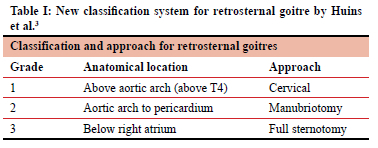
Goitre is classified by the World Health Organization (WHO) as Grade 0, 1, and 2.12Table I).3
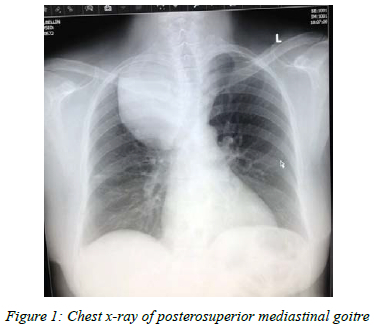
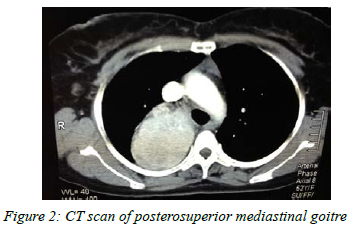
Mediastinal goitres are either diagnosed in the work up of patient with superior vena cava syndrome, non-specific restrictive cardiorespiratory symptoms or incidentally during routine preoperative imaging.4,5 The largest mediastinal goitre (900 g) ever described presented with a longstanding history of respiratory symptoms associated later with stridor.44,5 In South Africa, Gvilia et al. from Pietersburg Hospital reported a case of retrosternal goitre that required sternotomy.6. We report our experience of mediastinal goitres diagnosed at our institution.
Objective
To describe the characteristics, clinical presentation and specific complications of mediastinal goitre treated with sternotomy at Chris Hani Baragwanath Academic Hospital (CHBAH).
Methods
In this observational descriptive study, we retrospectively reviewed all cases of mediastinal goitre treated at our institution over the past nine years (January 2013-September 2021). Parameters analysed included patient demographics, goitre characteristics (size, weight, anatomical localisation, function), clinical presentation, findings of pre- and postoperative laryngoscopy, surgical approach (sternotomy), intensive care unit (ICU) admission, comorbidity, histopathological reports, specific complications and anaesthetic considerations of the procedure.
For perspective, we also reviewed the total number of thyroidectomies performed during the study period.
All precautionary measures were taken to ensure safe anaesthesia. The cases were discussed at the multidisciplinary team (MDT) meeting that includes intensivists, anaesthetists and surgeons. The difficult airway set was available in all cases and included video laryngoscopy and bronchoscopy.
General and ENT surgeons were present during intubation in anticipation of rigid bronchoscopy. Cardiothoracic surgeons did not form part of the team.
All patients were managed with the endotracheal tube in place in the ICU postoperatively. The ICU requirement was due solely to the magnitude of surgery since there were no significant patient comorbidities.
Statistical analysis
Continuous variables are presented as means for normal distribution or as median with interquartiles ranges (IQRs) for data not normally distributed. Categorical variables are expressed as proportion by ratio or percentage.
Results
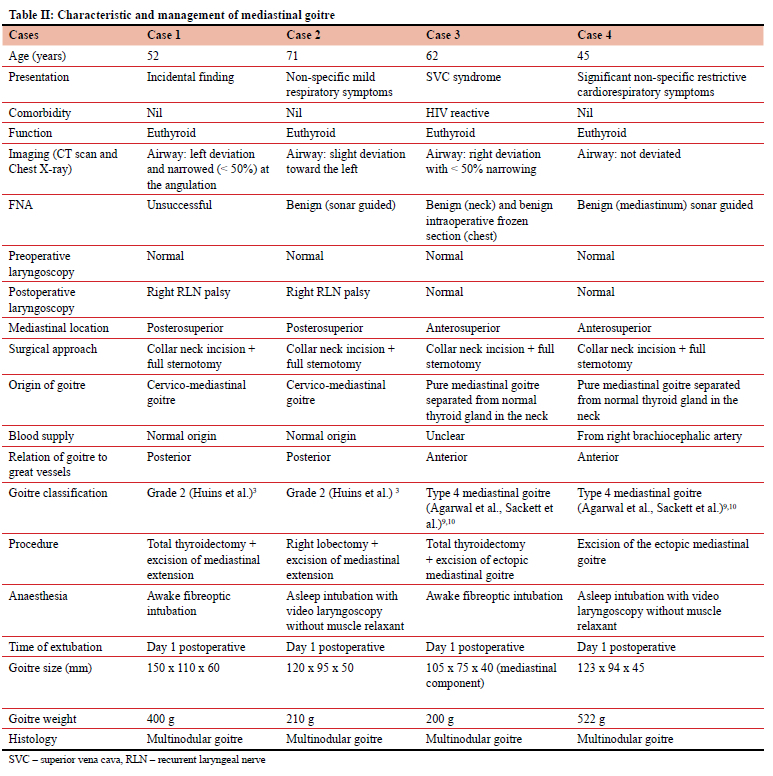
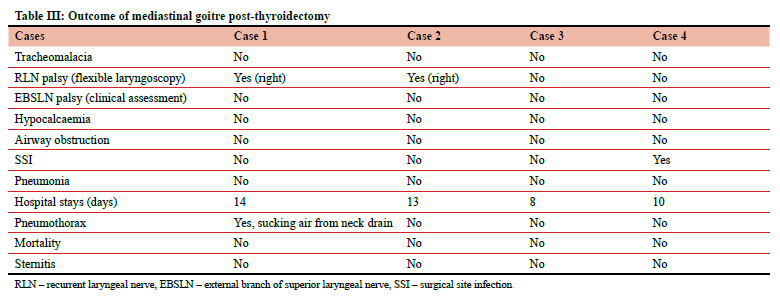
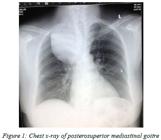
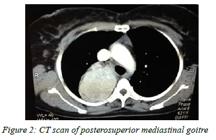
During the study period, there were four cases of mediastinal goitre out of 521 thyroidectomies performed (0.7%). All patients were female, and their mean age was 57.5 years (range 45-71 years). The patient and goitre characteristics are depicted in Table II, while patient outcomes are depicted in Table III.
Discussion
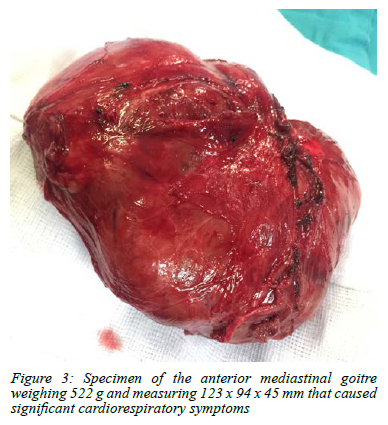
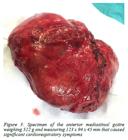
During embryology, the descent of the thyroid gland and the inferior parathyroid glands from the third pouch can arrest at any level in their course. The undescended lingual thyroid is by far the most common (90%) variation.789,10 Our case series of four patients with mediastinal goitre over a nine-year period, accounting for 0.7% of all thyroidectomies performed over the same period, attests to the rarity of the condition. This incidence is slightly higher than the 0.02-0.5% reported in the literature, presumably due to the low number of thyroidectomies performed at our institution. The patients in our series presented mostly with compressive symptoms related to the mediastinal location of the goitre; those with pure mediastinal goitres were more symptomatic likely due to the more limited space in the anterior mediastinum vs the posterior mediastinum. The significant size and weight of the goitres were most likely due to the atypical presentation and the invisible cervical component that delayed diagnosis.
Surgical challenges
Sternotomy was required to deliver the goitre in all cases. The sternotomy has the benefit of providing improved access and preventing inadvertent bleeding, especially in the case of pure mediastinal goitre which derives its blood supply from the chest. Minimal access surgery is also a viable option through video-assisted thoracoscopy (VAT).11
There were two instances of recurrent laryngeal nerve (RLN) palsy (both on the right) in the cases of goitre with posterior mediastinal extension. The literature reports a higher incidence of complications related to mediastinal goitre.88128
It is not surprising that there was no malignancy since the most common thyroid pathology is multinodular goitre and cancer is less than 5%.5
Anaesthetic challenges
The anaesthetic management of mediastinal goitres depends on the initial assessment, and the various types of airways may be classified as "safe", "uncertain" and "unsafe" according to Erdös and Tzanova.13
The "safe" airways are managed in a conventional manner that consists of intravenous or inhalation anaesthetic drugs with neuromuscular blockade. In "uncertain" airways, the patients are allowed to breathe spontaneously until they are intubated safely. The idea is to preserve the negative intrapleural pressure which maintains the airway patent.141516
The management of the patient with a retrosternal goitre presents a further challenge to the perioperative anaesthetic care due to the potential threat of acute cardiopulmonary decompensation that may occur during induction.171819
Conclusion
In our series, all four cases of euthyroid mediastinal goitre had an atypical presentation and sternotomy was successfully performed in all cases with no morbidity. There were two instances of RLN injury and no malignant histopathology. Despite the potential threat to the airway, all intubations were successful and uneventful.
Awareness of this rare subcategory of goitre is important, as the non-specific symptoms make diagnosis challenging. An MDT approach is required to ensure adequate preparation for the anaesthetic and surgical challenges this condition poses and to ensure a successful outcome.
Conflict of interest
The authors declare no conflict of interest.
Funding source
No funding was required.
Ethical approval
Ethical approval was obtained from the Human Research Ethics Committee of the University of the Witwatersrand and the research review board of CHBAH (clearance certificate No M211043).
ORCID
I Bombil https://orcid.org/0000-0002-4819-0785
PN Mogane https://orcid.org/0000-0002-5523-4539
RAMuganza https://orcid.org/0000-0001-5832-6095
REFERENCES
- 1. World Health Organization. United Nations Children's Fund, International Council for the Control of Iodine Deficiency Disorders 2007. Assessment of iodine deficiency disorders and monitoring their elimination. Geneva, Switzerland: World Health Organization; 2007. p. 14-16.
- 2. DeSouza FM, Smith PE. Retrosternal goitre. J Otorlaryngol. 1983;12:393-6.
-
3. Huins CT, Georgalas C, Mehrzad H, Tolley NS. A new classification system for retrosternal goitre based on a systemic review of its complications and management. Int J Surg. 2008;6:71-76. https://doi.org/10.1016/j.ijsu.2007.02.003.
» https://doi.org/10.1016/j.ijsu.2007.02.003 -
4. Shah PJ, Bright T, Singh SS, et al. Large retrosternal goitre: a diagnostic and management dilemma. Heart Lung Circ. 2006;15:151-2. https://doi.org/10.1016/j.hlc.2005.10.011.
» https://doi.org/10.1016/j.hlc.2005.10.011 - 5. Sadler GP, Mihai R. The thyroid gland. In: Lennard TWJ, editor. Endocrine surgery. Saunders Elsevier; 2009. p. 39-72.
-
6. Gvilia T, Jonas L, Van As AB. Retrosternal goitre at Pietersburg Hospital, Limpopo Province, South Africa: a case report. S Afr Med J. 2021;111(11b):1140-1. https://doi.org/10.7196/SAMJ.2021.v111i11b.16102.
» https://doi.org/10.7196/SAMJ.2021.v111i11b.16102 -
7. Oueriachi FE, Hammoumi MME, Arsalane A, et al. Primary mediastinal goiters. Springerplus. 2014;3:503. https://doi.org/10.1186/2193-1801-3-503.
» https://doi.org/10.1186/2193-1801-3-503 - 8. Morita SY, Zeiger MA. Thyroidectomy for large or substernal goiters. In: Duh Q-Y, Clark OH, Kebebew E, editors. Atlas of endocrine surgical techniques. Saunders Elsevier; 2010. p. 47-59.
- 9. Agarwal A, Mishra AK, Lombardi CP, Raffaelli M. Applied embryology of the thyroid and parathyroid. In: Randolph GW, editor. Surgery of the thyroid and parathyroid glands. Saunders Elsevier; 2013. p. 15-24.
-
10. Sackett WR, Reeve TS, Barraclough B, Delbridge L. Thyrothymic thyroid tests: incidence and relationship to the thyroid gland. J Am Coll Surg. 2002;195(5):635-40. https://doi.org/10.1016/S1072-7515(02)01319-4.
» https://doi.org/10.1016/S1072-7515(02)01319-4 -
11. Gupta P, Lau KKW, Rizvi I, Rathinam S, Waller DA. Video assisted thoracoscopic thyroidectomy for retrosternal goitre. Ann R Coll Surg Engl. 2014 Nov;96(8):606-8. https://doi.org/10.1308/003588414X14055925058634.
» https://doi.org/10.1308/003588414X14055925058634 - 12. Gregory GW, Rameau A, Netterville JL. Surgery of cervical and substernal goiter. In: Randolph GW, editor. Surgery of the thyroid and parathyroid glands. Saunders Elsevier; 2013. p. 63-77.
-
13. Erdös G, Tzanova I. Perioperative anaesthetic management of mediastinal mass in adults. Eur JAnaesthesiol. 2009;26(8):627-32. https://doi.org/10.1097/EJA.0b013e328324b7f8.
» https://doi.org/10.1097/EJA.0b013e328324b7f8 -
14. Tan PC, Esa N. Anesthesia for massive retrosternal goiter with severe intrathoracic tracheal narrowing: the challenges imposed: a case report. Korean J Anesthesiol. 2012;62(5):474-8. https://doi.org/10.4097/kjae.2012.62.5.474.
» https://doi.org/10.4097/kjae.2012.62.5.474 -
15. Bacuzzi A, Dionigi G, Del Bosco A, et al. Anaesthesia for thyroid surgery: perioperative management. Int J Surg. 2008;6(Suppl 1):S82-S85. https://doi.org/10.1016/j.ijsu.2008.12.013.
» https://doi.org/10.1016/j.ijsu.2008.12.013 -
16. Dempsey GA, Snell JA, Coathup R, Jones TM. Anaesthesia for massive retrosternal thyroidectomy in a tertiary referral centre. Br J Anaesth. 2013;111(4):594-9. https://doi.org/10.1093/bja/aet151.
» https://doi.org/10.1093/bja/aet151 -
17. Pan Y, Chen C, Yu L, Zhu S, Zheng Y. Airway management of retrosternal goitres in 22 cases in a tertiary referral centre. Ther Clin Risk Manag. 2020;16:1267-73. https://doi.org/10.2147/TCRM.S281709.
» https://doi.org/10.2147/TCRM.S281709 -
18. Cook TM, Morgan PJ, Hersch PE. Equal and opposite expert opinion. Airway obstruction caused by a retrosternal thyroid mass: management and prospective international expert opinion. Anaesthesia. 2011;66(9):828-36. https://doi.org/10.1111/j.1365-2044.2011.06650.x.
» https://doi.org/10.1111/j.1365-2044.2011.06650.x -
19. Wong P, Chieh Liew GH, Kothandan H. Anaesthesia for goitre surgery: a review. Proc Singapore Healthc. 2015;24(3):165-70. https://doi.org/10.1177/2010105815596095.
» https://doi.org/10.1177/2010105815596095