Time to operative care for breast cancer in the Cape Metro West region
Abstract
BACKGROUND: Time from diagnosis to operative care is a quality indicator in breast cancer (BCA) care. The recommended time from diagnosis to definitive treatment in South Africa (SA) is 31 days. The primary objective of this study was to determine the time to operative care (TOC) for BCA patients attending a multidisciplinary breast clinic at a tertiary hospital in Cape Town, SA. METHODS: This was a retrospective review of women with BCA reviewed by the BCA multidisciplinary unit at Groote Schuur Hospital, SA, from 1 January 2018 to 31 December 2019. RESULTS: Of 563 women who underwent BCA operations, 370 (65.7%) had surgery as the primary treatment modality. The median TOC for those who had surgery first was 86 days (IQR: 63-109). Of the 370 who had surgery first, 20 (5.4%) were operated on within the recommended 31 days. TOC at the district hospital was 35.1 days shorter (p < 0.001), and at the regional hospital, it was 16.3 days (p = 0.008) shorter than at the tertiary hospital after controlling for age, district, and stage of cancer. CONCLUSIONS: A low proportion of women with BCA had definitive surgery within the 31-day recommended waiting period. Decentralisation of operative care allowed faster access to surgery at district hospitals for women who did not need sentinel node biopsy or advanced anaesthesia care. Identifying additional resources needed to decrease TOC for BCA patients could improve access to timeous surgical care.
breast cancer; time to care; South Africa
Introduction
Breast cancer (BCA) is the most common form of cancer among women globally and, in 2020, it accounted for 11.7% of all new cancer cases among women and 6.9% of cancer-related deaths.11,2 In South Africa (SA), BCA is the most common cancer among women, and in 2018 was responsible for 23.2% of all cancer cases in women.3
Early detection, as well as timely and appropriate treatment, are important strategies for improving BCA outcomes, including reducing deaths. The BCA treatment pathway includes a multidisciplinary plan formulated by surgeons and oncologists with consideration of surgical removal of part or all of the breast, chemotherapy, and/or radiation. Surgery is the main treatment for BCA if detected before widespread metastases have occurred,45 4
There are sentinel stages along the BCA pathway to care, including the first symptom, first healthcare visit, diagnosis and first definitive (operative or non-operative) treatment, and the time between these can be measured (Figure 1). Various factors can contribute to delays in getting the first definitive care, and these factors could range from patient factors such as lack of health education and transportation challenges to fear of the healthcare system and use of alternative care providers. Healthcare system-related factors, such as lack of diagnostic or treatment resources or shortage of operating facilities, may also delay receiving definitive care.5,6

The South African Breast Cancer Control Policy states that all women with suspected BCA should have access to a specialised breast unit to direct definitive diagnostics and treatment. It also recommends that women with confirmed BCA should start definitive treatment within 31 days of diagnosis.7789> 36 days.1011
In SA, the majority of operations are done at regional and tertiary hospitals.12713
Methods
Study population and study design
This was a retrospective review of women with BCA reviewed by the BCA multidisciplinary unit at Groote Schuur Hospital (GSH) from 1 January 2018 to 31 December 2019. The study period ended before the COVID-19 pandemic, which changed TOC for most surgical conditions, including cancer.14
Eligibility criteria
The study included women with BCA aged 18 years and older who had a confirmed BCA diagnosis and underwent primary surgery as a component of their treatment. Men with BCA and women who did not have primary BCA surgery were excluded.
Study setting
GSH is a public tertiary hospital located in Cape Metro West health district of the Western Cape province of SA with an estimated catchment of 6 million.156
Data collection
Potential study participants were extracted from the BCA database. BCA diagnoses were confirmed using histopathology results from the National Health Laboratory Services. The primary outcome was the time (days) from breast biopsy to operation (TOC) for women who had surgery as their first definitive treatment. Women who had NAC as their first definitive treatment were identified through specific laboratory tests and clinic visits. NAC start date was not available, so TOC for women undergoing NAC was not calculated. Rural residence was defined as those from the West Coast subdistrict, and urban residence were all other subdistricts. Hospital type was district, regional, or tertiary.
Data analysis
Data were extracted and imported into STATA 17 (College Park, TX, USA) for statistical analysis. Median and interquartile range were used to describe age and TOC due to their non-normal distributions. TOC was only calculated for women who had surgery as their first definitive treatment. Quantile regression was used to explore associations with TOC, including age, cancer stage, operating hospital type, year of operation, and rural residence. This regression version was chosen because TOC was a continuous variable and not normally distributed. Univariate regression was done, and all factors with p < 0.10 were included in the multivariable analysis.
Sample size estimation
All BCA women who had surgery as their first definitive treatment during the 2-year period were identified. Based on a simple parametric test to detect a difference of 20% between the reported median delay of 40 days7
Ethical considerations
Ethical approval was obtained from the University of Cape Town Research Ethics Committee. Given the retrospective nature of this study and the low risk to participants, informed consent was waived. All personal data were de-identified before analysis.
Results
Participants' characteristics
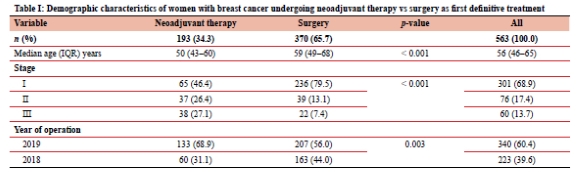
There were 794 women with BCA during the study period. Of these, 563 (70.9%) had a biopsy and an operation. Three hundred and seventy (65.7%) had surgery as their first definitive treatment, and l93 (34.3%) had NAC as their first definitive treatment. The median age of those who had surgery first was 59 (interquartile range [IQR] 49-68) years compared to 50 (IQR 43-60) years (p < 0.001) for those who had NAC first. Those who had surgery first were more likely to be stage 1 (79.5%) compared to those who had NAC (46.4%, p = 0.003) (Table I). BCA surgery volume increased over the study period.
Time to operative care
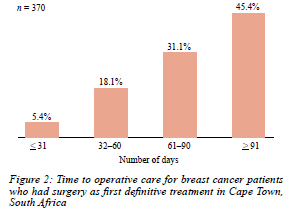
The median TOC for the 370 women who had surgery as their first definitive treatment was 86 days (IQR: 63-109). Of these, 20 (5.4%) were operated within the recommended 31 days, and 350 (94.6%) waited longer than 31 days (Figure 2).
Factors associated with time to operative care
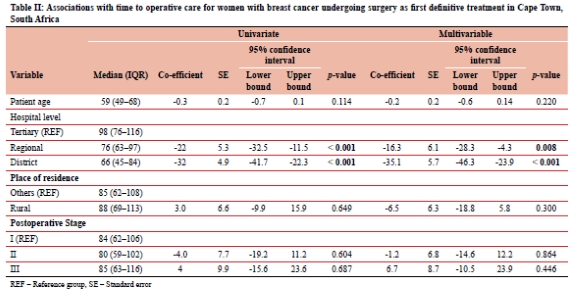
For the 370 BCA women who had surgery as their first definitive treatment, operating hospital type was significantly associated with TOC in the univariate analysis. This association remained significantly associated with TOC in the multivariable analysis. TOC at the district hospital was 35.1 days shorter (p < 0.001) than at the tertiary hospital, and 16.3 days shorter (p = 0.008) at the regional hospital compared to the tertiary hospital after controlling for age, rural residence, and stage of cancer (Table II).
Discussion
BCA is the most common cancer in women, and delays in care can result in poorer outcomes. A large US study of over 150 000 women with BCA demonstrated a 10% increase in mortality for each 60-day delay, most prominently in those with early-stage disease.11167,17 The median time from first treatment to definitive care for LMICs ranges from 2.6 to 6.5 months compared to 15 days in Germany, a HIC.1818
Time to treatment is a measure of health system efficiency. Timely treatment, including surgery, is crucial to reducing cancer-related mortality.1920,21 Access to timely surgery is particularly important in LMICs, where access to other effective and innovative cancer therapies, including new drugs, and human resources are limited compared to HICs.2219
Operating hospital type was associated with TOC. Patients operated on at district and regional hospitals had a median TOC of 2-5 weeks less than those operated on at the tertiary hospital. A similar finding was observed in a smaller study from the same health district, although the result did not reach statistical significance.723242526
As patient volume increases, there will be an increased demand for surgical care, which will impact theatre availability and treatment intervals. More efficient strategies and provision of resources for managing the increasing patient volume should be looked into to reduce treatment intervals and improve BCA outcomes. While we did not specifically study reasons for delays to operative care, based on our clinical observations, we have identified three likely causes of delays to BCA operative care in our setting. The primary cause was the time required to complete staging investigations, such as delays in obtaining staging CT scans and bone scans. Additionally, the unavailability of SLNB at district hospitals is a contributing factor. If this procedure, as well as a higher level of anaesthesia and postoperative care, was available at district hospitals, this would alleviate some operative pressures at tertiary and regional levels. Finally, the tertiary hospital theatre capacity is woefully inadequate to handle the number of patients requiring surgery. Additional BCA theatre lists with an increased number of breast surgeons, anaesthetic services, and nursing staff would decrease TOC.
Limitations
This study had some limitations. First, due to the study's retrospective nature, we were unable to fully assess other factors (such as patient sociodemographics and comorbidities) that may influence treatment interval or choice of hospital. We were also unable to analyse the waiting times and the reasons for delay, which is helpful information to inform appropriate interventions. For example, the timing of diagnostic modalities such as radiologic imaging would have added to a deeper understanding of why TOC was long. In addition, data on the number of lists per type of operating hospital level and the type of operations required by each patient (i.e. plastic surgery reconstruction) may have helped explain the longer delays at the tertiary hospital. Also, this study was limited to those seen at the BCA multidisciplinary unit of a tertiary hospital in a single province in SA. Therefore, findings may not be generalisable to other settings. Notwithstanding, our study provides valuable baseline information for a long BCA TOC that may inform the development of strategies to improve BCA care.
Conclusion
Our study revealed that women with BCA in our setting experience a significant delay between diagnosis and primary surgery, which can result in increased mortality and heightened anxiety. TOC at district hospitals was shorter than at higher-level health facilities. Decentralisation and upgrading of facilities will allow faster access to surgery for patients with early BCA. Additional strategies for decreasing TOC should be implemented, including advanced anaesthesia and sentinel node biopsy availability at the district level. In addition, there is an urgent need for increased human resources, expanded access to operating theatres, and enhanced availability of advanced axial imaging. With over 600 new BCA cases annually, our system is understaffed in terms of breast and plastic surgeons, radiologists, and pathologists to address this important surgical condition.
Conflict of interest
The authors declare no conflict of interest.
Funding source
No funding was required.
Ethical approval
Ethical approval was obtained from the University of Cape Town Research Ethics Committee. Given the retrospective nature of this study and the low risk to participants, informed consent was waived. All personal data were de-identified before analysis.
ORCID
EO Owolabi https://orcid.org/0000-0001-5575-7842
F Malherbe https://orcid.org/0000-0001-8910-6925
L Cairncross https://orcid.org/0000-0001-5368-9882
J Fargher https://orcid.org/0000-0002-0011-7191
T Esterhuizen https://orcid.org/0000-0002-8703-1664
REFERENCES
-
1. World Health Organization - International Agency for Research on Cancer. The Global Cancer Observatory Data 2020 [cited 2022 Oct 22]. Available from: https://gco.iarc.fr/today/data/factsheets/cancers/20-Breast-fact-sheet.pdf.
» https://gco.iarc.fr/today/data/factsheets/cancers/20-Breast-fact-sheet.pdf -
2. World Health Organization. Breast Cancer: Prevention and Control 2021 [cited 2024 Oct 22]. Available from: https://www.who.int/news-room/fact-sheets/detail/breast-cancer.
» https://www.who.int/news-room/fact-sheets/detail/breast-cancer -
3. National Institute for Communicable Diseases. National Cancer Registry: Cancer in South Africa, 2017 full report 2021 [cited 2021 Oct 5]. Available from: https://www.nicd.ac.za/centres/national-cancer-registry/.
» https://www.nicd.ac.za/centres/national-cancer-registry/ -
4. Wang J, Wu S-G. Breast cancer: an overview of current therapeutic strategies, challenge, and perspectives. Breast Cancer (Dove Med Press). 2023;15:721-30. https://doi.org/10.2147/BCTT.S432526.
» https://doi.org/10.2147/BCTT.S432526 -
5. Bagguley D, Fordyce A, Guterres J, et al. Access delays to essential surgical care using the Three Delays Framework and Bellwether procedures at Timor Leste's national referral hospital. BMJ Open. 2019;9(8):e029812. https://doi.org/10.1136/bmjopen-2019-029812.
» https://doi.org/10.1136/bmjopen-2019-029812 -
6. Meara JG, Leather AJM, Hagander L, et al. Global Surgery 2030: evidence and solutions for achieving health, welfare, and economic development. Lancet. 2015;386(9993):569-624. https://doi.org/10.1016/j.ijoa.2015.09.006.
» https://doi.org/10.1016/j.ijoa.2015.09.006 -
7. Moodley J, Cairncross L, Naiker T, Constant D. From symptom discovery to treatment - women's pathways to breast cancer care: a cross-sectional study. BMC Cancer. 2018;18(1):312. https://doi.org/10.1186/s12885-018-4219-7.
» https://doi.org/10.1186/s12885-018-4219-7 -
8. Kaufman CS, Shockney L, Rabinowitz B, et al. National Quality Measures for Breast Centers (NQMBC): a robust quality tool: breast center quality measures. Ann Surg Oncol. 2010;17:377-85. https://doi.org/10.1245/s10434-009-0729-5.
» https://doi.org/10.1245/s10434-009-0729-5 -
9. Zhu S, Li S, Huang J, et al. Time interval between breast cancer diagnosis and surgery is associated with disease outcome. Sci Rep. 2023;13(1):12091. https://doi.org/10.1038/s41598-023-39259-3.
» https://doi.org/10.1038/s41598-023-39259-3 -
10. Eaglehouse YL, Georg MW, Shriver CD, Zhu K. Time-to-surgery and overall survival after breast cancer diagnosis in a universal health system. Breast cancer research and treatment. 2019;178:441-50. https://doi.org/10.1007/s10549-019-05404-8.
» https://doi.org/10.1007/s10549-019-05404-8 -
11. Bleicher RJ, Ruth K, Sigurdson ER, et al. Time to surgery and breast cancer survival in the United States. JAMA Oncology. 2016;2(3):330-9. https://doi.org/10.1001/jamaoncol.2015.4508. Erratum in: JAMA Oncol. 2016;2(9):1244. https://doi.org/10.1001/jamaoncol.2016.2968.
» https://doi.org/10.1001/jamaoncol.2015.4508 -
12. Naidu P, Chu KM. District hospital surgical capacity in Western Cape province, South Africa: a cross-sectional survey. S Afr Med J. 2021;111(4):343-9. https://doi.org/10.7196/SAMJ.2021.v111i4.15281.
» https://doi.org/10.7196/SAMJ.2021.v111i4.15281 -
13. MacQuene T, Smith L, Odland ML, et al. Prioritising and mapping barriers to achieve equitable surgical care in South Africa: a multi-disciplinary stakeholder workshop. Global Health Action. 2022;15(1):2067395. https://doi.org/10.1080/16549716.2022.2067395.
» https://doi.org/10.1080/16549716.2022.2067395 -
14. Rine S, Lara ST, Bikomeye JC, et al. The impact of the COVID-19 pandemic on cancer care including innovations implemented in Sub-Saharan Africa: a systematic review. J Glob Health. 2023;13:06048. https://doi.org/10.7189/jogh.13.06048.
» https://doi.org/10.7189/jogh.13.06048 -
15. Aartsma DP, Groenewald E, Koen L, Potocnik F, Niehaus D. A clinical profile of inpatient admissions to the psychogeriatric unit at Stikland Hospital. S Afr J Psychiatr. 2019;25:1344. https://doi.org/10.4102/sajpsychiatry.v25i0.1344.
» https://doi.org/10.4102/sajpsychiatry.v25i0.1344 -
16. South African National Department of Health. Breast Cancer Control Policy. 2017. p. 1-77. Available from: chrome-extension://efaidnbmnnnibpcajpcglclefindmkaj/https://www.health.gov.za/wp-content/uploads/2021/07/breast-cancer-policy.pdf.
» chrome-extension://efaidnbmnnnibpcajpcglclefindmkaj/https://www.health.gov.za/wp-content/uploads/2021/07/breast-cancer-policy.pdf -
17. Pace LE, Mpunga T, Hategekimana V, et al. Delays in breast cancer presentation and diagnosis at two rural cancer referral centers in Rwanda. Oncologist. 2015;20(7):780-8. https://doi.org/10.1634/theoncologist.2014-0493.
» https://doi.org/10.1634/theoncologist.2014-0493 -
18. Unger-Saldaña K. Challenges to the early diagnosis and treatment of breast cancer in developing countries. World J Clin Oncol. 2014;5(3):465-77. https://doi.org/10.5306/wjco.v5.i3.465.
» https://doi.org/10.5306/wjco.v5.i3.465 -
19. Richards MA, WestcombeAM, Love SB, Littlejohns P, Ramirez AJ. Influence of delay on survival in patients with breast cancer: a systematic review. Lancet. 1999;353(9159):1119-26. https://doi.org/10.1016/S0140-6736(99)02143-1.
» https://doi.org/10.1016/S0140-6736(99)02143-1 -
20. Unger-Saldaña K, Infante-Castañeda C. Delay of medical care for symptomatic breast cancer: a literature review. Salud Publica Mex. 2009;51:s270-s85. https://doi.org/10.1590/S0036-36342009000800018.
» https://doi.org/10.1590/S0036-36342009000800018 -
21. Hamilton W, Walter FM, Rubin G, Neal RD. Improving early diagnosis of symptomatic cancer. Nat Rev Clin Oncol. 2016;13(12):740-9. https://doi.org/10.1038/nrclinonc.2016.109.
» https://doi.org/10.1038/nrclinonc.2016.109 -
22. Barrios CH. Global challenges in breast cancer detection and treatment. Breast. 2022;62(Suppl 1):S3-S6. https://doi.org/10.1016/j.breast.2022.02.003.
» https://doi.org/10.1016/j.breast.2022.02.003 -
23. Daily Maverick. What to do about South Africa's Chronic surgical delays. Available from: https://www.dailymaverick.co.za/article/2022-07-20-what-to-do-about-south-africas-chronic-surgical-delays/.
» https://www.dailymaverick.co.za/article/2022-07-20-what-to-do-about-south-africas-chronic-surgical-delays/ -
24. Project Flamingo. Closing the gap on timely cancer care. Available from: https://www.projectflamingo.co.za/.
» https://www.projectflamingo.co.za/ -
25. Bust L, Chu K. Improving district hospital surgical capacity in resource limited settings: challenges and lessons from South Africa: comment on "Improving access to surgery through surgical team mentoring-policy lessons from group model building with local stakeholders in Malawi". Int J Health Policy Manag. 2022;11(10):2361. https://doi.org/10.34172/ijhpm.2022.6937.
» https://doi.org/10.34172/ijhpm.2022.6937 -
26. Clarke DL, Aldous C. Surgical outreach in rural South Africa: are we managing to impart surgical skills? S Afr Med J. 2014;104(1):57-60. https://doi.org/10.7196/SAMJ.7252.
» https://doi.org/10.7196/SAMJ.7252