Patterned bruising caused by an automobile tyre: An accurate guide to the mechanism of injury
R Mohan
Department of Surgery, SDM College of Medical Sciences & Hospital, Dharwad: 580009, Karnataka, India
Patterned bruises are frequently noted on trauma victims. Although these bruises do not require any specific treatment, they provide objective evidence of impact. They also provide valuable clues to determining the impacting object, the mechanism of injury and have medico-legal importance. We present a case to illustrate and discuss the clinical utility of patterned bruises.
Case study
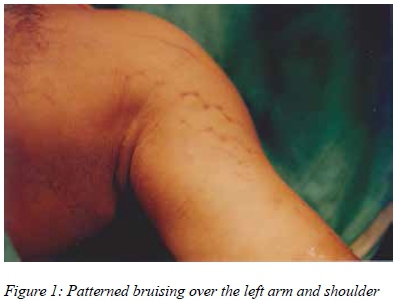
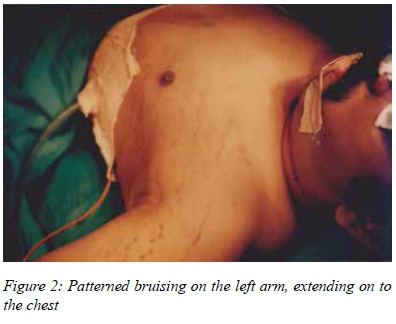
We present the case of a twenty-six-year old man, who was found unconscious at a road side and bought to the emergency centre. On examination, he was unconscious, responsive only to painful stimuli, in hypotension, with tachycardia and tachypnoea. Bilaterally equal and responsive pupils, pallor, tracheal deviation to the right and a distinct zigzag pattern of bruising over the left upper part of his torso were revealed by a general survey. There were multiple, evenly placed, zigzag-shaped bruise lines on the lateral and anterior aspect of the left arm (Figure 1), continuing across the anterior aspect of the left shoulder, extending on to the anterior left chest wall, and running obliquely downwards to the xiphisternum (Figure 2). The injury was suggestive of a patterned bruise caused by a tyre thread design. The width of the tyre tread pattern measured approximately 12cm, indicating that an automobile may have run over him, and that substantial weight had been borne by the patient.
Although there were no other apparent external wounds, fracture of the left clavicle, multiple rib fractures, and fracture of the pelvis and the right femur were also noted. An examination of the respiratory system revealed decreased air entry with posterior dullness on both sides. There was minimal abdominal distension, with generalised guarding. The chest X-ray confirmed bilateral multiple rib fractures and haemopneumothorax, with lung contusion. Multiple lacerations in the right lobe of the liver with hemoperitoneum were shown by ultrasound.
Most injuries were noted along the oblique direction of tyre travel, from the left upper region across the midline, on to the right middle and lower regions of the body. The patterned bruising was suggestive of the mechanism of injury and significant force during impact. An investigation was carried out for underlying injuries.
Discussion
A bruise which bears the shape, imprint or contour of the impacting object, or anything that is interposed between the impacting object and the skin is called a patterned bruise. Thus, impact by a rounded object or a cricket ball results in a doughnut-shaped bruise, the bruise occurring as a circular broad rim with an area of central pallor. Similarly, an injury with a rod-shaped object results in an area of central pallor, outlined by two narrow parallel bands of bruising, known as tramline bruising. Bruising that reproduces the texture of clothing, the thread pattern from a tyre, the ridge pattern from the sole of a shoe, or linear marks caused by the application of a ligature are examples of patterned bruising.1,2
The bruise may bear the pattern of a headlight rim, grill, bumper or the thread mark of a tyre. This guides identification of the type of vehicle that impacted on the patient. A bruise caused by an assailant's kick may be matched to the ridge pattern on the sole of the shoe that was worn.133
Thus, it is possible to reconstruct or predict the mechanism of injury based on a patterned bruise.1-3 Bruising on the anterior abdominal wall could be the only clinical finding suggestive of intra-abdominal injury.456
Thus, a patterned bruise is an important clinical finding which provides information on the impacting object, helps to predict the mechanism of injury, constitutes objective evidence of impact and is of medico-legal significance. Trauma team personnel and clinicians should not casually disregard patterned bruising as insignificant, as its presence is suggestive of serious underlying injuries. The location, dimension and description of bruises should be meticulously documented, and a diligent effort made to determine whether or not there are clinically unapparent injuries.
REFERENCES
- 1. Rao VJ. Patterned injury and its evidentiary value. J Forensic Sci. 1986;31(2):768-772.
- 2. Mohanty MK, Rastogi P, Kumar GP, et al. Periligature injuries in hanging. J Clin Forensic Med. 2003;10(4):255-258.
- 3. Wankhede AG. Patterned injuries caused by a wooden plank. J Forensic Leg Med. 2008;15(2):118-123.
- 4. Spitz DJ. Unrecognised fatal liver injury caused by a bicycle handlebar. Am J Emerg Med. 1999;17(3):244.
- 5. Bansal V, Conroy C, Tominaga GT, Coimbra R. The utility of seat belt sign to predict intra- abdominal injury following motor vehicle crashes. Traffic Inj Prev. 2009;10(6):567-572.
- 6. Dunstan FD, Guildea ZE, Kontos K, et al. A scoring system for bruise patterns: a tool for identifying abuse. Arch Dis Child 2002;86(5):330-333.