Enhanced recovery after surgery (ERAS) in penetrating abdominal trauma: A prospective single-center pilot study
Abstract
BACKGROUND: Enhanced recovery after surgery (ERAS) programmes employed in elective surgery have provided strong evidence for decreased lengths of hospital stay without increase in postoperative complications. The aim of this study was to explore the role and benefits of ERAS implemented in patients undergoing emergency laparotomy for penetrating abdominal trauma. METHODS: Institutional University of Cape Town Human Research Ethics Committee (UCT-HREC) approved study. A prospective cohort of 38 consecutive patients with isolated penetrating abdominal trauma undergoing emergency laparotomy were included in the study. The enhanced recovery protocols (ERPs) included: early urinary catheter removal, early nasogastric tube (NGT) removal, early feeding, early mobilisation/physiotherapy, early intravenous line removal and early optimal oral analgesia. This group was compared to a historical control group of 40 consecutive patients undergoing emergency laparotomy for penetrating abdominal trauma, prior to the introduction of the ERP. Demographics, mechanism of injury, injury severity scores (ISS) and penetrating abdominal trauma index (PATI) were determined for both groups. The primary end-points were length of hospital stay (LOS) and incidence of postoperative complications (Clavien-Dindo classification) in the 2 groups. The difference in means was tested using the t-test assuming unequal variances. Statistical significance was defined as p-value less than 0.05 (p < 0.05). RESULTS: The two groups were comparable with regards to age, gender, mechanism of injury, ISS and PATI scores. The mean time to solid diet, urinary catheter and nasogastric tube (NGT) removal was 3.6 (non-ERAS) and 2.8 (ERAS) days [p < 0.035], 3.3 (non-ERAS) and 1.9 (ERAS) days [p < 0.00003], 2.1 (non-ERAS) and 1.2 (ERAS) days [p < 0.0042], respectively. There was no difference in time from admission to time of laparotomy 313 (non-ERAS) vs 358 (ERAS) minutes [p < 0.07]. There were 11 and 12 complications in the non-ERAS and ERAS groups, respectively. When graded as per the Clavien-Dindo classification, there was no significant difference in the 2 groups (p < 0.59). Hospital stay was significantly shorter in the ERAS group: 5.5 (SD 1.8) days vs. 8.4 (SD 4.2) days [p < 0.00021]. CONCLUSION: This pilot study shows that ERPs can be successfully implemented with significant shorter hospital stays without any increase in postoperative complications in trauma patients undergoing emergency laparotomy for penetrating abdominal trauma.
Introduction
Enhanced recovery after surgery (ERAS) or enhanced recovery protocols (ERP) is a concept first described by Kehlet in the early 1990s.11-8 The approach employs a multimodal perioperative care pathway designed to attenuate the surgical stress response and accelerate postoperative recovery.2 7,8 These benefits should be easily transferable to the trauma patient population, if not greater, since trauma patients are generally younger, fitter and metabolically stable. Penetrating abdominal trauma is a major cause of morbidity and mortality in large urban trauma centres. It accounts for a significant number of hospital admissions and consumes a large portion of the health care budget. We developed and implemented an ERP for patients undergoing emergency laparotomy for isolated penetrating abdominal trauma and analysed the effect of this protocol.
Methods
Approval for the study was granted by the Department of Surgery Research Committee and the University of Cape Town Faculty of Health Sciences Human Research Ethics Committee. Stable patients presenting to Groote Schuur Hospital Trauma Centre (GSHTC) with isolated penetrating abdominal trauma (stab (SW) and gunshot (GSW) wounds) that required an emergency laparotomy over a one year period from 1 January to 31 December 2013 were analysed. Patients with extra-abdominal injuries, those that required damage control surgery, and patients requiring intensive care unit admission for postoperative support were excluded from the study.
During the first half of the year patients were recruited into the control group. In July 2013, we implemented our ERP and began treating patients that met all the inclusion criteria as per our ERP. We recruited 38 consecutive patients from July to December 2013. Based on ERAS consensus guidelines, an ERP was designed.2
The ERP was implemented and a prospective cohort of 38 consecutive patients analysed (July - December 2013). This group was compared to a historical control group of 40 consecutive patients (January - June 2013) undergoing emergency laparotomy for penetrating abdominal trauma, prior to introduction of the ERP. Demographic data, adherence to the ERP, length of hospital stay and postoperative complications as per Clavien-Dindo classification were analysed. The primary end-points were length of hospital stay and incidence of postoperative complications. Statistical analysis was performed using Microsoft Excel and Stata. T-test was performed comparing means and statistical significance was defined as a p-value < 0.05.
Results
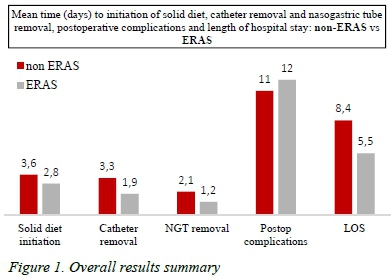
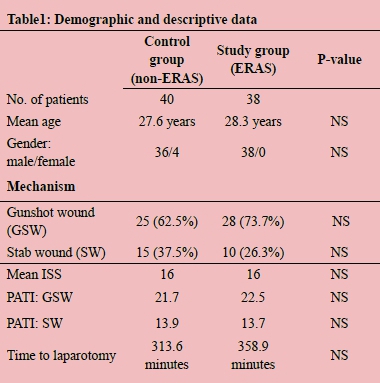
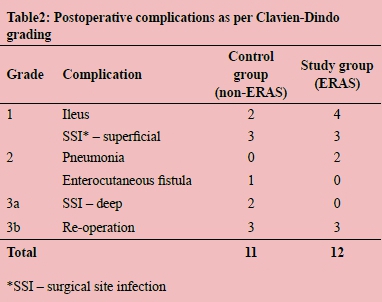
The study included 78 patients (38 - ERAS and 40 - nonERAS). The 2 groups were comparable with regard to age, gender, mechanism of injury, injury severity scores (ISS), penetrating abdominal trauma index (PATI) score and time to laparotomy (Table 1). The mean time to initiation of solid diet, urinary catheter removal and NGT removal was 3.6 (non-ERAS) and 2.8 (ERAS) days [p < 0.035], 3.3 (nonERAS) and 1.9 (ERAS) days [p < 0.00003], 2.1 (non-ERAS) and 1.2 (ERAS) days [p < 0.0042], respectively (Figure 1). Patients in the ERAS group had statistically significant earlier removal of NGTs, urinary catheters and earlier initiation of solid diet. The Clavien-Dindo classification system was used to record postoperative complications (Table 2). There were 11 and 12 complications in the non-ERAS and ERAS group, respectively. When graded as per the Clavien-Dindo classification, there was no statistically significant difference in postoperative complications grade for grade, and overall between the non-ERAS and ERAS group (p < 0.59). Mean hospital length of stay (LOS) was 5.5 days (SD 1.8) in the ERAS group and 8.4 days (SD 4.2) in the non-ERAS group (Figure 1). The shorter LOS in the ERAS group was statistically significant, (p < 0.00021).
Discussion
ERAS programmes have consistently been shown to have both cost-related and patient-related benefits.
King et al. examined the influence of an ERP on clinical outcome, cost and quality of life after surgery for colorectal surgery.910
Conclusion
This small pilot study shows that enhanced recovery protocols can be successfully implemented with significant shorter hospital stays without any increase in postoperative complications in a select group of trauma patients undergoing emergency laparotomy for isolated penetrating abdominal trauma. Furthermore, the study shows that enhanced recovery protocols can also be applied to patients undergoing emergency surgery. Given the fact that penetrating abdominal trauma remains a substantial burden of disease, especially in developing countries such as South Africa, this proven approach to patient care in elective surgery can now be safely employed in the trauma and emergency setting.
REFERENCES
- 1. Kehlet H. Multimodal approach to control postoperative pathophysiology and rehabilitation. Br J Anaesth. 1997;(78):606-617.
- 2. Lassen K, Soop M, Nygren J, et al. Consensus review of optimal perioperative care in colorectal surgery: Enhanced Recovery After Surgery (ERAS) Group recommendations. Arch Surg. 2009;144(10):961-969.
- 3. Wind J, Polle SW, Fung Kon Jin PHP, et al. Systematic review of enhanced recovery programmes in colonic surgery. Br J Surg. 2006:800-809.
- 4. Throop PP. Infrarenal aortic surgery with a 3-day hospital stay: a report of success with a clinical pathway. J Vasc Surg. 1999;(29):787-792.
- 5. Tovar EA, Roethe RA, Weissig MD, et al. One-day admission for lung lobectomy: An incidental result of a clinical pathway. Ann Thorac Surg. 1998;(65):803-806.
- 6. Arumainayagam N, McGrath J, Jefferson KP, et al. Introduction of an enhanced recovery protocol for radical cystectomy. BJU Int. 2008;(101):698-701.
- 7. Nicholson A, Lowe MC, Parker J, et al. Systematic review and meta-analysis of enhanced recovery programmes in surgical patients. Br J Surg. 2014;101(3):172-188.
- 8. Anderson ADG, McNaught CE, MacFie J, et al. Randomized clinical trial of multimodal optimization and standard perioperative surgical care. Br J Surg. 2003;(90):1497-1504.
- 9. King PM, Blazeby JM, Ewings P, et al. The influence of an enhanced recovery programme on clinical outcomes, costs and quality of life after surgery for colorectal cancer. Color Dis. 2006;(8):506-513.
- 10. Adamina M, Kehlet H, Tomlinson GA, et al. Enhanced recovery pathways optimize health outcomes and resource utilization: A meta-analysis of randomized controlled trials in colorectal surgery. Surgery. 2011;830-840.