Endoscopy-induced complication of barotrauma with concomitant benign pneumoperitoneum
Endoscopy is widely used for diagnostic and therapeutic purposes in modern clinical practice. Two of the less common complications are barotrauma and benign pneumoperitoneum. In isolation, these two complications have been successfully managed conservatively. We report a case of concomitant insufflation-induced complication of barotrauma and benign pneumoperitoneum following endoscopy on a 74-year-old female who was admitted for lower gastrointestinal (GIT) bleeding. A non-therapeutic laparotomy was performed, and she had an uneventful postoperative course. Although conservative management has been documented, in confounding findings, there should be a low threshold for intervention.
barotrauma; endoscopy; benign pneumoperitoneum
CASE REPORT
Endoscopy-induced complication of barotrauma with concomitant benign pneumoperitoneum
H GopeeI; TK Van StadenII
IDepartment of Surgery, Chris Hani Baragwanath Academic Hospital, University of the Witwatersrand, South Africa
IIDepartment of Surgery, Thelle Mogoerane Regional Hospital, University of the Witwatersrand, South Africa
Endoscopy is widely used for diagnostic and therapeutic purposes in modern clinical practice. Two of the less common complications are barotrauma and benign pneumoperitoneum. In isolation, these two complications have been successfully managed conservatively. We report a case of concomitant insufflation-induced complication of barotrauma and benign pneumoperitoneum following endoscopy on a 74-year-old female who was admitted for lower gastrointestinal (GIT) bleeding. A non-therapeutic laparotomy was performed, and she had an uneventful postoperative course. Although conservative management has been documented, in confounding findings, there should be a low threshold for intervention.
Keywords: barotrauma, endoscopy, benign pneumoperitoneum
Case report
A 74-year-old female presented to a regional state hospital with lower gastrointestinal (GIT) bleeding and low haemoglobin (Hb). She was known to have hypertension on hydrochlorothiazide for the last twenty years and a history of nonsteroidal anti-inflammatory drugs (NSAIDs) for osteoarthritis. On presentation, she had haematochezia with fresh clots per rectum but did not have haematemesis. Her blood pressure was 137/82 mmHg, and her heart rate was 87 beats per minute. She had a Glasgow Coma Scale (GCS) of 14 and her Hb was 5.3 g/dL. She responded to initial intravenous fluid resuscitation with Ringer's lactate solution and intravenous proton pump inhibitor administration. Her Hb stabilised after transfusion of two units of packed red blood cells to 8.2 g/dL and her GCS was 15. She was prepare d for an upper endoscopy and bowel preparation was administered for a lower endoscopy on the next available operating theatre list, due to a congested emergency theatre.
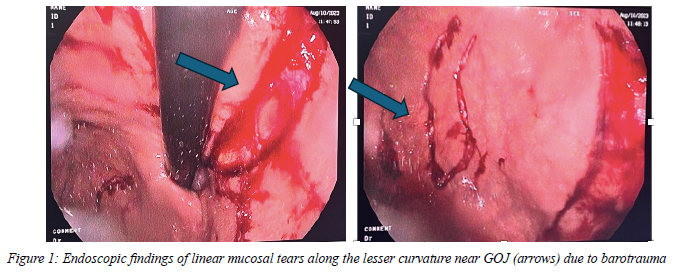
On upper endoscopy, Los Angeles grade B oesophagitis, Hills grade III hiatal hernia and antral gastritis were noted. Insufflation-induced barotrauma in the lesser curve around the gastroesophageal junction (GOJ) was found during the procedure. Findings of the barotrauma, as illustrated by the arrows in Figure 1, were linear mucosal tears greater than 3 cm in size that were not present during the initial insertion of gastroscope. No features of perforation were noted, and no other pathologies were found to account for the gastrointestinal bleed.
A limited colonoscopy revealed melaena and colonic diverticula. The procedure was abandoned at the rectosigmoid junction due to poor bowel preparation and a computed tomography (CT) angiography was ordered.
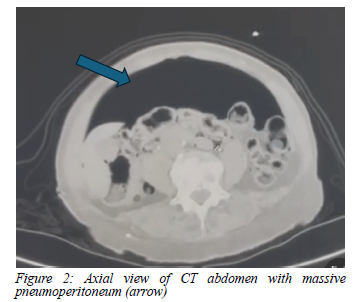
The CT angiography findings were in keeping with massive pneumoperitoneum, as illustrated by the arrow in Figure 2. However, no overt source of hollow viscus perforation was noted. There was no active contrast blush to suggest GIT bleed and sigmoid diverticulosis was found.
The patient remained haemodynamically stable after the procedure. She did not have a tachycardia and had no features of peritonism. A laparotomy was performed due to the concern of barotrauma-induced gastric perforation with the significant pneumoperitoneum. Preoperatively the laboratory values of the patient were as follows: leukocytes 9660/mm3
Intraoperatively there was evidence of pneumoperitoneum, but there were no features of gastric or colonic perforation, and there were no intra-abdominal contaminations. The patient had an uneventful postoperative course and was discharged.
Discussion
Endoscopy has been a widely used tool in both diagnostic and interventional therapies since Kussmaul first used gastroscopy in 1868.123
An intact pylorus and competent lower oesophageal sphincter mechanism has been postulated to predispose to barotrauma. In 2016, Datta et al. reported a case of gastric barotrauma, which was caused by vomiting.43563 73
The diffusion properties of the gas used can influence the wall tension on the stomach wall. Nitrogen, which is the major constituent of ambient air, is poorly diffusible as compared to carbon dioxide. This leads to a higher wall tension with ambient air. A meta-analysis evaluating the use of carbon dioxide has shown both less perforation and post-procedural pain.88
The extent of endoscopic insufflation-induced complication of gastric barotrauma ranges from petechial lesions without bleeding to bleeding lesions with perforation. Cases without perforation have been managed successfully with a conservative approach.39
In lower GIT bleeding, the sensitivity of colonoscopy with suboptimal bowel preparation is poor. CT angiography was used in this case to identify a potential bleeding source that could benefit from interventional angioembolisation. In this reported case, CT scan and the intraoperative findings did not suggest hollow viscus perforation. The completely soft asymptomatic patient, with normal inflammatory markers, was not in keeping with diverticulitis even though colonic diverticula were noted intraoperatively. The limited lower endoscopy findings, along with the clinical and imaging findings, favoured the diagnosis of benign pneumoperitoneum. Benign pneumoperitoneum during colonoscopy is a rare occurrence and remains a diagnosis of exclusion.
Endoscopic-induced barotrauma and benign pneumoperitoneum are rare complications of endoscopy. Prompt recognition of barotrauma can avoid perforation. In separate cases of benign pneumoperitoneum and non-perforated barotrauma, conservative management can be considered. In confounding cases or any sign of haemodynamic instability, low threshold for intervention should be employed to avoid the morbidity and mortality associated with hollow viscus perforation.
Conflict of interest
The authors declare no conflict of interest.
Funding source
No funding was required.
Ethical approval
The handling of data in this study was done under a study protocol that was approved by the Human Research Ethics Committee of the University of the Witwatersrand (Ref: M240267).
ORCID
H Gopee https://orcid.org/0000-0002-4870-9153
TK Van Staden https://orcid.org/0009-0007-3573-8207
REFERENCES
-
1. Kluge F, Seidler E. Zur Erstanwendung der Ösophago-und Gastroskopie - Briefe von Adolf Kußmaul und seinen Mitarbeitern. Med Hist J. 1986;21(3/4):288-307. Available from: http://www.jstor.org/stable/25803874.
» http://www.jstor.org/stable/25803874 -
2. Shi X, Shan Y, Yu E, et al. Lower rate of colonoscopic perforation: 110 785 patients of colonoscopy performed by colorectal surgeons in a large teaching hospital in China. Surg Endosc. 2014;28(8):230916. https://doi.org/10.1007/s00464-014-3458-1.
» https://doi.org/10.1007/s00464-014-3458-1 -
3. Seth AK, Bansal RK. Endoscopic insufflation-induced gastric barotrauma during percutaneous endoscopic gastrostomy: A report of three patients and review of literature. J Dig Endosc. 2021;12(02):103-6. https://doi.org/10.1055/s-0041-1724134.
» https://doi.org/10.1055/s-0041-1724134 -
4. Datta S, Adlakha N, Ivanina EA, Swaminath A. Gastric barotrauma: When the trauma comes from within: 2749. Am J Gastroenterol. 2016;111():p S1375. https://doi.org/10.14309/00000434-201610001-02749.
» https://doi.org/10.14309/00000434-201610001-02749 -
5. Gilbert-Kawai ET, Wittenberg MD. Laplace's law and tension. In: Essential equations for anaesthesia. Cambridge, England: Cambridge University Press; 2014. p. 24-5. https://doi.org/10.1017/CBO9781139565387.014.
» https://doi.org/10.1017/CBO9781139565387.014 -
6. Spoormans I, Van Hoorenbeeck K, Balliu L, Jorens PG. Gastric perforation after cardiopulmonary resuscitation: Review of the literature. Resuscitation. 2010;81(3):272-80. https://doi.org/10.1016/j.resuscitation.2009.11.023.
» https://doi.org/10.1016/j.resuscitation.2009.11.023 -
7. Heinz A. Elastic fibers during aging and disease. Ageing Res Rev. 2021;66:101255. https://doi.org/10.1016/j.arr.2021.101255.
» https://doi.org/10.1016/j.arr.2021.101255 -
8. Wang WL, Wu ZH, Sun Q, et al. Meta-analysis: The use of carbon dioxide insufflation vs. room air insufflation for gastrointestinal endoscopy. Aliment Pharmacol Ther. 2012;35(10):1145-54. https://doi.org/10.1111/j.1365-2036.2012.05078.x.
» https://doi.org/10.1111/j.1365-2036.2012.05078.x -
9. Pearl JP, McNally MP, Elster EA, DeNobile JW. Benign pneumoperitoneum after colonoscopy: A prospective pilot study. Mil Med. 2006;171(7):648-9. https://doi.org/10.7205/MILMED.171.7.648.
» https://doi.org/10.7205/MILMED.171.7.648