Preoperative dietitian-led calorie-restricted diet: impact on left hepatic lobe volume and laparoscopic upper GIT surgery visibility
Abstract
BACKGROUND: The surgical benefits of preoperative low- or very low-calorie diets (LCDs or VLCDs) in bariatric surgery patients have been widely studied. This study aimed to observe the changes in body composition and left hepatic lobe volume (LHLV) following a two-week dietitian-led calorie-restricted diet in non-bariatric laparoscopic surgery patients where fatty liver often complicates the surgery. METHODS: The study included 47 patients scheduled for a hiatus hernia repair with an anti-reflux procedure. Participants underwent bioelectrical impedance measurements and abdominal ultrasounds to determine changes in LHLV at baseline and again pre-surgery after following a calorie-restricted diet (800-1000 kcal daily) for two weeks. RESULTS: Participants (median baseline body mass index [BMI]: 33.4 (30.9-36.0) kg/m2) experienced statistically significant (p < 0.05) decreases in body mass, BMI, waist circumference, body fat mass, body fat percentage, abdominal fat and muscle mass on the two-week calorie-restricted diet. A median LHLV reduction of 33% (IQR 12.8-49.6%. p < 0.05) was noted. The outcomes of the ultrasound were unknown to the surgeons at the time of the surgery, and the subjectively reported good surgical visibility of the oesophagogastric (EG) junction in 86.5% of cases. CONCLUSION: The findings suggest that in obese patients, losing 2.2 kg of body fat and 2.5 cm in waist circumference on a two-week dietitian-led calorie-restricted diet may significantly reduce LHLV that could potentially improve surgical visibility. Further research should determine if these changes in body composition may be used as a proxy for liver sonar.
preoperative very low-calorie diet (VLCD); low-calorie diet (LCD); liver volume reduction; body composition analysis; surgical access
Introduction
Non-alcoholic fatty liver disease (NAFLD), recently termed metabolic dysfunction-associated steatotic liver disease (MASLD), is increasing worldwide, primarily due to the increasing prevalence of overweight and obesity.1-3 Obesity and visceral adiposity, along with hepatomegaly, as seen in patients with MASLD, increase the complexity of laparoscopic upper gastrointestinal tract (GIT) surgery.4-6 An enlarged fatty liver, particularly the left hepatic lobe, is delicate and bleeds easily, complicating the surgeon's approach to and access to the oesophagogastric (EG) junction.7-10
As part of the enhanced recovery after surgery (ERAS) guidelines, many bariatric surgery centres recommend that patients undergo preoperative low- or very low-calorie diets (LCDs or VLCDs) to decrease hepatic volume and visceral adiposity.116,9,11 The effects and benefits of preoperative LCDs and VLCDs have been widely studied in bariatric surgery, yet the same preoperative practices are not in place for non-bariatric upper GIT laparoscopic surgery, where the benefits of increased intra-abdominal surgical visibility may also be observed.
In observational studies, preoperative weight loss interventions to reduce hepatic volume and visceral adiposity have been associated with improved surgical outcomes such as shorter operating times, shorter hospital stays, and reduced perceived surgical difficulty.12,13 VLCDs and LCDs are quick, safe, and effective methods to reduce weight and hepatic volume before laparoscopic upper GIT surgeries, with the greatest effect being noted in the first two weeks of the diet.13-15
The definition of VLCD and LCD varies between 450 kcal and 1 500 kcal per day. A VLCD is defined as a diet comprising between 450 and 800 kcal per day.16,17 An LCD is described as providing between 800 and 1 500 kcal per day.16
A calorie-restricted diet is used before bariatric surgery to lose predominantly fat mass (1.0 to 1.5 kg/week) while preserving lean muscle mass.1799
The study aimed to describe the changes in left hepatic lobe volume (LHLV) and body composition in patients scheduled for a hiatus hernia repair with an anti-reflux procedure following a two-week dietitian-led calorie-restricted diet in a South African private healthcare setting.
Methods
A cross-sectional study was conducted from March 2022 until May 2023 in a specialised high-volume upper GIT surgical unit in Pretoria, South Africa.
The surgical unit comprises three specialist laparoscopic surgeons who collectively perform, on average, 600 laparoscopic hiatus hernia repairs and anti-reflux procedures a year. Within this surgical unit, patients undergo a preoperative abdominal ultrasound to calculate LHLV. If the patient presents with hepatomegaly and hepatic steatosis, they are referred to a dietitian for an assessment, initiation of a preoperative two-week calorie-restricted diet and supporting nutrition education. Participants were included in the study if their baseline LHLV was greater than 250 ml, they were over the age of 18 years, and they consented to participate. The 250 ml cutoff value for LHLV was determined based on the surgeons' collective experience of the optimal surgical view of the EG junction in relation to liver size. Participants were excluded if they had renal dysfunction or were unable to undergo bioelectrical impedance due to having a pacemaker, being pregnant or weighing more than 250 kg.
Surgical technique
The study population included patients who were scheduled to undergo a laparoscopic hiatus hernia repair with an anti-reflux procedure, as well as revision surgeries. Participants were recruited after the surgeon confirmed their surgery plan. Therefore, convenience sampling was used. LHLV and anthropometric measurements (using bioelectrical impedance) were recorded pre- and post-dietary intervention.
Sonographic measurement of the LHLV
A trained sonographer conducted abdominal ultrasounds to determine the LHLV of participants. All sonograms were done via a subcostal or intercostal window while participants lay supine.181816(p = 0.7), indicating that ultrasonography is as accurate as MRI for liver volume calculation.
Anthropometry
Participants' height and waist circumference were measured using a stadiometer and an elastic measuring tape, respectively. Waist circumference was measured at the narrowest point between the lowest rib and the iliac crest.1419
Preoperative dietary intervention
The preoperative dietary intervention involved a two-week, dietitian-led, calorie-restricted diet, of between 800-1 000 kcal daily intake. Participants received a standardised meal plan, providing 40% of energy from protein, 25% from carbohydrates, and 35% from fats. Participants were allowed to purchase Nestle Optifast meal replacement shakes to replace one or all of their main meals.
Surgeon's subjective single-blinded questionnaire
A single-blinded, subjective questionnaire was completed by the operating surgeon postoperatively to assess the surgical visibility and the need for retractor adjustment (two-stage retraction), without prior knowledge of changes in LHLV. The questionnaire provided five options for the surgeon to choose from: "No perceived difficulty in accessing the EG junction", "Minimal adjustments of the liver retractor were necessary to attain adequate visualisation of the EG junction", "Repeated adjustments of the liver retractor were necessary to attain visualisation of the EG junction", "Impaired visualisation of the EG junction during the surgery", or "Surgery was impossible". The surgeon was also asked to report the surgical duration, defined as the time from the first incision to the removal of the last trocar.
Statistics
Analyses were conducted using SAS/STAT, Version 9.4 of the SAS system for Windows (Copyright © 2013 SAS Institute Inc. SAS and all other SAS Institute Inc. product or service names are registered trademarks of SAS Institute Inc., Cary, NC, USA). Numerical variables were summarised as medians and interquartile ranges (IQR) since the distribution was skewed, while categorical variables were reported as frequencies and percentages. Signed-rank tests were used to compare the changes from before to after the dietary intervention for numerical variables. Spearman's correlation was used to assess the relationship between the change in LHLV, the decrease in body fat mass, the decrease in waist circumference, and the decrease in body mass. P-values < 0.05 were considered statistically significant.
Results
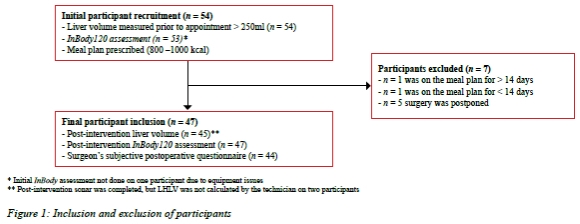
Of the 54 participants enrolled in the study, seven were excluded, including five participants who had their surgery postponed and never started the preoperative diet and two who did not follow the prescribed diet for the recommended two weeks (Figure 1). This led to 47 participants being included, of which 45 participants had pre- and post-intervention sonographic measurements of LHLV, and 46 had both pre- and post-intervention InBody120® assessments. For participants who lacked sonographic measurements, only their body composition changes were included. Conversely, only sonographic measurements were included for those who lacked body composition analyses.
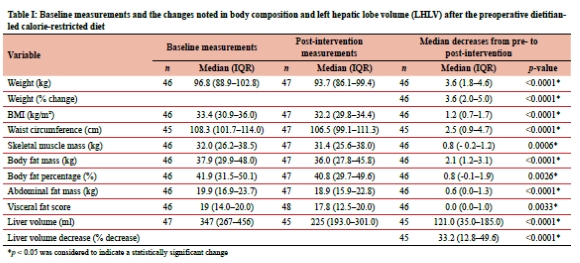
The median age of participants was 50 years (IQR 42.0-59.0 years), with slightly more females than biological males (57.4% and 42.6%, respectively). Participants had a median baseline body mass of 96.8 kg (IQR 88.1-102.8 kg) and a baseline BMI of 33.4 kg/m22(p < 0.0001) decrease in body mass, BMI, waist circumference, body fat mass, body fat percentage, abdominal fat and muscle mass during the two-week calorie-restricted diet (Table I). Waist circumference decreased by 2.5 cm (IQR 0.9-4.7 cm), and participants lost a median of 3.6 kg (IQR 1.9-4.6 kg) total body mass, 2.1 kg (IQR 1.2-3.1 kg) body fat mass and 0.8 kg (IQR 0.2-1.2 kg) skeletal muscle mass after following the two-week dietitian-led calorie-restricted diet. A significant median reduction of 33.2% in LHLV was also observed (p < 0.0001).
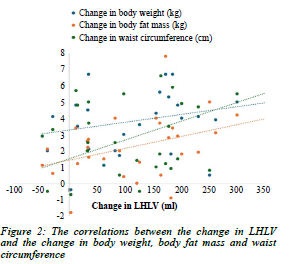
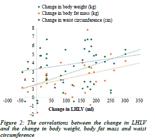
A significant positive correlation existed between the change in LHLV and the decrease in body fat mass following the two-week calorie-restricted diet (rs = 0.33; p = 0.03; Figure 2). Additionally, the decrease in body fat mass was positively correlated with the amount of body mass lost (rs = 0.41; p = 0.01) and the decrease in waist circumference (rs = 0.36; p = 0.02). There was no significant correlation between the decrease in LHLV and the decrease in body mass (rs = 0.07; p = 0.64) or waist circumference (rs = 0.07; p = 0.63).
Analysis of the questionnaire scored by the surgeons revealed no perceived difficulty in accessing the EG junction in 86.5% of the cases. A larger decrease in LHLV appeared to correlate with improved perceived visibility of the EG junction during surgery. No liver injuries were reported. The median surgical duration for the patients undergoing the hiatus hernia repair with anti-reflux procedure and revision surgery was 30.2 minutes (IQR 24.5-33.5 minutes) and 33.6 minutes (IQR 29.5-44.0 minutes), respectively.
Discussion
An enlarged fatty liver can occupy a large percentage of the abdominal cavity and can hinder major upper abdominal surgeries such as pancreatic, liver, oesophageal and gastric resections, bariatric surgery, and benign surgeries such as gallbladder removal, hiatus hernia repairs and anti-reflux surgeries. This study, conducted in a South African setting, showed that a dietitian-led calorie-restricted diet of 800 kcal - 1 000 kcal a day, followed for two weeks before non-bariatric upper GIT laparoscopic surgery, significantly decreased LHLV, potentially improving the surgical visibility of the hiatus.
The observed 33.2% reduction in LHLV aligns with previous findings that a short-term calorie restriction of two weeks can effectively and safely shrink the liver and lower abdominal fat levels.16,19 Childs et al.16InBody® assessments and liver ultrasounds and MRI on the participants, starting before they started the LCD. The study concluded that there was little value in following an LCD for longer than three weeks as nearly half of the participants (47%) observed the largest decrease in liver volume in the first week, and 90% of the participants received maximal liver volume loss within the first three weeks.1616
In a study similar to the current one, Fris2020
The current study also showed that liver shrinkage occurs proportional to the decrease in body fat mass and that a reduction in body fat mass before surgery can indicate an improvement in hepatomegaly. The findings suggest that in compliant obese patients, losing 2.2 kg of body fat and 2.5 cm in waist circumference on a two-week dietitian-led calorie-restricted diet may significantly reduce LHLV that could potentially improve surgical visibility. Although a subjective observation, surgeons reported good surgical visibility of the EG junction in 86.5% of cases. This may be clinically relevant, as it aligns with previous research suggesting that reducing hepatic volume can decrease intraoperative complications, shorten surgical times, and enhance surgical visualisation.15
While VLCDs are effective in this context, concerns have been raised that these benefits come at the cost of muscle mass loss9
The findings of this study suggest that incorporating a two-week preoperative calorie-restricted diet (800 kcal -1000 kcal/day) into ERAS protocols may be beneficial for obese patients with hepatomegaly and increased visceral adiposity undergoing non-bariatric upper GIT procedures. These interventions could potentially offer some of the same advantages observed in bariatric surgery. Based on intraoperative observations, the surgeons proposed that a preoperative abdominal ultrasound may not be necessary to assess liver volume. Instead, BMI could serve as an approach that will be further explored in a follow-up study.
These findings are consistent with previous systematic reviews,15,21 which suggests that VLCDs and LCDs can be safely implemented in patients undergoing non-bariatric abdominal surgery. Such diets have been well tolerated and are associated with improvements in surgical outcomes, including enhanced intraoperative visibility and reduced need for retractor adjustments, ultimately facilitating smoother surgical workflows.15
Limitations
We concede that the non-randomised study design may limit the generalisation of the findings, affecting the robustness of the results. Studies with larger randomised samples are recommended to further validate these findings and allow these preoperative principles to be applied to a broader surgical population. The study participants had a median and interquartile range that fell into the Class II obesity category. This may limit the generalisability of the findings to individuals with lower or higher BMI classifications.
Blood tests, such as blood lipids, would have provided valuable biochemical data to complement the study's findings. Since no validated questionnaire exists, none could have been used for the surgeon's subjective assessment of the perceived difficulty of the surgery and surgical visibility.
Conclusion
Many upper GIT surgeries are not emergency surgeries, and the surgical advantage of following a preoperative calorie-restricted diet is evident. The results of the current study suggest that a reduction of at least 2.1 kg in body fat and a decrease of 2.5 cm in waist circumference over two weeks may be associated with a sufficient reduction in liver volume to potentially improve surgical visibility in the abdominal cavity. The results of the current study also suggest that two weeks is sufficient time to allow for statistically and clinically significant shrinkage of the left hepatic lobe and improved surgical visibility, as subjectively reported by the operating surgeons.
Conflict of interest
The authors declare no conflict of interest.
Funding source
Funding for research: none
Ethical approval
Ethical approval was obtained from the Health Sciences Research Ethics Committee (HSREC) of the University of the Free State (UFS, Ethical Clearance number: UFS-HSD2021/1664/2202-0007).
ORCID
FM Price https://orcid.org/0000-0003-2533-0041
L van den Berg https://orcid.org/0000-0002-4819-4110
JGM Smit https://orcid.org/0009-0007-4442-3514
REFERENCES
-
1. Al-Dayyat HM, Rayyan YM, Tayyem RF. Non-alcoholic fatty liver disease and associated dietary and lifestyle risk factors. Diabetes Metab Syndr Clin Res Rev. 2018;12(4):569-75. https://doi.org/10.1016/j.dsx.2018.03.016.
» https://doi.org/10.1016/j.dsx.2018.03.016 -
2. Rinella ME, Neuschwander-Tetri BA, Siddiqui MS, et al. AASLD Practice guidance on the clinical assessment and management of nonalcoholic fatty liver disease. Hepatology. 2023;77(5):1797-835. https://doi.org/10.1097/HEP.0000000000000323.
» https://doi.org/10.1097/HEP.0000000000000323 -
3. Chan WK, Chuah KH, Bhavani Rajaram R, Lim LL, Ratnasingam J, Vethakkan SR. Metabolic dysfunction-associated steatotic liver disease (MASLD): a state-of-the-art review. J Obes Metab Syndr. 2023;32(3):197-213. https://doi.org/10.7570/jomes23052.
» https://doi.org/10.7570/jomes23052 -
4. Hughes DL, Elmasry M, Wilson I, El Kafsi J. Evaluating the evidence for a liver shrinkage diet for obese patients prior to laparoscopic cholecystectomy: a systematic review and meta-analysis. J Minim Access Surg. 2024;20(1):1-6. https://doi.org/10.4103/jmas.jmas_142_23.
» https://doi.org/10.4103/jmas.jmas_142_23 -
5. Seeras K, Bittar K, Siccardi MA. Nissen Fundoplication [Internet]. Treasure Island (FL): StatPearls Publishing; 2023. Available from: https://www.ncbi.nlm.nih.gov/books/NBK519521/.
» https://www.ncbi.nlm.nih.gov/books/NBK519521/ -
6. Diab S, Bertin JB, Simeu B, et al. Impact of preoperative protein sparing modified fast diet on bariatric surgery. Obes Surg. 2023;33(1):17-24. https://doi.org/10.1007/s11695-022-06361-w.
» https://doi.org/10.1007/s11695-022-06361-w -
7. Lewis MC, Phillips ML, Slavotinek JP, et al. Change in liver size and fat content after treatment with Optifast® very low calorie diet. Obes Surg. 2006;16(6):697-701. https://doi.org/10.1381/096089206777346682.
» https://doi.org/10.1381/096089206777346682 -
8. Van Wissen J, Bakker N, Doodeman HJ, et al. Preoperative methods to reduce liver volume in bariatric surgery: a systematic review. Obes Surg. 2016;26(2):251-6. https://doi.org/10.1007/s11695-015-1769-5.
» https://doi.org/10.1007/s11695-015-1769-5 -
9. Romeijn MM, Kolen AM, Holthuijsen DDB, et al. Effectiveness of a low-calorie diet for liver volume reduction prior to bariatric surgery: a systematic review. Obes Surg. 2021;31:350-6. https://doi.org/10.1007/s11695-020-05070-6.
» https://doi.org/10.1007/s11695-020-05070-6 -
10. Iannelli A, Martini F, Schneck AS, et al. Preoperative 4-week supplementation with omega-3 polyunsaturated fatty acids reduces liver volume and facilitates bariatric surgery in morbidly obese patients. Obes Surg. 2013;23(11):1761-5. https://doi.org/10.1007/s11695-013-0942-y.
» https://doi.org/10.1007/s11695-013-0942-y -
11. Stenberg E, dos Reis Falcão LF, O'Kane M, et al. Guidelines for perioperative care in bariatric surgery: Enhanced Recovery After Surgery (ERAS) Society recommendations: a 2021 Update. World J Surg. 2022;46(4):729-51. https://doi.org/10.1007/s00268-021-06394-9.
» https://doi.org/10.1007/s00268-021-06394-9 -
12. Hollis G, Franz R, Bauer J, Bell J. Implementation of a very low calorie diet programme into the preoperative model of care for obese general elective surgery patients: outcomes of a feasibility randomised control trial. Nutr Diet. 2020;77(5):490-8. https://doi.org/10.1111/1747-0080.12601.
» https://doi.org/10.1111/1747-0080.12601 -
13. Sivakumar J, Chong L, Ward S, et al. Body composition changes following a very-low-calorie preoperative diet in patients undergoing bariatric surgery. Obes Surg. 2020;30(1):119-26. https://doi.org/10.1007/s11695-019-04174-y.
» https://doi.org/10.1007/s11695-019-04174-y -
14. Colles SL, Dixon JB, Marks P, Strauss BJ, O'Brien PE. Preoperative weight loss with a very-low-energy diet: quantitation of changes in liver and abdominal fat by serial imaging. Am J Clin Nutr. 2006;84(2):304-11. https://doi.org/10.1093/ajcn/84.2.304.
» https://doi.org/10.1093/ajcn/84.2.304 -
15. MacCormick A, Puckett M, Aroori S. The safety, tolerability and clinical impact of preoperative very low-calorie diet prior to non-bariatric abdominal surgery: a systematic review. Langenbeck's Arch Surg. 2024;409(327):1-8. https://doi.org/10.1007/s00423-024-03509-3.
» https://doi.org/10.1007/s00423-024-03509-3 -
16. Childs J, Mudge LA, Esterman A, Thompson SK. What is the optimal time on a low-calorie diet prior to laparoscopic anti-reflux surgery? A prospective case-controlled study. J Gastrointest Surg. 2022;26(11):2249-54. https://doi.org/10.1007/s11605-022-05438-2.
» https://doi.org/10.1007/s11605-022-05438-2 - 17. Delbridge E, Proietto J. State of the science: VLED (Very Low Energy Diet) for obesity. Asia Pac J Clin Nutr. 2006;15(Suppl. 1):49-54.
-
18. Kitajima K, Taboury J, Boleslawski E, Savier E, Vaillant JC, Hannoun L. Sonographic preoperative assessment of liver volume before major liver resection. Gastroenterol Clin Biol. 2008;32(4):382-9. https://doi.org/10.1016/j.gcb.2008.02.007.
» https://doi.org/10.1016/j.gcb.2008.02.007 -
19. Mclester CN, Nickerson BS, Kliszczewicz BM, Mclester JR. Reliability and agreement of various inbody body composition analysers as compared to dual-energy x-ray absorptiometry in healthy men and women. J Clin Densitom. 2020;23(3). https://doi.org/10.1016/j.jocd.2018.10.008.
» https://doi.org/10.1016/j.jocd.2018.10.008 -
20. Fris RJ. Preoperative low energy diet diminishes liver size. Obes Surg. 2004;14(9):1165-70. https://doi.org/10.1381/0960892042386977.
» https://doi.org/10.1381/0960892042386977 -
21. Chowdhury N, Hasnan S, Ullah S, Thompson SK. Low-calorie diets are effective for weight loss in patients undergoing benign upper gastrointestinal surgery: a systematic review and meta-analysis. Surg Endosc. 2024;38(8):4171-85. https://doi.org/10.1007/s00464-024-11016-1.
» https://doi.org/10.1007/s00464-024-11016-1