A step in the right direction for end-stage kidney disease in South Africa
T du Toit
Transplant Unit, Division of General Surgery, Department of Surgery, Faculty ofHealth Sciences, Groote Schuur Hospital and University of Cape Town, South Africa
The Vascular Society of Southern Africa (VASSA) should be commended on the publication of clinical practice guidelines to assist healthcare professionals caring for patients with chronic kidney disease and their dialysis access. The guidelines provide an important and sound framework to facilitate clinical decision-making and should be welcomed.
Chronic kidney disease (CKD) in South Africa (SA) is on the increase and has become one of the leading causes of mortality, accounting for an estimated 1 000 deaths per million population (pmp) annually.12
For the majority of patients who have progressed to end-stage kidney disease (ESKD), kidney transplantation will improve survival, decrease cost and improve quality of life compared to dialysis.34
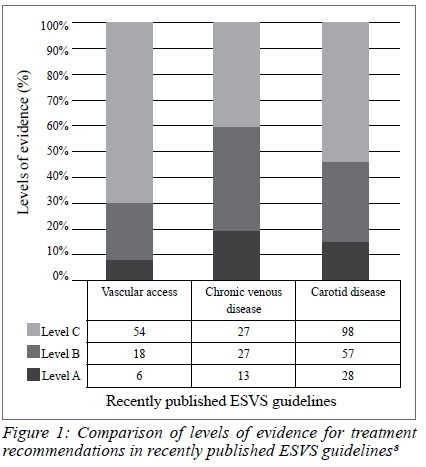
The projected number of patients receiving dialysis worldwide is set to double from 2.61 million in 2010, to 5.44 million in 2030.56,7 However, on review of recently published guidelines by the European Society for Vascular Surgery (ESVS), 70% of vascular access recommendations were based on expert opinion (Level C evidence), as opposed to 40% of chronic venous disease, 47% of carotid disease and 51% of peripheral arterial disease recommendations (Figure 1).8
Multiple international societies have published guidelines on the management of dialysis access. The most recent of these, and arguably the most comprehensive, is an update on the 2006 National Kidney Foundation - Kidney Disease Outcomes Quality Initiative (NKF-KDOQI) guidelines published earlier this year.9
Although vascular surgeons are undoubtedly best equipped to manage vascular access, there is only approximately one vascular surgeon pmp in SA. Vascular services are unevenly distributed and often concentrated in larger, metropolitan areas. In order to reach 278 dialysis units and 8 881 patients across SA and to keep up with future demand, a thoughtful strategy that includes general surgeons needs to be outlined and implemented. Training of general surgery registrars in vascular access needs to be prioritised. Dialysis access procedures should provide crucial training opportunities when appropriately selected and properly supervised, without detriment to the patient.10
The marked disparity in healthcare resources between the public and private sector has been previously described and is particularly acute in relation to accessing dialysis services. In 2017, the treatment rate of ESKD patients in the public sector was 66 pmp, compared to 855 pmp in the private sector.4 4
Peritoneal dialysis (PD) offers a survival benefit during the first 1.5-2 years, with higher patient satisfaction and lower cost compared to haemodialysis.114
The recently updated NKF-KDOQI guidelines have emphasised the importance of establishing an ESKD Life-Plan, contingency plan and succession plan for each patient receiving or nearing dialysis.9
Undoubtedly, clinical practice guidelines can improve the quality of dialysis, decrease associated morbidity and mortality and improve the quality of life of ESKD patients. However, one should not underestimate the challenge that the implementation of guidelines across healthcare sectors, hospital groups and medical and surgical specialities might pose. Those involved in managing dialysis access should use these guidelines as a framework for best practice, while remaining aware of the paucity of high quality evidence and the need to work together in a coordinated fashion to address the evidence gaps.
REFERENCES
-
1. Mayosi BM, Lawn JE, Van Niekerk A, et al. Health in South Africa: Changes and challenges since 2009. Lancet. 2012;380(9858):2029-43. https://doi.org/10.1016/S0140-6736(12)61814-5.
» https://doi.org/10.1016/S0140-6736(12)61814-5 -
2. Stanifer JW, Jing B, Tolan S, et al. The epidemiology of chronic kidney disease in sub-Saharan Africa: a systematic review and meta-analysis [published correction appears in Lancet Glob Health. 2014 May;2(5):266]. Lancet Glob Health. 2014;2(3):e174-e181. https://doi.org/10.1016/S2214-109X(14)70002-6.
» https://doi.org/10.1016/S2214-109X(14)70002-6 -
3. Purnell TS, Auguste P, Crews DC, et al. Comparison of life participation activities among adults treated by hemodialysis, peritoneal dialysis, and kidney transplantation: a systematic review. Am J Kidney Dis. 2013;62(5):953-73. https://doi.org/10.1053/j.ajkd.2013.03.022.
» https://doi.org/10.1053/j.ajkd.2013.03.022 -
4. Davids MR, Jardine T, Marais N, et al. South African Renal Registry Annual Report 2017. Afr J Nephrol. 2019;22(1):60-71. https://doi.org/10.21804/22-1-3810.
» https://doi.org/10.21804/22-1-3810 -
5. Liyanage T, Ninomiya T, Jha V, et al. Worldwide access to treatment for end-stage kidney disease: a systematic review. Lancet. 2015;385(9981):1975-82. https://doi.org/10.1016/S0140-6736(14)61601-9.
» https://doi.org/10.1016/S0140-6736(14)61601-9 -
6. Persson SE, Boman K, Wanhainen A, et al. Decreasing prevalence of abdominal aortic aneurysm and changes in cardiovascular risk factors. J Vasc Surg. 2017;65(3):651-8. https://doi.org/10.1016/j.jvs.2016.08.091.
» https://doi.org/10.1016/j.jvs.2016.08.091 -
7. Goodney PP, Beck AW, Nagle J, et al. National trends in lower extremity bypass surgery, endovascular interventions, and major amputations. J Vasc Surg. 2009;50(1):54-60. https://doi.org/10.1016/j.jvs.2009.01.035.
» https://doi.org/10.1016/j.jvs.2009.01.035 -
8. Argyriou C, Georgiadis GS, Lazarides MK. Vascular access guidelines: do we need better evidence? Eur J Vasc Endovasc Surg. 2018;56(4):608. https://doi.org/10.1016/j.ejvs.2018.05.031.
» https://doi.org/10.1016/j.ejvs.2018.05.031 - 9. Lok CE, Huber TS, Lee T, et al; KDOQI Vascular Access Guideline Work Group. KDOQI clinical practice guideline for vascular access: 2019 update. Am J Kidney Dis. 2020;75(4) (suppl 2):S1-S164.
-
10. Gundevia Z, Whalley H, Ferring M, et al. Effect of operating surgeon on outcome of arteriovenous fistula formation. Eur J Vasc Endovasc Surg. 2008;35(5):614-8. https://doi.org/10.1016/j.ejvs.2007.11.018.
» https://doi.org/10.1016/j.ejvs.2007.11.018 -
11. Sinnakirouchenan R, Holley JL. Peritoneal dialysis versus hemodialysis: risks, benefits, and access issues. Adv Chronic Kidney Dis. 2011;18(6):428-32. https://doi.org/10.1053/j.ackd.2011.09.001.
» https://doi.org/10.1053/j.ackd.2011.09.001