Gastrointestinal obstruction in neonates and infants - a four-year profile in Chris Hani Baragwanath Academic Hospital
Abstract
BACKGROUND: Different disease entities that cause gastrointestinal (GI) obstruction have been studied in isolation; however, no description of GI obstruction in neonates and infants in South Africa could be identified. This study aims to describe the profile of GI obstruction in neonates and infants at Chris Hani Baragwanath Academic Hospital (CHBAH) from January 2016 to December 2019. METHODOLOGY: This was a retrospective record review conducted on all patients < 1 year of age with GI obstruction admitted to CHBAH. Data on age at presentation, sex, presenting symptoms, aetiology, diagnostic imaging, operative and non-operative management, complications, and 30-day mortality were collected. RESULTS: A total of 299 patients were enrolled in this study. They were predominantly male (n = 175, 58.53%) and were neonates at presentation (n = 177, 59.20%). Congenital malformations (n = 203, 67.89%) were more common than acquired conditions (n = 96, 32.11%). Anorectal malformation (ARM) and small bowel atresia were the most common congenital condition (n = 61, 20.40%; n = 34, 11.37% respectively). Intussusception was the most common acquired condition (n = 78, 26.08%). The morbidity rate was 95 (31.77%) with nosocomial sepsis and surgical site sepsis accounting for 49 (51.58%) of the morbidities. Mortality rate was 16 (5.35%) and 10 (62,5%) of the mortalities had associated nosocomial sepsis. CONCLUSION: Congenital malformations of the GI tract are more common than acquired pathologies in neonates and infants in CHBAH. Sepsis causes significant morbidity in the postoperative period.
gastrointestinal obstruction; infants; acquired; congenital
Introduction
Gastrointestinal (GI) obstruction occurs due to complete or partial luminal occlusion within the GI tract,12,3 Due to the high frequency and non-specificity of these presenting symptoms, diagnosis can be delayed or missed altogether, leading to significant morbidity and mortality.455
Globally, mortality under five years of age has declined over the past three decades from 93 deaths per 1 000 in 1990 to 38 deaths per 1 000 in 2021.678
Different disease entities that cause GI obstruction have been studied in isolation;9-11 however, the description of GI obstruction in neonates and infants in South Africa could not be identified. Therefore, this study aims to describe the profile of GI obstruction in neonates and infants at Chris Hani Baragwanath Academic Hospital (CHBAH) from January 2016 to December 2019.
Methodology
The study design consisted of a retrospective record review. Approval to conduct the study was obtained from the Human Research Ethics Committee (Medical) of the University of the Witwatersrand (M201182).
This study was conducted in the Department of Paediatric Surgery at CHBAH. CHBAH, located in Soweto, Johannesburg, is the largest hospital in South Africa, with a bed capacity of 2 680 beds. The outpatient paediatric surgery department sees 11 932 patients and 2 316 surgeries are performed annually.12
The study population consisted of all patients < 1 year of age admitted to the Department of Paediatric Surgery at CHBAH with a diagnosis of GI obstruction between January 2016 and December 2019. Patients with a functional obstruction due to an underlying medical condition, including electrolyte abnormalities, sepsis, and patients presenting with postoperative complications referred for further management from other facilities, as well as those with incomplete records were excluded from the study.
Data were extracted from the Department of Paediatric Surgery database (Healthspace), captured on REDCap and exported to an Excel spreadsheet for analysis by one author (OB). The weekly departmental morbidity and mortality record was used as a supplementary data source. The following data were collected: age at presentation, sex, presenting symptoms, aetiology, diagnostic imaging, operative and non-operative management, complications, and 30-day mortality. The data capture instrument is shown in Supplementary file number 1.
Data analysis was performed using Stata v17 (Stata Statistical Software: Release 17. College Station, TX: StataCor LLC). Continuous data were expressed as mean and standard deviation. Categorical variables were expressed as frequencies and percentages.
Results
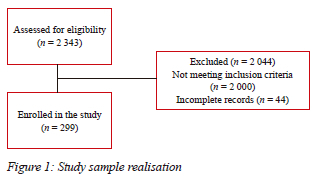
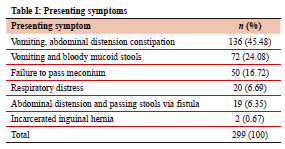
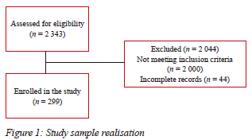
A total of 299 patients were included in this study, of which 175 (58.53%) were males and the majority, 177 (59.20%) were neonates. The sample realisation is shown in Figure 1. The mean (SD) age was 67 (93.8) days at presentation, and Table I displays the presenting symptoms.
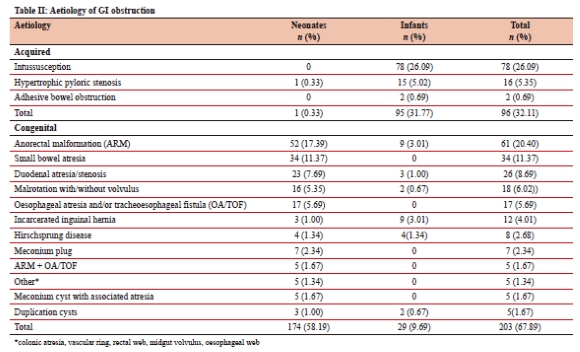
Congenital malformations are more common, 203 (67.89%) than acquired causes, 96 (32.11%). The aetiology of GI obstruction is shown in Table II. VACTERL (the association between vertebral anomalies, anorectal malformations [ARM], cardiovascular anomalies, tracheoesophageal fistula, oesophageal atresia [OA], renal and, or radial anomalies and limb defects) association was noted in 10 (3.34%) of the patients.
Radiological investigations were documented in 267 (89.30%) of the patients, of which 178 (59.53%) had a plain film X-ray, 69 (23.08%) patients had an ultrasound scan, a contrast study in 19 (6.35%) patients, and 1 (0.33%) patient had documented dual imaging.
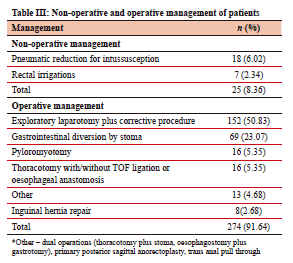
The non-operative and operative management of patients is shown in Table III.
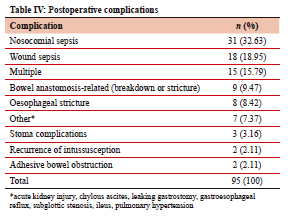
Postoperative complications were noted in 95 (31.77%) patients and are shown in Table IV.
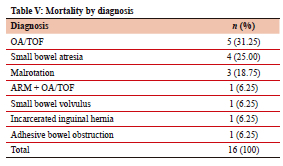
The mortality was 16 (5.35%), as shown in Table V by diagnosis. Of the 16 patients who died, 10 (62.50%) had complications with nosocomial sepsis.
Discussion
This study aimed to describe the profile of GI obstruction in patients < 1 year of age at a tertiary hospital regarding their presentation, aetiological spectrum, investigation and management, as well as postoperative morbidity and mortality.
The demographic profile of the patients was similar to that of other studies, showing a male predominance and the majority of patients presenting in the neonatal period.2,3,13,14 Major congenital anomalies, such as GI tract anomalies, will be symptomatic in the neonatal period, hence most patients presented as neonates.
Vomiting, abdominal distention, and not passing stools were the most common presenting symptoms, which is similar to findings from other studies.2,3,15 Most patients (89.30%) had a documented radiological investigation, with 59.53% having a plain film X-ray. Plain radiographs are usually the initial imaging modality used and can give information on the obstruction's presence, level and complications.16
Globally, 94% of congenital anomalies occur in low-to middle-income countries (LMICs) and this is due to higher fertility rates which translate to higher birth rates and net prevalence of anomalies.1718132518 1718
ARM was the most prevalent congenital anomaly (20.40%), similar in Malawi 18%132 1918
Hartford et al.,9
Intussusception was the most prevalent acquired aetiology, accounting for 26.09% of the cohort. Higher prevalence rates were documented in Nigeria (44.4%)15510,20,21 Disparities in the presentation, management and outcomes of intussusception between high-income and LMICs have been documented.2223
Operative management was performed in 91.46% of the cases, and all procedures were open. The operative rate was higher than in Kenya (55.3%)313
Postoperative complications were reported in 31% of the patients, with surgical site sepsis accounting for 18.95% of the postoperative complications. This was higher than the rate reported by the GlobalSurg Collaboration in 202024 25262626
Nosocomial sepsis accounted for 32.63% of the postoperative complications in this study. Nosocomial sepsis as a postoperative complication in paediatric surgery is not well documented. Only one study from Turkey in 2002 reported that nosocomial sepsis accounted for 2.74% of postoperative complications.2728
The mortality rate in this study was 5.35%, with the majority of deaths (31.25%) occurring in patients with OA/TOF. The majority of deaths in OA/TOF are caused by associated congenital anomalies, followed by sepsis and pulmonary insufficiency.2930
A limitation of the study was that it was done contextually at CHBAH, and the results may not be generalisable to other contexts. Due to the retrospective nature of this study, patient records had to be excluded due to incomplete data. The authors recommend that further studies exploring the causes of mortality in this age group be done in order to determine policies and actions that can be taken to reduce mortality rates.
Conclusion
Congenital malformations of the GI tract are more common than acquired pathologies in neonates and infants at CHBAH, with intussusception as the most common acquired cause of GI obstruction in infants. Sepsis causes significant morbidity in the postoperative period, and mortality is more common in patients with OA/TOF.
Conflict of interest
The authors declare no conflict of interest.
Funding source
No funding was required.
Ethical approval
Approval to conduct the study was obtained from the Human Research Ethics Committee (Medical) of the University of the Witwatersrand (M201182).
ORCID
O Baratedi https://orcid.org/0009-0003-6885-6956
J Scribante https://orcid.org/0000-0002-2221-5024
J Loveland https://orcid.org/0000-0002-3341-0749
REFERENCES
-
1. Alshareef AM, Alghaseb SS, Alghaseb LS, et al. Paediatric intestinal obstruction, management and outcomes: A simple literature review. Egypt J Hosp Med. 2018;72(5):4454-62. https://doi.org/10.21608/ejhm.2018.9507.
» https://doi.org/10.21608/ejhm.2018.9507 - 2. Ogundoyin OO, Afolabi AO, Ogunlana DI, Lawal TA, Yifieyeh AC. Pattern and outcome of childhood intestinal obstruction at a tertiary hospital in Nigeria. Afr Health Sci. 2009;9(3):170-3.
-
3. Ooko PB, Wambua P, Oloo M, et al. The spectrum of paediatric intestinal obstruction in Kenya. Pan Afr Med J. 2016;24:43. https://doi.org/10.11604/pamj.2016.24.43.6256.
» https://doi.org/10.11604/pamj.2016.24.43.6256 -
4. Kim JS. Acute abdominal pain in children. Pediatr Gastroenterol Hepatol Nutr. 2013;16(4):219-24. https://doi.org/10.5223/pghn.2013.16.4.219.
» https://doi.org/10.5223/pghn.2013.16.4.219 -
5. Twahirwa I, Ndayiragije C, Nyundo M, Rickard J, Ntaganda E. Paediatric intestinal obstruction: analysis of aetiologies and factors influencing short-term outcomes in Rwanda. World J Pediatr Surg. 2022;5(4):e000424. https://doi.org/10.1136/wjps-2022-000424.
» https://doi.org/10.1136/wjps-2022-000424 -
6. UNICEF. Child mortality - UNICEF DATA. Available from: https://data.unicef.org/topic/child-survival/under-five-mortality/. Accessed 5 March 2024.
» https://data.unicef.org/topic/child-survival/under-five-mortality/ -
7. UNICEF. Neonatal mortality - UNICEF DATA. Available from: https://data.unicef.org/topic/child-survival/neonatal-mortality/. Accessed 5 March 2024.
» https://data.unicef.org/topic/child-survival/neonatal-mortality/ -
8. UNICEF. Country profiles - UNICEF DATA. Available from: https://data.unicef.org/country/zaf/. Accessed 5 March 2024.
» https://data.unicef.org/country/zaf/ -
9. Hartford L, Brisighelli G, Gabler T, Westgarth-Taylor C. Single-stage procedures for anorectal malformations: A systematic review and meta-analysis. J Pediatr Surg. 2022;57(9):75-84. https://doi.org/10.1016/jjpedsurg.2021.12.024.
» https://doi.org/10.1016/jjpedsurg.2021.12.024 - 10. Cox S, Withers A, Arnold M, et al. Clinical presentation and management of childhood intussusception in South Africa. Pediatr Surg Int. 2021;37(10):1361-70. https://doi.org/10.1007/s00383-021-04946-7.
-
11. Arnold R, Khokho K, Narrainsamy K, Brits E, Joubert G. Infantile hypertrophic pyloric stenosis: profile, management and outcome of patients admitted to a tertiary hospital in Bloemfontein, South Africa. S Afr J Surg. 2019;57(2):64. https://doi.org/10.17159/2078-5151/2019/v57n2a2811.
» https://doi.org/10.17159/2078-5151/2019/v57n2a2811 -
12. Zanini A, Maistry N, Brisighelli G, et al. The burden of disease and pathology at a rapidly expanding tertiary paediatric surgical unit in South Africa. World J Surg. 2021;45(8):2378-85. https://doi.org/10.1007/s00268-021-06144-x.
» https://doi.org/10.1007/s00268-021-06144-x -
13. Shah M, Gallaher J, Msiska N, McLean SE, Charles AG. Paediatric intestinal obstruction in Malawi: characteristics and outcomes. Am J Surg. 2016;211(4):722-6. https://doi.org/10.1016/j.amjsurg.2015.11.024.
» https://doi.org/10.1016/j.amjsurg.2015.11.024 -
14. Black AJ, Lu DYD, Yefet LS, Baird R. Sex differences in surgically correctable congenital anomalies: A systematic review. J Pediatr Surg. 2020;55(5):811-20. https://doi.org/10.1016/j.jpedsurg.2020.01.016.
» https://doi.org/10.1016/j.jpedsurg.2020.01.016 -
15. Emeka CK, Ikemefuna OI, Tochukwu EJ. Spectrum of paediatric intestinal obstruction in a tertiary hospital in Enugu, Nigeria. EPMA J. 2019;7:112-6. https://doi.org/10.11648/j.ejpm.20190706.14.
» https://doi.org/10.11648/j.ejpm.20190706.14 -
16. Nelms DW, Kann BR. Imaging modalities for evaluation of intestinal obstruction. Clin Colon Rectal Surg. 2021;34(4):205-18. https://doi.org/10.1055/s-0041-1729737.
» https://doi.org/10.1055/s-0041-1729737 -
17. Sitkin NA, Ozgediz D, Donkor P, Farmer DL. Congenital anomalies in low- and middle-income countries: The unborn child of global surgery. World J Surg. 2015;39(1):36-40. https://doi.org/10.1007/s00268-014-2714-9.
» https://doi.org/10.1007/s00268-014-2714-9 -
18. Adane F, Afework M, Seyoum G, Gebrie A. Prevalence and associated factors of birth defects among newborns in Sub-Saharan African countries: A systematic review and meta-analysis. Pan Afr Med J. 2020;36:1-22. https://doi.org/10.11604/pamj.2020.36.19.19411.
» https://doi.org/10.11604/pamj.2020.36.19.19411 -
19. Sharma S, Mazingi D, Imam S, et al. Anorectal malformations in low and middle-income countries- spectrum, burden and management. Semin Pediatr Surg. 32;6(2023):151349. https://doi.org/10.1016/j.sempedsurg.2023.151349.
» https://doi.org/10.1016/j.sempedsurg.2023.151349 -
20. Carapinha C, Truter M, Bentley A, Welthagen A, Loveland J. Factors determining clinical outcomes in intussusception in the developing world: Experience from Johannesburg, South Africa. S Afr Med J. 2016;106(2):177-80. https://doi.org/10.7196/SAMJ.2016.v106i2.9672.
» https://doi.org/10.7196/SAMJ.2016.v106i2.9672 -
21. Kumalo V, Withers A, Jugmohan B, et al. Clinical outcomes of intussusception: The experience in Johannesburg, South Africa. S Afr J Child Health 2023;17(1):1-5. https://doi.org/10.7196/SAJCH.2023.v17i1.1924.
» https://doi.org/10.7196/SAJCH.2023.v17i1.1924 -
22. Akello VV, Cheung M, Kurigamba G, et al. Paediatric intussusception in Uganda: differences in management and outcomes with high-income countries. J Pediatr Surg. 2020;55(3):530-4. https://doi.org/10.1016/j.jpedsurg.2019.07.003.
» https://doi.org/10.1016/j.jpedsurg.2019.07.003 -
23. Huppertz HI, Soriano-Gabarró M, Grimprel E, et al. Intussusception among young children in Europe. Pediatr Infect Dis J. 2006;25(Suppl 1):22-9. https://doi.org/10.1097/01.inf.0000197713.32880.46.
» https://doi.org/10.1097/01.inf.0000197713.32880.46 -
24. GlobalSurg Collaborative Surgical site infection after gastrointestinal surgery in children: an international, multicentre, prospective cohort study. BMJ Glob Health. 2020;5(12):1-14. https://doi.org/10.1136/bmjgh-2020-003429.
» https://doi.org/10.1136/bmjgh-2020-003429 -
25. The World Bank. South Africa MPO - Public Documents| The World Bank. Available from: https://thedocs.worldbank.org. Accessed 24 September 2024.
» https://thedocs.worldbank.org -
26. Torborg A, Cronje L, Thomas J, et al. South African Paediatric Surgical Outcomes Study: a 14-day prospective, observational cohort study of paediatric surgical patients. Br J Anaesth. 2019;122:224-32. https://doi.org/10.1016/j.bja.2018.11.015.
» https://doi.org/10.1016/j.bja.2018.11.015 -
27. Önen A, Çiğdem MF, Geyik ÖF, et al Epidemiology and control of nosocomial infections in paediatric surgery. J Hosp Infect. 2002;52(3):166-70. https://doi.org/10.1053/jhin.2002.1285.
» https://doi.org/10.1053/jhin.2002.1285 -
28. Withers A, Cronin K, Mabaso M, et al. Neonatal surgical outcomes: a prospective observational study at a tertiary academic hospital in Johannesburg, South Africa. Pediatr Surg Int. 2021;37(8):1061-8. https://doi.org/10.1007/s00383-021-04881-7.
» https://doi.org/10.1007/s00383-021-04881-7 - 29. Davari HA, Hosseinpour M, Nasiri GM, Kiani G. Mortality in oesophageal atresia - assessment of probable risk factors (10 years' experience). J Res Med Sci. 2012;17(6):540-2.
-
30. Livingston MH, Dcruz J, Pemberton J, Ozgediz D, Poenaru D. Mortality of paediatric surgical conditions in low and middle income countries in Africa. J Pediatr Surg. 2015;50(5):760-4. https://doi.org/10.1016/j.jpedsurg.2015.02.031.
» https://doi.org/10.1016/j.jpedsurg.2015.02.031