Trauma ICU patients requiring tracheostomy: a single-centre experience
Abstract
BACKGROUND: The tracheostomy is a commonly performed procedure in the context of trauma care. There is paucity of data on factors affecting outcomes after a tracheostomy. This study aims to determine complication and mortality rates of tracheostomies in trauma patients and to determine the association of these outcomes with level of surgeon, urgency of procedure and surgical approach utilised. METHODS: This was a retrospective audit at a single academic hospital. All patients who had tracheostomies performed by trauma unit staff within the unit between 1 June 2016 and 31 May 2023 were included. Clinical variables and outcomes were evaluated. RESULTS: A total of 247 patients were enrolled in the study. The overall complication rate was 4.86%. There was no significant difference in complication rates when comparing level of surgeon (p < 0.999), urgency of procedure (p = 0.469) or surgical approach (p = 0.444). Thirty-day all-cause mortality rate was 21.05%. There was no significant difference in mortality rates among the different levels of surgeons (p = 0.678) or surgical approach (p = 0.553). Mortality rates were significantly higher (p = 0.022) in elective tracheostomies than emergency tracheostomies. CONCLUSION: The use of different surgical approaches did not affect complication or mortality rates of tracheostomies performed. Elective procedures had a higher mortality rate than emergency procedures which suggests urgency alone may not be a risk factor and that burden of injury may need to be considered. Seniority of surgeon did not affect complication or mortality rates. This supports that structured training with adequate supervision allows junior doctors to safely perform such procedures.
trauma; tracheostomy; airway management; intensive care; South African healthcare
Introduction
Trauma is a worldwide problem affecting all populations and is a leading cause of death and injury.112
There are a variety of indications for tracheostomy, particularly in critically ill patients. The commonest indication for tracheostomy is a prolonged need for mechanical ventilation.33
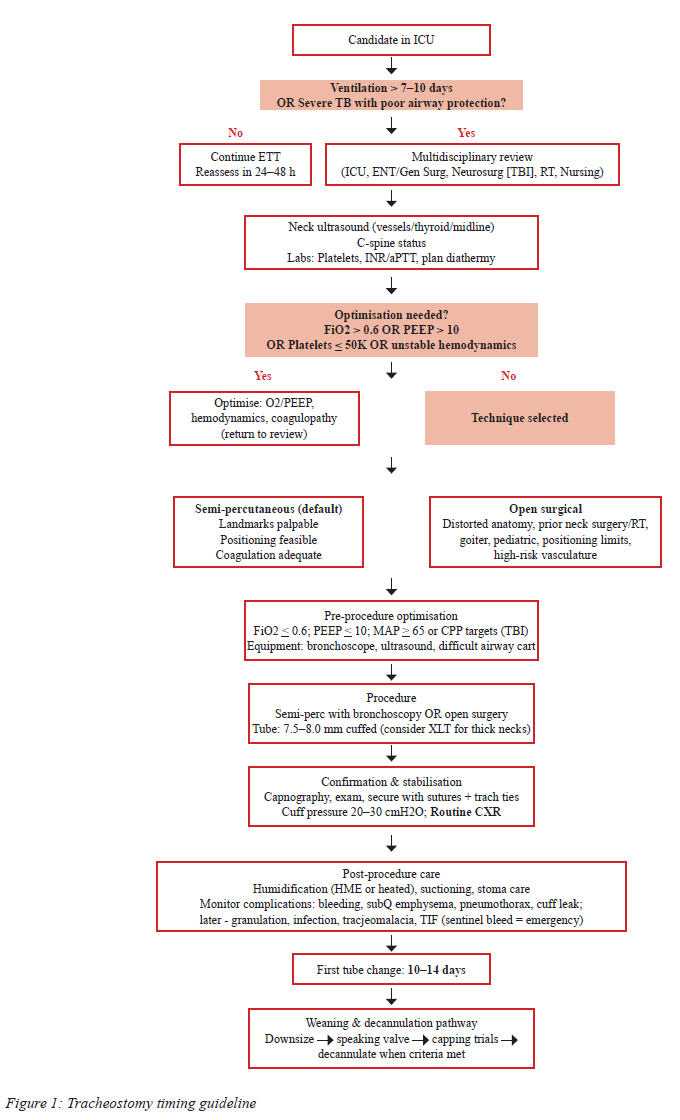
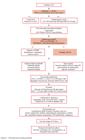
There is much debate regarding timing of tracheostomies.4356Figure 1 shows the guideline used in this institution.
There are several surgical approaches to tracheostomies.788
With a percutaneous dilatational technique, a needle is inserted into the trachea and the Seldinger technique is used to sequentially dilate a tract and insert the tracheostomy tube.99
There are advantages and pitfalls to both surgical and percutaneous dilatational tracheostomy techniques.999
Regardless of surgical approach, the tracheostomy can result in complications. Early complications include loss of airway, bleeding, damage to surrounding structures, pneumothorax, dislodged tracheostomy, surgical site infection and even death.101010
The aim of this study is to determine complication and mortality rates of tracheostomies in this setting and to determine the association of these outcomes with level of surgeon, urgency of procedure and surgical approach utilised. Additionally, number of days intubated prior to tracheostomy and patient mechanism of injury were assessed.
Patients and methods
A retrospective audit was conducted at Charlotte Maxeke Johannesburg Academic Hospital, a single Level 1 Trauma Centre in Johannesburg from 1 June 2016 to 31 May 2023. All adult patients who had tracheostomies performed by the trauma surgery staff within the unit in this period were included. Patient demographics, mechanism of injury, duration of intubation, urgency of procedure, surgical approach and level of surgeon were recorded. Emergency tracheostomies were those that were performed on day 0 of intubation. Surgical trainees have completed 3 years of general medical training and surgical consultants have completed at least 5 years of specialist training. Outcomes evaluated included in hospital complications and mortality rates within 30 days of tracheostomy.
Statistical analysis was completed with assistance from the Surgical Statistics Hub at the University of the Witwatersrand Department of Surgery. STATA version 17 was used to analyse data. Categorical data relationships were determined using chi- square or Fischer exact tests. Continuous data relationships were determined using Shapiro-Wilk or Mann Whitney U tests. Logistic regression methods were applied to compare different variables. Statistical significance was determined using p-value < 0.05.
Results
A total of 247 patients were enrolled in the study. Of these patients 86.6% (n = 214) were male and 13.36 % were female. The ages of patients enrolled in the study ranged from 18 to 92 years old with a median age of 33 years and interquartile range of 28-41 years.
The predominant mechanism of injury in patients requiring tracheostomies was blunt trauma consisting of 68.83% (n = 170) of the cohort as opposed to 31.17% (n = 77) being penetrating trauma. The patients who required tracheostomies had a median intubation period of 8 days (IQR 5-10 days) before tracheostomy was performed. Tracheostomies performed were done by a semi-open hybrid technique (63.97%), open technique (34.82%) and percutaneous dilatational (1.21%) technique.
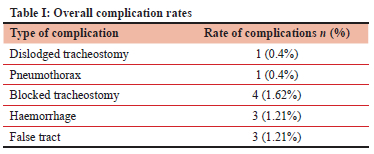
Acute tracheostomy complications occurred in 4.86% of patients enrolled in the study (Table I).
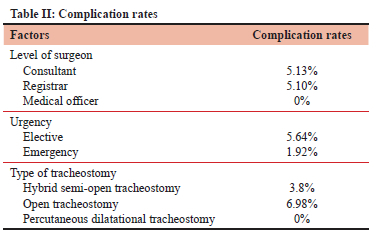
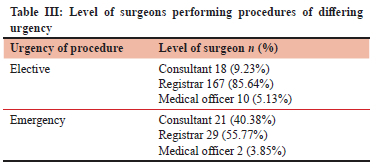
There was no statistically significant difference in complication rates across the different surgeon levels in the study (p < 0.999). There was also no statistically significant difference (p = 0.469) in the complication rates of emergency and elective tracheostomies (Table II). However, a significant difference was observed in the distribution of procedure urgency (p < 0.001): consultants performed 40.38% of emergency tracheostomies with a surgical trainee observing, whereas they carried out only 9.23% of elective tracheostomies. Registrars and medical officers performed the remaining procedures as outlined in Table III. The type of tracheostomy performed (i.e. surgical approach) had no statistically significant bearing on complication rates (p = 0.444).
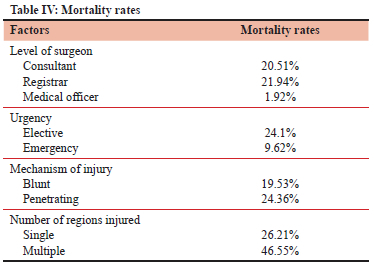
The all-cause mortality rate at 30 days within the study cohort was 21.05%. The average time to death was 10 days after tracheostomy (± 8 days). Mortality rates were significantly higher in patients who had elective tracheostomies compared to emergency tracheostomies (p = 0.022), with mortality rates of 24.1% and 9.62%, respectively (Table IV). The study found no significant difference in mortality rates among the various surgeon levels (p = 0.678), injury mechanisms (p = 0.404) or the number of regions injured (p = 0.7338).
Discussion
This study showed that patients requiring tracheostomies were more likely to have sustained blunt traumatic injuries than penetrating injuries. This is consistent with current data which shows that tracheostomies are predominantly required in patients who are intubated for prolonged periods after sustaining traumatic brain injuries from blunt trauma.11
The mean age of patients enrolled in our study correlates with that of the general trauma population as trauma affects young patients globally.12131114
However, there is discourse that promotes earlier tracheostomy to facilitate early liberation from mechanical ventilation, better pulmonary toilet and decreased sedation requirements.6
Complication rates in our study were comparable to the study done by Murray et al.10
In our clinical setting, the most performed surgical approach was a semi open hybrid technique followed by open tracheostomy and percutaneous dilatational tracheostomy. The hybrid approach is favoured as it allows surgical trainees to learn the skill of the open tracheostomy,1215
The mortality rate in our study mirrored that of the general trend.1617
Medical officers, registrars and consultants performed tracheostomies in this study. The mortality rates and distribution of complications were similar across all surgeon levels. This suggests that within this unit tracheostomies are being performed safely regardless of seniority of the surgeon which may reflect adequate supervision and training or protocol standardisation. Consultants performed significantly more emergency tracheostomies than elective tracheostomies. This may indicate that in more urgent situations, deference is given to more senior surgeons to perform the procedure.
Conclusions
The use of different surgical approaches to performing tracheostomies does not largely affect complication or mortality rates from the procedure. Our study demonstrated higher mortality rates in patients who had elective tracheostomies. This suggests that urgency alone may not be a risk factor and further interrogation of injury severity and comorbid conditions is necessary. Seniority of surgeons had little effect on complication and mortality rates from tracheostomies. This supports a structured training programme with adequate supervision allowing junior doctors to safely perform procedures. It further supports that competence rather than seniority alone is imperative.
Further studies with larger sample size and prospective design may be necessary to further interrogate outcomes of tracheostomies in trauma patients.
Limitations
There are several limitations that should be acknowledged in relation to this study. The study was conducted in a single academic hospital, and results may not be easily extrapolated to other contexts. As a retrospective review, the data collected was limited to routinely kept patient records. This may have limited the sample size as well as the parameters investigated in the study.
Conflict of interest
The authors declare no conflict of interest.
Funding source
No funding was required.
Ethical approval
This study was performed in line with the principles of the Declaration of Helsinki. Approval was granted by the University of Witwatersrand Human Research Ethics Committee (Ref M231165).
ORCIDS Moosa https://orcid.org/0009-0009-6365-032X
S Makhadi https://orcid.org/0000-0003-3381-5866
REFERENCES
-
1. Norman R, Matzopoulos R, Groenewald P, Bradshaw D. The high burden of injuries in South Africa. Bull World Health Organ. 2007;85(09):695-702. https://doi.org/10.2471/BLT.06.037184.
» https://doi.org/10.2471/BLT.06.037184 -
2. Del Toro‐Diez E, Ríos De Choudens CS, Lajud SA, Pascual‐Marrero J, Baez‐Bermejo A. Tracheostomy outcomes on trauma patients. OTO Open. 2023;7(2):e48. https://doi.org/10.1002/oto2.48.
» https://doi.org/10.1002/oto2.48 -
3. Cheung NH, Napolitano LM. Tracheostomy: Epidemiology, indications, timing, technique, and outcomes. Respir Care. 2014;59(6):895-915; discussion 916-9. https://doi.org/10.4187/respcare.02971.
» https://doi.org/10.4187/respcare.02971 -
4. Freeman BD. Tracheostomy update: When and how. Crit Care Clin. 2017;33(2):311-22. https://doi.org/10.1016/j.ccc.2016.12.007.
» https://doi.org/10.1016/j.ccc.2016.12.007 -
5. Brass P, Hellmich M, Ladra A, Ladra J, Wrzosek A. Percutaneous techniques versus surgical techniques for tracheostomy. Cochrane Database Syst Rev. 2016;7(7):CD008045. https://doi.org/10.1002/14651858.CD008045.pub2.
» https://doi.org/10.1002/14651858.CD008045.pub2 -
6. Selvakumar S, Chan K, Ngatuvai M, et al. Timing of tracheostomy in patients with severe traumatic brain injuries: The need for tailored practice management guidelines. Injury. 2022;53(8):2717-24. https://doi.org/10.1016/j.injury.2022.06.031.
» https://doi.org/10.1016/j.injury.2022.06.031 -
7. Lais G, Piquilloud L. Tracheostomy: Update on why, when and how. Curr Opin Crit Care. 2025;31(1):101-7. https://doi.org/10.1097/MCC.0000000000001224.
» https://doi.org/10.1097/MCC.0000000000001224 - 8. Durbin CG. Tracheostomy: Why, when, and how? Respir Care. 2010;55(8):1056-68. PMID: 20667153.
-
9. Feldman MJ, Milner SM, Dhanjani KM, Stjepanovic Z, Gerold K. Semi-open percutaneous tracheostomy in burn patients. Burns. 2011;37(6):1072-8. https://doi.org/10.1016/j.burns.2011.03.002.
» https://doi.org/10.1016/j.burns.2011.03.002 -
10. Murray M, Shen C, Massey B, Stadler M, Zenga J. Retrospective analysis of post-tracheostomy complications. Am J Otolaryngol. 2022;43(2):103350. https://doi.org/10.1016/j.amjoto.2021.103350.
» https://doi.org/10.1016/j.amjoto.2021.103350 -
11. Casamento AJ, Bebee B, Glassford NJ, Bellomo R. Prediction of tracheostomy in critically ill trauma patients: A systematic review. Crit Care Resusc. 2018;20(4):258-67. https://doi.org/10.1016/S1441-2772(23)00965-1.
» https://doi.org/10.1016/S1441-2772(23)00965-1 -
12. Kang D, Jeong IB, Kwon SJ, Son JW, Ku GW. Safety and feasibility of hybrid tracheostomy. Acute Crit Care. 2021 Nov;36(4):369-73. https://doi.org/10.4266/acc.2021.00801.
» https://doi.org/10.4266/acc.2021.00801 -
13. Cai SQ, Hu JW, Liu D, et al. The influence of tracheostomy timing on outcomes in trauma patients: A meta-analysis. Injury. 2017;48(4):866-73. https://doi.org/10.1016/j.injury.2017.02.023.
» https://doi.org/10.1016/j.injury.2017.02.023 -
14. Mieth M, Schellhaab A, Huttner F, et al. Tracheostomy techniques. Chirurg. 2016;87(1):73-83; quiz 84-5. German. https://doi.org/10.1007/s00104-015-0116-7.
» https://doi.org/10.1007/s00104-015-0116-7 -
15. Johnson-Obaseki S, Veljkovic A, Javidnia H. Complication rates of open surgical versus percutaneous tracheostomy in critically ill patients. Laryngoscope. 2016;126(11):2459-67. https://doi.org/10.1002/lary.26019.
» https://doi.org/10.1002/lary.26019 - 16. Namin AW, Kinealy BP, Harding BC, Alnijoumi MM, Dooley LM. Tracheotomy outcomes in the medical intensive care unit. Mo Med. 2021;118(2):168-72. PMID: 33840862; PMCID: PMC8029615.
-
17. Lipton G, Stewart M, McDermid R, et al. Multispecialty tracheostomy experience. Ann R Coll Surg Engl. 2020;102(5):343-7. https://doi.org/10.1308/rcsann.2019.0184.
» https://doi.org/10.1308/rcsann.2019.0184