Missed appendicitis presenting as necrotising fasciitis of the thigh
Abstract
Acute appendicitis is one of the most commonly encountered surgical emergencies. It usually presents with typical symptoms; however, diagnostic doubt may be encountered in atypical presentations. Rarely, complicated appendicitis may manifest as necrotising fasciitis (NF), further complicating the diagnosis and management. This case illustrates an atypical presentation where the diagnosis of appendicitis was initially missed. This report explores the pathophysiology, diagnostic challenges, and management principles when appendicitis presents as NF.
appendicitis; necrotising fasciitis; atypical appendicitis
CASE REPORT
Missed appendicitis presenting as necrotising fasciitis of the thigh
K HendryI; OO JolayemiI, II
INgwelezana Hospital, South Africa
IISchool of Clinical Medicine, University of KwaZulu-Natal, South Africa
SUMMARY
Acute appendicitis is one of the most commonly encountered surgical emergencies. It usually presents with typical symptoms; however, diagnostic doubt may be encountered in atypical presentations. Rarely, complicated appendicitis may manifest as necrotising fasciitis (NF), further complicating the diagnosis and management. This case illustrates an atypical presentation where the diagnosis of appendicitis was initially missed. This report explores the pathophysiology, diagnostic challenges, and management principles when appendicitis presents as NF.
Keywords: appendicitis, necrotising fasciitis, atypical appendicitis
Case Report
A previously well 16-year-old female presented with a week history of worsening right hip pain extending into the right leg. She had right lower quadrant discomfort and vomiting, which had since resolved by presentation. The patient was incorrectly diagnosed twice. Initially as septic arthritis of the hip, which was excluded on X-ray, and secondly as cellulitis of the right lower limb.
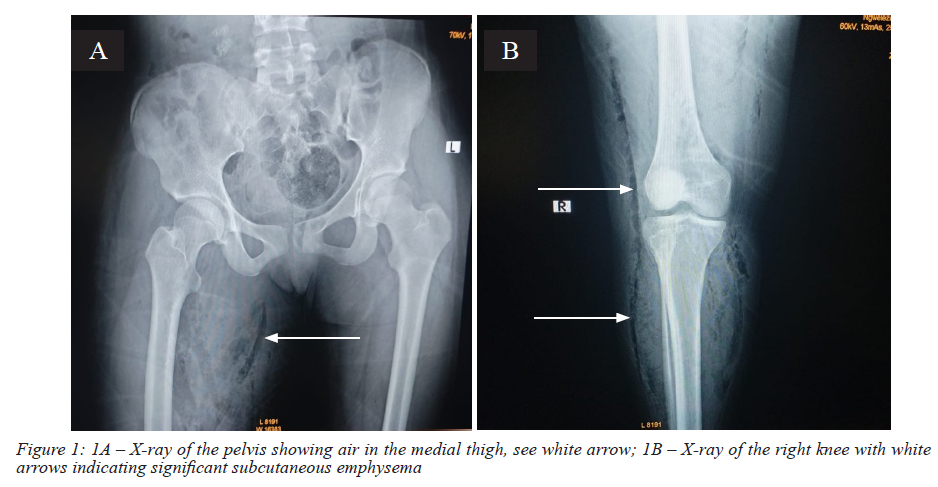
On presentation, the patient was acutely ill and in septic shock, with a blood pressure of 99/77, heart rate of 128, and Glasgow Coma Score of 14/15. Abdominal examination was insignificant, apart from very mild lower abdominal tenderness over the groin area. Her right lower limb was erythematous, tender, and exhibited crepitus extending from the medial groin to the knee. A plain radiograph of the right lower limb revealed extensive subcutaneous emphysema (Figure 1). The abdominal radiographs were unremarkable. An ultrasound excluded a deep vein thrombosis and intraabdominal free fluid. Laboratory results revealed a white cell count of 16x109/L, C-reactive protein 217 mg/L, and a laboratory risk indicator for necrotising fasciitis (LRINEC) score of 11.
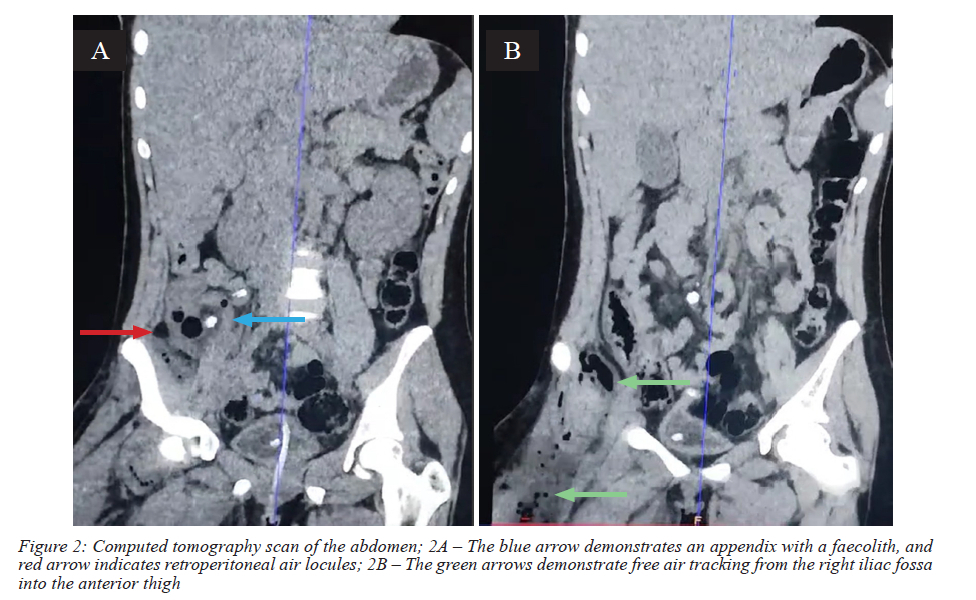
A computed tomography (CT) of the abdomen demonstrated retroperitoneal air tracking into the pelvis and right thigh with no joint involvement (Figure 2). A collection in the right retroperitoneal space raised suspicion of appendicitis with psoas muscle involvement. The patient was assessed as having necrotising fasciitis (NF) of the thigh secondary to a ruptured appendicitis and was prepared for emergency surgery.
Intraoperative findings included a perforated retrocecal appendix, with NF extending from the retroperitoneum into the right thigh. An appendectomy and extensive thigh debridement were performed, followed by intensive care unit (ICU) admission for inotropic support and renal replacement therapy. She required five additional debridements of the right limb, prolonged antibiotic therapy, vacuum-assisted wound closure, and eventually, split-thickness skin grafting. Intensive physiotherapy enabled her to regain mobility, and she was discharged with a walking aid.
Discussion
Acute appendicitis usually presents with typical symptoms and follows an uncomplicated course. Complicated appendicitis, however, may present with perforation, abscess formation or even NF, masking typical symptoms and making the diagnosis challenging. NF secondary to perforated appendicitis is rare, with only 35 documented cases in the literature over the last 30 years on a recent PubMed search. This case report is unique as it illustrates an insidious presentation of appendicitis with minimal abdominal symptoms.
Appendicitis complicated by NF is associated with significant morbidity and mortality. Of the cases reviewed, two patients required hip disarticulation1,2 and a recent systematic review of 16 cases reported a mortality rate of 46%.3 The main risk factors for appendicitis complicated by NF appear to be immunosuppression, extremes of age, diabetes, cancer and HIV. Furthermore, HIV positive individuals and elderly patients were more likely to have increased length of hospital stay and mortality.4,5
NF is a severe, rapidly progressive soft tissue infection commonly caused by skin infections, trauma, intravenous drug use and surgical complications.3,5 The most common classification of NF is based on microbiology. Type 1 NF is polymicrobial and is usually caused by non-Group A streptococci. Type 2 is monomicrobial and involves Group A beta-haemolytic streptococcus or staphylococcus. Type 3 is caused by marine and vibrio species, and Type 4 by fungal organisms.3,5
Predominant and isolated NF of the thigh without abdominal symptoms, as in this case report, is a rare presentation, noted in only a few other reports.6-10 Anatomical areas commonly affected by NF secondary to appendicitis include the anterior abdominal wall, retroperitoneum, perineum, and thigh.8,9 The common determinant for NF progression is a retrocecal appendix.8,9 This has clinical and anatomical significance and explains the presentation of thigh symptoms without abdominal symptoms. A retrocecal perforated appendix introduces sepsis into the retroperitoneal space along fascial planes to the abdominal wall and lateral flank. The superior lumbar triangle (Grynfeltt-Lesshaft) and inferior lumbar triangle (Petit) are anatomical spaces that provide a conduit for infection to travel between the retroperitoneal abdomen and the flank.8,9 Spread from the retroperitoneal space to the thigh occurs along the psoas and deep to the inguinal ligament, through the femoral canal, the sciatic foramen or the obturator foramen.
This case highlights the diagnostic challenges associated with appendicitis, especially when complicated by NF.7-10 A high index of suspicion is required because the signs and symptoms are subtle and non-specific, especially early in the course of the disease.3 Pain that is out of proportion to the examination should alert the clinician to the likelihood of NF. Crepitus and subcutaneous emphysema, as seen in this case study, are rare and late signs. Biochemical markers and imaging are helpful adjuncts.
Imaging is useful when the diagnosis of NF is in doubt, or the source of sepsis is unknown. Plain radiographs of the involved extremities may demonstrate the presence of subcutaneous emphysema; however, the sensitivity is low and may only be helpful in late stages. MRI is the gold standard imaging modality due to its high sensitivity, but it has low specificity.78 CT, due to its accessibility, is the most commonly utilised modality and has the advantage of being able to evaluate for primary sources of infections. It is essential to ensure that the entire extent of affected tissue is imaged, as this may reveal a potential nidus of infection, such as the appendix, in this case.8
The management in these cases involves surgical management of the appendix and NF principles: early, aggressive surgical debridement and intravenous antimicrobial therapy.9,10 The wound should be reassessed within 24 hours, and further debridement should be performed as required. Intravenous antimicrobial therapy should be administered based on local susceptibility patterns. Empiric clindamycin should be added when a Group A streptococcal infection is suspected. Delayed reconstruction and skin cover can be performed 3-6 weeks thereafter.7
Although appendicitis is a common surgical emergency, its rare presentation as NF poses a serious diagnostic and therapeutic challenge. The surgeon must maintain a high index of suspicion. Prompt imaging and early surgical intervention are vital. One should never forget to exclude intra-abdominal sepsis in atypical cases of lower extremity soft tissue infections, especially when accompanied by systemic illness.
Conflict of interest
The authors declare no conflict of interest.
Funding source
No funding was required.
Ethical approval
In accordance with University of KwaZulu-Natal Biomedical Research Ethics Committee this case report was given exemption in line with SA DoH Ethics Guidance (2014).
Written consent for case study write up, photos and image use was granted by the patient.
ORCIDK Hendry https://orcid.org/0009-0006-4984-6586
OO Jolayemi https://orcid.org/0000-0003-3254-3344
REFERENCES
-
1. Papanikolas M, Kim JJ, Mackenzie S. Hindquarter amputation resulting from a perforated retroperitoneal appendicitis: A rare case. ANZ J Surg. 2020;90(3):e46-E47. https://doi.org/10.1111/ans.15617.
» https://doi.org/10.1111/ans.15617 -
2. Taif S, Alrawi A. Missed acute appendicitis presenting as necrotising fasciitis of the thigh. Case Rep. 2014;2014. https://doi.org/10.1136/bcr-2014-204247.
» https://doi.org/10.1136/bcr-2014-204247 -
3. Damisa J, Ahmed S, Harrison S, et al. Necrotising fasciitis: A narrative review of the literature. Br J Hosp Med. 2021;82(4):1-9. https://doi.org/10.12968/hmed.2020.0577.
» https://doi.org/10.12968/hmed.2020.0577 -
4. Chen CW, Hsiao CW, Wu CC, et al. Necrotising fasciitis due to acute perforated appendicitis: Case report. J Emerg Med. 2010;39(2):178-80. https://doi.org/10.1016/j.jemermed.2007.09.026.
» https://doi.org/10.1016/j.jemermed.2007.09.026 -
5. Allaw F, Wehbe S, Kanj SS. Necrotising fasciitis: An update on epidemiology, diagnostic methods, and treatment. Curr Opin Infect Dis. 2024;37(2):105-11. https://doi.org/10.1097/QCO.0000000000000988.
» https://doi.org/10.1097/QCO.0000000000000988 -
6. Funk S, Warren K, DeNapoli TS, et al. Necrotising fasciitis of the right lower extremity from ruptured appendicitis: Case report. JBJS Case Connector. 2021;11(1):e20.00250. https://doi.org/10.2106/JBJS.CC.20.00250.
» https://doi.org/10.2106/JBJS.CC.20.00250 - 7. Lee JH, Hong Y, Lee SH. Right thigh necrotising fasciitis induced by perforated appendicitis. J Korean Soc Emerg Med. 2018;29(3):275-9.
-
8. Hsieh CH, Wang YC, Yang HER, et al. Extensive retroperitoneal and right thigh abscess in a patient with ruptured retrocecal appendicitis: An extremely fulminant form of a common disease. World J Gastroenterol 2006;12:496-9. https://doi.org/10.3748/wjg.v12.i3.496.
» https://doi.org/10.3748/wjg.v12.i3.496 -
9. Chin TWY, Ko KWS, Tsang KH. Necrotising fasciitis: A rare complication of acute appendicitis. Hong Kong Med J. 2018;24(5):535-7. https://doi.org/10.12809/hkmj166180.
» https://doi.org/10.12809/hkmj166180 -
10. Chandel V, Patlolla SR, Khokhar I, et al. Missed perforated appendicitis presenting as flank necrotising fasciitis: A rare phenomenon. Am J Gastroenterol. 2022;117(Suppl):S3452.https://doi.org/10.14309/01.ajg.0000870448.22371.e2.
» https://doi.org/10.14309/01.ajg.0000870448.22371.e2