Outcomes of patients with Hirschsprung's disease post-pull-through procedure
Abstract
BACKGROUND: In low- to middle-income countries, diagnosing and managing Hirschsprung's disease (HD) presents challenges. This study aimed to determine the outcomes of patients with HD post-pull-through (PT) surgery in the Department of Paediatric Surgery at Chris Hani Baragwanath Academic Hospital (CHBAH) between 01 January 2016 and 30 June 2024. METHODS: In Section 1, demographics and complications (according to the Clavien-Dindo Classification System) were collected retrospectively. In Section 2, the functional bowel outcomes (using the Rintala Bowel Functional Score) were collected prospectively. RESULTS: There were 78 HD-diagnosed patients in the database; 43 (55%) were included in section 1, and 32 (74%) in section 2. Thirty-seven patients (86%) were male, and 21 (49%) had inside flushing toilets. Thirty-two (74%) patients had a transition zone at the rectosigmoid junction, and five (14%) had total colonic HD. The median (IQR) age at diagnosis was 3 (22) months, and only 13 (30%) were diagnosed before 1 month. The median (IQR) age at PT was 19 (28.8) months. Eighteen (42%) patients had no postoperative complications, and 21 (49%) needed surgery-PT. Nineteen patients (59%) had excellent continence, and 11 (34%) had good continence. There was no statistically significant difference in functional outcomes, age at first diagnosis (p = 0.924), available toilet facilities (p = 0.791), or the level of disease (p = 0.624). CONCLUSION: The majority of HD patients at CHBAH had a delayed diagnosis and some postoperative complications following PT. However, most patients had excellent to good functional bowel outcomes.
Hirschsprung's disease; low- to middle-income countries; functional bowel outcomes; complications
Introduction
Hirschsprung's disease (HD) is a congenital condition marked by the lack of ganglion cells in the enteric nervous system. HD affects approximately 1 in every 5000 live births.1231
In low- to middle-income countries (LMIC), a high number of patients with HD present beyond the age of one year, which may negatively impact the management and outcomes of these patients. These patients tend to have a higher incidence of recurrent enterocolitis, malnutrition, or severely dilated proximal bowel and perforation.13
Long-term challenges in children who underwent PT surgery for HD may include recurrent enterocolitis, soiling, and obstructive symptoms. The exact incidence of each of these challenges is not well described.14
Moreover, the lack of a definition and classification of surgical complications after an HD PT surgery has made interpreting surgical outcomes difficult. Different authors used terms such as mild, moderate, and severe to describe surgical complications, but little clarity has been given to defining the terms used.56,7
Of note, the majority of studies on the short- and long-term outcomes of HD are conducted in high-income countries1,2,8 and very little is known about bowel function in LMICs9
Materials and methods
A retrospective and prospective descriptive research design was followed, and approval to conduct this study was obtained from the Human Research Ethics Committee of the University of the Witwatersrand (M230431).
The study was conducted in the Department of Paediatric Surgery at CHBAH. The Department admits, on average, 2400 patients and performs over 1500 surgeries per annum. The Department has a dedicated colorectal unit, the Johannesburg Paediatric Colorectal Clinic (JPCC), which manages, on average, 2100 patients per annum. The unit has performed more than 1200 surgeries since its inception.
The study population consisted of children undergoing PT surgery for HD at CHBAH. The sample size was realised by the number of children in the HD database, and a consecutive convenience sampling method was used. Children > 3 years of age who had a histological diagnosis of HD and had had PT surgery at least six months prior were included in the study. Children with developmental delays and those whose caregivers declined consent were excluded.
The authors compiled a data collection instrument comprising two sections. Section 1 consists of the following demographic variables: sex, age, type of toilet facility, age at HD diagnosis, level of disease, age at first procedure, and age at PT surgery and classifying postoperative complications using Clavien-Dindo Classification of Surgical Complications.106
Post-surgery patients were followed up at the JPCC and were never discharged from the clinic; the follow-up period varied with each patient, depending on their condition. One author (TT) collected Section 1 data from the JPCC database and Section 2 data during the patient's follow-up visit, or by telephone. He is fluent in most of the languages spoken by patients attending CHBAH and was able to assist them with any problems they had.
At JPCC, the Swenson PT procedure is performed exclusively; CHBAH is a teaching hospital, so multiple surgeons could have performed the PT, but all used the same technique (Swenson). Preoperative contrast enema was done in all patients with a positive rectal biopsy for HD before an elective colostomy was performed. In the case of an emergency colostomy for bowel obstruction, a contrast enema was not performed. Diagnosis was confirmed histologically in all patients before PT surgery. At JPCC, colostomy is the procedure of choice in patients with colonic HD, as ileostomies carry a high risk of dehydration and mortality. Frozen section is not available at our centre; therefore, the stoma doughnut is sent out for identification of ganglion cells before PT surgery. In this study, enterocolitis was defined as intestinal inflammation characterised by fever, abdominal distension, diarrhoea, and sepsis,11
Neonatal group (0-28 days)
Delayed diagnosis group (> 28 days-1 year)
Late diagnosis group (> one year-18 years)
REDCap was used to capture data. Data analysis was performed using GraphPad Prism 2024. Categorical data are described using frequencies and percentages, and continuous data are described using means and standard deviations. Comparisons between age at first diagnosis and toilet type with regard to functional outcome were performed using the Kruskal-Wallis test. The comparison of disease severity and functional outcome was performed using the Mann-Whitney U test. A p-value of 0.05 was considered statistically significant. Charts were designed using the DATAtab Team (2024).
Results
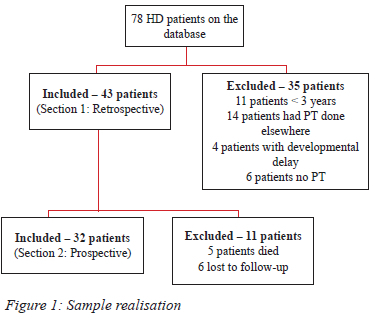
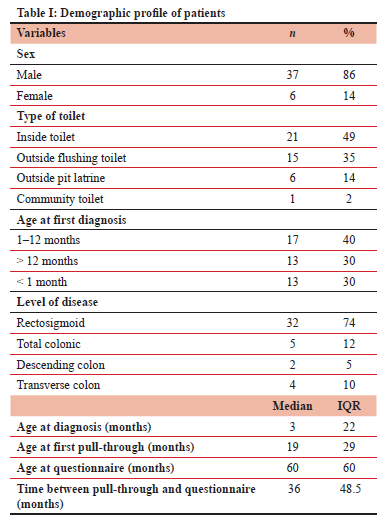
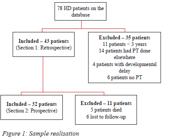
Seventy-eight patients were captured on the database. Forty-three patients (55%) were included in Section 1, and 32 (41%) in Section 2. The sample realisation is shown in Figure 1. The demographic profile of the patients is shown in Table I. Determining the presentation of HD was beyond the scope of the study. However, the presentation differed and depended on the age of the presentation; older patients presented with constipation and a distended abdomen, as well as failure to thrive and recurrent need for washouts; younger patients presented with a distended abdomen, delayed meconium passage, and sometimes enterocolitis.
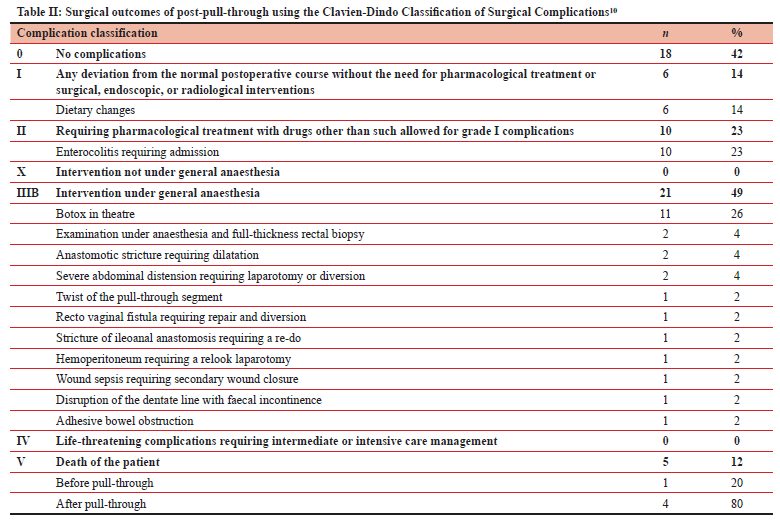
The surgical outcomes post-PT surgery (using the Clavien-Dindo Classification of Surgical Complications) are shown in Table II.12
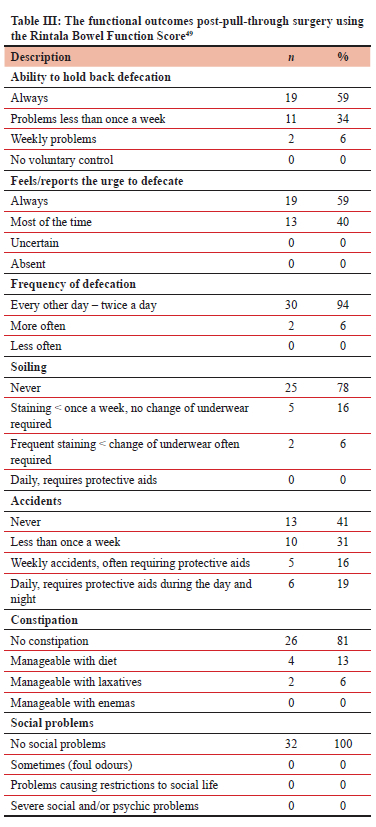
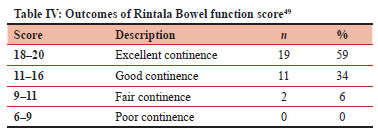
The mean (SD) Rintala Bowel Function Score13Table III shows the functional outcomes post-PT surgery using the Rintala Bowel Function Score13Table IV shows the classification according to continence.
Of the 32 patients included in section 2, 27 (84%) were male, 27 (84%) had rectosigmoid HD, and 5 (16%) had total colonic disease.
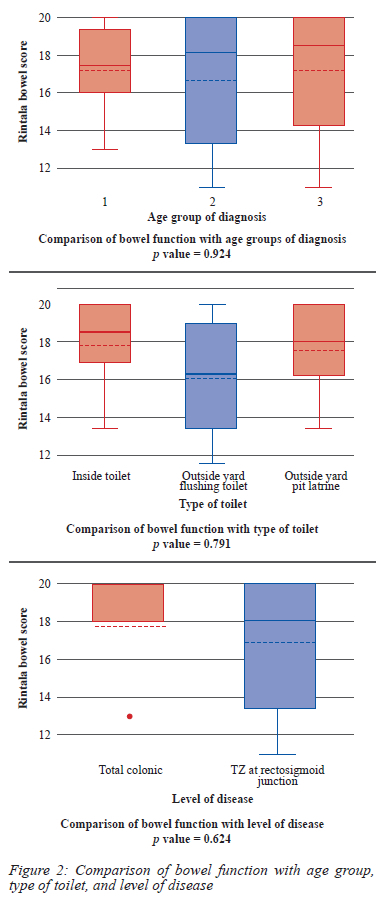
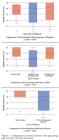
As shown in Figure 2, there was no statistically significant difference between functional outcomes and age at first diagnosis (p = 0.924), available toilet facilities (p = 0.791), and the level of disease (p = 0.624).
Discussion
In this study, a male-female ratio of 6:1 is reported; this is higher than the range of 3.3:1-4:1 reported in the United States of America,14151617
The late diagnosis of HD may negatively impact the management and outcomes of patients.189,15,19 However, it is higher than the 5% reported in Tanzania.202122,23
A single-stage transanal Swenson PT surgery is typically performed when patients present with HD within the first month of life.8
Rectosigmoid HD predominance of more than 80% has been reported in high-income countries and LMICs.1,24-27 A systematic review and meta-analysis28
This study reported a 49% complication rate; 28% of these occurred in patients who underwent examination under anaesthesia in theatre. As a routine at JPCC, patients who present with features of obstruction that may occur post-PT surgery undergo a contrast enema and an examination under anaesthesia, combined with a Botox injection or a full-thickness rectal biopsy. General anaesthesia is considered a complication under the Clavien-Dindo Classification of Surgical Complications. Excluding these patients, our complication rate was 21%. The 30-day postoperative complication rate reported in Sweden2912303132
The mortality rate in this study was 12%. This is higher than reported in Sweden (3%),33343522303637
Postoperative enterocolitis represents severe morbidity and mortality in patients with HD.38394041
In this study, a faecal soiling rate of 22% was reported. This is lower than the 29.41% in India42434445464748
While none of the children in this study reported social problems according to parental responses on a single questionnaire item, this finding should be interpreted with caution. The reliance on parental proxy reporting and the limited scope of the questionnaire's social issues question prevent definitive conclusions regarding the absence of social problems within this population. A comprehensive assessment of quality of life (QOL) employing validated instruments that encompass diverse aspects of social functioning is necessary before asserting that the participating children lack social difficulties. Davidson et al.46
In this study, 70% of patients presented with a delayed diagnosis. Despite this, 59% of patients reported excellent and 34% good continence. The continence scores observed in our study are similar to those reported in Ethiopia (57% excellent and 32% good continence); however, the authors reported a lower incidence of delayed diagnosis (57.5%).434649
The favourable functional outcomes observed in our study can be attributed, in part, to the proactive approach during the establishment of JPCC. At the time, it was known that patients presenting to JPCC presented late, predominantly had malnutrition, and came from economically disadvantaged backgrounds; this influenced us to tailor surgeries to patients' specific needs. A critical component of our intervention strategy involved implementing a staged surgical procedure, which facilitated necessary nutritional rehabilitation before definitive surgical intervention. This approach included integrating multidisciplinary support and engaging dietitians and psychologists as essential contributors to the patient's routine clinical assessments. Furthermore, establishing a dedicated caregiver follow-up communication platform that enables direct interactions with the surgical team and fosters caregiver support groups was instrumental in enhancing patient outcomes. Collectively, these factors show the importance of a comprehensive, team-oriented approach to managing the health of this vulnerable population, ultimately leading to improved clinical results.
This study has some limitations. It was done contextually at CHBAH, and the results of this study may not be generalisable to other hospitals. However, the results from this study provide important information regarding patients treated at CHBAH. Due to the study's scope, functional outcomes were assessed during the study period rather than at standardised times throughout patients' postoperative journey.
It is recommended that a longitudinal study assessing patients' improvement in bowel function and a QOL study using a validated instrument to describe patients' social problems be conducted at JPCC. More studies utilising validated instruments, such as the Rintala Bowel Function Score5010
Conclusion
The majority of HD patients at CHBAH had a delayed diagnosis and some postoperative complications following PT surgery. However, most patients had excellent to good functional bowel outcomes.
Conflict of interest
The authors declare no conflict of interest.
Funding source
There is no funding to declare.
Ethical approval
Ethical approval obtained from the Human Research Ethics Committee of the University of the Witwatersrand, ethics number M230431.
ORCID
T Thelele https://orcid.org/0000-0002-9159-7425
J Scribante https://orcid.org/0000-0002-2221-5024
C Bebington https://orcid.org/0000-0002-0234-323X
G Brisighelli https://orcid.org/0000-0002-5449-7820
REFERENCES
- 1. Ashcraft KW, Holcomb GW, Murphy JP, Ostlie DJ, editors. Ashcraft's Pediatric Surgery. 6th ed. Saunders/Elsevier; 2014.
-
2. Proctor ML, Traubici J, Langer JC, et al. Correlation between radiographic transition zone and level of aganglionosis in Hirschsprung's disease: Implications for surgical approach. J Pediatr Surg. 2003;38(5):775-8. https://doi.org/10.1016/jpsu.2003.50165.
» https://doi.org/10.1016/jpsu.2003.50165 -
3. Haricharan RN, Georgeson KE. Hirschsprung disease. Semin Pediatr Surg. 2008;17(4):266-75. https://doi.org/10.1053/j.sempedsurg.2008.07.005.
» https://doi.org/10.1053/j.sempedsurg.2008.07.005 -
4. Bai Y, Chen H, Hao J, Huang Y, Wang W. Long-term outcome and quality of life after the Swenson procedure for Hirschsprung's disease. J Pediatr Surg. 2002;37(4):639-42. https://doi.org/10.1053/jpsu.2002.31625.
» https://doi.org/10.1053/jpsu.2002.31625 - 5. Clavien PA, Sanabria JR, Strasberg SM. Proposed classification of complications of surgery with examples of utility in cholecystectomy. Surgery. 1992;5(111):518-26.
-
6. Byström C, Östlund S, Hoff N, Wester T, Granström AL. Evaluation of bowel function, urinary tract function, and quality of life after transanal endorectal pull-through surgery for Hirschsprung's disease. Eur J Pediatr Surg. 2021;31(01):040-8. https://doi.org/10.1055/s-0040-1715612.
» https://doi.org/10.1055/s-0040-1715612 -
7. Lee CC, Lien R, Chian MC, et al. Clinical impacts of delayed diagnosis of Hirschsprung's disease in newborn infants. Pediatr Neonatol. 2012;53(2):133-7. https://doi.org/10.1016/j.pedneo.2012.01.011.
» https://doi.org/10.1016/j.pedneo.2012.01.011 -
8. Georgeson KE, Cohen RD, Hebra A, et al. Primary laparoscopic-assisted endorectal colon pull-through for Hirschsprung's disease: A new gold standard. Ann Surg. 1999;229(5):678. https://doi.org/10.1097/00000658-199905000-00010.
» https://doi.org/10.1097/00000658-199905000-00010 -
9. Moore SW, Albertyn R, Cywes S. Clinical outcome and long term quality of life after surgical correction of Hirschsprung's disease. J Pediatr Surg. 1996;31(11):1496-502. https://doi.org/10.1016/S0022-3468(96)90164-5.
» https://doi.org/10.1016/S0022-3468(96)90164-5 -
10. Wester T, Granström AL. Hirschsprung disease: Bowel function beyond childhood. Semin Pediatr Surg. 2017;26(5):322-7. https://doi.org/10.1053/j.sempedsurg.2017.09.008.
» https://doi.org/10.1053/j.sempedsurg.2017.09.008 -
11. Lewit RA, Kuruvilla KP, Fu M, Gosain A. Current understanding of Hirschsprung-associated enterocolitis: Pathogenesis, diagnosis and treatment. Semin Pediatr Surg. 2022;31(2):151162. https://doi.org/10.1016/j.sempedsurg.2022.151162.
» https://doi.org/10.1016/j.sempedsurg.2022.151162 -
12. Hoff N, Wester T, Granström AL. Classification of short term complications after transanal endorectal pull-through for Hirschsprung's disease using the Clavien-Dindo grading system. Pediatr Surg Int. 2019;35(11):1239-43. https://doi.org/10.1007/s00383-019-04546-6.
» https://doi.org/10.1007/s00383-019-04546-6 -
13. Zhang Z, Li Q, Li B, Alganabi M, Li L. Long-term bowel function and paediatric health-related quality of life after transanal rectal mucosectomy and partial internal anal sphincterectomy pull-through for Hirschsprung disease. Front Pediatr. 2023;11:1099606. https://doi.org/10.3389/fped.2023.1099606.
» https://doi.org/10.3389/fped.2023.1099606 -
14. Ambartsumyan L, Smith C, Kapur RP. Diagnosis of Hirschsprung disease. Pediatr Dev Pathol. 2020;23(1):8-22. https://doi.org/10.1177/1093526619892351.
» https://doi.org/10.1177/1093526619892351 -
15. Bradnock TJ, Knight M, Kenny S, Nair M, Walker GM. Hirschsprung's disease in the UK and Ireland: Incidence and anomalies. Arch Dis Child. 2017;102(8):722-7. https://doi.org/10.1136/archdischild-2016-311872.
» https://doi.org/10.1136/archdischild-2016-311872 -
16. Bandré E, Kaboré RAF, Ouedraogo I, et al. Hirschsprung's disease: Management problem in a developing country. Afr J Paediatr Surg. 2010;7(3):166. https://doi.org/10.4103/0189-6725.70418.
» https://doi.org/10.4103/0189-6725.70418 -
17. Azad AD, Charles AG, Ding Q, Trickey AW, Wren SM. The gender gap and healthcare: Associations between gender roles and factors affecting healthcare access in Central Malawi, June-August 2017. Arch Public Health. 2020;78(1):119. https://doi.org/10.1186/s13690-020-00497-w.
» https://doi.org/10.1186/s13690-020-00497-w -
18. Ouladsaiad M. How to manage a late diagnosed Hirschsprung's disease. Afr J Paediatr Surg. 2016;13(2):82. https://doi.org/10.4103/0189-6725.182562.
» https://doi.org/10.4103/0189-6725.182562 -
19. Moore SW. Hirschsprung disease: Current perspectives. Open Access Surg [Internet]. 2016:9:39-50. https://doi.org/10.2147/OAS.S81552.
» https://doi.org/10.2147/OAS.S81552 -
20. Trinidad S, Kayima P, Kotecha V, et al. Hirschsprung's disease in low- and middle-income countries. Semin Pediatr Surg. 2022;31(2):151163. https://doi.org/10.1016/j.sempedsurg.2022.151163.
» https://doi.org/10.1016/j.sempedsurg.2022.151163 -
21. Ekenze S. Congenital obstructive bowel anomalies presenting after neonatal age. Malawi Med J. 2019;31(1):77. https://doi.org/10.4314/mmj.v31i1.13.
» https://doi.org/10.4314/mmj.v31i1.13 -
22. Mshumpela C, Brisighelli G, Westgarth-Taylor C. Devastating outcomes of traditional enemas: Unusual indications for well known operations. Eur J Pediatr Surg Rep. 2020;08(01):e3-e6. https://doi.org/10.1055/s-0039-1700957.
» https://doi.org/10.1055/s-0039-1700957 -
23. Van Andel T, Van Onselen S, Myren B, Towns A, Quiroz D. "The medicine from behind": The frequent use of enemas in Western African traditional medicine. J Ethnopharmacol. 2015;174:637-43. https://doi.org/10.1016/j.jep.2015.06.040.
» https://doi.org/10.1016/j.jep.2015.06.040 -
24. Cheung M, Kakembo N, Rizgar N, et al. Epidemiology and mortality of paediatric surgical conditions: Insights from a tertiary centre in Uganda. Pediatr Surg Int. 2019;35(11):1279-89. https://doi.org/10.1007/s00383-019-04520-2.
» https://doi.org/10.1007/s00383-019-04520-2 -
25. Chhabra S, Kenny SE. Hirschsprung's disease. Surg Oxf. 2016;34(12):628-32. https://doi.org/10.1016/j.mpsur.2016.10.002.
» https://doi.org/10.1016/j.mpsur.2016.10.002 -
26. Martucciello G. Hirschsprung's Disease, one of the most difficult diagnoses in Pediatric Surgery: A review of the problems from clinical practice to the bench. Eur J Pediatr Surg. 2008;18(3):140-9. https://doi.org/10.1055/s-2008-1038625.
» https://doi.org/10.1055/s-2008-1038625 -
27. Higashi M, Ieiri S, Toshiba R, et al. Hirschsprung's disease patients diagnosed at over 15 years of age: An analysis of a Japanese nationwide survey. Pediatr Surg Int. 2009;25(11):945-7. https://doi.org/10.1007/s00383-009-2447-2.
» https://doi.org/10.1007/s00383-009-2447-2 -
28. Laughlin DM, Friedmacher F, Puri P. Total colonic aganglionosis: A systematic review and meta-analysis of long-term clinical outcome. Pediatr Surg Int. 2012;28(8):773-9. https://doi.org/10.1007/s00383-012-3117-3.
» https://doi.org/10.1007/s00383-012-3117-3 -
29. Beltman L, Roorda D, Backes M, et al. Risk factors for short term complications graded by Clavien-Dindo after transanal endorectal pull-through in patients with Hirschsprung disease. J Pediatr Surg. 2022;57(8):1460-6. https://doi.org/10.1016/j.jpedsurg.2021.07.024.
» https://doi.org/10.1016/j.jpedsurg.2021.07.024 -
30. Mabula JB, Kayange NM, Manyama M, et ak. Hirschsprung's disease in children: A five-year experience at a University teaching hospital in northwestern Tanzania. BMC Res Notes. 2014;7(1):410. https://doi.org/10.1186/1756-0500-7-410.
» https://doi.org/10.1186/1756-0500-7-410 -
31. Ekenze SO, Ngaikedi C, Obasi AA. Problems and outcome of Hirschsprung's disease presenting after 1 year of age in a developing country. World J Surg. 2011;35(1):22-6. https://doi.org/10.1007/s00268-010-0828-2.
» https://doi.org/10.1007/s00268-010-0828-2 -
32. Van Elsland SL, Peters RPH, Grobbelaar N, et al. Paediatric ART adherence in South Africa: A comprehensive analysis. AIDS Behav. 2019;23(2):475-88. https://doi.org/10.1007/s10461-018-2235-x.
» https://doi.org/10.1007/s10461-018-2235-x -
33. Löf Granström A, Wester T. Mortality in Swedish patients with Hirschsprung disease. Pediatr Surg Int. 2017;33(11):1177-81. https://doi.org/10.1007/s00383-017-4150-z.
» https://doi.org/10.1007/s00383-017-4150-z -
34. Taguchi T, Obata S, Ieiri S. Current status of Hirschsprung's disease: Based on a nationwide survey of Japan. Pediatr Surg Int. 2017;33(4):497-504. https://doi.org/10.1007/s00383-016-4054-3.
» https://doi.org/10.1007/s00383-016-4054-3 -
35. Anderson JE, Vanover MA, Saadai P, et al. Epidemiology of Hirschsprung disease in California from 1995 to 2013. Pediatr Surg Int. 2018;34(12):1299-303. https://doi.org/10.1007/s00383-018-4363-9.
» https://doi.org/10.1007/s00383-018-4363-9 -
36. Vogel I, Eeftinck Schattenkerk LD, Venema E, et al. Major stoma related morbidity in young children following stoma formation and closure: A retrospective cohort study. J Pediatr Surg. 2022;57(10):402-6. https://doi.org/10.1016/j.jpedsurg.2021.11.021.
» https://doi.org/10.1016/j.jpedsurg.2021.11.021 -
37. Tan AYE, Deogracias JMC. Major stoma complications in paediatric patients in a tertiary hospital in a low- middle income country: A retrospective cohort study. Pediatr Surg Int. 2024;40(1):208. https://doi.org/10.1007/s00383-024-05791-0.
» https://doi.org/10.1007/s00383-024-05791-0 -
38. Duci M, Santoro L, Dei Tos AP, et al. Postoperative Hirschsprung's associated enterocolitis (HAEC): Transition zone as a putative histopathological predictive factor. J Clin Pathol. 2023:jcp-2023-209129. https://doi.org/10.1136/jcp2023-209129.
» https://doi.org/10.1136/jcp2023-209129 -
39. Engum SA, Grosfeld JL. Long-term results of treatment of Hirschsprung's disease. Semin Pediatr Surg. 2004;13(4):273-85. https://doi.org/10.1053/j.sempedsurg.2004.10.015.
» https://doi.org/10.1053/j.sempedsurg.2004.10.015 -
40. Gosain A, Frykman PK, et al. Guidelines for the diagnosis and management of Hirschsprung-associated enterocolitis. Pediatr Surg Int. 2017;33(5):517-21. https://doi.org/10.1007/s00383-017-4065-8.
» https://doi.org/10.1007/s00383-017-4065-8 -
41. Zhang X, Sun D, Xu Q, et al. Risk factors for Hirschsprung disease-associated enterocolitis: A systematic review and meta-analysis. Int J Surg. 2023;109(8):2509-24. https://doi.org/10.1097/JS9.0000000000000473.
» https://doi.org/10.1097/JS9.0000000000000473 -
42. Aravind KL, Nisha N, Sushmitha R, Madiwal C. Duhamel's procedure for Hirschsprung's disease and the functional outcome in a tertiary care centre. Indian J Child Health. 2021;8(1):51-5. https://doi.org/10.32677/IJCH.2021.v08.i01.010.
» https://doi.org/10.32677/IJCH.2021.v08.i01.010 -
43. Wondemagegnehu BD, Andargie A. Postoperative bowel function in children operated for Hirschsprung's disease in a low-income setting: Institution-based cross-sectional study. J Child Health Care. 2024:13674935241289159. https://doi.org/10.1177/13674935241289159.
» https://doi.org/10.1177/13674935241289159 -
44. Raghunath SM, Maniam R, Dhanasekarapandian V, Govindarajan H. Assessment of functional outcome following Duhamel retro-rectal pull-through surgery for Hirschsprung's disease: A follow-up study. J Coloproctology. 2023;43(04):e271-e275. https://doi.org/10.1055/s-0043-1776891.
» https://doi.org/10.1055/s-0043-1776891 -
45. Zimmer J, Tomuschat C, Puri P. Long-term results of transanal pull-through for Hirschsprung's disease: A meta-analysis. Pediatr Surg Int. 2016;32(8):743-9. https://doi.org/10.1007/s00383-016-3908-z.
» https://doi.org/10.1007/s00383-016-3908-z -
46. Davidson JR, Kyrklund K, Eaton S, et al. Long-term surgical and patient-reported outcomes of Hirschsprung Disease. J Pediatr Surg. 2021;56(9):1502-11. https://doi.org/10.1016/j.jpedsurg.2021.01.043.
» https://doi.org/10.1016/j.jpedsurg.2021.01.043 -
47. Koopman JS. Diarrhea and school toilet hygiene in Cali, Colombia. Am J Epidemiol. 1978;107(5):412-20. https://doi.org/10.1093/oxfordjournals.aje.a112559.
» https://doi.org/10.1093/oxfordjournals.aje.a112559 -
48. Khumalo TP, Schönfeldt HC, Vermeulen H. Consumer acceptability and perceptions of maize meal in Giyani, South Africa. Dev South Afr. 2011;28(2):271-81. https://doi.org/10.1080/0376835X.2011.570074.
» https://doi.org/10.1080/0376835X.2011.570074 -
49. Pini Prato A, Erculiani M, Novi ML, et al. Delayed diagnosis in Hirschsprung disease. Pediatr Surg Int. 2024;40(1):65. https://doi.org/10.1007/s00383-024-05657-5.
» https://doi.org/10.1007/s00383-024-05657-5 -
50. Neuvonen MI, Kyrklund K, Rintala RJ, Pakarinen MP. Bowel function and quality of life after transanal endorectal pull-through for Hirschsprung disease: Controlled outcomes up to adulthood. Ann Surg. 2017;265(3):622-9. https://doi.org/10.1097/SLA.0000000000001695.
» https://doi.org/10.1097/SLA.0000000000001695