Extralevator abdominoperineal excision for low rectal cancer: oncological outcome after five-year follow-up
Abstract
BACKGROUND: Extralevator abdominoperineal excision (ELAPE) is a surgical technique that is indicated for low rectal cancer where sphincter preservation is not possible. Compared to conventional abdominoperineal excision major advantages of ELAPE are the risk reduction of intraoperative bowel perforation and positive circumferential margin which lead to a better oncological outcome. The aim of this study was to present our results in ELAPE surgeryMETHODS: From February 2011 to February 2015, 40 patients underwent surgery for low rectal cancer at the Oncology Institute of Vojvodina. The collected data included sex, age, preoperative staging, neoadjuvant treatment, operative time, rate of intraoperative bowel perforation, rate of positive circumferential resection margins, histopathological analysis, postoperative mortality, tumour, node and metastasis (TNM) classification, local recurrence (LR) rate and presence of distant metastasesRESULTS: Positive circumferential margin was found in three (7.5%) patients while eight (20%) patients had intraoperative bowel perforation. LR during follow-up was seen in seven (17.5%) patients, three of them had intraoperative bowel perforation and two patients had positive circumferential margin. The estimated five-year cumulative incidence of LR is 7%. Distant metastases occurred in 18 (45%) patients. The estimated five-year survival rate is 62%CONCLUSION: The study shows satisfactory five-year survival rates of 62% in a highly complex patient group treated by ELAPE procedure
rectal cancer; extralevator abdominoperineal excision; local recurrence; overall survival
Introduction
The introduction of new surgical techniques in rectal cancer surgery such as low anterior rectal resection (LAR), total mesorectal excision (TME) and extralevator abdominoperineal excision (ELAPE) resulted in a lower recurrence rate, the decrease of postoperative urinary and sexual dysfunction and overall survival rate improvement in this cohort.1,2
ELAPE as a technique was promoted and popularised mostly by Prof. T Holm at the University of Karolinska, Sweden, in 2000 and was subsequently adopted mainly in Western Europe.34-6
At the Oncology Institute of Vojvodina, this technique has been used since 2011 after one surgeon attended an educational programme at the University of Karolinska, Sweden. Our hospital is the only one in Serbia that performs this procedure as a standard approach in low and locally advanced rectal cancer, in addition to conventional abdominoperineal rectal excision (APE). Due to excellent visibility of surgical planes in the perineal phase, great position for the surgeon and the whole team and the better teaching and assisting possibilities, we consider ELAPE a much better option than APE.
This surgical technique is indicated in patients with low rectal cancer where sphincter preservation is not possible. Various studies have shown better short-term oncological outcomes compared to standard APE.7,8
The advantage of the ELAPE procedure lies in the reduction of intraoperative perforation (IOP) and positive circumferential margin (CRM) when compared to conventional APE. This is mainly due to the better visibility of surgical planes since patients are in a prone position during the surgery.9
The purpose of the study was to show a single institutional experience with ELAPE in a prone position with analysis of surgical and oncological outcome.
Methods
The data was collected prospectively from 40 patients who underwent ELAPE procedure for low rectal cancer in the period from February 2011 to February 2015.
The open ELAPE procedure was mainly performed in primary tumours and in 4/40 cases due to the local recurrence (LR) after previous low anterior resections (LARs).
Preoperative diagnostics included digital rectal exam, colonoscopy with biopsy, pathohistological verification of rectal cancer, endorectal ultrasound, pelvic MRI, and abdominal and chest CTs. The treatment protocol was reviewed by a multidisciplinary team comprised of a medical oncologist, a radiotherapist and a surgeon. Ultimately, the shared decision-making approach was implemented. It included a risk and benefit assessment of the treatment options, for each patient individually.
Registered data included sex, age, preoperative stage of tumour, administration of neoadjuvant therapy, operative time, intraoperative bowel perforation, histopathological analysis, presence of positive circumferential resection margins, postoperative mortality, TNM classification and presence of distant metastases.
Neoadjuvant treatment (chemo-radiotherapy or CRT) was applied according to the protocol which involved the usage of 5 FU/LV and radiotherapy at a dose of 50 Gy (25 x 2 Gy) or a short course with 25 Gy (5 x 5 Gy) in patients with locally advanced tumours. Restaging was performed six to eight weeks after CRT with pelvic MRI, CT of the abdomen and chest. Patients without the metastatic disease were operated by ELAPE procedure eight to twelve weeks after CRT. Patients with preoperative verified metastases were excluded from the study.
The abdominal part of the ELAPE surgical procedure involves the TME to the lower border of the coccyx, posteriorly, the autonomic nerves inferiorly, and to the level of vesicles in men or the vaginal fornix in women in anterior and lateral directions. The split left colon is brought out to form a colostomy. Following the abdominal section of the open surgery, the perineal part was performed in the prone position. After dissection in the extralevator plane, the external sphincter and levator muscles were excised en bloc with the rectum and mesorectum to create a more cylindrical specimen without a waist. The tip of the coccyx was excised routinely in all patients. The reconstruction of the pelvic floor was performed with the combination of omentum and polypropylene, composite or biological mesh.10,11
Postoperative follow-up included routine medical checkups, rectal examination, proctoscopy, and carcinoembryonic antigen (CEA) and carbohydrate antigen 19-9 (CA) tumour markers. The follow-ups were scheduled for every 3 months during the first year, twice per year for the second and third postoperative year and annually after that. The routine, annual check-ups included a colonoscopy, tumour markers (CEA, CA 19-9), MRI of the abdomen and pelvis and a chest CT.
The study analysed the incidence of IOP, positive CRM and overall 5-year survival. We reviewed how many patients ended up developing LR, distant metastases, how many had received neoadjuvant therapy and at what stage of the tumour they were at.
Data was presented as numbers with corresponding percentages, and the difference was determined by chi-square and Fisher's exact test. Age was presented as the median (IKR 25-75 percentile), time of surgery was presented as the mean values and the difference in mortality was determined using the Mann-Whitney U test. Overall survival was calculated using the Kaplan-Meier method. Follow-up time was represented as the time elapsed since the initial surgery. For statistical analysis, we used the IBM SPSS Statistics 20 programme.
Results
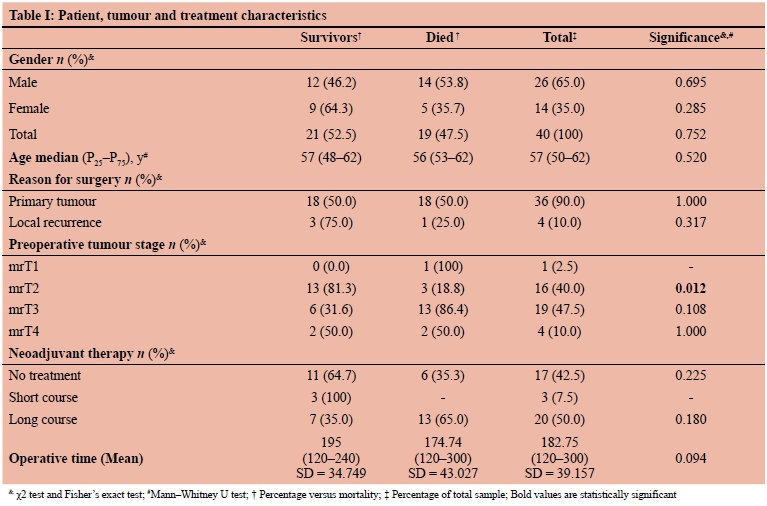
The characteristics of patients operated by ELAPE surgical procedure are shown in Table I. In our study, 14 out of 40 (35%) patients were women and the median age was 57 (range 39-81). During follow-up, 21 patients (52.5%) survived. In 36 patients (90%), the primary rectal cancer was the indication for surgery. For the remaining four (10%), the indication for surgery was LR after a previous LAR. Preoperative staging revealed 17 patients (42.5%) with mrT1-T2 tumour and 23 (57.5%) with mrT3-T4 (treated by neoadjuvant irradiation). The long course of radiotherapy, at a dose of 50 Gy (25 x 2 Gy) was received by 20 (50%) patients, while short course radiotherapy at a dose of 25 Gy (5 x 5 Gy) was implemented on three (7.5%) patients. There was a statistically significant difference in the survival rate of mrT2 patients (p < 0.05) when compared to other mrT stages, where 13 out of 16 patients (81.3%) survived. The mean operative time (measured in minutes) was 182.75 (range 120-300; SD = 39.157). A statistically significant difference in gender mortality rates was found (%2 = 4.263; df = 1; p = 0.039). Half of the deceased patients died within the first two years of follow-up (Table I).
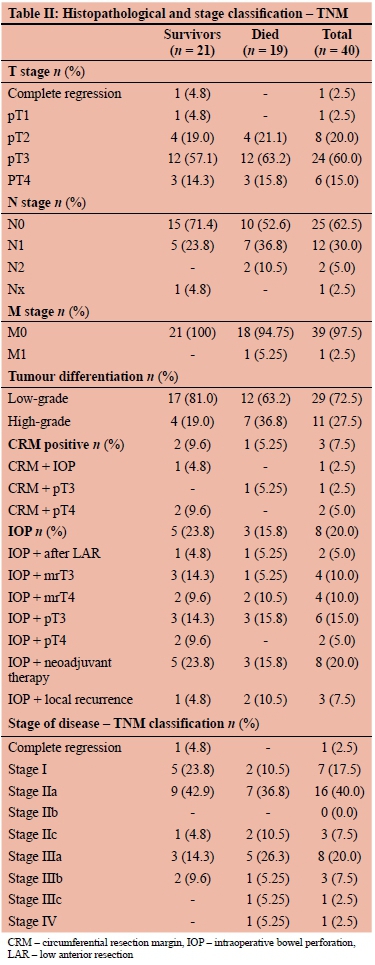
Positive CRM was found in three (7.5%) patients (one patient had pT3 and two patients had pT4 tumour). Within this group one patient also had IOP. Two patients who had positive CRM survived during the follow-up with no signs of LR. Low-grade tumours were found in 29 (72.5%) patients. In this study nine (22.5%) patients had pT1-T2, 24 (60%) had pT3 and six (15%) patients had pT4. There were no statistically significant differences (p > 0.05) in mortality rates. Complete histopathological regression was verified in one (2.5%) patient. pN0 tumour stage was found in 25 (62,5%) patients, while 14 (35%) had lymph node metastases. Intraoperative bowel perforation was verified in eight (20%) patients, two (25%) of which underwent surgery because of LR after previous LAR. All patients with IOP had locally advanced rectal cancer (T3 or T4). Preoperative radiological staging confirmed that four (10%) patients had mrT3 stage cancer, while the other four (10%) patients had mrT4 stage tumour. Postoperative histopathological findings showed that six (15%) patients had pT3, while the other two (5%) had pT4 stage tumour. Comparison of preoperative mrT staging in relation to postoperative pT stage, indicates a low therapeutic tumour response to CRT (only two patients responded to radiation by reducing tumours from T4 to T3) and this might be the reason for IOP in this subgroup of patients. LR was developed in three patients with IOP (7.5% of the total number of patients). During follow-up, five (62.5%) patients with IOP survived, while the other three (37.5%) patients died due the appearance of metastases in liver and lungs (Table II).
TNM classification is shown in Table II. The highest percentage (40%) of patients were in Stage IIa.
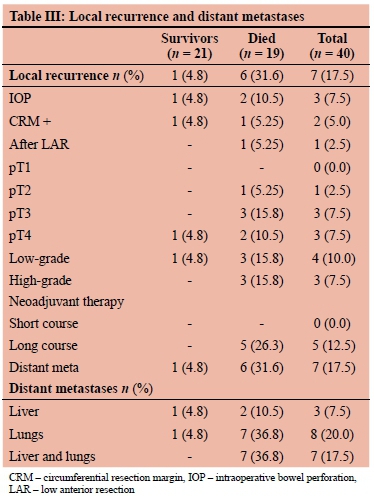
LR appeared in seven (17.5%) patients, three (7.5%) had an intraoperative perforation of the bowel and two (5%) patients had positive CRM. LR also occurred in one patient whose cause of surgery was LR after LAR. Out of seven of our patients with LR, one (2.5%) had pT2, three (7.5%) had pT3 tumour and three (7.5%) had pT4 tumour. High-grade tumour differentiation had three (7.5%) patients. Neoadjuvant therapy (50 Gy radiotherapy) was received by five (12.5%) patients who developed LR and they did not survive. In our sample group, all patients who developed LR got distant metastases, but only one patient survived (Table III).
Distant metastases were diagnosed in 18 (45%) patients. Liver metastases were confirmed in three (7.5%) patients, lung metastases in eight (20%), while both liver and lung metastases were reported in seven (17.5%) patients. Out of 19 deceased patients, 16 (84.25%) had distant metastases (Table III).
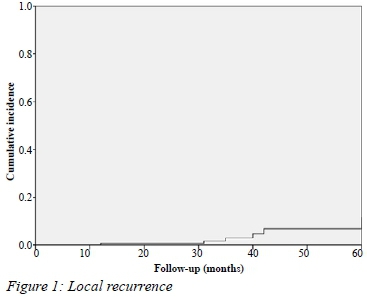
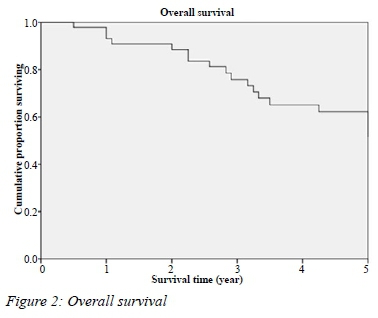
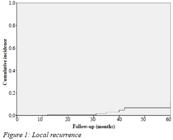
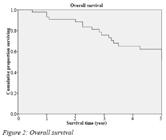
The estimated cumulative incidence of local relapse in five-year period is 7% (Figure 1). The overall five-year survival was 62% (Figure 2).
Discussion
The introduction of total mesorectal excision and neo-adjuvant radiotherapy has indisputably improved the outcome of oncological treatment in low rectal cancer.12-14 Results and prognosis have shown to be better in patients who undergo LAR. Few studies have shown poorer prognosis and survival rate after APE in comparison to LAR.15 16,17 The main problems cited are IOP and positive CRM, which in the case of ELAPE surgical technique are present significantly less relative to APE.1819
A retrospective cohort study by Hanif et al., confirms the previously mentioned advantages of ELAPE procedures, with one disadvantage present - that it shows the short-term results only in a relatively small number of patients.20 p < 0.001). The mean of operative time in our study is 182.75 (range 120-300; SD = 39.157).21
Similar results were found by the multicentre analysis of West et al. which compared 176 ELAPE European colorectal surgical procedures with 124 standard APE performed at UK centres.2223
Recommendation for the use of ELAPE technique in patients with low rectal cancer was also made by Zhang et al. Their meta-analysis included 17 studies with 3 479 patients.24
Our study did not find a statistically significant correlation between IOP and positive CRM with the rates of LR. This study found that three (7.5%) patients who developed LR had IOP. Most patients underwent neoadjuvant therapy with histopathological findings of postoperative T3 and T4 tumour stages and almost half of them had a high-grade tumour differentiation.2425 26
In our study, the estimated LR rate over a five-year period was 7%. LR had seven or 17.5% patients. The overall five-year survival rate was 62%. Distant metastases had 18 (45%) patients. Similar results were reported by Palmer et al. in a study involving 193 patients: the estimated LR rate, during the five-year period, was 6% and the overall five-year survival rate was 60%. Distant metastases had 61 or 33% of patients in this study.27
Study limitations
The limitation of this study is a small number of analysed patients. Therefore, a larger sample size is needed, longer follow-up and comparison with the standard APE to analyse surgical and oncological advantages/disadvantages of this procedure.
Conclusion
This study found satisfactory five-year survival rates of 62% in the highly complex patient group treated by ELAPE procedure. Excellent visualisation of the operative field enables a more advanced education of the residents, with a shorter learning curve and faster mastering of this demanding surgical technique. Extralevator plane of dissection with greater resection of the perineal structures during the procedure may have oncological benefit but this has to be proven in large, multi-centric randomised trials.
Conflict of interest
The authors declare no conflict of interest.
Funding source
The author(s) received no financial support for the research, authorship, and/or publication of this article.
Ethical approval
Ethical approval was obtained from Oncology Institute of Vojvodina Research Ethics Committee 4/20/2-2406/2-6
ORCID
A Dermanovic https://orcid.org/0000-0002-0678-9837
Z Radovanovic https://orcid.org/0000-0002-9609-195X
D Lukic https://orcid.org/0000-0003-3742-4774
M Duric https://orcid.org/0000-0002-8337-6534
M Kresoja https://orcid.org/0000-0002-1442-9495
D Golijanin https://orcid.org/0000-0001-7282-1893
REFERENCES
-
1. Shihab O, Brown G, Daniels I, et al. Patients with low rectal cancer treated by abdominoperineal excision have worse tumours and higher involved margin rates compared with patients treated by anterior resection. Dis Colon Rectum. 2010;53(1):53-6. https://doi.org/10.1007/DCR.0b013e3181c70465.
» https://doi.org/10.1007/DCR.0b013e3181c70465 -
2. Maurer C, Z'Graggen K, Renzulli P, et al. Total mesorectal excision preserves male genital function compared with conventional rectal cancer surgery. Brit J Surg. 2001;88(11):1501-5. https://doi.org/10.1046/j.0007-1323.2001.01904.x.
» https://doi.org/10.1046/j.0007-1323.2001.01904.x -
3. Shihab O, Heald R, Holm T, et al. A pictorial description of extralevator abdominoperineal excision for low rectal cancer. Color Dis. 2012;14(10):e655-e660. https://doi.org/10.1111/j.1463-1318.2012.03181.x.
» https://doi.org/10.1111/j.1463-1318.2012.03181.x - 4. Koszarowski T, Qotkowski K, Oszacki J. Surgical treatment of rectal carcinoma. Pol Przegl Chir. 1956;28:745-52 [in Polish].
- 5. Koszarowski T. Evaluation of indications and results of various operative procedures used for the surgical treatment of rectal cancer. Pol Przegl Chir. 1964;36:315-24.
-
6. Bçbenek M. Abdominosacral amputation of the rectum for low rectal cancers - ten years of experience. Ann Surg Oncol. 2009;16(8):2211-7. https://doi.org/10.1245/s10434-009-0517-2.
» https://doi.org/10.1245/s10434-009-0517-2 -
7. Winter D. Extralevator abdominoperineal resection for low rectal cancer. Arch Surg. 2010;145(9):811. https://doi.org/10.1001/archsurg.2010.174.
» https://doi.org/10.1001/archsurg.2010.174 -
8. Han J, Wang Z, Wei G, et al. Randomised clinical trial of conventional versus cylindrical abdominoperineal resection for locally advanced lower rectal cancer. Am J Surg. 2012;4(3):274-82. https://doi.org/10.1016/j.amjsurg.2012.05.001.
» https://doi.org/10.1016/j.amjsurg.2012.05.001 -
9. West N, Finan P, Anderin C, et al. Evidence of the oncologic superiority of cylindrical abdominoperineal excision for low rectal cancer. J Clin Oncol. 2008;26(21):3517-22. https://doi.org/10.1200/jco.2007.14.5961.
» https://doi.org/10.1200/jco.2007.14.5961 -
10. Holm T, Ljung A, Häggmark T, et al. Extended abdominoperineal resection with gluteus maximus flap reconstruction of the pelvic floor for rectal cancer. Brit J Surg. 2007;94(2):232-8. https://doi.org/10.1002/bjs.5489.
» https://doi.org/10.1002/bjs.5489 -
11. Tao Y, Han J, Wang Z. Extralevator abdominoperineal excision for advanced low rectal cancer - where to go. World J Gastroenterol. 2020;26(22):3012-23. https://doi.org/10.3748/wjg.v26.i22.3012.
» https://doi.org/10.3748/wjg.v26.i22.3012 - 12. Heald R, Moran B, Ryall R, et al. Rectal cancer. Arch Surg. 1998;133(8):894-9.
- 13. Higgins G, Humphrey E, Dwight R, et al. Preoperative radiation and surgery for cancer of the rectum. VASOG trial II. Cancer. 1986;58:352-9.
-
14. Chan A, Wong A, Langevin J, et al. Preoperative chemotherapy and pelvic radiation for tethered or fixed rectal cancer - a phase II dose escalation study. Int J Radiat Oncol. 2000;48(3):843-56. https://doi.org/10.1016/s0360-3016(00)00692-1.
» https://doi.org/10.1016/s0360-3016(00)00692-1 -
15. Anderin C, Martling A, Hellborg H, et al. A population-based study on outcome in relation to the type of resection in low rectal cancer. Dis Colon Rectum. 2010;53(5):753-60. https://doi.org/10.1007/DCR.0b013e3181cf7e27.
» https://doi.org/10.1007/DCR.0b013e3181cf7e27 -
16. De Nardi P, Summo V, Vignali A, et al. Standard versus extralevator abdominoperineal low rectal cancer excision outcomes: a systematic review and meta-analysis. Ann Surg Oncol. 2015;22(9):2997-3006. https://doi.org/10.1245/s10434-015-4368-8.
» https://doi.org/10.1245/s10434-015-4368-8 -
17. Shen Z, Bu Z, Li A, et al. Multicentre study of surgical and oncologic outcomes of extra-levator versus conventional abdominoperineal excision for lower rectal cancer Eur J Surg Oncol. 2020;46(1):115-22. https://doi.org/10.1016/j.ejso.2019.08.017.
» https://doi.org/10.1016/j.ejso.2019.08.017 - 18. Stelzner S, Koehler C, Stelzer J, et al. Extended abdominoperineal excision vs. standard abdominoperineal excision in rectal cancer - a systematic overview. Int J Colorectal Dis. 2011;26(10):1227-40.
-
19. Krishna A, Rickard M, Keshava A, et al. A comparison of published rates of resection margin involvement and intraoperative perforation between standard and 'cylindrical' abdominoperineal excision for low rectal cancer. Color Dis. 2012;15(1):57-65. https://doi.org/10.1111/j.1463-1318.2012.03167.x.
» https://doi.org/10.1111/j.1463-1318.2012.03167.x -
20. Hanif Z, Bradley A, Hammad A, et al. Extralevator abdominoperineal excision (Elape) - a retrospective cohort study. Ann Med Surg. 2016;10:32-5. https://doi.org/10.1016/j.amsu.2016.07.016.
» https://doi.org/10.1016/j.amsu.2016.07.016 -
21. Qi X, Cui M, Liu M, et al. Extralevator abdominoperineal excision versus abdominoperineal excision for low rectal cancer. Chin Med J. 2019;132(20):2446-56. https://doi.org/10.1097/CM9.0000000000000485.
» https://doi.org/10.1097/CM9.0000000000000485 -
22. West N, Anderin C, Smith K, et al. Multicentre experience with extralevator abdominoperineal excision for low rectal cancer. Brit J Surg. 2010;97(4):588-99. https://doi.org/10.1002/bjs.6916.
» https://doi.org/10.1002/bjs.6916 -
23. Carpelan A, Karvonen J, Varpe P, et al. Extralevator versus standard abdominoperineal excision in locally advanced rectal cancer - a retrospective study with long-term follow-up. Int J Colorectal Dis. 2018;33(4):375-81. https://doi.org/10.1007/s00384-018-2977-y.
» https://doi.org/10.1007/s00384-018-2977-y - 24. Zhang Y, Wang D, Zhu L, et al. Standard versus extralevator abdominoperineal excision and oncologic outcomes for patients with distal rectal cancer.Medicine. 2017;96(52):e9150. https://doi.org/10.1097/MD.0000000000009150.
-
25. Prytz M, Angenete E, Bock D, et al. Extralevator abdominoperineal excision for low rectal cancer - extensive surgery to be used with discretion based on 3-year local recurrence results. Ann Surg. 2016;263(3):516-21. https://doi.org/10.1097/SLA.0000000000001237.
» https://doi.org/10.1097/SLA.0000000000001237 -
26. Martijnse I, Dudink R, West N, et al. Focus on extralevator perineal dissection in supine position for low rectal cancer has led to better quality of surgery and oncologic outcome. Ann Surg Oncol. 2011;19(3):786-93. https://doi.org/10.1245/s10434-011-2004-9.
» https://doi.org/10.1245/s10434-011-2004-9 -
27. Palmer G, Anderin C, Martling A, et al. Local control and survival after extralevator abdominoperineal excision for locally advanced or low rectal cancer. Color Dis. 2014;16(7):527-32. https://doi.org/10.1111/codi.12610.
» https://doi.org/10.1111/codi.12610