Damage control surgery of the critical Jehovah's Witness patient - a narrative review
Abstract
South Africa has a high burden of trauma related injuries with haemorrhage remaining a leading treatable complication of trauma. Expedient management of haemorrhage serves to reduce patient morbidity and mortality. Damage control surgery aims to minimise haemorrhage, contain contamination, and allow restoration of physiology in an intensive care unit (ICU) before proceeding to definitive surgery. Over time, damage control surgery has found favour in non-trauma-related surgeries in unstable patients. The Jehovah's Witness (JW) religion believes that blood is sacred and strictly do not consent to blood or blood product transfusions, including in emergency settings. Thus, the management of a bleeding or bled-out JW patient proves to be a unique challenge in modern medicine. For the JW patient who is undergoing damage control surgery, the primary goal is to win time for recovery of the haemoglobin level by maintaining adequate oxygen delivery to tissues. We review the multiple methods available to optimise haemodynamic stability in a bleeding JW patient. These include techniques aimed at (i) minimising blood loss, (ii) optimising oxygen delivery (DO2), (iii) optimising oxygen consumption (VO2), and (iv) correction of coagulopathy. The management of haemorrhage in the JW patient remains challenging. It is imperative for healthcare professionals to be aware of all options available when treating these patients in order to provide optimal treatment whilst maintaining respect for their beliefs.
damage control surgery; Jehovah's Witness; trauma-related injuries
Introduction
Trauma contributes significantly to morbidity and mortality worldwide.11,2 Most of these injuries occur as a result of violence and traffic incidents. For every one mortality, there are approximately 10-30 trauma survivors.2
Haemorrhage is one of the treatable complications of trauma. Expedient management of haemorrhage serves to reduce patient morbidity and mortality. Damage control surgery, an approach suggested in the early 1900s to reduce haemorrhage following liver trauma, was resurrected in civilian trauma centres in the late twentieth century.34
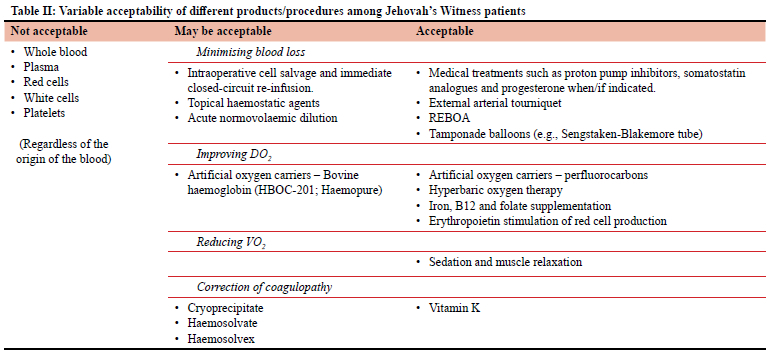
The Jehovah's Witness (JW) religion was established in 1881 and has approximately 7.8 million followers worldwide. The religion believes that blood is sacred and that blood itself can be a conveyor of sin from one individual to the next. The blood of Christ, however, is deemed holy and serves as a potential for salvation. Given these beliefs, JW strictly do not consent to blood transfusions, including in emergency settings.5
Thus, the management of a bleeding or bled-out JW patient proves to be a unique challenge in modern medicine. A challenge which can be met with appropriate prehospital management, damage control resuscitation and postoperative critical care.
Important aspects of the prehospital care that may influence your ongoing resuscitation include any history of active arterial bleeding, use of an external arterial tourniquet and any early administration of medical measures to limit blood loss (e.g., tranexamic acid or topical haemostatic agents). Furthermore, given the variability of acceptance of blood-related products and/or procedures to the JW patient, any advanced directive or in-person consent given to the paramedic on scene should be sought.
For the JW patient who is undergoing damage control surgery, the primary goal is to win time for recovery of the haemoglobin level by maintaining adequate oxygen delivery to cellular level.678
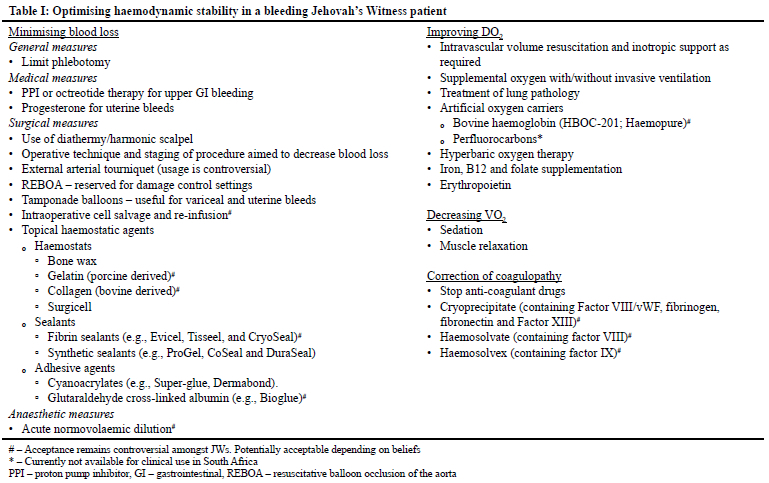
Optimising haemodynamic stability in a bleeding JW patient should involve the following four specific goals: (i) minimising blood loss, (ii) optimising oxygen delivery (DO2), (iii) optimising oxygen consumption (VO2) and (iv) correction of coagulopathy (Table I).5
Minimising blood loss
Surgical measures
The crux of surgical measures to decrease blood loss rests on meticulous attention to haemostasis. Surgical techniques to minimise blood loss may include use of diathermy and/ or ultrasonic scalpels for dissection.910
The application of an external arterial tourniquet remains controversial,1112
The resuscitative balloon occlusion of the aorta (REBOA) is an established method used to control bleeding in the damage control setting413
The use of tamponade balloons such as the oesophageal Sengstaken-Blakemore tube for an upper gastrointestinal bleed,145
The use of intraoperative cell salvage and autologous blood transfusion has become an important method of minimising blood loss.15151617
A wide variety of topical haemostatic agents exist and their role in minimising blood loss is well established.1816 5,10,16 Topical haemostatic agents may be classified into three broad areas: (i) haemostats, (ii) sealants and (iii) adhesives (Table II).19
Haemostats may be mechanical or active in nature
Mechanical agents which form a physical obstacle to the flow of blood or provide a physical matrix for clot initiation.18 18 18,19
Active agents contain thrombin which converts fibrinogen into fibrin for effective haemostasis.19
Sealants may be fibrin (animal derived) or synthetic in nature
Fibrin sealants (e.g., Evicel, Tisseel, and CryoSeal) are derived from human or animal blood products.1918
Synthetic sealants (ProGel, CoSeal and DuraSeal) are composed of polyethylene glycol polymers and at least one additional (non-human/non-animal derived) component. These agents form a mechanical sealant to tissue fluids, as well as a barrier to cell ingrowth.18
Adhesive agents include cyanoacrylates and glutaraldehyde cross-linked albumin
Cyanoacrylates (e.g., Super-glue, Dermabond) are synthetic liquid monomers that rapidly form polymers in the presence of a minimal quantity of water and thereby quickly glue adjacent surfaces together.1814
Glutaraldehyde cross-linked albumin (e.g., Bioglue) consists of a 10% glutaraldehyde solution and a 45% bovine serum albumin solution which are mixed upon administration.1819
General measures to reduce anaemia
Cumulative blood loss from regular phlebotomy can be a significant contributor to the development of anaemia.20 21 2122
Medical measures
Common occurring bleeding conditions such as peptic ulcers should be prevented and managed using proton pump inhibitors (PPIs) with the potential use of a somatostatin analogue (e.g., Octreotide®) in the treatment of a variceal bleed.1423
Anaesthetic measures
The actively bleeding patient warrants prompt and guided therapy. The surgeon aims to control or stop the haemorrhage, whilst the anaesthetist aims to minimise loss whilst cautiously promoting oxygen delivery to essential organs often utilising permissive hypotensive techniques. These permissive hypotensive techniques have been shown to minimise intraoperative blood loss in patients who refuse allogenic blood transfusions.242526,27
Acute normovolaemic dilution is another technique that may be considered to minimise blood loss. It involves the removal of whole blood from a patient preoperatively and replacing the intravascular volume with a crystalloid fluid. The removed whole blood may then be later re-infused once haemostasis has been achieved. This manoeuvre dilutes haematocrit and therefore decreases the intraoperative red cell loss.2829
Optimising oxygen delivery (DO2)
Delivery of oxygen at a tissue level is dependent on multiple factors defined in the following equation: Oxygen delivery = cardiac output x (1.39 x Hb x oxygen saturation) + (0.003 x PaO2).22
During damage control surgery in the JW patient, optimisation of haemoglobin level may not be possible. Cardiac output can be optimised by intravascular volume resuscitation (preload) together with the use of inotropic support as required.302).3031
Technological advancement has led to the development of artificial oxygen carriers which may be an alternative to blood transfusion in the JW patient. Research into these agents is ongoing. Two major categories of oxygen carriers are currently being investigated for use in humans: haemoglobin-based oxygen carriers (HBOCs) and perfluorocarbons (PFCs).632 32 16,22 Unlike HBOCs, PFCs are not animal or human derived and are completely synthetic. By design they are able to dissolve large amounts of oxygen and thus provide tissue oxygenation.22
Other methods that have been used to improve delivery of oxygen in the JW patient include hyperbaric oxygen therapy, iron, vitamin B12 and folate supplementation, and erythropoietin stimulation of red cell production.5
Optimising oxygen consumption (VO2)
In addition to minimising bleeding and optimising oxygen delivery, anaemia tolerance can be improved by optimising oxygen consumption at a tissue level.
Active or passive cooling to achieve mild intraoperative hypothermia (34-36 °C) has been used in JW patients as a means of decreasing oxygen demand.5,30,33 However, even mild hypothermia (< 1 °C) has been shown to significantly increase blood loss and transfusion requirements.34 352 do not outweigh the side effects of its use.
Sedation may be used during the damage control resuscitation and intraoperatively to reduce oxygen consumption. The use of propofol, midazolam, opioids, or thiopentone to produce a clinically desirable level of sedation in spontaneously breathing patients has been shown to reduce VO2 by 10-15%36,37 and thus improve the JW patient's tolerance of anaemia. The use of neuromuscular blockage may also serve to decrease the oxygen requirements of respiratory effort and is commonly used intraoperatively.33
Correction of coagulopathy
Management of coagulopathy is a tenet of damage control resuscitation.35528165,38 As these preparations are directed at treating more specific factor deficiencies, they do not contain all the coagulation factors and are therefore less effective in correcting global coagulation factor deficiencies.2855,28 Desmopressin (DDAVP) is a synthetic analogue of the antidiuretic hormone vasopressin and is acceptable to the JW patient. DDAVP increases hepatic release of factor VIII and endothelial release of tissue plasminogen activator and von Willebrand factor (VWF).394041
Legal rights and consent in South Africa
Consent and refusal of components of treatment are issues that may occur during the emergency management of a JW patient. An adult (age > 18 years old) of sound decisional capacity may refuse (in part or all) life-saving treatment with blood or blood products as per their belief.4243
The key principle in the care of the JW patient who is a minor is that the child's best interests are paramount. Factors that may need to be taken into consideration, bearing in mind that they may conflict with each other include: the maturity of the child concerned, the wishes and opinions of the parents/guardian and the clinical condition of the child. In the emergency setting in which the injured child and/or the parent/guardian are refusing the life-saving administration of blood or blood products to a minor, the HPCSA guidance states that a healthcare practitioner may treat the child, provided it is in the child's best interests and that the treatment given is "limited to treatment which is reasonably required in [the] emergency."444412 and folate supplementation, and erythropoietin stimulation of red cell production can be used.5
Conclusion
The management of haemorrhage in the JW patient remains challenging. However, the resurrection of previous practices and the advent of new medical, haemostatic and surgical therapies has mitigated some of these challenges. It is imperative for healthcare professionals to be aware of all options available when treating these patients; especially as knowledge of available treatment modalities will reduce morbidity and mortality in this population group whilst maintaining respect for their beliefs.
The JW Hospital Liaison Committee Network offers a free service to healthcare professionals who treat JW patients. This service is available 24 hours a day and is useful when navigating issues of consent and counselling. They may be contacted by telephone: +27 83 226 5959 or email:
Conflict of interest
The authors declare no conflict of interest.
ORCID
REFERENCES
-
1. Nicol A, Knowlton LM, Schuurman N, et al. Trauma surveillance in Cape Town, South Africa: an analysis of 9236 consecutive trauma centre admissions. JAMA Surg. 2014;149(6):549-56. https://doi.org/10.1001/jamasurg.2013.5267.
» https://doi.org/10.1001/jamasurg.2013.5267 - 2. Hardcastle T, Oosthuizen G, Clarke D, Lutge E. Trauma a preventable burden of disease in South Africa - review of the evidence with a focus on KZN. In: Padarath A, King J, Mackie EL, Casciola J, editors. South African Health Review. Durban: Health Systems Trust; 2016.
-
3. Benz D, Balogh ZJ. Damage control surgery: current state and future directions. Curr Opin Crit Care. 2017;23(6):491-7. https://doi.org/10.1097/MCC.0000000000000465.
» https://doi.org/10.1097/MCC.0000000000000465 -
4. Ordonez CA, Parra MW, Serna JJ, et al. Damage control resuscitation: REBOA as the new fourth pillar. Colomb Med. 2020;51(4):1-12. https://doi.org/10.25100/cm.v51i4.4353.
» https://doi.org/10.25100/cm.v51i4.4353 -
5. Lawson T, Ralph C. Perioperative Jehovah's Witnesses: a review. Br J Anaesth. 2015;115:676-87. https://doi.org/10.1093/bja/aev161.
» https://doi.org/10.1093/bja/aev161 -
6. Berend K, Levi M. Management of adult Jehovah's Witness patients with acute bleeding. J Med. 2009;122:1071-6. https://doi.org/10.1016/j.amjmed.2009.06.028.
» https://doi.org/10.1016/j.amjmed.2009.06.028 - 7. Intaglietta M. Microcirculatory basis for the design of artificial blood. Microcirculation. 1999;6(4):247-58.
-
8. Varela JE, Gomez-Marin O, Fleming LE, Cohn SM. The risk of death for Jehovah's Witnesses after major trauma. J Trauma. 2003;52(5):967-72. https://doi.org/10.1097/01.TA.0000048302.05312.FE.
» https://doi.org/10.1097/01.TA.0000048302.05312.FE -
9. The Royal College of Surgeons of England. Code of practice for the surgical management of Jehovah's Witnesses [Internet]. 2002. Available from: www.rcseng.ac.uk.
» www.rcseng.ac.uk -
10. The Royal College of Surgeons of England. Caring for patients who refuse blood [Internet]. 2016. Available from: www.rcseng.ac.uk. Accessed 20 Jan 2022.
» www.rcseng.ac.uk -
11. Welling DR, Burris DG, Hutton JE, Minken SL, Rich NM. A balanced approach to tourniquet use: lessons learned and relearned. J Am Coll Surg. 2006;203(1):106-15. https://doi.org/10.1016/j.jamcollsurg.2006.02.034.
» https://doi.org/10.1016/j.jamcollsurg.2006.02.034 -
12. Levent A, Köse Ö, Linke P, Gehrke T, Çitak M. Does tourniquet use decrease blood loss following primary total knee arthroplasty in Jehovah's Witness patients? Jt Dis Relat Surg. 2020;31(3):419-25. https://doi.org/10.5606/ehc.2020.76244.
» https://doi.org/10.5606/ehc.2020.76244 -
13. Mangar D, Shube S, Omar H, et al. Intravascular balloon to minimise blood loss during total hip replacement in a Jehovah's Witness. J Clin Anesth. 2011;23(1):71-74. https://doi.org/10.1016/j.jclinane.2009.10.023.
» https://doi.org/10.1016/j.jclinane.2009.10.023 -
14. National Institute for Health and Care Excellence. Acute upper gastrointestinal bleeding in over 16s - management clinical guideline. 2012. Available from: www.nice.org.uk/guidance/cg141. Accessed 28 Dec 2021.
» www.nice.org.uk/guidance/cg141 -
15. Ashworth A, Klein AA. Cell salvage as part of a blood conservation strategy in anaesthesia. Br J Anaesth. 2010;105(4):401-16. https://doi.org/10.1093/bja/aeq244.
» https://doi.org/10.1093/bja/aeq244 -
16. Hospital Liaison Committees for Jehovah's Witnesses [Internet]. Available from: https://www.jw.org/en/medical-library/strategies-downloads/hospital-liaison-committees-jehovahs-witnesses/. Accessed 29 Dec 2021.
» https://www.jw.org/en/medical-library/strategies-downloads/hospital-liaison-committees-jehovahs-witnesses/ -
17. Fourtounas M. Cell saver physics - a review. S Afr J Anaesth Analg. 2020;26:S49-54. https://doi.org/10.36303/SAJAA.2020.26.6.S3.2537.
» https://doi.org/10.36303/SAJAA.2020.26.6.S3.2537 -
18. Achneck HE, Sileshi B, Jamiolkowski RM, et al. A comprehensive review of topical haemostatic agents: efficacy and recommendations for use. Ann Surg. 2010;251(2):217-28. https://doi.org/10.1097/SLA.0b013e3181c3bcca.
» https://doi.org/10.1097/SLA.0b013e3181c3bcca -
19. Vyas KS, Saha SP. Comparison of haemostatic agents used in vascular surgery. Expert Opin Biol Ther. 2013;13(12):1663-72. https://doi.org/10.1517/14712598.2013.848193.
» https://doi.org/10.1517/14712598.2013.848193 -
20. Eyster E, Bernene J, Hershey MS. Nosocomial anaemia. JAMA. 1973;223(1):73-74. https://doi.org/10.1001/jama.223.1.73.
» https://doi.org/10.1001/jama.223.1.73 -
21. Smoller R, Kruskall M. Phlebotomy for diagnostic laboratory tests in adults. New Engl J Med. 1986;314:1233-5. https://doi.org/10.1056/NEJM198605083141906.
» https://doi.org/10.1056/NEJM198605083141906 -
22. Milligan LJ, Bellamy MC. Anaesthesia and critical care of Jehovah's Witnesses. BJA Educ Critical Care Pain. 2004;4(2):35-39. https://doi.org/10.1093/bjaceaccp/mkh012.
» https://doi.org/10.1093/bjaceaccp/mkh012 -
23. Munro MG, Mainor N, Basu R, Brisinger M, Barreda L. Oral medroxyprogesterone acetate and combination oral contraceptives for acute uterine bleeding: a randomised controlled trial. Obstet Gynecol. 2006;108(4):924-9. https://doi.org/10.1097/01.AOG.0000238343.62063.22.
» https://doi.org/10.1097/01.AOG.0000238343.62063.22 -
24. Boldt J, Weber A, Mailer K, Papsdorf M, Schuster P. Acute normovolaemic haemodilution vs controlled hypotension for reducing the use of allogeneic blood in patients undergoing radical prostatectomy. Br J Anaesth. 1999;82(2):170-4. https://doi.org/10.1093/bja/82.2.170.
» https://doi.org/10.1093/bja/82.2.170 -
25. Nishant, Kumari R. Surgical management in treatment of Jehovah's Witness in trauma surgery in Indian subcontinent. J Emerg Trauma Shock. 2014;7(3):215-21. https://doi.org/10.4103/0974-2700.136868.
» https://doi.org/10.4103/0974-2700.136868 -
26. Howell SJ. Consensus statements and expert guidance: interpret with care. Br J Anaesth. 2019;122(6):719-22. https://doi.org/10.1016/j.bja.2019.03.013.
» https://doi.org/10.1016/j.bja.2019.03.013 -
27. Salmasi V, Maheshwari K, Yang D, et al. Relationship between intraoperative hypotension, defined by either reduction from baseline or absolute thresholds, and acute kidney and myocardial injury after noncardiac surgery. Anesthesiology. 2017;126(1):47-65. https://doi.org/10.1097/ALN.0000000000001432.
» https://doi.org/10.1097/ALN.0000000000001432 -
28. Chae C, Okocha O, Sweitzer BJ. Preoperative considerations for Jehovah's Witness patients: a clinical guide. Curr Opin Anaesthesiol. 2020;33(3):432-40. https://doi.org/10.1097/ACO.0000000000000871.
» https://doi.org/10.1097/ACO.0000000000000871 -
29. Marsh J, Bevan D. Haematological care of the Jehovah's Witness patient. Br J Haematol. 2002;119:25-37. https://doi.org/10.1046/j.1365-2141.2002.03639.x.
» https://doi.org/10.1046/j.1365-2141.2002.03639.x -
30. Martyn V, Farmer SL, Wren MN, et al. The theory and practice of bloodless surgery. Transfus Apher Sci. 2002;27:29-43. https://doi.org/10.1016/S1473-0502(02)00024-1.
» https://doi.org/10.1016/S1473-0502(02)00024-1 -
31. Roberson RS, Bennett-Guerrero E. Impact of red blood cell transfusion on global and regional measures of oxygenation. Mt Sinai J Med. 2012;79(1):66-74. https://doi.org/10.1002/msj.21284.
» https://doi.org/10.1002/msj.21284 -
32. Mer M, Hodgson E, Wallis L, et al. Haemoglobin glutamer-250 (bovine) in South Africa: consensus usage guidelines from clinician experts who have treated patients. Transfusion (Paris). 2016;56(10):2631-6. https://doi.org/10.1111/trf.13726.
» https://doi.org/10.1111/trf.13726 -
33. Vaziri K, Roland JC, Robinson LL, Reines HD, Fakhry SM. Extreme anaemia in an injured Jehovah's Witness: a test of our understanding of the physiology of severe anaemia and the threshold for blood transfusion. J Trauma. 2009;67(1):E11-13. https://doi.org/10.1097/TA.0b013e318047bfc8.
» https://doi.org/10.1097/TA.0b013e318047bfc8 -
34. Rajagopalan S, Mascha E, Na J, Sessler DI. The effects of mild perioperative hypothermia on blood loss and transfusion requirement. Anaesthesiology. 2008;108:71-78. https://doi.org/10.1097/01.anes.0000296719.73450.52.
» https://doi.org/10.1097/01.anes.0000296719.73450.52 -
35. Kaafarani H, Velmahos G. Damage control resuscitation in trauma. Scand J Surg. 2014;103:81-88. https://doi.org/10.1177/1457496914524388.
» https://doi.org/10.1177/1457496914524388 - 36. Weyland W, Brauer A, Weyland A, Janitzki AS, Braun U. The effect of sedation on oxygen uptake during spontaneous breathing. Anaesthesist. 1993;42(6):391-5.
-
37. Rouby JJ, Glaser P, Guillosson JJ, et al. Haemodynamic and metabolic effects of morphine in the critically ill. Circulation. 1981;64(1):53-59.https://doi.org/10.1161/01.CIR.64.1.53.
» https://doi.org/10.1161/01.CIR.64.1.53 - 38. Makan J, Steyn E, Davidson A, et al. Blood Bank Clinical Guidelines, 5th ed. 2014.
-
39. Franchini M. The use of desmopressin as a haemostatic agent: a concise review. Am J Haematol. 2007;82:731-5. https://doi.org/10.1002/ajh.20940.
» https://doi.org/10.1002/ajh.20940 -
40. Mannucci PM. Desmopressin (DDAVP) in the treatment of bleeding disorders: the first twenty years. Haemophilia. 2000;6(Suppl 1):60-67. https://doi.org/10.1046/j.1365-2516.2000.00059.x.
» https://doi.org/10.1046/j.1365-2516.2000.00059.x -
41. Carless PA, Stokes BJ, Moxey AJ, Henry DA. Desmopressin use for minimising perioperative allogeneic blood transfusion [Internet]. 2008. Available from: http://www.thecochranelibrary.com.
» http://www.thecochranelibrary.com. -
42. Ball R, Corbis/World Medical Association. Medical student holding a newborn. Medical Ethics Manual, 3rd ed. 2015. Available from: https://www.wma.net/wp-content/uploads/2016/11/Ethics_manual_3rd_Nov2015_en.pdf.
» https://www.wma.net/wp-content/uploads/2016/11/Ethics_manual_3rd_Nov2015_en.pdf -
43. Medical Protection Society. Consent to Medical Treatment in South Africa - an MPS guide putting members first [Internet]. 2010. Available from: www.mps-group.org.
» www.mps-group.org -
44. The Health Professions Council of South Africa. Guidelines for good practice in the health care professions seeking patients' informed consent - the ethical considerations booklet 4 [Internet]. Pretoria; 2016. Available from: http://www.hpcsa.co.za.
» http://www.hpcsa.co.za