Abbreviated laparotomy (damage control) in emergency general surgery: indications, risks and resource-based applications in the South African context
Introduction
"Damage-control" surgery originated in trauma care, emphasising expeditious control of haemorrhage and contamination to avert physiological collapse. This concept has extended into emergency general surgery (EGS) for conditions such as peritonitis, bowel ischaemia, and abdominal catastrophes. Mortality in EGS may reach up to 17% in affluent settings. The precise role of abbreviated laparotomy remains ill-defined, especially in resource-diverse environments such as South Africa. Controversies persist regarding its timing and technique - particularly decisions around deferred versus immediate bowel reconstruction and the choice of temporary abdominal closure method - highlighting the need for context-specific guidance.12
Evidence base: limitations and promise
The evidence underpinning abbreviated laparotomy in EGS consists largely of heterogeneous, single-centre, retrospective series, limiting generalisability and development of validated selection criteria.3 Nonetheless, preliminary data suggest that, with appropriate patient selection, abbreviated laparotomy may avert physiological deterioration without increasing mortality or length of stay.3 Conversely, inappropriate application may pose harm and impose unnecessary healthcare costs.4 Public-sector surgical outcomes are highly context-dependent, particularly given resource and structural variability.2
Concept and definitions
Abbreviated, staged or rapid source-control laparotomy (damage control) entails swift decontamination and source control - potentially with bowel ligature and discontinuity - often followed by maintenance of an open abdomen and delayed definitive repair and fascial closure.1,5 Goals include reduction of operative time, prevention of intra-abdominal hypertension, facilitation of re-exploration, and transition to surgical critical care before reconstruction.
Indications
Trauma only accounts for around 20% of open abdomen cases worldwide.2 For non-trauma EGS, the predominant indications include peritonitis with systemic derangement, visceral ischaemia, failed source control at index surgery, and extensive oedema with risk of abdominal compartment syndrome (ACS), as reported by the International Register of Open Abdomen (IROA).2,6,7
Distinct physiological differences inform different strategies, with trauma patients typically presenting young, with isolated injury in a relatively clean field - amenable to staged reconstruction, whereas EGS patients present older, comorbid, septic, and in grossly contaminated fields.3 While scoring systems such as APACHE, SOFA, and POSSUM may assist in assessing surgical risk, evidence remains limited.3
Restricting open abdomen to ACS or high-risk cases
Guidelines from the World Society of Emergency Surgery (WSES) stipulate that established or concern for ACS emerge as a key justification for leaving the abdomen open.1 Open abdomen can be considered, but deferred, in nontrauma patients when there is unstable physiology requiring ongoing resuscitation, uncontrolled intra-abdominal contamination, or deferred intestinal reconstruction.1,2
Older and physiologically fragile patients derive significant benefit from closed abdominal compartments, which support lung mechanics and arrest excessive fluid shifts.8 A study analysing 320 emergency laparotomies found that while temporary abdominal closure (TAC) did not increase mortality, it was associated with longer ICU and hospital stays, indicating increased morbidity primarily through prolonged hospitalisation rather than more frequent major complication.8
Preoperative optimisation: six-hour resuscitation window
The Surviving Sepsis Campaign recommends completion of initial resuscitation elements within a 3-6-hour window, including fluid bolus (30 mL/kg), early broad-spectrum antibiotics, and vasopressor/inotropic support where required.49 The Sepsis Bundle Project (SEP-1) similarly mandates timely initiation of these interventions.4,9
In septic peritonitis, instituting a structured six-hour preoperative optimisation phase before source control may correct distributive shock adequately, facilitating safer laparotomy to prevent irreversible physiological collapse, although evidence is limited.
Deferred anastomosis vs stoma decision at index operation
In trauma-driven "clip-and-drop" strategies, deferred anastomosis often succeeds due to optimal physiology and clean operative fields. In contrast, septic EGS is characterised by oedematous, inflamed tissues vulnerable to anastomotic failure.9
Ordonez and colleagues (2010) evaluated deferred primary anastomosis (n = 34) against diversion (n = 78) in severe peritonitis managed with staged laparotomy - finding equivalent length of stay, morbidity and mortality but noting increased risk of anastomotic failure and leakage in the deferred anastomosis group (8.8% vs. 5.1%; p = 0.359). Although the leak rate would still be considered acceptable, factors associated with increased leak rates were thought to be sepsis resulting in hemodynamic instability, purulent/ faecal peritonitis, bowel oedema, or ischemia.8 Later cohort studies (n > 300) comparing upfront anastomosis, primary closure with ostomy, and staged approach reported higher re-laparotomy rates, prolonged ventilation, and length of stay among the staged approach patients; nonetheless, 65 of 99 (66%) staged approach patients achieved successful reconstruction without increased mortality.1,9
Still, given the high leak risk and the unstable septic milieu, prudent surgical practice favours deciding between preforming anastomoses upfront or considering ostomies at the index operation, rather than relying on potentially unsuccessful deferred reconstruction. Although proven to be favourable in the trauma population, due to a multitude of factors, the deferred anastomosis should be considered with caution in select patients outside of the trauma setting.9
TAC: practical applications for South Africa
The gold standard for TAC is vacuum-assisted closure (VAC) with mesh-mediated fascial traction. Early closure rates of approximately 90% within 7 days have been reported.6,10 However, many South African smaller hospitals lack access to commercial VAC systems. Therefore, alternatives - including Bogota bags or modified vacuum systems -remain essential though associated with lower closure rates and elevated risk of entero-atmospheric fistulas.2,10
IROA data show overall open abdomen mortality of 17%, complication rate of 38%, and a third developing enteric fistulae; VAC yields higher definitive fascial closure rates (> 80%) compared to non-VAC methods.2,6,11
Surgical critical care principles for open abdomen management
Open abdomen patients require a multidisciplinary critical care approach focused on achieving early closure. Key elements include:
• Maintaining normothermia3
• Tailored fluid management guided by perfusion, avoiding overload3
• Monitoring intra-abdominal pressure preferably every 12 hours4
• Initiating enteral nutrition within 24 hours when bowel continuity allows2
• Addressing hypermetabolic states and nitrogen loss2,6,11
These measures support fascial closure rates and decrease ICU stay, complications, and costs.2,6,11
Re-exploration and definitive closure
Early re-exploration - ideally within 48 hours - is advocated, as delays diminish chances of primary fascial closure and increase morbidity.6 Definitive closure should proceed when source control is confirmed, tissue oedema resolves, and ACS is no longer a threat. Where direct closure is not possible, options include component separation, planned ventral hernia, or mesh closure (synthetic or biologic), chosen based on contamination and resource availability.6,10
Outcomes and complications
Mortality after abbreviated laparotomy in EGS largely reflects initial physiological derangement. A 2021 systematic review and meta-analysis, including 21 observational studies with > 2 000 patients, reported lower-than-expected mortality in indicated patients.7 Nonetheless, frequent complications include entero-atmospheric fistulae, frozen abdomen, and ventral hernia.2,6,10
European Hernia Society Registry (630 patients) data revealed 71% early fascial closure rate, with superior outcomes in VAC plus mesh traction cases.10,11 Prolonged open abdomen is linearly associated with increased risk, ICU stay, ventilatory days, and cost.6 Risk factors encompass delayed closure, poor bowel protection, bowel repairs/anastomoses, colonic resection, large-volume fluid resuscitation (> 5 L in 24 hours), intra-abdominal sepsis, and direct application of synthetic mesh to bowel.6,7 Preventive strategies include early closure, bowel coverage, avoidance of synthetic contact, deferred prosthetic placement, and early enteral feeding.2,7
Proposed advantages of applying abbreviated laparotomy principles
1. Physiological rescue in unstable patients
Shorter operative times reduce physiological insult in critically ill patients with sepsis, shock, or metabolic derangement, preventing a "second hit." Supported by WSES consensus and IROA data.1,3,7
2. Prevention/treatment of abdominal compartment syndrome (ACS)
Open abdomen strategies avert lethal intra-abdominal hypertension in massively resuscitated or septic patients.4
3. Facilitating re-exploration and staged source control
Allows planned "second-look" for uncertain bowel viability or severe contamination.2,5
4. Bridge to definitive surgery in resource-limited settings
Abbreviated laparotomy permits stabilisation at smaller centres using pragmatic TAC methods (Bogota bag, improvised VAC) prior to transfer.6
5. Modern VAC systems improve closure rates
Mesh-mediated traction VAC achieves > 80-90% early fascial closure, reducing fistula risk.610
6. No excess mortality when appropriately indicated
Systematic reviews (Haltmeier et al.,6 > 2 000 patients) show abbreviated laparotomy does not increase mortality compared with definitive index surgery.
Concerns and disadvantages facing abbreviated laparotomy
1. High morbidity with prolonged open abdomen
Entero-atmospheric fistula, frozen abdomen, and planned ventral hernia occur in up to 38% of IROA patients.2
2. Longer ICU and hospital stay
TAC associated with significantly prolonged critical care and hospitalisation despite similar mortality.8
3. Infective and nutritional complications
Exposed bowel and prosthetic mesh increase infection risk; prolonged open abdomen worsens catabolism and protein loss.4
4. Deferred anastomosis risk in septic peritonitis
Unlike trauma, deferred anastomosis in septic EGS patients is associated with higher leak rates and worse outcomes.9
5. Resource and expertise requirements
VAC systems and ICU-level monitoring often unavailable in district hospitals, limiting safe application.6
6. Potential for overuse
Derived from trauma practice; if applied without ACS, ongoing contamination, or instability, abbreviated laparotomy may add morbidity without survival benefit.10
7. Economic burden
Prolonged ICU, multiple dressings, and staged surgery increase costs - a major concern in South African public-sector hospitals.8
Contextualising for the South African setting
While international registries such as IROA and the European Hernia Society provide valuable insights into open abdomen management, their applicability to South African practice requires careful consideration. Resource availability -including access to commercial negative-pressure wound therapy systems, ICU-level monitoring, and surgical critical care support - varies widely between tertiary referral centres and district hospitals. Moreover, patient populations in South Africa often present with a higher burden of comorbidities, delayed access to care, and limited perioperative support.
The principles of abbreviated laparotomy must be adapted pragmatically: selecting patients at highest risk for abdominal compartment syndrome, applying structured preoperative resuscitation protocols, making early stoma decisions, and utilising locally feasible temporary abdominal closure techniques such as Bogota bags or improvised vacuum dressings. Explicitly integrating these resource-conscious strategies ensures that the benefits of abbreviated laparotomy - physiological rescue, staged source control, and facilitation of re-exploration - can be realised safely within the South African healthcare context.
Conclusion
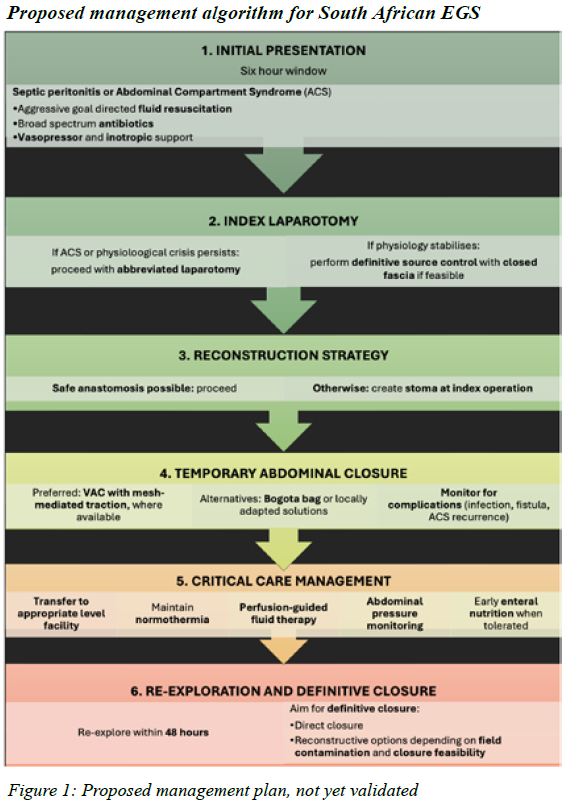
Abbreviated laparotomy in EGS is a carefully staged continuum of care, distinct from trauma damage-control strategies. In South African settings, especially those with constrained resources, its use must be deliberate - guided by recognition of abdominal compartment syndrome risk, a structured six-hour optimisation phase, decisive stoma planning at index operation, and pragmatic TAC techniques. Such an approach maximises benefits while reducing iatrogenic complications and resource drain (Figure 1).
ORCID
REFERENCES
-
1. Coccolini F, Roberts D, Ansaloni L, et al. The open abdomen n trauma and non-trauma patients: WSES guidelines. World J merg Surg. 2018;13:7. https://doi.org/10.1186/s13017-018-0167-4.
» https://doi.org/10.1186/s13017-018-0167-4 - 2. De Waele JJ, Kaplan M, Sugrue M, et al. International Register of Open Abdomen (IROA): Clinical epidemiology and outcomes. World J Surg. 2015;39(1):83-92.
-
3. Kirkpatrick AW, Roberts DJ, De Waele J, et al. Intraabdominal hypertension and the abdominal compartment syndrome: Updated consensus definitions. Intensive Care Med. 2013;39(7):1190-206. https://doi.org/10.1007/s00134-013-2906-z.
» https://doi.org/10.1007/s00134-013-2906-z - 4. Ordoñez C, Pino L, Badiel M, et al. Damage control in severe peritonitis: Re-laparotomy and open abdomen management in Colombia. World J Surg. 2010;34:2161-7.
- 5. Willms A, Schaaf S, Schwab R, et al. Mesh-mediated fascial traction in the open abdomen: EuraHS registry results. Hernia. 2022;26(3):625-34.
- 6. Haltmeier T, Weiser T, Stawicki SP, et al. Outcomes of open abdomen versus definitive closure in emergency general surgery: Systematic review and meta-analysis. Br J Surg. 2022;109(2):135-45.
- 7. Bunino FM, Kluger Y, Sartelli M, et al. Temporary abdominal closure in emergency general surgery: Outcomes from the WSES registry. J Trauma Acute Care Surg. 2025;Epub ahead of print.
-
8. Ordoñez C, Sánchez ÁI, Pineda JA, et al. Deferred primary anastomosis versus diversion in patients with severe secondary peritonitis managed with staged laparotomies. World J Surg.2010;34(1):169-76. https://doi.org/10.1007/s00268-009-0285-y.
» https://doi.org/10.1007/s00268-009-0285-y - 9. Becher RD, Peitzman AB, Sperry JL. Damage control surgery in non-trauma patients: Time for a rethink? J Trauma Acute Care Surg. 2016;80(6):933-8.
-
10. Coccolini F, Catena F, Montori G, et al. IROA: The International Register of Open Abdomen: An international effort to better understand the open abdomen. World J Emerg urg. 2015;10:8. https://doi.org/10.1186/s13017-015-0029-2.
» https://doi.org/10.1186/s13017-015-0029-2 -
11. Boele van Hensbroek P, Wind J, Dijkgraaf MGW, et al. emporary closure of the open abdomen: A systematic review n delayed primary fascial closure in patients with an open abdomen. World J Surg. 2009;33(2):199-207. https://doi.org/10.1007/s00268-008-9867-3.
» https://doi.org/10.1007/s00268-008-9867-3