Transvaginal small bowel evisceration
We report on the rare entity of transvaginal small bowel herniation following a transvaginal hysterectomy. The risk factors, presentation, initial management and various surgical approaches are discussed. It is a condition that requires prompt surgical intervention. This report serves to highlight awareness of the condition, and how knowledge of the various methods of addressing an ischaemic bowel and a ruptured vaginal vault can result in a favourable outcome.
CASE REPORT
Transvaginal small bowel evisceration
M A Noorbhai; T E Madiba
Department of Surgery, University of KwaZulu-Natal; Inkosi Albert Luthuli Central Hospital, Durban, South Africa
ABSTRACTWe report on the rare entity of transvaginal small bowel herniation following a transvaginal hysterectomy. The risk factors, presentation, initial management and various surgical approaches are discussed. It is a condition that requires prompt surgical intervention. This report serves to highlight awareness of the condition, and how knowledge of the various methods of addressing an ischaemic bowel and a ruptured vaginal vault can result in a favourable outcome.
A 71-year-old Caucasian woman underwent a transvaginal hysterectomy for utero-vaginal prolapse. Despite the operation, she experienced discomfort from anterior vaginal prolapse and had incomplete bladder emptying. Further surgery was not considered because of multiple co-morbidities, most importantly congestive cardiac myopathy, dyslipidaemia and chronic obstructive pulmonary disease.
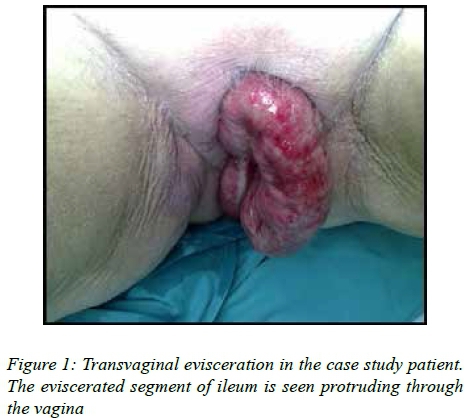
Nine months later, she presented with a 24-hour history of an excruciating painful mass protruding from her vagina. She was haemodynamically stable, with diffuse abdominal tenderness and distension with guarding. The protruding mass was a segment of ischaemic small bowel, which eviscerated via a tight vaginal vault defect (Figure 1).
In view of her co-morbidities, an extra-abdominal resection of the protruding small bowel was attempted. However, healthy small bowel could not be delivered through the small defect in the vaginal vault, and she was then submitted to laparotomy. The bowel was reduced intra-abdominally via bimanual manoeuvre. A stapled functional end-to-end anastomosis was then performed approximately 10cm from the ileocaecal junction. The vaginal vault defect was closed, and a vaginopexy to the sacrospinous ligament was performed using polydioxanone. The patient made an uneventful recovery and was discharged five days later. She was seen at six months for follow-up and was well.
Discussion
Transvaginal small bowel evisceration is a rare, but life-threatening condition, which tends to occur in postmenopausal women.1,2 Risk factors for the development of this condition include the triad of menopause, previous vaginal surgery and pelvic floor disorders.421,2 Other predisposing factors that have been suggested include previous obstetrical trauma, instrumentation with foreign objects and having multiple sexual partners.1
Transvaginal evisceration is associated with both abdominal and vaginal hysterectomy.132
Clinical features include sudden abdominal or pelvic pain, with or without vaginal bleeding, and sudden protrusion of a mass through the vagina44511 1 5
An abdominal X-ray should be performed to exclude foreign bodies. Initial management includes stabilisation of the patient, wrapping of the bowel with a warm moist saline swab, and immediate surgical repair under prophylactic antibiotic cover.1
Transvaginal, transabdominal, combined vaginal-abdominal and a laparoscopic vaginal approach have all been described.4 311,3
The transabdominal approach is the preferred approach, and is ideal for patients with a high or tight vaginal vault defect, with an oedematous eviscerated bowel.211
Surgical repair of the vaginal vault defect itself may include a primary repair, omental patch, dermal graft and mesh repair.1,2 Successful primary repair is dependent on the integrity of the tissue edges.1
Our patient was a poor surgical risk, and had healthy tissue edges. Therefore, we opted for the combined vaginal-abdominal approach and an immediate primary vaginal vault repair with a monofilament suture.
The timing of the correction of the anatomical pelvic floor defect is dependent on the patient's condition and on the health of the pelvic tissue. Whereas some authors have cautioned against urgent repair in the presence of infection or unhealthy tissue which does not hold sutures well, most authors suggest immediate closure as it decreases the risk of re-evisceration and peritonitis.1,2
Bearing in mind that the incidence of hysterectomies has increased over the years, a high index of suspicion is warranted in patients who present with pelvic organ prolapse. Patients with bowel prolapse may present to the general surgeon directly or via the gynaecology department. Therefore, it is important for the general surgeon to be aware of this potentially devastating condition.
Conclusion
This is the first report of transvaginal small bowel evisceration in Africa. An awareness of the condition and knowledge of the methods used to address both the ischaemic bowel and ruptured vaginal vault can result in minimal operative time and improved patient outcomes.
This case report illustrates that in patients with a previous vaginal hysterectomy who present with the previously described symptoms, a transvaginal evisceration should be high on the differential diagnosis. When it does occur, it is a surgical emergency which warrants prompt intervention. Early diagnosis and management is important as this condition is associated with high morbidity and mortality.
REFERENCES
- 1. Ramirez PT, Klemer DP. Vaginal evisceration after hysterectomy: a literature review. Obstet Gynaecol Surv. 2002;57(7):462-467.
- 2. Parra RS, Da Rocha JJR, Feres O. Spontaneous transvaginal small bowel evisceration: a case report. Clinics (Sao Paulo). 2010; 65(5):559-561.
- 3. Elsaify WM. Spontaneous vaginal evisceration and intra- abdominal small bowel strangulation: a report of the first case and review of the literature. Eur Surg. 2006;38(4):315-317.
- 4. Iaco PD, Ceccaroni M. Transvaginal evisceration after hysterectomy: is vaginal cuff closure associated with a reduced risk? Eur J Obstet Gynecol Reprod Biol. 2006;125(1):134-138.
- 5. Virtanen HS, Ekholm E. Evisceration after enterocele repair: a rare complication of vaginal surgery. Int Urogynecol J Pelvic Floor Dysfunct. 1996;7(6):344-347.