The epidemiological characteristics of major trauma in Pietersburg and Mankweng hospitals, Limpopo province
Abstract
BACKGROUND: Data on trauma burden and outcome varies amongst the nine South African Provinces. In Limpopo Province there is a paucity of data which this study aimed to quantify and characterise the severe trauma burden in the province. METHODS: A retrospective chart review for all patients with injury severity score (ISS) > 16 over a 6-year period (Jan 2015-Dec 2020) at two central hospitals in Limpopo province. Descriptive analysis was undertaken of the following variables: patient demographics, injury patterns and outcomes. RESULTS: The review identified 355 patients whose mean age was 31 years (Range 0.25-74 years). Eighty four per cent were males. Forty nine per cent were unemployed. The most common mechanisms of injury were interpersonal violence 49 % and motor vehicle crashes (MVCs) 34.9%. Head (41%), torso (25%) and limbs (15.2%) were the body-regions most frequently involved. The median ISS was 16 with IQR (16-16) (0). The median length of stay was 7 days with IQR (5-15) (10). Of the ICU admissions 50% were MVCs and 56% due to head injury. Of the 50 deaths 50% were due to MVC and pedestrian vehicle crashes (PVCs), and head injuries were present in 54% of those who died. CONCLUSION: Young males were the most predominantly affected. Assault and MVC were the most common mechanisms of injury. The unemployment rate also seems to be a key factor in trauma epidemiology in the province. Further study of the wider trauma burden is required.
Limpopo; trauma; injury severity score; death
Introduction
The burden of injuries is increasing in low- to middle-income countries (LMICs). The mortality of major trauma is six times higher than in higher-income countries.123
In LMIC countries such as Botswana, several studies have been conducted. Mwandri et al. reported that the knowledge of essential trauma care (by both nurses and doctors), district hospital capability to provide essential surgery and the organisation of trauma care were found to be lacking.4
In another LMIC country, Tanzania, the Mwandri et al. study found males to be most commonly affected at 84%, and the most common mechanism of injury was motor vehicle crash (MVC) at 69%, followed by violence at 20% and then falls at 9%.5
South Africa is included in the list of LMIC countries, and the injury burden is heavily influenced by two major factors - MVC and interpersonal violence.678
Limpopo province remains one ofthe most under-resourced and under-researched of the South African provinces. Fewer studies were carried out there. A study by Mavhungu et al. reported males to be most commonly affected at 70%, and 40% of general surgery emergencies were trauma related.91011
Methods
Design
This was a retrospective cohort study of patients who sustained major trauma between 1 January 2015 and 31 December 2020.
Setting
The study was conducted at Pietersburg and Mankweng hospitals, the two central hospitals in Limpopo province serving a population of about 6 million.
Participants
Patients of all ages who sustained significant injury and who had an injury severity score (ISS) > 16. These include cases referred to general surgery, neurosurgery, urology, cardiothoracic, maxillo-facial surgery and orthopaedic surgery.
Variables
Data were collected on demographics, admission and discharge data, mechanism of injury, types of injury, admission blood pressure (BP), admission Glasgow Coma Scale (GCS), ISS, operative intervention, length of hospital stay and outcome.
Results
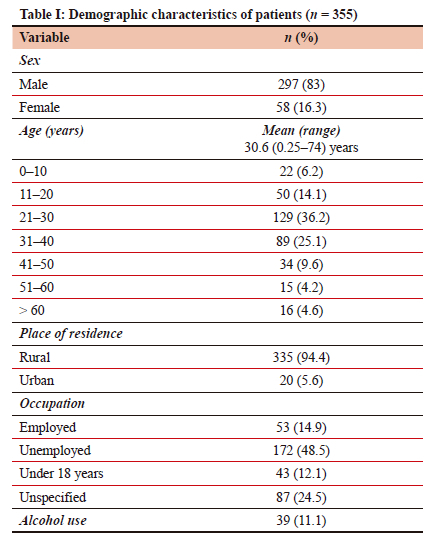
The study identified 355 patients over the 6-year period. Males contributed 297 (83.7%) with a male to female ratio of 5:1 with a mean age of 31 years. Ninety-eight per cent of patients were Black, followed by Whites at 1% and Asians 1%. The registered unemployment rate was 48.5%, while those under 18 years were 12.1% and the unspecified group was 24.5%; this included patients who were not in formal employment and could not pay hospital fees (Table I).
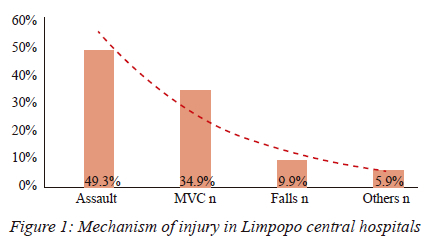
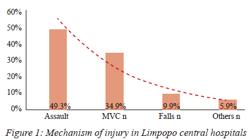
The most common mechanism of injury was interpersonal violence (assault) at 175 (49.2%), followed by MVC at 124 (34.9%) falls at 35 (0.98%) and others at 21 (0.06%) (Figure 1). Alcohol levels were only noted for 11% of the entire population from entirely self-reporting.
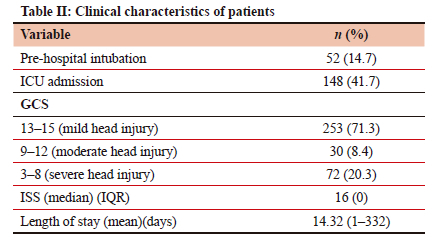
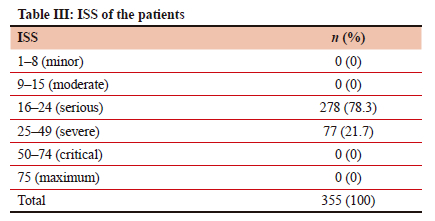
Seventy-one per cent of patients had mild traumatic brain injury (TBI), followed by severe TBI at 20.3% (Table II). Seventy-eight per cent of patients had an ISS of 16-24, while 21.7% had an ISS of 25-49 (Table III). The median ISS was 16 with interquartile range (IQR) of 16-20, while the average length of hospital stay was 14 days. Overall, 41.7% of patients in the study were admitted to ICU. Pre-hospital intubation was done in 14.7% of patients.
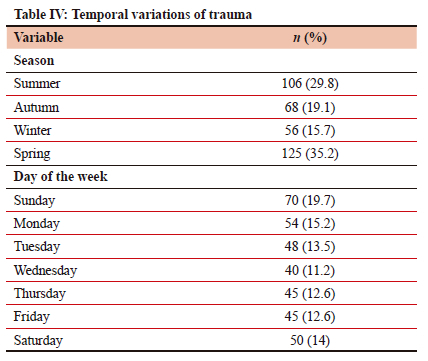
Concerning the day of the week and seasonal variation, most of the trauma admissions occurred on a Sunday (19.70%), followed by Monday (15%). Trauma occurred mostly in spring season (35.2%), followed by summer (29.8%) (Table IV). Almost 98% of patients were transported to the hospital by ground EMS, followed by private and air ambulance. Eighty-eight per cent of patients were inter-hospital transfers, while 12% were direct referrals.
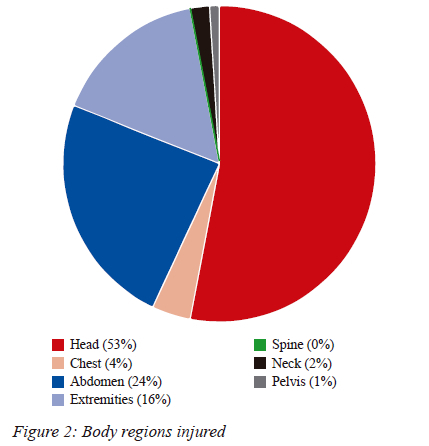
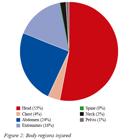
In terms of body region with most to least injury presentation, head injury contributed 180 (53%), followed by abdominal injuries at 81 (22.8%), orthopaedic injuries at 57 (16.0%) and chest injuries at 13 (3.6%) cases (Figure 2).
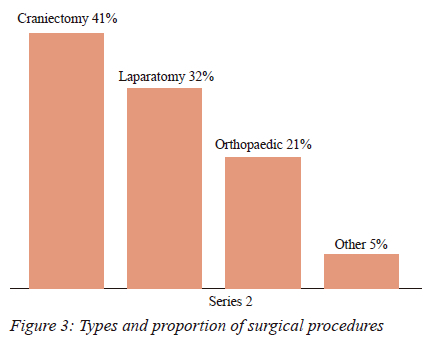
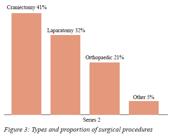
Regarding the need for surgical intervention, out of a total of 355 patients, 317 required a surgical procedure. Craniotomies were the lead procedure at these referral hospitals and contributed 131 of the required operations (41.3%), followed by laparotomies, constituting 102 (32.2%) and orthopaedic operations 67 (21.1%). Other procedures performed included neck exploration (for visceral injuries) (5), arm exploration for vascular injuries (5), mandibular operations (3), exploration of the thigh for vascular injuries (3) and amputation of the leg (1) (Figure 3).
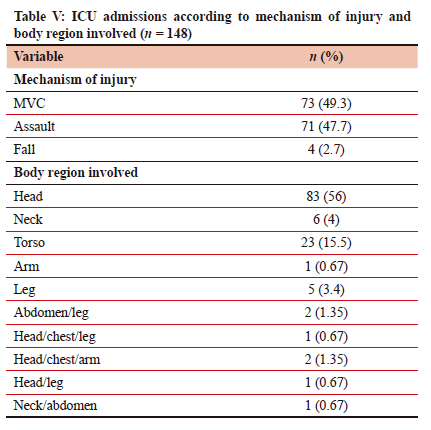
In total, 41.7% of trauma admissions were admitted to ICU. Regarding ICU admissions, MVCs accounted for 49.3% of cases, followed by assault at 47.7% and then 2.7% for falls. The most commonly admitted body injury in ICU was the head at 56%, followed by torso injuries at 15.5% (Table V).
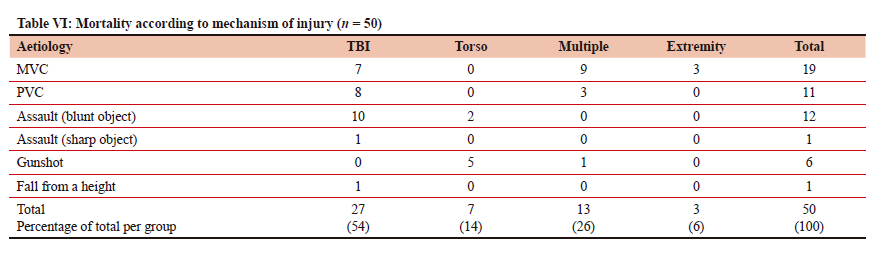
The mortality rate in the study was 14%, with 50 deaths recorded. Almost 36% of the deaths were caused by MVC, followed by PVC at 24% and then assault with a blunt object. TBI contributed to almost 54% of all deaths (Table VI).
Discussion
The study highlights the trauma burden encountered in an under-resourced setting. Quality data on trauma is limited, therefore making it difficult to influence governments on public health policies and provision of appropriate amenities and clinical resources.12
The study shows a high male preponderance. This is consistent with a study by Marle et al. with 69% and a mean age of 27.8 years.13
The registered unemployment rate in the study was 48.5%. This is consistent with the national unemployment rate among the youth of 45.5%, while the national rate is at 32.9%. Young black males seem to be the most affected group in trauma, combined with factors such as unemployment. Unemployment itself seemed to be a major contributing factor in the epidemiology of trauma in this study, associated with the use of alcohol and outdoor activities, for example, being on the streets at night, increasing the rate of trauma.10
About 94% of patients in the study reside in rural areas. Fleet et al. reported that the mortality in patients treated in the rural setting was 5% more than in an urban setting.1414
The most common mechanism of injury in the study was interpersonal violence at 49.2%. Worldwide it is estimated that intentional injury accounts for about 33% of all trauma. This agrees with study by Hunter et al. in the 19-30 years age group in Cape Town, that reported that this constituted 51%.15816
The most common cause of TBI in the study was interpersonal violence, which contributed about 62.6%. This is higher than a previous study by Jerome et al. which reported interpersonal violence to be accountable for 39.6% of TBI.1718
In the current study, trauma occurred most commonly in spring (35.2%), followed by summer (29.8%) and on a Sunday (19.7%), followed by a Monday (15.2%). These findings are consistent with the Bhana et al. study from Johannesburg which reported that the trauma incidence was higher on Sundays (24.4%) and occurred mainly in Spring (33%).19
Alcohol presence was recorded in only 11% of the patients in the current study population. This is lower than the Hirvikangas study which reported 55% with self-reporting of patients.20
The overall mortality is 14%. MVC accounted for 60% of the deaths and 54% died of TBI.
The results, despite a small sample size, seem to highlight two things, namely, the difficulty in obtaining data in an under-resourced environment suggesting the need for a trauma registry to be established in this (and all the other) provinces, and the need to have a dedicated trauma care unit in the province to coordinate the care of severely injured patients.
Limitations
By being retrospective, the study had some limitations. Incomplete documentation and inability to retrieve almost half of the potentially includable files was a problem, resulting in the smaller than expected sample-size. There could be selection bias since patients who died before admission were not included, as well as the fact that these were all referred patients to a central facility and therefore the study does not reflect the trauma cases managed at regional or district hospitals in Limpopo. These figures may represent the tip of the iceberg.
Conclusion
Assault and MVC are the most common mechanisms of injury. Young economically active males are the most predominantly affected. The issue of young male unemployment and involvement in outdoor activities seem to be a key factor in the epidemiology of trauma in the province. Unemployment seems to increase the number of trauma admissions especially in interpersonal violence. This seems to suggest that there is a need for general behaviour modification. There is also a need for road safety awareness strategies. The need for electronic patient records and development of a trauma registry would improve data reliability.
Acknowledgements
I would like to acknowledge Ms Maggie Landman and the administrative staff of Pietersburg/ Mankweng hospitals for the retrieval of files. A special thanks to Mr D Motanyane for bringing together the lists, and Mr N Rakgole and F Lebea for helping with the statistical issues.
Conflict of interest
The authors declare no conflict of interest.
Funding source
No funding was required.
Ethical approval
Ethical approval was acquired from the University of KwaZulu-Natal Biomedical Research Ethics Committee (Ref :00003999/2022) and Limpopo Provincial MREC (REC300408006).
ORCID
SN Phaleng https://orcid.org/0000-0001-8779-0436
TC Hardcastle https://orcid.org/0000-0002-3967-0234
REFERENCES
-
1. Mock C, Lormand J, Goosen J, et al. Guidelines for essential trauma care. Geneva: World Health Organization; 2004. Available from: https://hdl.loc.gov/loc.gdc/gdebookspublic201763202. Accessed 5 October 2019.
» https://hdl.loc.gov/loc.gdc/gdebookspublic201763202 - 2. Centres for Disease Control and Prevention. National centre for injury prevention and control. Web based injury statistics query and reporting systems. Fatal and non-fatal injury data; 2017.
-
3. Hardcastle TC. Studies on the epidemiology of trauma. The first step in systems planning and systems evaluation. J Emerg Trauma Shock. 2018;11(4):241-2. https://doi.org/10.4103/JETS.JETS_61_17.
» https://doi.org/10.4103/JETS.JETS_61_17 -
4. Mwandri MB, Hardcastle TC. Evaluation of resources necessary for provision of trauma care in Botswana. An initiation for a local system. World J Surg. 2018;42:1629-38. https://doi.org/10.1007/s00268-017-4381-0.
» https://doi.org/10.1007/s00268-017-4381-0 -
5. Mwandri MB, Hardcastle TC, Sawe H, et al. Trauma burden, patient demographics and care process in major hospitals in Tanzania: A needs assessment for improving healthcare resource management. Afr J Em Med. 2020;10(3):111-7. https://doi.org/10.1016/j.afjem.2020.01.010.
» https://doi.org/10.1016/j.afjem.2020.01.010 -
6. Hardcastle TC. A trauma system for KZN - local development for local need [dissertation]. Durban: University of KZN; 2014. Available from: https://researchspace.ukzn.ac.za/items/a63e866a-b180-49db-9e64-3657b81d80e6.
» https://researchspace.ukzn.ac.za/items/a63e866a-b180-49db-9e64-3657b81d80e6 -
7. Hardcastle T, Oosthuizen G, Clarke D, Lutge E. Trauma, a preventable burden of disease in South Africa. A review of the evidence, with a focus on KwaZulu-Natal. In: Paradath A, King J, Mackie E, Casciola J, editors. South African Health Review, Durban: Health Systems Trust: 2016;178-89. Available from: https://www.hst.org.za/publications/south;africanhealth-review-2016.
» https://www.hst.org.za/publications/south;africanhealth-review-2016 -
8. Tefera A, Lutge EE, Moodley N, et al. Tracking the trauma epidemic in KwaZulu-Natal, South Africa. World J Surg. 2023;47(8):1940-5. https://doi.org/10.1007/s00268-023-07032-2.
» https://doi.org/10.1007/s00268-023-07032-2 - 9. Mavhungu R, Van As AB. An audit of emergency admissions to the adult general surgery department at Pietersburg hospital, Polokwane, Limpopo province, South Africa, during an 8-month period in 2021. S Afr Med J. 2022;112(11b):888-91.
-
10. Compton WM, Gfroer J, Conway KP, Finger MS. Unemployment and substance outcomes in the United States 2002-2010. Drug Alcohol Depend. 2014;142:350-3. https://doi.org/10.1016/j.drugalcdep.2014.06.012.
» https://doi.org/10.1016/j.drugalcdep.2014.06.012 -
11. Mphekgwana PM. Influence of environmental factors on injury severity using ordered logit regression model in Limpopo province, South Africa. J Environ Public Health. 2022;2022:5040435. https://doi.org/10.1155/2022/5040435.
» https://doi.org/10.1155/2022/5040435 -
12. Shanthakumar D, Payne A, Leitch T, Alfa-Wali M. Trauma care in low- and middle-income countries. Surg J (NY). 2021;7(4):e281-e285. https://doi.org/10.1055/s-0041-1732351.
» https://doi.org/10.1055/s-0041-1732351 -
13. Marle T, Mash R. Trauma patients at the Helderberg district hospital emergency centre, SA. A descriptive study. Afr J Em Med. 2021;11(20):315-20. https://doi.org/10.1016/j.afjem.2021.03.012.
» https://doi.org/10.1016/j.afjem.2021.03.012 -
14. Fleet AL, Lauzier F, Tounkara FK, et al. Profile of trauma mortality and trauma care resources at rural emergency departments and urban trauma centres in Quebec: a population-based retrospective cohort study. BMJ Open. 2019;9(6):e028512. https://doi.org/10.1136/bmjopen-2018-028512.
» https://doi.org/10.1136/bmjopen-2018-028512 -
15. Hunter LD, Lahri S, Van Hoving DJ. Case mix of patients managed in the resuscitation area of a district public hospital in Cape Town. Afr J Emerg Med. 2017;7(1):19-23. https://doi.org/10.1016/j.afjem.2017.01.001.
» https://doi.org/10.1016/j.afjem.2017.01.001 -
16. Schuurman N, Cinnamon J, Walker BB. Intentional injury and violence in Cape Town, South Africa: an epidemiological analysis of trauma admissions data. Global Health. 2015;8:27016. https://doi.org/10.3402/gha.v8.27016.
» https://doi.org/10.3402/gha.v8.27016 -
17. Jerome E, Laing GL, Bruce JL, et al. An audit of traumatic brain injury (TBI) in a busy developing-world trauma service exposes a significant deficit in resources available to manage severe TBI. S Afr Med J. 2017;107(7):621-5. https://doi.org/10.7196/SAMJ.2017.v107i7.10562.
» https://doi.org/10.7196/SAMJ.2017.v107i7.10562 -
18. Mamo D, Aklog E, Gebremedhin Y. Patterns and outcome of patients admitted to ICU of Addis Ababa Burn Emergency and Trauma hospital. Sci Rep. 2023;13:6364. https://doi.org/10.1038/s41598-023-33437-z.
» https://doi.org/10.1038/s41598-023-33437-z -
19. Bhana M, Fru P, Plani F. A long walk to freedom - the epidemiology of penetrating trauma in SA. Analysis of 4697 patients over a six-year period at Chris Hani Baragwanath hospital. S Afr J Surg. 2022;60(2):77-83. https://doi.org/10.17159/2078-5151/SAJS3582.
» https://doi.org/10.17159/2078-5151/SAJS3582 -
20. Hirvikangas R, Bertell J, Martilla E, et al. Patient injury-related alcohol use underestimated in patients with facial fractures. Oral Surg Med Oral Path Oral Radiol. 2020;130(3):336-404. https://doi.org/10.1016/j.oooo.2020.03.041.
» https://doi.org/10.1016/j.oooo.2020.03.041