Anal plasmablastic lymphoma with complete response to antiretroviral therapy - a case report
A 40-year-old male, known to be positive with the human immunodeficiency virus (HIV), presented with a large perianal mass and faecal obstruction. His CD4 count was 121 cells/mm3 suggesting advanced HIV disease, and he was started on second-line antiretroviral therapy. Magnetic resonance imaging (MRI) confirmed a large mass involving the anorectal junction. A biopsy of the tumor revealed a plasmablastic lymphoma (PBL). A diverting colostomy was performed for faecal obstruction. While awaiting chemotherapy treatment, the tumour rapidly decreased in size with complete clinical resolution. PBL is rare and has a dismal prognosis. Spontaneous regression of PBL has been reported but regression on second-line antiretroval therapy has not been previously described.
lymphoma; plasmablastic; human immunodeficiency virus; anal tumour; Ammon regression
CASE REPORT
Anal plasmablastic lymphoma with complete response to antiretroviral therapy - a case report
D MontwediI; M RamabulanaI; N KhanII
IDepartment of Surgery, Kalafong Hospital, University of Pretoria, South Africa
IIDepartment of Diagnostic Radiology and Imaging, Kalafong Hospital, University of Pretoria, South Africa
A 40-year-old male, known to be positive with the human immunodeficiency virus (HIV), presented with a large perianal mass and faecal obstruction. His CD4 count was 121 cells/mm3
Keywords: lymphoma, plasmablastic, human immunodeficiency virus, anal tumour, Ammon regression
Case report
A 40-year-old male presented with perianal pain and rectal bleeding of six months duration. He was aware of a mass next to his anus that had been enlarging during this period. More recently, he also had difficulty in passing stools. He reported no weight loss but complained of night sweats. He had been diagnosed with human immunodeficiency virus (HIV) infection three years previously and reported having been on conventional first-line antiretroviral (ARV) treatment (tenofovir, efavirenz, emtricitabine) for this period.
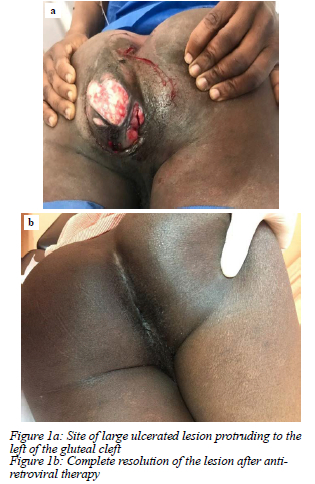
Clinical examination revealed a healthy-looking man with no systemic abnormalities. There was a large perianal mass to the left and posterior to the anal orifice (Figure 1a). The surface was devoid of skin and superficially ulcerated but the defect did not have an elevated margin. The tumour involved the anal orifice which was displaced to the right. The mass extended high into the ischio-anal space on digital rectal examination. The anus was almost completely obstructed and sigmoidoscopy was not possible. There were no palpable groin lymph nodes. Routine blood tests revealed no abnormalities. The patient's CD4 count was 121 cells/mm3
A core needle biopsy was performed. Microscopic examination revealed an unremarkable epidermis with no signs of dysplasia. The dermis contained a sheeted, poorly cohesive malignant lymphoid proliferation. Large cells, most of which had a plasmacytoid appearance, were identified. These cells had prominent basophilic nucleoli and eccentric nuclei. The cytoplasm was abundant and amphophilic. Mitotic figures could be seen. A morphological diagnosis of a high-grade lymphoma was made.
A panel of immunohistochemical stains were performed in the presence of adequate positive and negative controls. In addition, Epstein-Barr encoding region in situ hybridisation (EBER-ISH) was positive in most lesional cells. Based on the cellular morphology and immunohistochemical profile the diagnosis of a high-grade lymphoma was confirmed. The features were considered to be best in keeping with a plasmablastic lymphoma (PBL).
Computerised tomography (CT scan) of the chest, abdomen and pelvis showed a large localised tumour adjacent to the anus and rectum, and bulging externally next to the anus. There were no abnormalities in the abdomen or chest. A staging magnetic resonance imaging (MRI) scan confirmed a large predominantly homogenous hypointense mass extending into the surrounding structures. (Figures 2a and 3a.) The mass was predominantly perineal with involvement of the anorectal junction. There was also involvement of the internal and external anal sphincters, as well as components of the levator ani complex. There were large lymph nodes in the pelvis and left ischiorectal fossa.
To address the patient's faecal obstruction a sigmoid colostomy was performed. Due to the low CD4 count and the presence of an advanced AIDS defining tumour, second-line ARV therapy (tenofovir, lamivudine, dolutegravir) was immediately commenced. The mass rapidly decreased in size over a period of six months, while awaiting commencement of proposed cyclophosphamide, hydroxydaunorubicin, oncovin and prednisone (CHOP) chemotherapy, and had a complete clinical resolution (Figure 1b). Chemotherapy was nevertheless commenced. A repeat MRI after six months confirmed the complete clinical response (Figures 2b and 3b). The patient's colostomy was uneventfully reversed one year later. He is currently well and disease free.
Consent for publication of this case was given by the patient as well as the Research Ethics Committee of the Faculty of Health Sciences of the University of Pretoria (Ref 730/2023).
Discussion
PBL is a rare, highly-aggressive subtype of diffuse B-cell non-Hodgkin lymphoma occurring mainly in immunocompromised subjects.121
The pathogenesis of PBL is poorly understood but there is an association with Epstein-Barr virus (EBV) in the majority of the patients who are also HIV positive.13
There are no established guidelines on the management of PBL due to the rarity of the condition. Different chemotherapy regimens have been used with variable outcomes. The current National Comprehensive Cancer Network (NCCN) guidelines recommend infusional etoposide phosphate, prednisone, oncovin, cyclophosphamide and hydroxydaunorubicin EPOCH rather than the previous CHOP regimen.45
Spontaneous regression of PBL has been reported in immunocompetent patients after biopsy without any treatment. The postulated mechanism of regression is by immune stimulation by infection after biopsy.67,8 The dramatic response of our patient's tumour to second-line ARV treatment is remarkable and unique. This was presumably due to immune restoration.
Perianal conditions affect 30% of patients with HIV infection. These are mostly perianal abscesses, ulcers and condylomata.789,10 Although anal PBL is extremely rare, lymphoma needs to be considered in the differential diagnosis of perianal conditions in HIV-positive patients. Notwithstanding the poor prognosis, some patients may have complete resolution of disease on ARV treatment alone, as described in this patient.
Acknowledgement
We acknowledge the assistance of Professor VOL Karusseit of the Department of Surgery with critical review of the manuscript, and assistance with writing.
Conflict of interest
The authors declare no conflict of interest.
Funding source
This study received no funding.
Ethical approval
Consent for publication of this case was given by the Research Ethics Committee of the Faculty of Health Sciences of the University of Pretoria (Ref 730/2023).
ORCIDD Montwedi https://orcid.org/0000-0002-2923-7920
M Ramabulana https://orcid.org/0009-0006-3939-5208
REFERENCES
-
1. Bailly J, Jenkins N, Chetty D, et al. Plasmablastic lymphoma: An update. Int J Lab Hematol. 2022;44(Suppl 1):54-63. https://doi.org/10.1111/ijlh.13863.
» https://doi.org/10.1111/ijlh.13863 -
2. Delecluse HJ, Anagnostopoulos I, Dallenbach F, et al. Plasmablastic lymphomas of the oral cavity: A new entity associated with the human immunodeficiency virus infection. Blood. 1997;89(4):1413-20. https://doi.org/10.1182/blood.V89.4.1413.
» https://doi.org/10.1182/blood.V89.4.1413 -
3. Cioc AM, Allen C, Kalmar JR, et al. Oral plasmablastic lymphomas in AIDS patients are associated with human herpesvirus 8. Am J Surg Pathol. 2004;28(1):41-6. https://doi.org/10.1097/00000478-200401000-00003.
» https://doi.org/10.1097/00000478-200401000-00003 -
4. NCCN Practice Guidelines in Oncology. AIDS-related B-cell lymphomas (AIDS-2). Available from: http://www.nccn.org/professionals/physician_gls/PDF/nhl.pdf. Accessed 10 November 2023.
» http://www.nccn.org/professionals/physician_gls/PDF/nhl.pdf -
5. Castillo J, Winer ES, Stachurski D, et al. Clinical and pathological differences between human immunodeficiency virus-positive and human immunodeficiency virus-negative patients with plasmablastic lymphoma. Leuk Lymphoma. 2010;51:2047-2053. https://doi.org/10.3109/10428194.2010.516040.
» https://doi.org/10.3109/10428194.2010.516040 -
6. Lee KT, Misron NA, Abdul Aziz N, Wong CH, Liew HK. Spontaneous regression of plasmablastic lymphoma in an immunocompetent patient: Case report and review of the literature. Case Rep Hematol. 2022;2022:1142049. https://doi.org/10.1155/2022/1142049.
» https://doi.org/10.1155/2022/1142049 -
7. Nadal SR, Manzione CR, Galvão VM, Salim VR, Speranzini MB. Perianal diseases in HIV-positive patients compared with a seronegative population. Dis Colon Rectum. 1999;42(5):649-54. https://doi.org/10.1007/BF02234144.
» https://doi.org/10.1007/BF02234144 -
8. Chagas LA, Camilo GB, Machado DC. Plasmablastic lymphoma of the anal canal in an HIV-infected patient. Am J Case Rep. 2014;15:543-9. https://doi.org/10.12659/AJCR.892313.
» https://doi.org/10.12659/AJCR.892313 - 9. Cyprich J, Noren ER, Date J, et al. Rare case of anal plasmablastic lymphoma in a patient with HIV. ACS Case Rev Surg. 2022;3(8):69-73.
-
10. Tajudeen M, Dutta S, Jain A, Srinivas BH, Nelamangala Ramakrishnaiah VP. A rare case of HIV-associated plasmablastic lymphoma of Anal Canal. Cureus. 2021; 13(9):e17782. https://doi.org/10.7759/cureus.17782.
» https://doi.org/10.7759/cureus.17782