#PlasticSurgery: an overview of the internet presence and utilisation of social media platforms by South African plastic surgeons
Abstract
BACKGROUND: Information about plastic surgery procedures is becoming more easily accessible everyday as the influence of social media expands rapidly. Plastic surgeons may use these platforms to advertise their practices and facilitate patient education. This study aimed to investigate the online presence of South African plastic surgeons with regard to personal practice websites and social media profiles. METHODS: Plastic surgeons listed on the Association of Plastic, Reconstructive and Aesthetic Surgeons of South Africa (APRASSA) website were searched for on the internet. Professional websites were examined for links to social media (Facebook, Instagram, Twitter). Personal profiles on Facebook, Twitter and Instagram were excluded. RESULTS: The total number of South African plastic surgeons listed on the APRASSA website totaled 148 at the time of collation. Three surgeons (2%) had direct links to their personal website on the APRASSA listing. Sixty-four plastic surgeons (42.7%) had websites directly related to their plastic surgery practice. Of those, only 15 provided links to any form of social media. Twelve surgeons had links to a Facebook page (18.75%) pertaining to their practice. Eleven had links to a Twitter profile (17.8%), and only one had links to an Instagram account (1.6%). CONCLUSION: The role of social media in the plastic surgery community appears to have significant implications for the future of the specialty. Adoption of these platforms is necessary to maintain interaction with patients and colleagues in the digital age.
Plastic surgery; social media; Facebook; Instagram; Twitter
Introduction
Plastic and Reconstructive Surgeons in South Africa is steadily growing in demand as awareness amongst the general population grows on account of increased exposure to the profession via the media. The major avenues of exposure in this current era are the social media platforms which have become common parlance in daily life. Of these social media platforms, Facebook, Twitter and Instagram have established themselves as the primary platforms of the social media world. Increasing numbers of plastic surgeons are utilising these social media platforms for exposure of their practices as well as patient education regarding the various reconstructive and cosmetic procedures on offer. Montemurro et al.1
Facebook is an online social networking service which also allows users to search for services (usually through "groups" or "fan pages"), obtain information, and provide or examine reviews for these services. Twitter is a social networking site that enables individuals and businesses to share information or thoughts via text posts known as "tweets." Twitter is a "microblog," through which users can tweet up to 280 characters at a time. Instagram is a mobile photo and video sharing application and service that allows users to share pictures and videos either publicly or privately on the platform. Instagram users are also able to link their shared media to other social networks, such as Facebook and Twitter.
The first half of 2017 saw an information explosion on social media as plastic surgeons worldwide began to establish profiles across all social media platforms. A general search for the term "plastic surgery" yields an ever-growing plethora of profiles related to plastic surgery practices and surgeons. Many surgeons have begun using these platforms to enhance exposure to their practices by various means, including patient education through pre- and postoperative images, as well as intraoperative videos of various procedures, both reconstructive and cosmetic.
This study aimed to assess and describe the extent to which South African plastic surgeons have an online presence on the internet and on social media platforms as described above (Facebook, Instagram, Twitter), as well as which surgeons had websites with links to their social media platforms. In addition, further aims were to determine if there is a predilection for online presence based on geographical location within South Africa, or related to time since attainment of their specialty.
Methods
A list of registered plastic surgeons in South Africa was compiled from information on the Association of Plastic, Reconstructive and Aesthetic Surgery of South Africa (APRASSA) website, found under the Find a plastic surgeon link. Each plastic surgeon was searched for using the Chrome web browser and Google search engine, using the search terms "Dr" followed by the surgeon's name and surname as it appears on the APRASSA website. Those professional websites were then examined for links to social media such as Facebook, Instagram or Twitter. Websites were also examined regarding the nature of information available on the website. Websites and social media accounts/profiles belonging to joint practices of multiple surgeons were excluded. Personal profiles on Facebook, Twitter and Instagram were also excluded. All data was collected from publicly accessible websites over a period of two days in July 2017.
Results
The total number of South African plastic surgeons whose information is listed on the APRASSA website totaled 148 at the time of collation. Of those, only 3 surgeons (2%) had direct links to their personal website on the APRASSA listing. In total, 64 plastic surgeons (42.7%) had websites directly related to their plastic surgery practice. Of those 64, only 15 provided links to any form of social media. All websites contained some form of academic and educational biographies of the surgeon, as well as information pertaining to cosmetic and reconstructive surgical procedures offered by the surgeon. This information provided insight for visitors regarding the indications and technical nature of these procedures.
Twelve surgeons had links to a Facebook page (18.75%) pertaining to their practice. Eleven had links to a Twitter profile (17.8%), and only one had links to an Instagram account (1.6%).
Thirty surgeons provided information on the year of the qualification on their websites (46.9%). The remainder were ascertained searching for this information from the freely accessible Health Practitioners Council of South Africa (HPCSA) website.
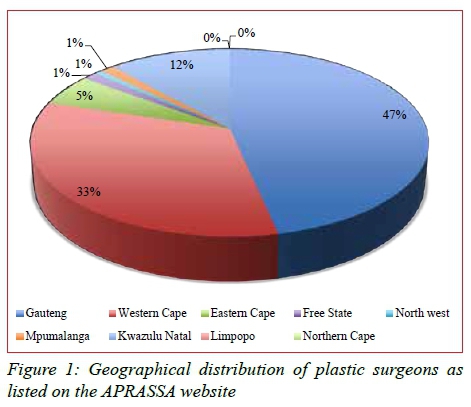
The geographical distribution of all one hundred and forty-eight surgeons is described in Figure 1, with the vast majority being in Gauteng and the Western Cape.
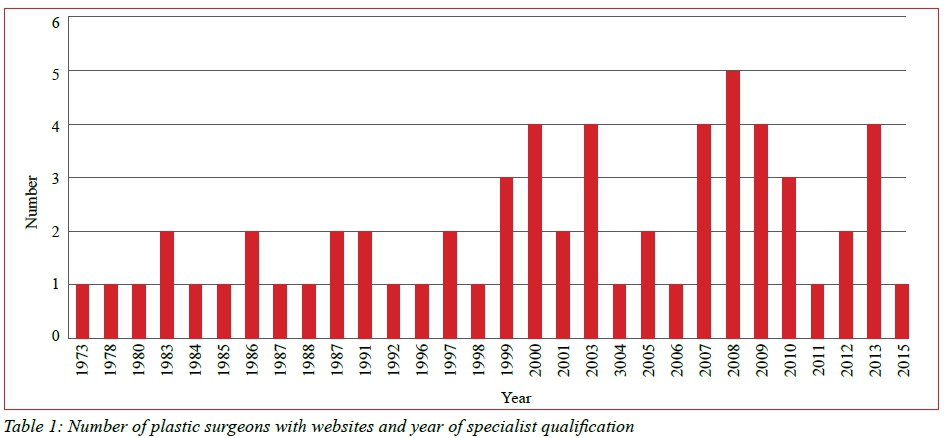
The average year of qualification for those surgeons who had websites was the year 2000. Table 1 depicts the number of surgeons with websites as a function of the year of their graduation. As one might expect, the number of surgeons who had websites steadily increased as the year of qualification increased.
Discussion
There is a marked proclivity for surgeons from Gauteng and the Western Cape to have an online presence as compared to the remainder of the country. This is possibly related to these provinces being amongst the most densely populated in the country, according to Census 2011 statistics.2
The predominant social media currently being utilised by South African plastic surgeons with an online presence are Facebook and Twitter (18.75% and 17.8% respectively). Professional website usage among South African plastic surgeons was 42.7%. This is low compared to the study by Mabvuure34
One of the possible reasons for low social media usage amongst South African plastic surgeons is as a result of the limits imposed by the Health Professions Council of South Africa (HPCSA). The HPCSA have prescribed ethical rules of conduct regarding advertising of a health-care practitioner's services, which are publicly accessible on its website.5
"(1) A practitioner shall be allowed to advertise his or her services or permit, sanction or acquiesce to such advertisement: Provided that the advertisement is not unprofessional, untruthful, deceptive or misleading or causes consumers unwarranted anxiety that they may be suffering from any health condition.
(2) A practitioner shall not canvass or tout or allow canvassing or touting to be done on his or her behalf. "touting" means conduct which draws attention, either verbally or by means of printed electronic media, to one's offers, guarantees or material benefits."
Comparatively, the advertising guidelines as found on the American Society of Plastic Surgeons (ASPS) website allow more freedom in advertising one's practice, either by means of professional websites, or social media.6
Of those plastic surgeons who had a personal website, only 10% had a link from their practice website to some form of social media. Once more, this is comparably low when compared to the sole study from the UK in 2011 which found that only 36.2% of plastic surgeons used social networking.3 784,9-11
With regard to the year of qualification and online presence, one notices a distinct increase in the number of surgeons utilising social media around the end of each decade. One may theorise that this is because social media has only become relevant since the inception of these platforms in the mid-2000s, along with the progressively more accessible internet, and concomitant awareness of having an online presence.
The average person spends approximately 2 hours per day on social media.812
A study by von Muhlen13
The use of these social media platforms is not without its pitfalls. A systematic review by Dorfman14
A plastic surgeon's online presence in today's age of social media may dramatically enhance their depiction as a professional and expert, regardless of their actual fellowship or years in practice.8,11Rohrich15
Conclusion
There is a great scope for the implementation of social media in the South African medical community. Social media platforms are currently underutilised by South African plastic surgeons, and developing this would provide an opportunity to interact with patients, as well as to serve as educational tools for professionals and the public alike. While the HPCSA guidelines are currently restrictive, the demand exists to collaborate with plastic surgeons and other medical professionals to develop appropriate local standards to guide social media use and advertising. Perhaps it is time that South African plastic surgeons (and similarly all medical specialists) be encouraged to embrace modern trends and follow suit of their peers worldwide?
REFERENCES
-
1. Montemurro P, Porcnik A, Heden P, Otte M. The influence of social media and easily accessible online information on the aesthetic plastic surgery practice: literature review and our own experience. Aesthetic Plast Surg. Apr 2015;39(2):270-7. Available from: http://dx.doi.org/10.1007/s00266-015-0454-3 [PMID: 25697277]
» http://dx.doi.org/10.1007/s00266-015-0454-3 -
2. 2011 Census, Statistics South Africa. [Accessed on 22 July 2017]. Available from: http://www.statssa.gov.za
» http://www.statssa.gov.za -
3. Mabvuure NT, Rodrigues J, Klimach S, Nduka C. A cross-sectional study of the presence of United Kingdom (UK) plastic surgeons on social media. J Plast Reconstr Aesthet Surg. Mar 2014;67(3):362-7. Available from: http://dx.doi.org/10.1016/j.bjps.2013.12.015 [PMID:24439701]
» http://dx.doi.org/10.1016/j.bjps.2013.12.015 -
4. Wheeler CK, Said H, Prucz R, Rodrich RJ, Mathes DW. Social media in plastic surgery practices: emerging trends in North America. Aesthet Surg J. 2011;31:435-41. Available from: http://dx.doi.org/10.1177/1090820X11407483 [PMID: 21551435]
» http://dx.doi.org/10.1177/1090820X11407483 -
5. Health Professions Council of South Africa. Professional Conduct and Ethics. [Accessed on 23 September 2017]. Available from: http://www.hpcsa.coza/conduct/ethics
» http://www.hpcsa.coza/conduct/ethics -
6. American Society of Plastic Surgeons. Advertisers Guidelines for Compliance with ASPS Code of Ethics. [Accessed on 27 September 2017]. Available from: http://www.plasticsurgery.org/documents/governance/asps-ethics-advertisers-guidelines.pdf
» http://www.plasticsurgery.org/documents/governance/asps-ethics-advertisers-guidelines.pdf -
7. Dauwe P, Heller JB, Unger J, Graham D, Rohrich R. Social networks uncovered: 10 tips every plastic surgeon should know. Aesthetic Surg J. 2012;32(8):1010-5. Available from: http://dx.doi.org/10.1177/1090820X12462027 [PMID:23042902]
» http://dx.doi.org/10.1177/1090820X12462027 -
8. Gould DJ, Leland HA, Ho AL, Patel KM. Emerging trends in social media and plastic surgery. Ann Transl Med. Dec 2016; 4(23):455. Available from: http://dx.doi.org/10.21037/atm.2016.12.17 [PMID:28090511]
» http://dx.doi.org/10.21037/atm.2016.12.17 -
9. Stevens RJG, Hamilton NM, O'Donoghue JM, Davies MP. The use of the internet and social software by plastic surgeons. Eur J Plast Surg. 2012;35(10):747-55. Available from: http://dx.doi.org/10.1007/s00238-011-0681-z
» http://dx.doi.org/10.1007/s00238-011-0681-z -
10. Vardanian AJ, Kusnezov N, Im DD, Lee JC, Jarrahy R. Social media use and impact on plastic surgery practice. Plast Reconstr Surg. 2013;131:1184-93. Available from: http://dx.doi.org/10.1097/PRS.0b013e318287a072 [PMID: 23629099]
» http://dx.doi.org/10.1097/PRS.0b013e318287a072 -
11. Nassab R, Navsaria H, Myers S, Frame J. Online marketing strategies of plastic surgeons and clinics: a comparative study of the United Kingdom and the United States. Aesthet Surg J. 2011;31:566-71. Available from: http://dx.doi.org/10.1177/1090820X11411162 [PMID: 21719869]
» http://dx.doi.org/10.1177/1090820X11411162 -
12. Internet World Stats - Usage and Population Statistics. Available from: http://www.internetworldstats.com [Accessed on 22 July 2017].
» http://www.internetworldstats.com -
13. Von Muhlen M, Ohno-Machado L. Reviewing social media use by clinicians. J Am Med Inform Assoc. Sep-Oct 2012;19(5):777-81. Available from: http://dx.doi.org/10.1136/amiajnl-2012-000990 [PMID: 22759618]
» http://dx.doi.org/10.1136/amiajnl-2012-000990 -
14. Dorfman RG, Vaca EE, Fine NA, Schierle CF. The Ethics of Sharing Plastic Surgery Videos on Social Media: Systematic Literature Review, Ethical Analysis, and Proposed Guidelines. Plast Reconstr Surg. Oct 2017;140(4):825-36. Available from: http://dx.doi.org/10.1097/PRS.0000000000003695 [PMID:28953738]
» http://dx.doi.org/10.1097/PRS.0000000000003695 -
15. Rohrich RJ, Weinstein AG. Connect with plastic surgery: social media for good. Plast Reconstr Surg. Mar 2012;129(3):789-92. Available from: http://dx.doi.org/10.1097/PRS.0b013e3182402f85 [PMID: 22373982]
» http://dx.doi.org/10.1097/PRS.0b013e3182402f85