Evaluation of a flagship business school programme in global surgery: a cross-sectional study
Abstract
BACKGROUND: Surgical disciplines often lack executive leadership training. To address this gap, the University of Cape Town's Global Surgery Division partnered with its Graduate School of Business to create a novel leadership programme for surgical system strengthening in low- to middle-income countries. This study evaluated the programme's impact on alumni careers and development. METHODS: A cross-sectional study was conducted using a structured online questionnaire distributed to all 72 alumni (2022-2025) of the University of Cape Town (UCT)'s Executive Leadership in Global Surgery programme. Quantitative data on professional development, career outcomes, and programme engagement were collected. RESULTS: A total of 43 participants completed the survey (59.70% response rate). Up to 36 participants (83.70%) found the programme transformative or partially transformative, and 37 (86.00%) rated the curriculum as highly relevant. After the programme, 29 (67.40%) reported significantly improved confidence and 13 (30.20%) reported moderate improvement. Over half (23, 53.50%) increased involvement in policy or advocacy, and 9 (20.90%) received a promotion or new leadership role. Most (35, 81.40%) applied the skills daily or weekly, and 14 (32.60%) expanded programme projects into larger initiatives. Prior training and experience were not significant predictors of leadership evolution. Key barriers included time constraints and limited institutional support. CONCLUSION: The UCT Executive Leadership in Global Surgery course provides practical leadership and implementation tools through a novel business-school framework. By building competence, confidence, and a professional network, this model shows potential to strengthen surgical systems across Africa and similar settings. Such programmes could be adopted by other business schools in partnership with surgical departments.
global surgery; health systems strengthening; leadership; quality improvement
Introduction
The global burden of surgical disease remains immense, with billions lacking access to safe, timely, and affordable surgical care. This disparity is most acute in low- to middle-income countries (LMICs), where health systems are often under-resourced and under-strengthened.11,2 Addressing this critical gap requires more than clinical expertise; it demands skilled leadership to build capacity, advocate for policy change, and manage complex surgical systems effectively.
Leadership in surgery is increasingly recognised as essential for advancing health system strengthening and improving surgical outcomes globally.3,4 Executive leadership programmes are uniquely positioned to cultivate essential leadership competencies.56
Conventional surgical training develops technical mastery but often fails to prepare surgeons for systems-level leadership.789,10
This study aimed to evaluate the impact of a surgical leadership course taught within a business school environment - the Executive Leadership in Global Surgery course at the University of Cape Town (UCT) - by exploring its influence on alumni's professional development, assessing subsequent career trajectories, and identifying alumni-led initiatives and continued engagement in global surgery after course completion.
Material and methods
Study design
This cross-sectional study used a descriptive, quantitative survey approach, collecting data from course alumni through a structured questionnaire to capture information on their professional development, early career outcomes, and post-course engagement in global surgery.
Reporting guideline
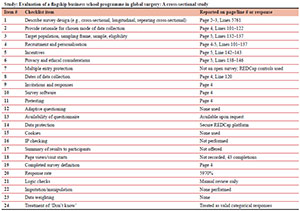
This study was reported in accordance with the CHERRIES (Checklist for Reporting Results of Internet E-Surveys) guideline.11
Setting and context
The University of Cape Town's Executive Leadership in Global Surgery programme, delivered through its Graduate School of Business, aims to equip surgeons, anaesthetists, and health systems leaders with global surgery, leadership, management, advocacy and diplomacy training to address surgical disparities in resource-limited settings. By leveraging participants' diverse experiences, the programme fosters cross-cultural collaboration and problem-solving. This innovative programme is convened by the Division of Global Surgery in the Faculty of Health Sciences and aims to prepare leaders to navigate complex, resource-constrained health environments.12,13
Admission to the programme is competitive and targeted healthcare specialists (surgeons, anaesthetists), hospital managers, and health officials who demonstrated existing leadership experience and a commitment to strengthening surgical systems. The course tuition was approximately $1 460 USD. The programme was delivered through a blended model that combined on-site and remote learning, utilising UCT's state-of-the-art facilities and digital platforms. The model was built around three core phases: an initial series of preparatory webinars to establish foundational concepts, an intensive in-person contact week in Cape Town for immersive learning and direct engagement with faculty and peers, and a subsequent 4-month compulsory project component practical application of knowledge. During this final phase, participants developed and implemented a context-specific implementation or research project in their home country, supported by dedicated coaches and regular virtual check-ins.
The curriculum was structured around five core competencies designed to address key gaps in surgical systems leadership. These were: 1) Surgical Systems Strengthening focused on applying analytical frameworks - such as the World Health Organization's (WHO) health systems building blocks and The Lancet Commission on Global Surgery's indicators - to assess and improve the six core components of a surgical system; 2) Innovation involved developing and scaling new technologies and processes, often employing human-centred design principles to overcome resource constraints; 3) Leadership and Management centred on cultivating strategic skills, using tools like stakeholder analysis and SWOT (strengths, weaknesses, opportunities, threats) analysis to drive organisational change; 4) Quality Improvement and Programme Management provided the tools for designing and evaluating projects using established methodologies like Plan-Do-Study-Act (PDSA) cycles and logic models; 5) Policy, Advocacy and Diplomacy equipped leaders to effectively engage with stakeholders and shape health policy through the crafting of evidence-based policy briefs and advocacy strategies.
Data collection methods
A comprehensive, in-depth survey (see Addendum) was developed in collaboration with global surgery education experts to evaluate the impact of the course, capturing data from alumni up to four years post-completion. The survey assessed sustained impact across key domains: practical application of leadership competencies, career advancement, engagement in global surgery initiatives, and professional network value. The survey instrument was developed de novo for this evaluation, as no validated tool existed for the specific context of a business-school-based global surgery leadership programme. To ensure face and content validity, the draft instrument was iteratively reviewed by a panel of three experts in global surgery education, health professions education, and survey design. Their feedback was used to refine question clarity, relevance, and comprehensiveness. Full psychometric validation (e.g. factor analysis for construct validity, Cronbach's alpha for internal consistency) was not pursued. This decision was pragmatic, based on the small, fixed population size (n = 72), which is insufficient for robust validation analyses, and aligns with common practice in early-stage programme evaluations where the primary goal is to generate preliminary evidence of impact and inform programme development. The instrument was pilot-tested with alumni to refine clarity and relevance. Pilot responses were excluded from the final analysis, though participants were re-invited to complete the revised survey to maintain statistical power given the small target population. The survey was subsequently distributed via email and direct message on social media using REDCap14
Data analysis
Survey data were analysed using the latest version of R (version 4.5.1)15
Sampling
The survey was distributed to all 72 alumni from the 2022-2025 cohorts, constituting a census of the target population. All alumni were invited, and the resulting sample of 43 comprising 13 from the 2022 cohort, 16 from 2023, 22 from 2024, and 21 from the 2025 cohort represents a period sample of those who chose to participate.
Results
Participants' demographic and professional characteristics
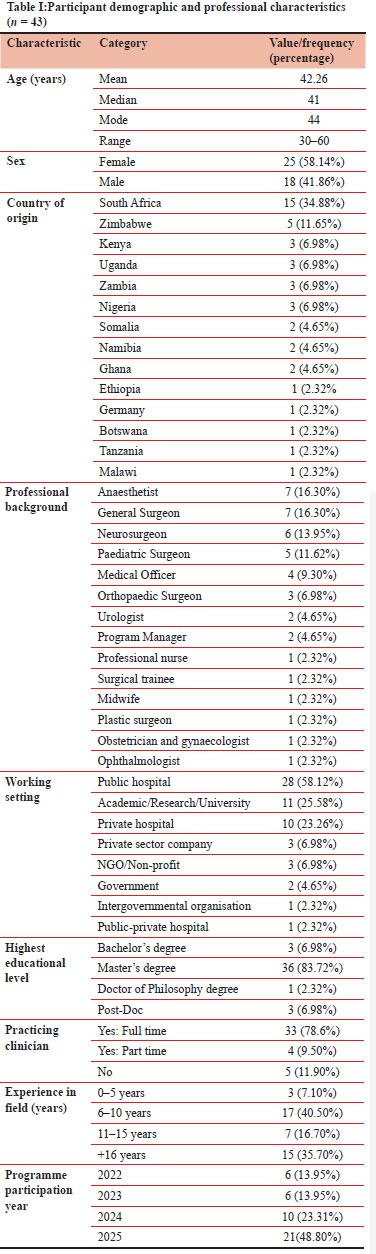
A total of 43 participants completed the survey (59.70% response rate), representing 14 countries (13 from Africa). The mean age was 42.26 years, with 58.14% female. Most respondents were from South Africa (34.88%) and Zimbabwe (11.65%), with diverse surgical specialties represented. The majority worked in public hospitals (58.12%), held a Master's degree (83.72%), and were full-time clinicians (78.60%). Nearly half of participants attended the programme in 2025 (48.80%). In Table I, participants could select multiple working settings, hence the total exceeds 43. Of the 43 respondents, 16 (37.20%) reported more than one professional setting, with the most common combination being "Public hospital" and "Academic/Research/University". Detailed characteristics are presented in Table I.
Programme experiences and perceptions
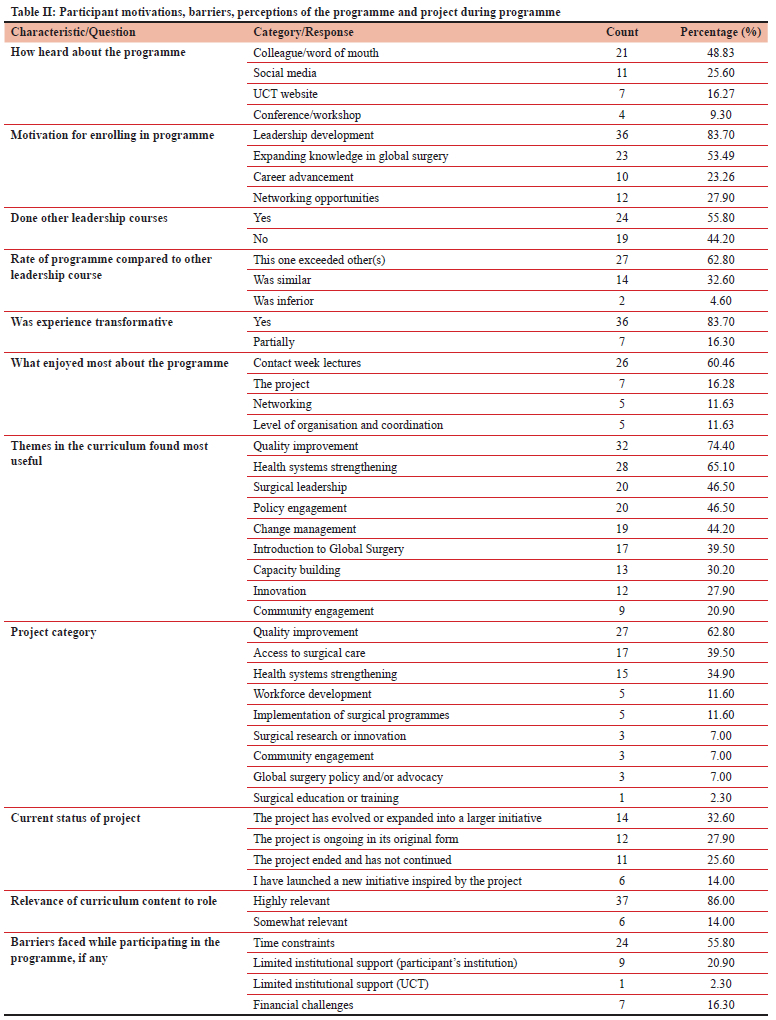
Participants reported learning about the programme primarily through colleagues or word of mouth (48.83%, 21/43). The main motivations for enrolling were leadership development (83.70%, 36/43), expanding knowledge in global surgery (53.49%, 23/43), career advancement (23.26%, 10/43), and networking opportunities (27.90%, 12/43). Just over half of the participants (55.80%, 24/43) had completed other leadership courses prior to this programme. When asked to rate the overall quality of this programme compared to other leadership courses they had taken, 62.80% (27/43) felt it exceeded other courses, 32.60% (14/43) found it similar, and 4.60% (2/43) considered it inferior. Most participants (83.70%, 36/43) described their experience as transformative, with 16.30% (7/43) reporting it as partially transformative. The survey question defined a transformative experience as one that "led to a significant shift in your perspective, approach, or capabilities as a leader in global surgery." The aspects of the programme participants most enjoyed were the contact week lectures (60.46%, 26/43) and the project component (16.30%, 7/43) (Table II).
Competences and skills
Most useful curriculum themes were quality improvement (74.40%, 32/43), health systems strengthening (65.10%, 28/43), surgical leadership (46.50%, 20/43), policy engagement (46.50%, 20/43), and change management (44.20%, 19/43). Programme projects focused on quality improvement (62.80%, 27/43), access to surgical care (39.50%, 17/43), and health systems strengthening (34.90%, 15/43), with others addressing workforce, research, policy, community, and education. One-third of projects evolved into larger initiatives (32.60%, 14/43), while others remained ongoing (27.90%, 12/43), ended (25.60%, 11/43), or inspired new initiatives (14.00%, 6/43). Nearly all participants (86.00%, 37/43) found the curriculum highly relevant. Common barriers to full participation and project completion were time constraints (55.80%, 24/43), limited institutional support from the participant's home institution (22.90%, 10/43) and financial constraints (16.30%, 7/43) (Table II).
Reported programme's impact on confidence, leadership roles, and practice
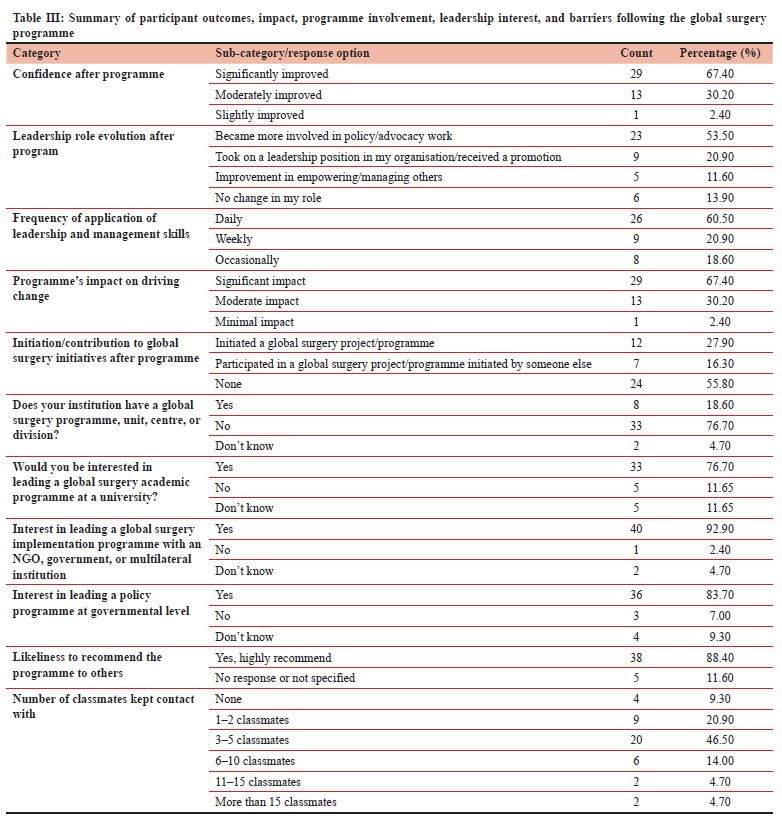
Up to 67.40% (29/43) of participants reported a significant improvement in confidence, 30.20% (13/43) reported moderate improvement, and 2.40% (1/43) reported slight improvement in their confidence level following programme's completion. Regarding leadership role evolution, 53.50% (23/43) became more involved in policy or advocacy work, 20.90% (9/43) took on a leadership position or received a promotion, 11.60% (5/43) reported improvement in empowering or managing others, and 13.90% (6/43) reported no change in their role. The frequency of applying leadership and management skills learned from the programme was daily for 60.50% (26/43), weekly for 20.90% (9/43), and occasionally for 18.60% (8/43). Programme impact on driving change was rated as significant by 67.40% (29/43), moderate by 30.20% (13/43), and minimal by 2.40% (1/43). For initiation or contribution to global surgery initiatives, 27.90% (12/43) had initiated a project or programme, 16.30% (7/43) had participated in a project/programme initiated by someone else, and 55.80% (24/43) had not yet contributed (Table III).
Global surgery and leadership education
Among participants, 18.60% (8/43) reported that their institution had a global surgery programme, unit, centre, or division, 76.70% (33/43) reported none, and 4.70% (2/43) were unsure. A majority expressed interest in leadership roles: 76.70% (33/43) in academic programmes at a university, 92.90% (40/43) in implementation programmes with an NGO, government, or multilateral institution, and 83.70% (36/43) in policy programmes at the governmental level. Most participants (88.40%, 38/43) indicated they would highly recommend the programme. Regarding peer connections, 46.50% (20/43) maintained contact with 3-5 classmates (Table III).
Relationship between prior leadership courses, experience, and leadership role evolution (non-significant)
To examine the association between prior leadership courses and leadership role evolution after the programme, the odds ratio (OR) was calculated from a 2 x 2 contingency table, and its statistical significance was assessed using Fisher's exact test. Participants with prior leadership courses had higher odds of evolving their leadership roles (OR = 5.08), but this result was not statistically significant (two-sided p = 0.077). Among participants with prior leadership courses, 22 of 24 reported leadership role evolution, compared with 13 of 19 participants without prior courses.
A logistic regression model was performed to assess the independent effects of prior leadership courses and years of experience on leadership role evolution. Both predictors showed trends toward higher odds of evolution, but neither reached statistical significance (Table IV).
Analysis of long-term impact by time since programme completion
A Spearman's rank-order correlation examined the relationship between years since programme completion and participants' likelihood of initiating or contributing to a global surgery initiative, policy, or program (n = 43). Descriptive analysis showed variation by cohort: among the 2024 graduates, 7 out of 10 (70.00%) had initiated or contributed to an initiative, followed by 4 out of 6 (66.70%) in the 2022 cohort. In contrast, only 1 of 6 participants (16.70%) from the 2023 cohort reported involvement, while 7 of 21 (33.30%) of the most recent 2025 graduates had done so. Overall, 18 initiatives were launched or supported across the four cohorts, representing 44.20% of participants.
A Spearman's rank-order correlation was conducted to assess the relationship between time since programme completion and initiative implementation. No statistically significant association was found (p = 0.166, p = 0.287). The 95% confidence interval ranged from 0.141-0.444, crossing zero and further supporting the absence of a significant monotonic relationship. These results suggest that the number of years since completing the programme is not a significant predictor of initiative implementation in this cohort.
Perceived transformative impact over time
A chi-square test of independence examined the relationship between time since programme completion and perception of the experience as transformative ("Yes") versus partially transformative ("Partially"). To meet assumptions, the 2-year (n = 6) and 3-year (n = 5) groups were combined into a single "2+ years" group (n = 11).
The association was statistically significant (χ2Table V).
Discussion
Cultivating a community of practice: the mid-career multidisciplinary cohort
The participants' mean age of 42.30 is a significant finding, indicating the programme appeals to mid-career professionals. Whilst the participants are at a career stage where leadership opportunities are likely to arise, the programme may have served to accelerate or position them for their next promotion. These are not novices, but experienced clinicians who have firsthand experience with systemic barriers to care. Their enrolment reflects a deliberate effort to gain the skills needed for health systems reform, not just to manage clinical challenges. The high proportion of respondents (37.20%) holding multiple professional roles (e.g., clinician and academic) further defines this cohort as highly driven individuals likely to seek out and benefit from such advanced training.
The strong female representation (58.10%) is particularly noteworthy against the backdrop of a surgically male-dominated field and under-representation of women in leadership roles globally.6,18 This suggests that the programme may be attracting a pool of high-potential female leaders who are actively seeking the skills and networks to advance their impact, potentially offering a model for addressing gender equity in global health leadership.
Furthermore, the multidisciplinary nature of the cohort, from anaesthetists and neurosurgeons to programme managers, mirrors the reality of surgical system delivery, which requires collaboration across specialties and professions.1920-22
The allure of applied learning: why quality improvement over other competences
Participants' strong preference for Quality Improvement (QI) and Health Systems Strengthening highlights a critical need among surgeons in resource-limited settings. This finding aligns with Deilkås et al.2324,25 QI provides a structured methodology to solve the problems that frustrate them daily. This explains why most projects were QI initiatives; participants were eager to apply a new, practical lens to longstanding, familiar challenges. The fact that over half of these projects either evolved into larger initiatives or are still ongoing is a testament to the programme's success in fostering not just theoretical understanding, but implementation capability. This moves the needle from "knowing" to "doing," which is the fundamental goal of effective leadership development.
The confidence to lead and the network to sustain it
The widely reported improvement in confidence is an important outcome. While this confidence boost is strongly linked to the programme's curriculum and peer network by the participants, simply being selected for a competitive course can be a validating and empowering experience.2627
The surge in internal confidence is reinforced by a network created by the participants. The sustained connections between participants across 14 countries creates a vital "community of practice." This network has the potential to act as a permanent source of peer support, technical advice, and collaborative opportunity, effectively extending the value of the programme far beyond its formal duration and creating a resilient pan-African web of change agents.28-30
Filling a void: creating the missing pipeline of global surgery leaders
The finding that 76.7% of participants come from institutions without formal global surgery units highlights a major deficit. This reveals not an underused pipeline, but its absence, creating a critical opportunity. Here, the programme's role expands beyond training to cultivating a leadership cohort and professional network where formal structures are lacking.
This finding echoes concerns raised in by Francis et al.31
Against this backdrop, participants' ambitions to lead academic (92.90%), implementation (76.70%), and policy (83.70%) initiatives can be understood as a direct response to this systemic vacuum. Their goals reflect the emergence of a workforce preparing to establish the very systems that are currently inadequate.
Graduates of this programme should be viewed not merely as alumni, but as key assets in global surgery - researchers, teachers, and innovators poised to strengthen surgical systems. Early evidence shows participants are already applying their skills daily (60.50%), empowering colleagues (11.60%), and scaling projects into larger initiatives (46.60%). By contributing to agencies that govern and fund surgical care, they can drive structural change. This replicable model of multidisciplinary leadership development does not just transform the leader, it also equips them to transform surgical systems.
Limitations
This study has several limitations that must be considered when interpreting its findings. First, the reliance on self-reported data is susceptible to recall and social desirability biases; while anonymisation likely mitigated this, it cannot be eliminated. Second, the survey instrument, while developed with expert input, lacked formal psychometric validation, which may affect the precision of measured constructs like confidence and transformative impact. Third, the absence of a control group makes it challenging to attribute outcomes like promotions or policy involvement solely to the programme. Fourth, the uneven response across cohorts and the potential for non-response bias - where more engaged or positively influenced alumni may have been more likely to participate - should be acknowledged. However, the novelty of the discipline and the course, would not have allowed for similar comparators. Fifth, the small sample size, particularly within cohort subgroups, limits the statistical power and reliability of inferential analyses and generalisability of these specific findings. Finally, the high proportion of recent 2025 graduates (48.8%) may introduce recency bias in ratings of the experience as 'transformative'.
Strengths
According to our knowledge, this is the first programme of this kind in the world - an Executive Leadership in Global Surgery taught through a Graduate School of Business. The study provides insights on the impact of the course and the outcomes of the course, from 4 different cohorts, providing insights on immediate and medium-term outcomes at year 0, year 1, year 2, and year 3. The programme appears to act as a potent catalyst for individuals already predisposed to leadership, equipping them with tools, skills, and networks, to develop their leadership.
Recommendations and generalisability
For future research, longitudinal approaches could help assess how outcomes evolve over time. Qualitative methodologies might also offer deeper insight into the experiences and mechanisms behind leadership development. Where possible, including comparison groups could strengthen understanding of the programme's specific impact, while studies comparing this model to other training formats could help identify its unique value.
The generalisability of this business-school partnership model to other LMIC contexts depends on key contextual factors: the presence of a strong academic business school, committed surgical department leadership, and funding to support participant costs. The core principles - applied learning, multidisciplinary cohorts, and a focus on implementation projects - are widely applicable. However, adaptation would be needed to fit local institutional cultures, resources, and health system priorities. This model presents a viable template for other universities, including historically disadvantaged institutions, to adapt in partnership with their business or public health schools to build local surgical leadership capacity.
Conclusion
The Executive Leadership in Global Surgery course represents a novel and promising model for surgical leadership education by integrating improvement science and leadership training within a business school framework. The positive outcomes reported by alumni - including increased confidence, career advancement, and project implementation - suggest that the programme is strongly associated with meaningful professional development. This study indicates that targeted investment in the leadership development of mid-career African surgical providers holds significant potential as a key strategy for strengthening surgical systems in Africa.
Conflict of interest
The authors declare no conflict of interest.
Funding source
No funding was required.
Ethical considerations
All participants were provided with information about the study's purpose, methods, and potential risks. Informed consent was obtained prior to data collection.
The confidentiality of participants' responses was maintained, with data being anonymised to protect their identities. Only the research team had access to identifiable information.
Ethical approval
The study had ethical approval from the University of Cape Town's Research Ethics Committee (HREC REF NO: 382/2025) before data collection was initiated.
ORCID
Y Zolo https://orcid.org/0000-0002-9134-5703
W Mulwafu https://orcid.org/0000-0002-1652-332X
C Cunningham https://orcid.org/0000-0002-8188-0307
R Chivaka https://orcid.org/0009-0000-6286-1920
S Maswime https://orcid.org/0000-0003-4013-5164
REFERENCES
-
1. Quene TM, Bust L, Louw J, Mwandri M, Chu KM. Global surgery is an essential component of global health. Surgeon. 2022;20(1):9-15. https://doi.org/10.1016/j.surge.2021.10.001.
» https://doi.org/10.1016/j.surge.2021.10.001 -
2. Meara JG, Leather AJM, Hagander L, et al. Global Surgery 2030: Evidence and solutions for achieving health, welfare, and economic development. Lancet. 2015;386(9993):569-624. Available from: http://www.thelancet.com/article/S014067361560160X/fulltext. Accessed 27 Aug 2024.
» http://www.thelancet.com/article/S014067361560160X/fulltext -
3. Surgical Leadership | HMS Postgraduate Education [Internet]. Available from: https://postgraduateeducation.hms.harvard.edu/certificate-programs/surgical-leadership. Accessed 2 May 2025.
» https://postgraduateeducation.hms.harvard.edu/certificate-programs/surgical-leadership -
4. Kumar B, Swee ML, Suneja M. Leadership training programmes in graduate medical education: A systematic review. BMC Med Educ. 2020;20(1):1-10. https://doi.org/10.1186/s12909-020-02089-2.
» https://doi.org/10.1186/s12909-020-02089-2 -
5. How to Choose an Executive Leadership Programme in 2025 [Internet]. IMD. 2025. Available from: https://www.imd.org/blog/leadership/executive-leadership-program/. Accessed 20 Aug 2025.
» https://www.imd.org/blog/leadership/executive-leadership-program/ -
6. What is executive leadership training? All you need to know [Internet]. Retorio. 2024. Available from: https://www.retorio.com/blog/what-is-executive-leadership-training. Accessed 20 Aug 2025.
» https://www.retorio.com/blog/what-is-executive-leadership-training -
7. Ellis LD. How strengthening leadership skills can help surgeons achieve quality and safety in the operating room. Harvard Medical School Professional, Corporate, and Continuing Education [Internet]. 2023. Available from: https://learn.hms.harvard.edu/insights/all-insights/how-strengthening-leadership-skills-can-help-surgeons-achieve-quality-and-safety-operating-room. Accessed 20 Aug 2025.
» https://learn.hms.harvard.edu/insights/all-insights/how-strengthening-leadership-skills-can-help-surgeons-achieve-quality-and-safety-operating-room -
8. Wang Y, Fu Y, Wu X, et al. Integrating experiential learning theory with innovation and entrepreneurship education: A qualitative study on Chinese medical students. BMC Med Educ. 2025;25(1):1227. https://doi.org/10.1186/s12909-025-07804-5.
» https://doi.org/10.1186/s12909-025-07804-5 -
9. Maghami N, Hsu CY, Fahey TJ, et al. Identifying general surgery trainees' perception of leadership, leadership needs, and development of a leadership curriculum. Proc (Bayl Univ Med Cent). 2025;38(4):462-73. https://doi.org/10.1080/08998280.2025.2485835.
» https://doi.org/10.1080/08998280.2025.2485835 -
10. Ho JW, Cerier EJ, Diaz CM, et al. Residents need a dynamic approach to leadership education: A qualitative study. J Surg Educ. 2024;81(6):794-803. https://doi.org/10.1016/j.jsurg.2024.03.003.
» https://doi.org/10.1016/j.jsurg.2024.03.003 -
11. Eysenbach G. Improving the quality of web surveys: The checklist for reporting results of Internet E-surveys (CHERRIES). J Med Internet Rev. 2004;6(3):e34. https://doi.org/10.2196/jmir.6.3.e34.
» https://doi.org/10.2196/jmir.6.3.e34 -
12. University of Cape Town - Africa Health Collaborative [Internet]. Available from: https://africahealthcollaborative.org/partner/university-of-cape-town/. Accessed 12 May 2025.
» https://africahealthcollaborative.org/partner/university-of-cape-town/ -
13. Sims D, Zingela Z, Mokhachane M, et al. Medical education, reflections and perspectives from South Africa: A review. BMC Med Educ. 2025;25(1):370. https://doi.org/10.1186/s12909-025-06910-8.
» https://doi.org/10.1186/s12909-025-06910-8 -
14. REDCap [Internet]. Available from: https://www.project-redcap.org/. Accessed 28 Aug 2024.
» https://www.project-redcap.org/ -
15. R: The R Project for Statistical Computing [Internet]. Available from: https://www.r-project.org/. Accessed 19 May 2025.
» https://www.r-project.org/ -
16. Seemann NM, Webster F, Holden HA, et al. Women in academic surgery: Why is the playing field still not level? Am J Surg. 2016;211(2):343-9. https://doi.org/10.1016/j.amjsurg.2015.08.036.
» https://doi.org/10.1016/j.amjsurg.2015.08.036 -
17. Malik TG. Women in surgical fields; Time to break the glass ceiling. Pak J Med Sci. 2021;37(5):1249. https://doi.org/10.12669/pjms.37.5.4583.
» https://doi.org/10.12669/pjms.37.5.4583 -
18. Gargiulo DA, Hyman NH, Hebert JC, et al. Women in surgery: Do we really understand the deterrents? Arch Surg. 2006;141(4):405-7; discussion 407-8. https://doi.org/10.1001/archsurg.141.4.405.
» https://doi.org/10.1001/archsurg.141.4.405 -
19. Pryor AD. Surgical evolution: Collaboration is the key. Arch Surg [Internet]. 2005;140(3):237-40. https://doi.org/10.1001/archsurg.140.3.237.
» https://doi.org/10.1001/archsurg.140.3.237 -
20. Negandhi P, Negandhi H, Tiwari R, et al. Building interdisciplinary leadership skills among health practitioners in the twenty-first century: An innovative training model. Front Public Health. 2015;3:221. https://doi.org/10.3389/fpubh.2015.00221.
» https://doi.org/10.3389/fpubh.2015.00221 -
21. Greenfield DR, Nugus P, Travaglia JF, Braithwaite J. Interprofessional learning and practice can make a difference. Med J Aust. 2011;194(7):364-5. https://doi.org/10.5694/j.1326-5377.2011.tb03008.x.
» https://doi.org/10.5694/j.1326-5377.2011.tb03008.x -
22. Wright K, Rowitz L, Merkle A, et al. Competency development in public health leadership. Am J Public Health. 2000;90(8):1202-7. https://doi.org/10.2105/AJPH.90.8.1202.
» https://doi.org/10.2105/AJPH.90.8.1202 -
23. Deilkås ET, Rosta J, Baathe F, et al. Physician participation in quality improvement work - interest and opportunity: A cross-sectional survey. BMC Primary Care. 2022;23(1):1-9. https://doi.org/10.1186/s12875-022-01878-6.
» https://doi.org/10.1186/s12875-022-01878-6 -
24. Dahrouge S, Armstrong CD, Hogg W, Singh J, Liddy C. High-performing physicians are more likely to participate in a research study: Findings from a quality improvement study. BMC Med Res Methodol. 2019;19(1):1-9. https://doi.org/10.1186/s12874-019-0809-6.
» https://doi.org/10.1186/s12874-019-0809-6 -
25. Davies H, Powell A, Rushmer R. Why don't clinicians engage with quality improvement? J Health Serv Res Policy. 2007;12(3):129-30. https://doi.org/10.1258/135581907781543139.
» https://doi.org/10.1258/135581907781543139 -
26. McNair R, Griffiths L, Reid K, Sloan H. Medical students developing confidence and patient centredness in diverse clinical settings: A longitudinal survey study. BMC Med Educ. 2016;16(1):176. https://doi.org/10.1186/s12909-016-0689-y.
» https://doi.org/10.1186/s12909-016-0689-y -
27. Suvvari SK. The role of leadership in project success: A quantitative analysis. International Journal of Communication Networks and Information Security (IJCNIS). 2024;1146-57. Available from: https://ijcnis.org/index.php/ijcnis/article/view/7319.
» https://ijcnis.org/index.php/ijcnis/article/view/7319. -
28. Gustavsen A. What does alumni mean? | SNHU [Internet]. Available from: https://www.snhu.edu/about-us/newsroom/community/what-does-alumni-mean. Accessed 20 Aug 2025.
» https://www.snhu.edu/about-us/newsroom/community/what-does-alumni-mean -
29. Cohen LH, Malloy CJ. The power of alumni networks. 2010. Available from: https://hbr.org/2010/10/the-power-of-alumni-networks. Accessed 20 Aug 2025.
» https://hbr.org/2010/10/the-power-of-alumni-networks -
30. Alayande BT, Seyi-Olajide JO, Fenta BA, et al. The Pan-African Surgical Healthcare Forum: An African qualitative consensus propagating continental national surgical healthcare policies and plans. PLOS Global Public Health. 2024;4(11):e0003635. https://doi.org/10.1371/journal.pgph.0003635.
» https://doi.org/10.1371/journal.pgph.0003635 -
31. Francis P, Chu K, Isiagi M, et al. Developing a pipeline of African global surgery scholars. S Afr Med J. 2023;113(7):1248-9. https://doi.org/10.7196/SAMJ.2023.v113i7.1104.
» https://doi.org/10.7196/SAMJ.2023.v113i7.1104

Supplementary material:
CHERRIES Checklist
Survey: Evaluating the Executive Leadership in Global Surgery Programme
Purpose: This survey aims to assess the impact and effectiveness of the Executive Leadership in Global Surgery programme at the University of Cape Town (UCT). Your responses will remain confidential and will be used solely for research and programme improvement.
Section 1: Participant demographics
1. What is your age? (In whole numbers)
2. What is your gender? (Select one)
Male
Female
Non-binary/Other
Prefer not to say
3. What is your current title?
Mr/Mrs
Doctor
Associate Professor
Adjunct Professor
Honorary Professor
Professor
Other (specify)
4. Which country do you work in? (Drop-down list of countries)
5. What is your country of origin? (Drop-down list of countries)
6. What best describes your professional background? (Select what applies.)
Medical officer
General surgeon
Vascular surgeon
Paediatric surgeon
Trauma surgeon
Ophthalmologist
Plastic surgeon
Cardiothoracic surgeon
Neurosurgeon
Family physician
Emergency physician
Anaesthetist
Obstetrician and gynaecologist
Public health specialist
Professional nurse
Physiotherapist
Dental surgeon
Occupation therapist
Non-medical
Other(specify)
7. What is your highest level of education?
Diploma
Bachelor's degree
Master's degree
PhD
Post-doc
8. Are you currently enrolled for any of the following degrees? (Select what applies.)
Master of Public Health
Master of Business Administration
MSc Global Surgery
Master's degree
PhD Global Surgery
PhD degree
9. Do you have any of the following qualifications? (Select what applies.)
Master of Public Health
Master of Business Administration
MSc Global Surgery
Master's degree - specify
PhD Global Surgery
PhD degree - specify
10. Where do you currently work?
Clinic
Public hospital
Private hospital
University
Non-governmental organisation
Private sector company
Government
Other specify
11. Are you currently practising as a clinician
Yes: full time
Yes: part time
No
12. How many years of experience do you have in your field? (Select one.)
0-5 years
6-10 years
11-15 years
16+ years
Section 2: Programme participation and experience
13. Which year did you participate in the Executive Leadership in Global Surgery programme? (Select one.)
2022
2023
2024
2025
14. How did you first hear about the programme? (Select one.)
UCT Website
Colleague/word of mouth
Conference/workshop
Social media
Other (Specify)
15. What was your primary motivation for enrolling in this programme? (Select all that apply.)
Leadership development
Career advancement
Expanding knowledge in global surgery
Networking opportunities
Other (Specify)
16. Overall, how would you rate the programme in terms of quality and meeting expectations? (Select one.)
Exceeded expectations
Met expectations
Somewhat met expectations
Did not meet expectations
17. Have you done other leadership courses?
Yes
No
18. How would you rate this course compared to other courses you have attended/know of?
This one exceeded other
Was similar
Was inferior
19. Was your experience with this course transformative?
Yes
No
Partially
Undecided
20. What did you enjoy the most from the course?
The contact week lectures
The project
The networking
The level of organisation and co-ordination
The side-events
The webinars
Section 3: Program content and curriculum
21. Which themes in the curriculum did you find the most useful? (Select all that apply.)
Introduction to Global Surgery
Health systems strengthening
Innovation
Quality improvement
Capacity building
Policy engagement
Community engagement
Change management
Surgical leadership
22. How relevant was the curriculum content to your current professional role?
Highly relevant
Somewhat relevant
Neutral
Not relevant
Section 4: Impact on leadership and career
23. Since completing the programme, how has your confidence in your leadership changed?
Significantly improved
Moderately improved
Slightly improved
No change
Less confident
24. Since completing the programme, how has your leadership role evolved? (Select all that apply.)
I took on a leadership position in my organisation
I received a promotion
I became more involved in policy/advocacy work
No change in my role
Other (Specify.)
25. How often do you apply the leadership and management skills learned in the programme? (Select one.)
Daily
Weekly
Occasionally
Rarely
26. How would you rate the programme's impact on your ability to drive change in your workplace or community? (Select one.)
Significant impact
Moderate impact
Minimal impact
No impact
27. Have you initiated or contributed to any new global surgery initiatives, policies, or programmes as a result of this training? (Select all that apply.)
Yes, I have initiated a global surgery project/programme
Yes, I have participated in a global surgery project/programme initiated by someone else
No, but I plan to in the future
No, I don't intend to
28. If you answered yes to the above, please specify what project and/or programme. (Type the answer.)
29. If you answered yes to the above, please specify what project and/or programme. (Type the answer.)
30. Does your institution have a global surgery programme, unit, centre, division
Yes
No
Don't know
31. Would you be interested in leading a global surgery academic programme at a university
Yes
No
I don't know
32. Would you be interested in leading a global surgery an implementation programme with an NGO, government or multilateral institution?
Yes
No
Don't know
33. Would you be interested in leading a policy programme at government level?
Yes
No
Don't know
34. Since completing the course, which of the following have you participated in? (Select all that apply)
Conducted Global Surgery research
Published a Global Surgery paper
Attended a Global Surgery conference
Organised a Global Surgery event or meeting
Invited UCT Global Surgery staff to your institution
Been invited by the UCT Global Surgery course for an activity or collaboration
Lectured in any of the UCT Global Surgery courses
Interested in lecturing in UCT Global Surgery short courses
35. Have you contributed to a national or international policy since taking the course? (If yes, please describe below.)
36. Have you contributed to national or international guidelines since taking the course? (If yes, please describe below.)
37. Have you kept in touch with other classmates
1-2
3-5
5-10
10-15
More than 15
38. Would you recommend this programme to others in your field? (Select one.)
Yes, highly recommend
Yes, with some reservations
No
Section 5: Programme delivery & learning format
39. What barriers, if any, did you face while participating in the programme? (Select all that apply.)
Time constraints
Financial challenges
Technological difficulties
Limited institutional support (UCT)
Limited institutional support (Your Institution)
None
40. Did you complete your project and get certification?
Yes
No
41. Would you be interested in being part of an alumni group?
Yes
No
42. Have you attended international global surgery meetings?
Yes
No
Section 6: Future improvements and suggestions
43. What additional topics would you like to see included in the programme?
44. Which areas of the programme need improvement for greater impact?