The profile and outcomes of patients in a newly established acute surgical care unit in a teaching tertiary hospital in Botswana
Abstract
BACKGROUND: The scope of emergency general surgical care services varies among health institutions and countries. The burden, profile, and outcomes of patients in many low- to middle-income countries is not adequately investigated. METHODS: Medical records of patients admitted to acute surgical care (ASC) team were reviewed for a year. Demographics, diagnosis, dates of admission and discharges, comorbidities, operative procedures and operative care providers, outcomes, and factors associated with outcomes were analysed. RESULT: During the study period, 278 ASC admissions were made. The median age was 32 years. Males constituted 52.5%. The common admissions were acute appendicitis (57.2%), intestinal obstructions (15.5%), and soft-tissue infections (6.1%). Twenty-one point two per cent of the admissions had comorbidities and HIV infection was the commonest comorbidity. Seventy-one point nine per cent of the patients underwent operations. Appendicectomies (72.0%) were the commonest operations. Most of the operations (60.5%) were performed by residents. Complications occurred in 9.7% of the cases of which 6.5% were surgical site infection (SSI) and 2.2% resulted in mortality. Patients with complications had a significantly higher rate of mortality, p < 0.001. For all admissions and operated patients longer onset of illness was associated with longer hospital stays (p = 0.002 and 0.031) and mortality (p = 0.014 and 0.019) respectively. Patients operated by surgeons and residents together had a longer hospital stay than only by residents, p < 0.001. Similarly, when surgeons operated alone the hospital stay was longer than residents, p = 0.002. CONCLUSION: The commonest ASC pathology was acute appendicitis. Longer onset of symptoms was associated with longer hospital stay and mortality. This study provides foundational data relevant to surgical education and unit organisation, including the development of clinical guidelines, resident supervision, and workforce planning.
acute surgical care; burden; outcomes; profile; teaching hospital
Introduction
Acute surgery care (ASC) service includes trauma, surgical critical care, and emergency general surgery.1-3 ASC is used as a synonym for emergency general surgery.4,5 ASC involves timely evaluation and management of nontrauma general surgical emergency adult patients. It refers to the management of patients who present with a wide range of urgent or emergency general surgical conditions, often in an unscheduled or off-hour setting. These patients typically lack well-structured preoperative plan, carry a high risk of rapid clinical deterioration, and are more prone to complications. This complex and unpredictable nature of care places significant demands on healthcare providers and strain already limited resources.1,68 It is among the most common reasons for hospital admissions,4,9 and accounts for a significant proportion of general surgical operations.7 The pathologies in ASC include but are not limited to acute appendicitis, cholecystitis, intestinal obstruction and perforations, complicated hernia, pancreatitis, cholangitis, diverticulitis, and other causes of abdominal sepsis.4,6
Historically, general surgical emergency patients fall under different surgical subspeciality units, and this resulted in less interest among subspecialists who have their own academic interest and primary clinical responsibilities.5,6 The conventional general surgical call model could be associated with increased surgeon burnout for double booking of surgeon time.7 Such mode creates conflict between scheduled clinical work and prompted care requiring surgical emergencies, resulting in provision of suboptimal care or hampering timely completion of scheduled work.4,6
Following a rapid expansion of medical knowledge and technologies, surgery has become more subspecialised.5 Established ASC has demonstrated improved daytime theatre utilisation and reduced after hour work; it has reduced the number of handovers from night to morning acute surgical care teams with resultant higher staff satisfaction and onsite consultant driven surgical leadership with improved patient outcome.5,6,10,11 It also resulted in lowering accident and emergency unit crowding and surgical decision-making time.12 In many developing health systems, ASC is poorly defined and inadequately supported.13
ASC units offer opportunities for training for medical students, surgical residents, emergency medicine residents, and for practising medical officers and general surgeons.6
This ASC unit was established 2021 along with trauma, breast and endocrinology, and colorectal units to help with the newly established Master's in General Surgery Programme at the University of Botswana. This study aims to investigate the profile and outcomes of acute general surgical patients at this unit. The findings in this study may help clinicians and policymakers in planning ASC workforce assignments, training, access to care, and resource allocations.
Methods and materials
A retrospective review of medical records of patients admitted to the ASC unit in the department of surgery at a tertiary academic hospital in Botswana was conducted from June 2023 to May 2024. The unit is run by a senior consultant general surgeon along with a general surgery resident in their ASC rotation and a medical officer. All emergency general surgical adult patients age > 13 years were admitted to the unit (patients < 13 years are admitted to the paediatrics surgical ward; this is in accordance with hospital policy). The on-call general surgeon attends to these patients and hands them over to the ASC unit team.
Data on patient demographics, diagnosis, comorbidity, date of admission and discharge, mode of treatment, level of training of surgical care provider, and outcomes were captured on a paper-based data collection form. The variables of interest were part of the standard documentation in the department, and data were collected immediately after patient discharge. No medical records or data were missed. Data were collected by general surgery residents rotating in the ASC unit after receiving training from the ASC unit team leader, who also supervised them during the data collection process. Continuous variables were described using median and percentages when they are grouped in intervals. Groups were compared using chi-square test (CST), Fisher's exact test (FET), or Mann-Whitney U test (MWUT), as appropriate. Bivariate and multivariate logistic regression analysis was employed to determine the association between independent (onset of symptoms to admission and operations, and accident and emergency to operation) and outcome variables (hospital stays and mortality). Variables with p-value < 0.05 in bivariate analysis were taken to multivariate analysis. Crude odds ratio (COR), adjusted odds ratio (AOR) and 95% confidence interval (CI) were calculated and p-value less than 0.05 was considered statistically significant. SPSS version-29 software was used to analyse the data.
Results
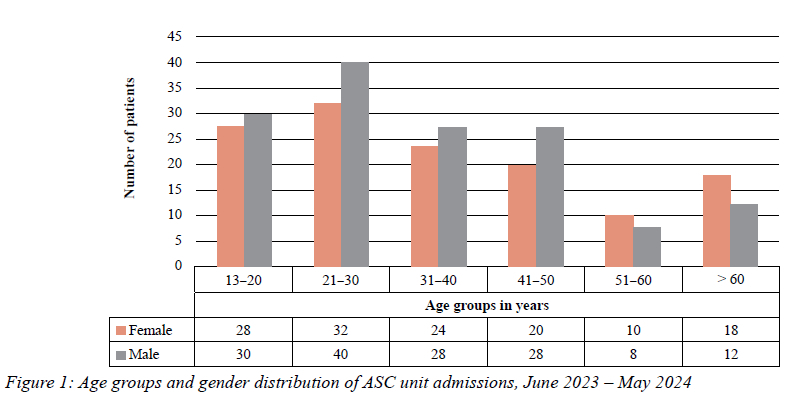
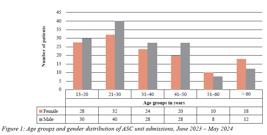
Two hundred and seventy-eight (278) patients were admitted to the ASC team from 1 June 2023 to 31 May 2024. Males contributed 146 (52.5%), while female constituted 132 (47.5%). The overall median [IQR] age was 32 [22-45] years: for males 32 [22-44] and for females 33 [22-47] years. Most patients were aged 21-30, comprising 72 individuals (25.9%) followed by the 13-20 age group with 58 patients (20.9%), and the 31-40 age group with 52 patients (18.7%) (Figure 1).
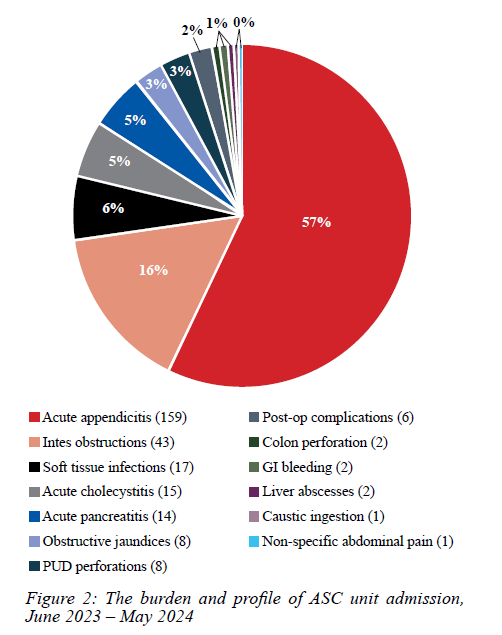
The commonest admission diagnosis was acute appendicitis in 159 patients (57.2%), followed by intestinal obstruction in 43 patients (15.5%), and soft tissue infection in 17 patients (6.1%). Of the 43 intestinal obstruction patients, 29 were small bowel (67.4%) and 12 were large bowel obstructions (27.9%). Two patients had compound volvuli (4.7%), ileosigmoid knotting. Small bowel obstructions were caused by adhesions in 17 cases (58.6%), hernia in eight cases (27.6%), TB peritonitis in two cases (6.9%), and one case each (3.4%) of Crohn's disease and intussusception. Large bowel obstructions were caused by sigmoid volvulus and colorectal cancer in five cases each (41.7%), and caecal volvulus in two cases (16.7%). Among the six patients admitted with a diagnosis of postoperative complications, three had post-appendicectomy visceral surgical site infection (SSI) (50.0%), two cases had wound dehiscence (33.3%), and one case had post-cholecystectomy subhepatic collection (16.7%). Among the two colonic perforations, one was due to an advanced caecal tumour and another one due to CMV infection (Figure 2).
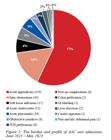
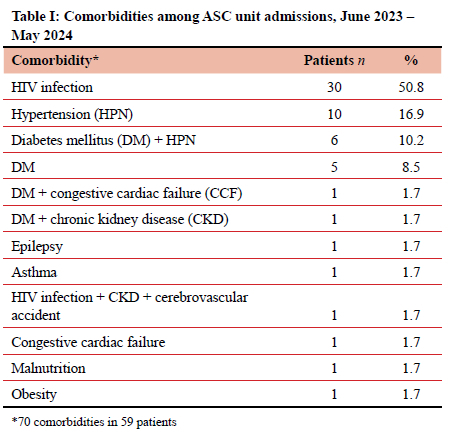
Fifty-nine patients (21.2%) had one or more comorbidities. A total of 70 comorbidities were recorded among the 59 patients. Of the 59 recorded comorbidities, HIV infection was the most common affecting 31 patients (11.2%). Hypertension was the second most common, occurring in 16 patients (5.8%), followed by diabetes mellitus in 8 patients (2.9%) (Table I).
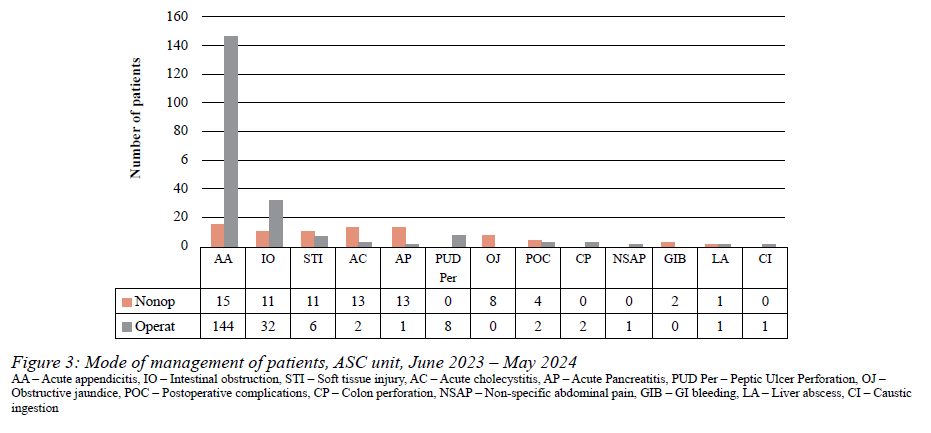
The median [IQR] age of operated males was 27 [2146] and females was 26 [20-39] years. The majority of the patients with acute appendicitis (90.6%) underwent operations, while the majority of the patients with acute cholecystitis (86.7%) were managed non-operatively. The patient with caustic injection, two patients with colon perforation, and eight patients with perforated peptic ulcer underwent operation. Most intestinal obstruction patients, 75.0%, were operated. One patient with acute pancreatitis was diagnosed intraoperatively. Two of the three nonspecific abdominal pain patients were operated and both patients had negative laparotomies. The commonest operations were appendicectomy (72.0%) and laparotomies (25.0%). Laparotomies were for intestinal obstructions (16.0%), peptic ulcer disease perforations (4.0%), acute cholecystitis (1.0%), postoperative complications (1.0%), colon perforations (1.0%), acute pancreatitis (0.5%), nonspecific abdominal pain (0.5%), liver abscess (0.5%), and caustic ingestion (0.5%) (Figure 3).
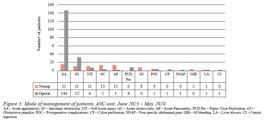
Most of the operations (21/200) were performed by residents (60.5%), while both surgeons and residents were present in 55 (27.5%) and surgeons alone in 24 operations (12.0%).
Most appendicectomies (106/144) were performed by residents alone (73.6%), while surgeons and residents together performed 26 (18.1%) and surgeons alone performed 12 appendicectomies (8.3%). Intraoperatively, 59/144 patients had complicated appendicitis (41.0%). Among the 59 complicated appendicitis patients, 40 were operated by residents (67.8%), 14 cases by surgeons and residents together (23.7%), and five cases by surgeons alone (8.5%). Though the rate of complicated appendicitis (14/26 operated in the presence of both surgeon and resident, 53.8%) was higher than 40 out of 106 when the resident operated alone (37.7%), it was not statistically significant, p = 0.134 (CST). Similarly, when surgeons operated alone, they operated on a higher number (5/12) of complicated appendicitis (41.7%) than residents (37.7%), but it did not reach statistical significance, p = 0.765 (FET).
The majority of the intestinal obstructions (18/32) were operated by surgeons and residents together (56.3%). Residents operated eight cases on their own (25.0%), while surgeons operated six (18.8%). Of the 29 small intestine obstructions, 21 were operated on (72.4%): 12 by surgeon and resident together (41.4%/57.1%), six by residents alone (20.7%/28.6%), and three by surgeons (10.3%/14.3%). Among the 12 large bowel obstruction patients, nine patients were operated (75.0%): six (50.0%/66.7%) by surgeon and resident together, two by surgeon alone (16.7%/22.2%), and one by resident alone (8.3%/11.1%). The rate of operations by surgeons and residents on small intestine obstruction (60.0%/75.0% vs 85.7%/75.0%) and large intestine obstruction (40.0%/50.0% vs. 14.3%/33.3%) respectively were not statistically different, p = 0.580 (FET). A surgeon and a resident each operated on one ileosigmoid knotting intestinal obstruction patient.
Five of the eight PUD perforations were operated by residents and surgeons together (62.5%), while two cases were operated by surgeons (25.0%) and one case was operated by a resident (12.5%).
Overall, complications were recorded in 27/278 patients (9.7%): SSIs in 13/200 (6.5%), deaths in 6/278 (2.2%), ileus in 2/194 (1.0%), respiratory failure in 2/278 (0.7%), enterocutaneous fistula (ECF) in 1/194 (0.5%), pancreatic pseudocyst in 1/14 (7.1%), and iatrogenic urethral injury 1/278 (0.4%). Two hundred and seventy-one patients were discharged home (97.5%), while one patient self-referred to a private health institution (0.4%).
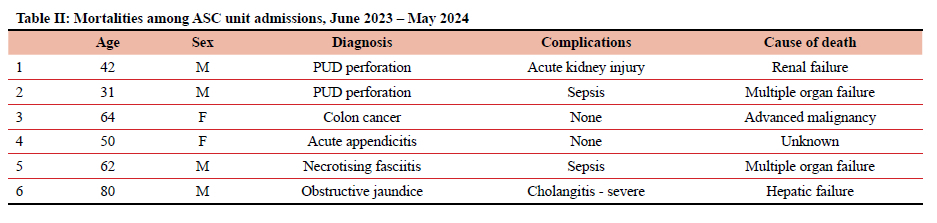
Among the six mortalities, two had PUD perforations. Both presented to the hospital after five days of onset of their symptoms. The 42-year-old male with no comorbidity developed acute kidney injury, and he died on the 10th postoperative day and 11th post-admission day. The 31-year- old male who had no comorbidity developed sepsis, and he died on the 8th postoperative day and 11th post admission day. Of note, these patients were operated by surgeon and resident together. The 64-year-old HIV-positive female patient presented after two days of onset of symptoms of large bowel obstruction, and she died on the same day of admission before any operative intervention. A 50-year-old female HIV-positive patient presented to the hospital after five days of the onset of symptoms and was operated after one day of admission. The intraoperative finding was gangrenous appendix with local contamination. She passed away on the first operative day. This patient was operated by a resident. The 62-year-old diabetic and hypertensive male patient presented to the hospital after 14 days of onset of symptoms. He had necrotising fasciitis of the anterior chest wall and died on third post-operation day. He was operated by a surgeon and resident together. The 80-year-old male patient presented after three months of onset of his symptoms and developed severe cholangitis. His condition did not allow for ERCP or operative interventions and he died on the sixth post-admission day (Table II).
There was no statistically significant difference in the rates of mortalities between patients who underwent operation (2.0%) and non-operated patients (2.6%), p = 0.674 (FET). Though patients with comorbidity had a higher rate of mortality (5.1%) than those with no comorbidity (1.4%), it did not reach statistical significance, p = 0.112 (FET). Patients who had complications had significantly higher mortality (16.0%) than those with no complications (0.8%), p < 0.001 (CST).
The overall median [IQR] (Range) hospital stay was 5 [3-8] (0-64) days - 4 [3-7] (0-47) for operated and 6 [412] (0-64) for non-operated patients, p < 0.001 (MWUT). Patients who had comorbidities had a significantly longer hospital stay, 7 [4-12] (0-57) than patients who had no comorbid conditions 4 [3-7] (0-64), p < 0.001 (MWUT).
There is no statistically significant difference in the median length of hospital stay between those who died, 5 [3-8] (064) and who were alive 4.5 [2-5] (0-11), p = 606 (MWUT).
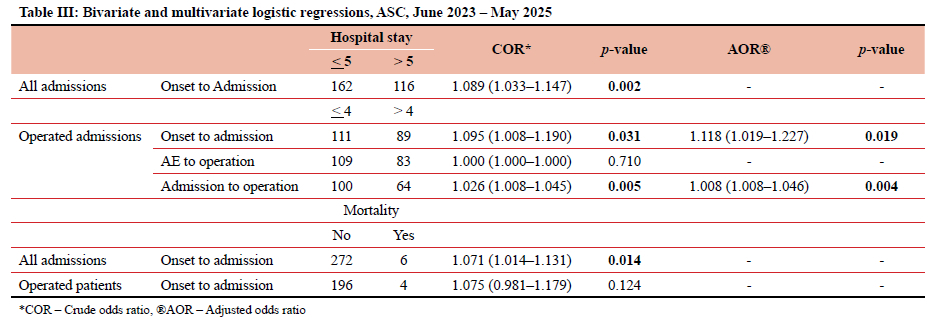
Among all admissions, in bivariate regression a longer onset of illness to admission was significantly associated with a longer hospital stay and mortalities, p = 0.002 and p = 0.014 respectively. Similarly, among operated patients a longer period from onset of illness to admission and admission to operation were significantly associated with longer hospital stays and mortalities in bivariate regression (p = 0.031 and p = 0.005 respectively) and multivariate regression (p = 0.019 and p = 0.004 respectively) (Table III).
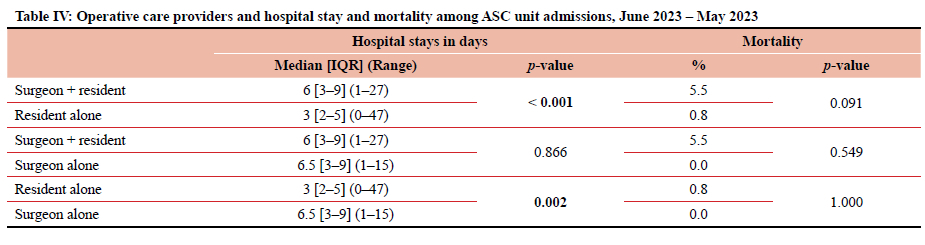
Among operative patients, patients operated by a surgeon and resident together had a longer median hospital stay than those patients operated by residents alone, p < 0.001 (MWUT). Similarly, patients operated by surgeons alone had significantly longer hospital stay than those operated by residents alone, p = 0.002 (MWUT). There was no statistically significant difference in the rate of mortalities among the operator groups (Table IV).
Discussion
Demographics of ASC admissions
The proportion of males in our study was 52.5%, which is lower than the 65.5% reported in a study from India.14 This is in contrast to females' dominance in studies from the United States, the Republic of South Africa, and Spain, 50.9-53.2%.3515 The median age in our study, 32 years, is lower than a report from the United States at 56 years.4 In a study from India,14 the majority of the patients, 58.5%, were in the age group 16-31 years, while we found 53.2% of our patients in the age group over 30 years. These variations in gender and age distribution could be due to the difference in the scope of ASC admissions in each health institution and countries, population epidemiology variations, and human development index which may affect the burdens and patterns of acute surgical pathologies.
Burden and patterns of ASC admissions
The three most common acute surgical admissions in our study were acute appendicitis (57.2%), intestinal obstruction (13.7%), and soft tissue infection (6.1%). Similarly, many previous studies reported acute appendicitis as the most common acute general surgical pathology, constituting 17.8% in the US,12 22.4% in Ghana,16 31.5% in India,14 and 30.9% in Spain.15 A study from the Republic of South Africa reported a lower rate of acute appendicitis, at 8.6%5 similar to another report from the US, at 5.3%.10 Intestinal obstruction was also reported as one of the common acute surgical pathologies in many studies, 18.5% in the US,12 12.6% in Ghana,16 12.5% in India,14 9.1% in the US in a different study,10 and 6.7% in Spain.15
A study from Ghana reported the causes of intestinal obstructions as postoperative adhesion in 37.5%, sigmoid volvulus in 24.3%, inflammatory adhesions 15.3%, colon cancer in 6.4%, intussusception and congenital band each in 3.8%, small bowel stricture in 3.1%, peritoneal carcinomatosis in 2.6%, and small bowel volvulus and caecal volvulus each in 1.2%.16 In our study, we sub-classified the causes into small and large bowel and found postoperative adhesion (58.6%), hernia (27.6%), TB peritonitis (6.9%), and Crohn's disease and intussusception (each 3.4%) as the causes of small bowel obstructions and sigmoid volvulus, and colorectal cancer (each 41.7%) and caecal volvulus (16.7%) as the causes of large bowel obstruction. Soft tissue infections were reported in 24.6% in the Republic of South Africa5 and 13.4% in US.10 Acute cholecystitis contributed 6.0% in our admissions, while others reported 12.3% in Spain,15 10.8% in the US,12 16.5% in India,14 10.9% in a different study in the US,10 and 5.0% in Republic of South Africa.14
Comorbidities among ASC admissions
The commonest comorbidities documented in our study were HIV infection (11.2%), hypertension (5.8%), and diabetes mellitus (2.9%). A study from Spain reported hypertension in 31.2%, dyslipidaemia in 23.2%, and diabetes mellitus in 12.6%.15
Modes of management of ASC admissions
The rate of operative interventions in our study (71.9%) was higher than the reported range, 25.0-63.4% from the globe.7,9,10,16,17 A study from the Republic of South Africa reported a higher rate of operative interventions in their female patients, 52.3%;5 43.5% of our female patients underwent operative interventions. Our patients who underwent operative procedures were younger, females 26 years and males 27 years, than a report from Republic of South Africa, females 46 years and males 51 years.5 The commonest procedures in our study were appendicectomy (72.0%), and laparotomies for intestinal obstruction (15.0%) and peptic ulcer disease perforations (4.0%). Others reported appendicectomy in 8.2-32.3%,5,10,15,16,18 bowel resections in 6.8-23.0%,10,19 and incision and drainage in 12.2%.10 This difference could be attributed to variations in the burden and types of diseases and the capacity of health systems across the different studies or populations.
Operative care providers in ASC admissions
In most teaching institutions the majority of the emergency operative interventions are performed by residents. In this study 60.5% were performed by residents. Similarly, a study from the Republic of South Africa reported a rate of 83.3%.5 The difference could be due to the difference in the duty roster - in our schedule only one resident was assigned for a call along with a general surgeon, and general surgeons could operate alone when the resident is held with other patients at the ward or accident and emergency department.
Outcomes among ASC admissions
The outcomes of patients are impacted by the experience and timely availability of ASC providers, the comorbidities of the patients, and the duration of the illness; timely availability of operation theatres is critical.91016,20 Following the establishment of ASC, many reported a lower complication rate and significant reduction in the number of operations during night shifts, decreased hospital cost, and length of hospital stay in various procedures.2123
The in-hospital overall complication rate in our study was 9.7%. Previous studies reported a complication rate ranging from 17.5-32.8%.5·7·9·14·18·24 This difference could be due to the difference in disease profile, resources, and reporting patterns of each study. Our SSI was 6.5%, while a systematic review from sub-Saharan Africa reported a rate of 14.4%.18 The mortality rate in our study (2.2%) falls in the rage reported by similar studies, 2.0-7.4%.5,14,16,18 The relatively lower rates of SSI and mortality observed in our study may partly be attributed to Botswana's provision of free and timely health services to its citizens, a well-organised interhospital referral system, and a government-sponsored ambulance service. Additionally, the routine use of prophylactic antibiotics as standard of care in operative cases likely contributed to these outcomes. Factors associated with higher mortalities include late presentation.15,16 In our study, for all admissions delayed presentation to the hospital was associated with significantly higher mortality and longer hospital stays.
The overall median hospital stay in our study was five days, which is longer than a study from the US intended to define and estimate the burden of emergency general surgery.3 The longer and statistically significant hospital stays observed in our study when surgeons and residents operated together may be explained by the tendency of residents to seek assistance from surgeons when faced with difficult cases.
Conclusion and recommendations
Our acute surgical care unit admissions involved younger population, and the commonest pathologies were acute appendicitis, intestinal obstructions, and soft tissue infections. The commonest comorbidity was HIV-infection. The majority of the admitted patients were operated, and most of these were performed by residents. The commonest complication was SSI. Longer onset of symptoms to arrival to the hospital was significantly associated with longer hospital stay and mortality among all admissions and operated patients.
This study provides foundational data relevant to surgical education and unit organisation, including the development of clinical guidelines, resident supervision, and workforce planning. To monitor and improve outcomes for emergency general surgical patients, and to assess the adequacy of caseloads for general surgery residents rotating through the ASC unit, we recommend the establishment of an ASC registry.
Limitations and strengths
The study was conducted retrospectively in the only teaching hospital, Princess Marina Hospital, in Botswana over a one-year period, it did not include other potential teaching sites to depict the bigger picture. Nevertheless, this study documented the burden, profile, and outcomes of acute general surgical admissions at the newly established teaching hospital. The results identified in this study can serve as an input for the academic staff, clinical care providers, and hospital management in their determination to improve the quality of healthcare provision and subsequent curriculum revision projects.
Conflict of interest
All authors declare no conflict of interest.
Funding source
No funding was required.
Ethical approval
Ethical approval was obtained from The Princes Marina Hospital granted permission to conduct this study, RE: PMH 2/11AII (180), dated 8 June 2023.
ORCIDAG Bedada https://orcid.org/0000-0002-5576-4409
N Tlotlo https://orcid.org/0009-0001-7483-0504
D Bogosi https://orcid.org/0009-0001-7044-4550
T Tumisang https://orcid.org/0009-0005-3506-5052
B Mogomotsi https://orcid.org/0009-0002-3334-0469
MG Collen https://orcid.org/0009-0005-1436-4969
HE Sleamsaw https://orcid.org/0000-0003-4101-2027
REFERENCES
-
1. Jurkovich GJ, Davis KA, Burlew CC, et al. Acute care surgery: An evolving paradigm. Curr Probl Surg. 2017;54(7):364-95. https://doi.org/10.1067/jxpsurg.2017.05.001.
» https://doi.org/10.1067/jxpsurg.2017.05.001 -
2. Moparthi KP, Javed H, Kumari M, et al. Acute Care Surgery: Navigating recent developments, protocols, and challenges in the comprehensive management of surgical emergencies. Cureus. 2024;16(1):e52269. https://doi.org/10.7759/cureus.52269.
» https://doi.org/10.7759/cureus.52269 -
3. Shafi S, Aboutanos MB, Agarwal S Jr, et al. Emergency general surgery: Definition and estimated burden of disease. J Trauma Acute Care Surg. 2013;74(4):1092-7. https://doi.org/10.1097/TA.0b013e31827e1bc7.
» https://doi.org/10.1097/TA.0b013e31827e1bc7 - 4. Ball CG, Hameed SM, Brenneman FD. Acute care surgery: A new strategy for the general surgery patients left behind. Can J Surg. 2010;53(2):84-5.
-
5. Klopper JH, Rayamajhi S, Venter JJ, et al. Provision of acute and elective general surgical care at a tertiary facility in the era of subspecialisation. S Afr Med J. 2017;107(11):948-51. https://doi.org/10.7196/SAMJ.2017.v107i11.12335.
» https://doi.org/10.7196/SAMJ.2017.v107i11.12335 - 6. Hameed SM, Brenneman FD, Ball CG, et al. General surgery 2.0: The emergence of acute care surgery in Canada. Can J Surg. 2010;53(2):79-83.
-
7. Ginzberg SP, Wirtalla CJ, Keele LJ, et al. An acute care surgeon's dilemma: Operative vs. non-operative management of emergency general surgery conditions in patients with recent colorectal cancer treatment. Am J Surg. 2024;227:15-21. https://doi.org/10.1016/j.amjsurg.2023.09.010.
» https://doi.org/10.1016/j.amjsurg.2023.09.010 -
8. De Simone B, Agnoletti V, Abu-Zidan FM, et al. The operating room management for emergency surgical activity (ORSA) study: A WSES international survey. Updates Surg. 2024;76(2):687-98. https://doi.org/10.1007/s13304-023-01668-4.
» https://doi.org/10.1007/s13304-023-01668-4 -
9. Coleman JJ, Davis KA, Savage SA, Staudenmayer K, Coimbra R. Emergency general surgery verification: Quality improvement and the case for optimal resources and process standards. J Trauma Acute Care Surg. 2024;96(1):e1-e4. https://doi.org/10.1097/TA.0000000000004135.
» https://doi.org/10.1097/TA.0000000000004135 -
10. Britt RC, Weireter LJ, Britt LD. Initial implementation of an acute care surgery model: Implications for timeliness of care. J Am Coll Surg. 2009;209(4):421-4. https://doi.org/10.1016/j.jamcollsurg.2009.06.368.
» https://doi.org/10.1016/j.jamcollsurg.2009.06.368 -
11. Cubas RF, Gómez NR, Rodriguez S, et al. Outcomes in the management of appendicitis and cholecystitis in the setting of a new acute care surgery service model: Impact on timing and cost. J Am Coll Surg. 2012;215(5):715-21. https://doi.org/10.1016/j.jamcollsurg.2012.06.415.
» https://doi.org/10.1016/j.jamcollsurg.2012.06.415 -
12. Qureshi A, Smith A, Wright F, et al. The impact of an acute care emergency surgical service on timely surgical decision- making and emergency department overcrowding. J Am Coll Surg. 2011;213(2):284-93. https://doi.org/10.1016/j.jamcollsurg.2011.04.020.
» https://doi.org/10.1016/j.jamcollsurg.2011.04.020 -
13. Hirshon JM, Risko N, Calvello EJ, et al. Health systems and services: The role of acute care. Bulletin of the World Health Organization. 2013;91:386-8. https://doi.org/10.2471/BLT.12.112664.
» https://doi.org/10.2471/BLT.12.112664 - 14. Arya PK. Study on the clinical characteristics of patients presenting with non-traumatic acute abdomen in a tertiary care hospital. 2024;13(11):136.
-
15. Cano-Valderrama O, Morales X, Ferrigni CJ, et al. Acute care surgery during the COVID-19 pandemic in Spain: Changes in volume, causes and complications. A multicentre retrospective cohort study. Int J Surg. 2020;80:157-61. https://doi.org/10.1016/j.ijsu.2020.07.002.
» https://doi.org/10.1016/j.ijsu.2020.07.002 -
16. Ohene-Yeboah M. Acute surgical admissions for abdominal pain in adults in Kumasi, Ghana. ANZ J Surg. 2006;76(10):898-903. https://doi.org/10.1111/j.1445-2197.2006.03905.x.
» https://doi.org/10.1111/j.1445-2197.2006.03905.x -
17. Ehlers VU, Kohler CF, Tefera A, Lutge E, Clarke DL. The burden of emergency abdominal surgery heavily outweighs elective procedures in KwaZulu-Natal province, South Africa. J Surg Res. 2021;259:414-9. https://doi.org/10.1016/j.jss.2020.09.013.
» https://doi.org/10.1016/j.jss.2020.09.013 -
18. Ndong A, Togtoga L, Bah MS, Ndoye PD, Niang K. Prevalence and mortality rate of abdominal surgical emergencies in Sub-Saharan Africa: A systematic review and meta-analysis. BMC Surg. 2024;24(1):35. https://doi.org/10.1186/s12893-024-02319-0.
» https://doi.org/10.1186/s12893-024-02319-0 -
19. Kutcher ME, Sperry JL, Rosengart MR, et al. The next pillar of acute care surgery. J Trauma Acute Care Surg. 2017;82(2):280-6. https://doi.org/10.1097/TA.0000000000001312.
» https://doi.org/10.1097/TA.0000000000001312 -
20. Earley AS, Pryor JP, Kim PK, et al. An acute care surgery model improves outcomes in patients with appendicitis. Ann Surg. 2006;244(4):498-504. https://doi.org/10.1097/01.sla.0000237756.86181.50.
» https://doi.org/10.1097/01.sla.0000237756.86181.50 -
21. Gandy RC, Truskett PG, Wong SW, et al. Outcomes of appendicectomy in an acute care surgery model. Med J Aust. 2010;193(5):281-4. https://doi.org/10.5694/j.1326-5377.2010.tb03908.x.
» https://doi.org/10.5694/j.1326-5377.2010.tb03908.x -
22. Michailidou M, Kulvatunyou N, Friese RS, et al. Time and cost analysis of gallbladder surgery under the acute care surgery model. J Trauma Acute Care Surg. 2014;76(3):710-4.https://doi.org/10.1097/TA.0000000000000117.
» https://doi.org/10.1097/TA.0000000000000117 -
23. Lau B, Difronzo LA. An acute care surgery model improves timeliness of care and reduces hospital stay for patients with acute cholecystitis. Am Surg. 2011;77(10):1318-21. https://doi.org/10.1177/000313481107701009.
» https://doi.org/10.1177/000313481107701009 -
24. Havens JM, Peetz AB, Do WS, et al. The excess morbidity and mortality of emergency general surgery. J Trauma AcuteCare Surg. 2015;78(2):306-11. https://doi.org/10.1097/TA.0000000000000517.
» https://doi.org/10.1097/TA.0000000000000517