Audit to evaluate the clinical presentation and surgical management of acute appendicitis at a secondary-level hospital in the Western Cape
Abstract
BACKGROUND: Acute appendicitis is a frequent cause of abdominal emergencies, with delayed presentation and diagnosis increasing the risk of perforation and postoperative morbidity. In South Africa, the accessibility to healthcare and referral to surgical services can impact patient outcomes. METHODS: All patients treated for acute appendicitis at George Regional Hospital during the period January 2024 -December 2024 (1 year) were included in the study. Patients who were admitted with acute appendicitis but discharged with an alternative diagnosis were excluded. RESULTS: The sample consisted of 218 patients. The majority (88.5%) underwent surgical management, with the remainder managed conservatively. Patients referred from district hospitals had a significantly higher rate of perforated appendicitis compared to local patients (57.9% vs 40.2%, p = 0.014). Delayed presentation with symptoms beyond 72 hours was strongly associated with perforation (IQR 2.0-4.5; p = 0.034). Laparoscopic appendicectomy was performed in 66.3% of cases, with a 20.3% conversion rate to open surgery, predominantly in cases of perforation. The median length of stay was longer in patients with perforated appendicitis (IQR 3-6 days; p < 0.001). No in-hospital mortality was observed. CONCLUSIONS: Delayed presentation was significantly associated with a higher risk of perforated appendicitis and greater operative complexity. Patients referred from district hospitals experienced higher rates of perforation likely due to delays in recognition, referral, and access to surgical care. Improving early diagnosis and streamlining referral pathways may reduce the incidence of complicated appendicitis and improve patient outcomes in our region.
appendicitis; perforated appendicitis; laparoscopic appendicectomy
Introduction
Appendicitis is one of the most common causes of an acute abdominal emergency and if neglected, can progress to perforation, leading to severe intra-abdominal contamination and sepsis.1
The incidence of the disease in South Africa seems to be increasing and occurs at a rate 9 cases per 100 000 people, with a peak incidence between the ages of 10 and 30.2
Delays in presentation and diagnosis are associated with increasing rates of perforation of the appendix.1,3,4
Perforated appendicitis is a severe complication which can lead to significant intra-abdominal contamination, requiring aggressive surgical management.4
In developed countries, the mortality rate for acute appendicitis is negligible and is approximately 0.1%. In contrast, in developing regions, it is reported to be several times higher. This is almost certainly due to delays in seeking medical care and inadequate healthcare services.5
In a resource-limited setting where access to computed tomography (CT) is limited, clinical and laboratory findings become the basis of diagnosis for acute appendicitis.1 667
Methodology
George Provincial Hospital is a secondary-level public facility in the Western Cape that serves as the primary referral centre for the Eden District.
Due to limited surgical capabilities at district-level hospitals, appendicectomies are rarely performed outside George Hospital (< 1 per month at district hospitals). Only select cases meeting specific patient criteria are managed operatively at peripheral sites, with most patients referred for definitive care.
The medical records of patients diagnosed with acute appendicitis at George Regional Hospital between 1 January and 31 December 2024 (12 months) were added to a manually kept database. This database is password-protected and uses number identification. The HREC of the University of Cape Town has ethical approval for its use.
Inclusion criteria consisted of all patients admitted with a clinical and/or radiological diagnosis of acute appendicitis, regardless of whether they were treated operatively or non-operatively. Patients who underwent laparoscopic appendectomy with no evident pathology but had the appendix removed were included. Patients were excluded if they were discharged with an alternative diagnosis. Patients who were managed in the district were excluded from this audit.
Comparisons were made between ruptured appendicitis and the region from which the patient was referred. The duration of symptoms was captured.
We compared the number of laparoscopic appendicect-omies to open appendicectomies and the conversion rate from laparoscopic to open procedure.
Data analyses were performed using IBM SPSS statistics version 30. For categorical data, appropriate descriptive statistics were reported in frequencies and percentages.
Inferential statistics were performed using the independent samples t-test or Mann-Whitney U test for numerical data and Pearson's chi-square or Fischer's exact test for categorical data. In the analyses, p-values less than 0.05 denoted statistical significance.
Results
The sample consisted of 218 patients. 193/218 (88.5%) patients had undergone surgery.
A subset of 25/218 patients (11.5%) were managed non-operatively. Radiological drainage (pigtail catheter insertion) was used in 2/218 cases (0.9%). Of the patients who were managed conservatively, 10/25 had radiological confirmation of acute appendicitis.
The mean age was 22.5, with ages ranging from 3 to 63. There were 120 males (55%) and 98 females (45%).
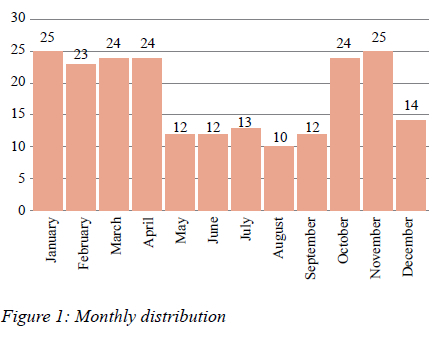
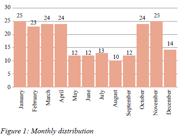
The cases demonstrated a seasonal trend (Figure 1), peaking in the summer months in January (25 cases) and lowest in the winter months (June 12 cases and August 10 cases, respectively).
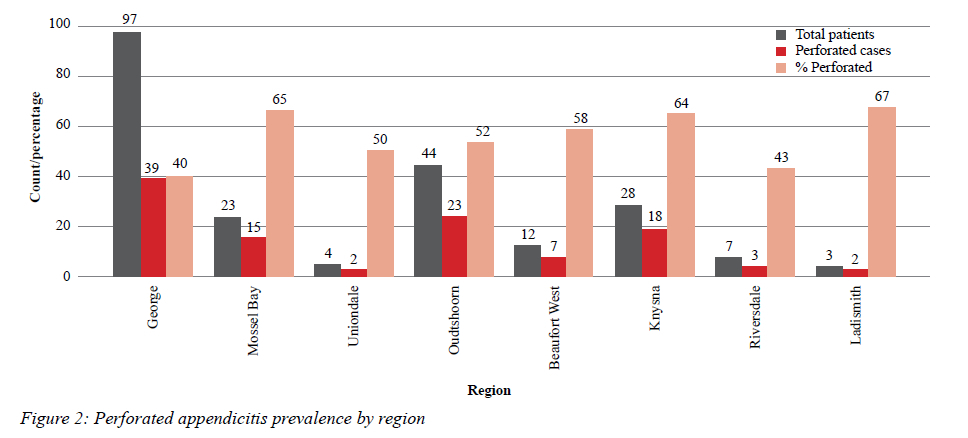
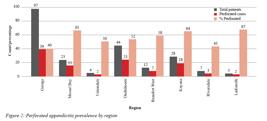
Most of the patients originated from surrounding districts, with Oudtshoorn (44/218; 20.2%) and Knysna (28/218; 12.8%) representing the highest regional contributions (Figure 2). There was a statistically significant difference in the prevalence of perforated appendicitis between George (40.2%) and other regions combined (57.9%) (p-value 0.014).
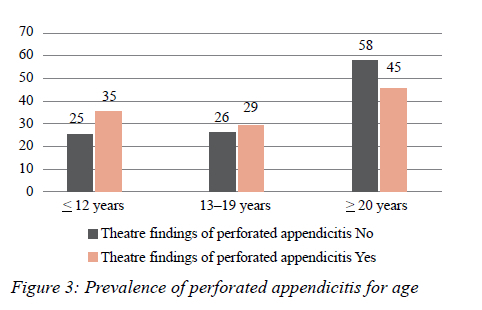
There was no statistically significant association between younger age and the incidence of perforated appendicitis (p = 0.176). Perforation was observed intraoperatively in 58.3% of patients under 12, 52.7% aged 13-19, and 43.7% over 20 years (Figure 3).
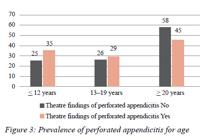
Symptom duration was recorded for all patients.
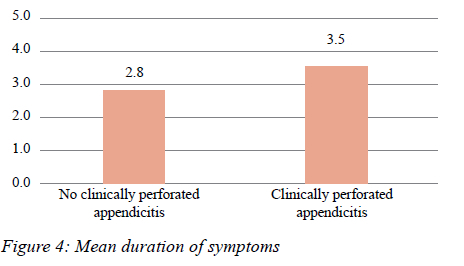
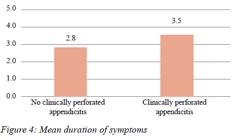
Most patients presented within the first 72 hours (IQR 2.04.5): 116/218 (53.2%) presented within 0-2 days, 78/218 (35.8%) within 3-6 days, and 24/218 (11.0%) after 7 days.
Those who presented with symptoms of more than 72 hours (IQR 2.0-4.5) (Figure 4) had a higher rate of perforation (p = 0.034).
An elevated white cell count (WCC) (> 12 x109(p = 0.002).
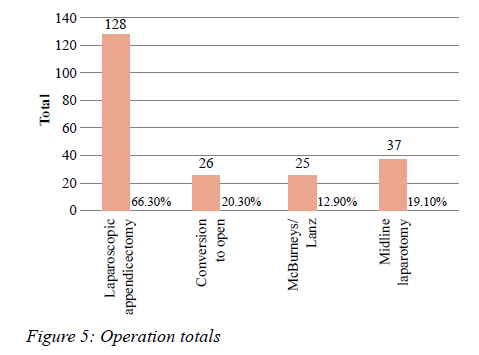
Ofthe patients who had surgery (193/218), most underwent laparoscopic appendicectomy: 128/193 (66.3%), with a conversion rate to open appendicectomy in 26/128 (20.3%). Open appendicectomy was performed in 62/193 (32.1%), of which 37/62 (59.6%) required midline laparotomy (Figure 5).
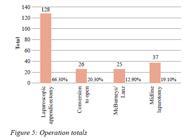
Of those that required conversion to open surgery, 23/128 (17.9%) had features of perforated appendicitis. Of this category, 17/23 (73.9%) were reported to have pus in more than one quadrant.
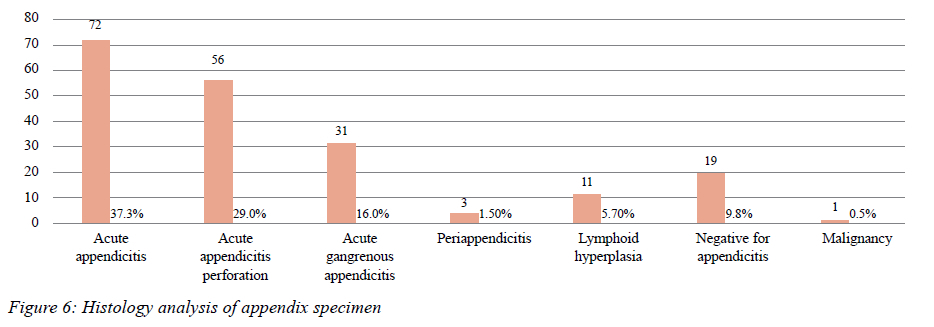
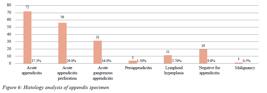
Perforated appendicitis was demonstrated intraoperatively in 109/193 (56.4%) cases and confirmed histologically in 87/193(45%) (Figure 6). Intra-abdominal pus involving more than one quadrant was found in 67/193 (34.7%). Relook laparotomies were required in 25/193 patients (12.9%).
The mean length of hospital stay (LOS) was 4.2 days. The median LOS was significantly longer for patients with perforated appendicitis (4 days, IQR 3-6 days) compared to those without perforated appendicitis (2 days, IQR 2-3 days) (p < 0.001). There were no deaths in this study.
All appendicectomy specimens were histologically evaluated (Figure 6). A total of 72/193 (37.3%) had acute appendicitis without perforation. Of note, 2/193 were due to parasites. Eighty-seven over one hundred and ninety-three 87/193 (45.0%) of patients had perforated appendicitis. Thirty-three patients (17%) showed no features of appendicitis, of which 3/193 (1.5%) were periappendicitis, and 11/193 (5.7%) showed lymphoid hyperplasia. One case of appendiceal malignancy was identified.
Discussion
George Regional Hospital accounted for the highest number of appendicitis cases (n = 97), with a prevalence of perforated appendicitis in 40.2% of cases. In contrast, peripheral regions such as Mossel Bay (65.2%), Oudtshoorn (52.3%), and Beaufort West (58.3%) had significantly higher perforation rates despite lower absolute case numbers.
There was a statistically significant difference in the prevalence of perforated appendicitis between local (George) and referred patients (40.2% vs 57.9%, p = 0.014), suggesting a persistent discrepancy in access to timely surgical care. These findings are similar to reports from East London (urban 35% vs rural 63%) and Pietermaritzburg (19% vs 71%), p < 0001,5,8 which show that rural patients are more likely to present with generalised peritonitis (76%), and to require ICU admission and relaparotomy compared to urban patients.8(p = 0.034). This is in keeping with other local reports.9
Data suggests that rural patients experience longer delays in presentation, higher rates of perforation and are more likely to need laparotomy, repeat-laparotomy, and ICU care.109,10 Even after presenting to a healthcare facility, delays are compounded by failure in timely referral and transportation.101111
The American Association for the Surgery of Trauma (AAST) recently developed an anatomical severity grading system for appendicitis to standardise assessment of disease severity.1213,14 This has been shown to apply to paediatric patients as well.14
The prevalence of perforation was significantly higher among patients with WCC > 12 (58%) compared to those without WCC > 12 (34.8%) (p = 0.002). This once again is in keeping with other reports from South Africa.1515
Laparoscopic appendectomy was the predominant operative modality (66.3%), with a 20.3% conversion rate. This corresponds to the trend in other local institutions like New Somerset Hospital in Cape Town, where laparoscopic surgery uptake increased from 29% to 68% over three years.1616
Other provinces have a different experience. A retrospective analysis from Pietermaritzburg of 851 patients with of acute appendicitis over six years (2013-2019) revealed that laparoscopic appendectomy was performed in only 15% of cases.17
There is evidence to suggest that South African surgical trainees have limited exposure to laparoscopic appendectomy, with key barriers including resource and mentorship constraints.18
A recent prospective, multicentre observational study from United States of 3 597 patients with acute appendicitis, reported that 90% of patients underwent CT and 91% underwent laparoscopic appendectomy. The median LOS was 1 day.1919(p < 0.001).2020
Conclusion
In our environment, delayed presentation is common and is significantly associated with an increased risk of perforated appendicitis. Patients referred from district hospitals experienced higher perforation rates than local patients likely due to barriers in timely recognition, transport, and limitations in diagnostic resources. Perforated appendicitis is associated with greater operative complexity, mandating higher rates of conversion to open appendicectomy. Efforts to improve recognition and referral are essential to reducing the burden of complicated appendicitis in our setting.
Conflict of interest
The authors declare no conflict of interest.
Funding source
No funding source was required.
Ethical approval
Ethical approval was obtained from the University of Cape Town, Faculty of Health Sciences, Human Research Ethics Committee. Ref: 184/2025
ORCID
IN Palkowski https://orcid.org/0000-0001-8641-2265
ΚK Polden https://orcid.org/0000-0003-4397-3673
C Claasen https://orcid.org/0009-0003-7203-2204
REFERENCES
-
1. Nshuti R, Kruger D, Luvhengo TE. Clinical presentation of acute appendicitis in adults at the Chris Hani Baragwanath Academic Hospital. Int J Emerg Med. 2014;7(1):12. https://doi.org/10.1186/1865-1380-7-12.
» https://doi.org/10.1186/1865-1380-7-12 -
2. Saidi H, Adwok J, Saidi HS, Adwok JA. Acute appendicitis: an overview. East Afr Med J. 2000;77(3). https://doi.org/10.4314/eamj.v77i3.46612.
» https://doi.org/10.4314/eamj.v77i3.46612 -
3. Berry J, Malt RA. Appendicitis near its centenary. Ann Surg.1984;200(5):567-75. https://doi.org/10.1097/00000658-198411000-00002.
» https://doi.org/10.1097/00000658-198411000-00002 -
4. Narsule CK, Kahle EJ, Kim DS, Anderson AC, Luks FI. Effect of delay in presentation on rate of perforation in children with appendicitis. Am J Emerg Med. 2011;29(8):890-3. https://doi.org/10.1016/j.ajem.2010.04.005.
» https://doi.org/10.1016/j.ajem.2010.04.005 - 5. Rogers AD, Hampton MI, Bunting M, Atherstone AK. Audit of appendicectomies at Frere Hospital, Eastern Cape. S Afr J Surg. 2008;46(3):74-7.
- 6. Di Saverio S, Podda M, De Simone B, et al. Diagnosis and treatment of acute appendicitis: 2020 update of the WSES Jerusalem guidelines. World J Emerg Surg. 2020;15(1):27.
-
7. Bendib H. Is non-operative treatment of acute appendicitis possible: a narrative review. African J Emerg Med. 2024;14(2):84-90. https://doi.org/10.1016/j.afjem.2024.03.006.
» https://doi.org/10.1016/j.afjem.2024.03.006 -
8. Kong VY, Bulajic B, Allorto NL, Handley J, Clarke DL. Acute appendicitis in a developing country. World J Surg. 2012;36(9):2068-73. https://doi.org/10.1007/s00268-012-1626-9.
» https://doi.org/10.1007/s00268-012-1626-9 -
9. Yang E, Cook C, Kahn D. Acute appendicitis in the public and private sectors in Cape Town, South Africa. World J Surg. 2015;39(7):1700-7. https://doi.org/10.1007/s00268-015-3002-z.
» https://doi.org/10.1007/s00268-015-3002-z -
10. Hernandez MC, Finnesgaard E, Aho JM, et al. Appendicitis: rural patient status is associated with increased duration of prehospital symptoms and worse outcomes in high- and low- middle-income countries. World J Surg. 2018;42(6):1573-80. https://doi.org/10.1007/s00268-017-4344-5.
» https://doi.org/10.1007/s00268-017-4344-5 -
11. Kong V, Aldous C, Handley J, Clarke D. The cost effectiveness of early management of acute appendicitis underlies the importance of curative surgical services to a primary healthcare programme. Ann R Coll Surg Engl. 2013;95(4):280-4. https://doi.org/10.1308/003588413X13511609958415.
» https://doi.org/10.1308/003588413X13511609958415 -
12. Tominaga GT, Staudenmayer KL, Shafi S, et al. The American Association for the Surgery of Trauma grading scale for 16 emergency general surgery conditions. J Trauma Acute Care Surg. 2016;81(3):593-602. https://doi.org/10.1097/TA.0000000000001127.
» https://doi.org/10.1097/TA.0000000000001127 -
13. Hernandez MC, Kong VY, Aho JM, et al. Increased anatomic severity in appendicitis is associated with outcomes in a South African population. J TraumaAcute Care Surg. 2017;83(1):175-81. https://doi.org/10.1097/TA.0000000000001422.
» https://doi.org/10.1097/TA.0000000000001422 -
14. Hernandez MC, Polites SF, Aho JM, et al. Measuring anatomic severity in pediatric appendicitis: validation of the American Association for the Surgery of Trauma Appendicitis Severity Grade. J Pediatr. 2018;192:229-33. https://doi.org/10.1016/j.jpeds.2017.09.017.
» https://doi.org/10.1016/j.jpeds.2017.09.017 -
15. Tshuga N, Ntola V, Naidoo R. The accuracy of white cell count and C-reactive protein in diagnosing acute appendicitis at a tertiary hospital. South African J Surg. 2024;62(3):282-6.https://doi.org/10.36303/SAJS.00163.
» https://doi.org/10.36303/SAJS.00163 -
16. Gouws J, Kariem N, Bougard H, Bust L, Chu KM. Laparoscopic appendectomy by surgical trainees at a public teaching hospital in Cape Town, South Africa: a retrospective, observational study. East Cent Afr J Surg. 2022;27(3). https://doi.org/10.4314/ecajs.v27i3.1.
» https://doi.org/10.4314/ecajs.v27i3.1 -
17. Naidoo M, Thirayan V, Kong V, et al. Trends in adoption of laparoscopic appendicectomy in a developing country: closing the gap. World J Surg. 2022;46(5):1015-21. https://doi.org/10.1007/s00268-022-06454-8.
» https://doi.org/10.1007/s00268-022-06454-8 -
18. Naidoo M, Kong V, Clarke D, Conradie B. Experience and perceptions of laparoscopic appendectomy amongst surgical trainees in SouthAfrica. South African J Surg. 2022;60(4):300-4. https://doi.org/10.17159/2078-5151/SAJS3739.
» https://doi.org/10.17159/2078-5151/SAJS3739 -
19. Yeh DD, Eid AI, Young KA, et al. Multicentre study of the treatment of appendicitis in America. Ann Surg. 2021;273(3):548-56. https://doi.org/10.1097/SLA.0000000000003661.
» https://doi.org/10.1097/SLA.0000000000003661 -
20. Bhaskar J, McLean RC, Bhaskar K, Brown LR. Temporal trends in the investigation, management and outcomes of acute appendicitis over 15 years in the north of England: a retrospective cohort study. World J Surg. 2022;46(9):2141-54. https://doi.org/10.1007/s00268-022-06586-x.
» https://doi.org/10.1007/s00268-022-06586-x