Outcomes of emergency abdominal surgery in an upper-middle income country urban health care system
Abstract
BACKGROUND: Abdominal emergencies are common and often require emergency surgery with mortality between 14% and 20%. Strategies have been introduced to reduce complications after emergency abdominal surgery, but resources in low-and middle-income countries (LMICs) countries are limited. There is a paucity of data on emergency abdominal surgery from the developing world. We aim to audit the mortality and morbidity of emergency laparotomies in the unique South African public health care system. Secondary endpoints were to identify system shortfalls to allocate quality improvement programmes to improve outcomes of acute abdominal emergencies. METHODS: A retrospective review of a prospectively maintained database was conducted on emergency surgical procedures at all the public-funded health facilities in the Cape Town Metro West, South Africa. RESULTS: There were 1471 patients who required emergency abdominal operations. The mean age was 36.7 (standard deviation (SD) = 15.95) with a male preponderance of 64.7%. The median duration of symptoms was 2 days (interquartile range (IQR) = 0-84). Overall 30-day mortality was 8% (n = 118) where 0.95% (n = 14) demised within 24 hours post-surgery. Factors associated with mortality were higher ASA class, higher Eastern Cooperative Oncology Group (ECOG) score, increasing age, higher Codman score, length of the procedure, presence of consultant during procedure, faecal contamination, contamination of more than one abdominal quadrant and use of inotropes intraoperatively. CONCLUSION: Despite resource constraints, patients presenting with abdominal emergencies requiring emergency abdominal surgery received care with mortality outcomes comparable to reported literature. This audit can be used as guide to identify healthcare system shortfalls to improve outcomes.
emergency; laparoscopy; laparotomy; urban
Introduction
Abdominal emergencies are common and often require emergency surgery. Emergency abdominal surgery carries a short-term mortality between 14% and 20%, with cardiopulmonary complications and sepsis being the most frequent causes of death.12,3 Timely recognition and effective management of postoperative complications may reduce mortality.
In the UK, the National Emergency Laparotomy Audit (NELA) was started in December 2012 with the aim of improving outcomes of emergency laparotomy for acute abdominal emergencies. The first pilot report showed a mortality of 14.5% and the reported mortality of the first national audit was 11.6%.45 67,8 Adequate postoperative level of care in HCU and ICU also allows early recognition of complications, allowing early management and hence adding to the slightly improved mortality rates.
South African data mostly comprises of single centre studies and there is currently no national database. A prospective audit by Spence et al. included all emergency laparotomies in Cape Town over a 3-month period. The study analysed 450 laparotomies for trauma (29.1%) and non-trauma (70.9%) related pathology and reported a mortality rate of 15.7%.9(n = 56) and non-trauma (n = 54) related pathology in KwaZulu-Natal included 110 patients and reported a 30-day in-hospital mortality of 16.4%.10
South Africa is an upper-middle income country with a unique 2-tiered, unequal health care system. The public healthcare system is utilised by approximately 86% of the population but receives only 50% of the total healthcare expenditure.11
The aim of this study was to audit the mortality and morbidity of emergency abdominal surgery in the unique South African public health care system. Secondary endpoints were to identify system shortfalls to allocate quality improvement programmes to improve outcomes of acute abdominal emergency procedures.
Methodology
Study design and period
A retrospective review of a prospectively maintained database was conducted on emergency surgical procedures carried out in all the public-funded health facilities in the Cape Town Metro West, South Africa. All patients who underwent emergency abdominal surgical operations (laparotomy/ laparoscopy) from 28 January 2021 to 31 January 2022 in the Metro West health district of Cape Town were included. Abdominal surgery was defined as any abdominal operation requiring open or laparoscopic exploration for emergency (unplanned) indications, trauma or otherwise. Acuity was defined using the standard National Confidential Enquiry into Patient Outcome and Death (NCEOPD) classification.
Study population
The public-funded health system in South Africa is divided into several health districts each with a central referral hospital. Groote Schuur Hospital (GSH) is the central referral hospital in the Cape Town Metro West health district and accepts referrals from three public surgical units within this health district. There are two district level hospitals (Mitchell's Plain District Hospital and Victoria Hospital) and one regional level hospital (New Somerset Hospital). Several private healthcare facilities in this region would intermittently refer uninsured individuals. Collectively, these hospitals make up the surgical referral base within the district which serves an estimated catchment area of 2 293 000 uninsured individuals.
Data analysis
Data was captured using REDCap (Research Electronic Data Capture, Vanderbilt University) (https://projectredcap.org). A formal introduction to the study was made to all general surgeons and trainees at the participating hospitals and at least one clinician per hospital was responsible for data capture. Data was entered using mobile phones or electronic tablets into the Emergency Laparotomy/Laparoscopy Collaborative (ELAC) database. Hospital theatre registries were reviewed at each site to ensure compliance. Data collection included any adverse events (AE) requiring surgical, endoscopic, or radiological intervention or resulting in death. All AEs were recorded daily on ward rounds until discharge or date of demise. All hospitals in the district reported at a combined, monthly morbidity and mortality meeting where the outcome measures were further verified.
Statistical analysis was performed using IBM SPSS (Chicago) Statistics version 28.0.1. Patient characteristics and perioperative details were analysed using descriptive statistics, and correlation with mortality assessed using chi-squared tests. A logistic regression analysis was performed to identify significant factors predictive of 30-day mortality. Variables were excluded from analysis if more than 20% of data was missing from the data set.
A confidence level of 95% was used. Unless otherwise indicated, a two-tail test hypothesis was used with an alpha-value of 0.05 as a discriminator for rejection of the null-hypothesis.
Results
There were 1471 patients who required emergency abdominal operations during the study period. The mean age was 36.7 (standard deviation (SD) = 15.95) with a male preponderance of 64.7%. At presentation to a surgical unit the median duration of symptoms was 2 days (interquartile range (IQR) = 0-84). The overall 30-day mortality was 8% (n = 118) where 0.95% (n = 14) demised within 24 hours post-surgery (Table I).
Most patients (1338 or 91%) were American Society of Anaesthesiologists (ASA)12
From the cohort of 1471 patients, the HIV status was known in 645 (44%). Twenty-five percent (n = 161) of those with a known HIV status were positive. Most patients (73.7% n = 1085) had a body mass index (BMI) between 18.5 and 40, 13.3% (n = 196) were morbidly obese with BMI over 40 and 1.8% (n =27) super obese with BMI over 50 and 10.1% (n = 149) were underweight with a BMI < 18.5.
The procedures were performed open in 56.4% (n = 830), laparoscopically in 35.7% (n = 525) and laparoscopic converted to open in 7.9% (n = 116) of patients. Trauma constituted 33% (n = 480) of the emergencies. Mortality data according to pathology is summarised in Table II. The highest cause of mortality in this study was associated with colorectal emergencies (17%), followed by small bowel obstruction and perforated peptic ulcer disease (10%), then trauma (7%) and appendicitis (3%).
The operations were performed by trainees and medical officers without supervision in 782 (53%). Consultant supervision was present in 689 (47%), with the consultant the primary surgeon in 378 (26%) of cases. Time to theatre was defined as the time of booking the operation to the time of the patient reaching the operating table. The median time to surgery was four hours (IQR = 0-34). The median duration for length of procedure was 90 mins. The postoperative care took place in the ward for 1234 (84%), HCU for 84 (6%) and ICU for 153 (10%) of patients. The median length of stay was 5 days (IQR = 1-424).
Thirty-two percent of patients developed severe postoperative complications (n = 471) defined as Clavien-Dindo13n = 118) demised. Thirteen per cent of all patients required re-operation (n = 196). One hundred and fifty-one (10.4%) required inotropic support during the perioperative and/or postoperative period with a mortality of 36.4%.
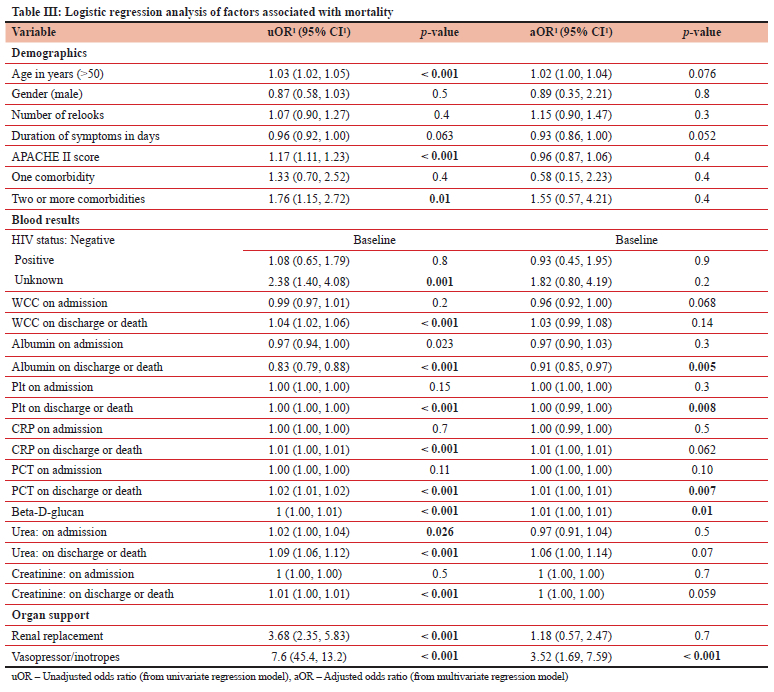
Using univariate analysis, the factors associated with significant mortality risk were higher ASA class, higher Eastern Cooperative Oncology Group (ECOG) score,14 15Table III).
Logistic regression with mortality as the dependent variable and preoperative factors as independent variable identified age, ASA status, length of operation and use of inotropes as independent predictors of 30-day mortality.
Discussion
Literature on outcomes of emergency laparotomy (EL) originates mostly from high-income countries, with a paucity of data following emergency abdominal surgery in low- and middle-income countries (LMICs) which is surprising given the frequency of these procedures.
Quality improvement studies in developed countries have shown that standardised protocols in the management of abdominal emergencies, including goal-directed resuscitation, early antibiotic initiation and early imaging to aid early source control in a select group of high-risk patients significantly improve postoperative mortality.7,8 Adequate postoperative level of care in HCU and ICU also allows early recognition of complications, allowing early management and hence adding to the slightly improved mortality rates.
This study presents data from a large series of patients requiring emergency abdominal surgery in a South African metropole. The overall mortality rate was 8% at 30 days, comparable to that previously reported of 7 to 21%.16-18 Amongst those who died within 30-days, 68% (n = 80) survived the first 72 postoperative hours.
The patients in this study were younger than in studies from high income countries (HIC) and the median age of our sample was in the third decade as opposed to the seventh decade reported in Denmark.119-22 This can be explained by the high number of penetrating trauma and appendicitis cases in the cohort that generally occurs in younger individuals. Penetrating trauma has a male predominance. Gender was not predictive of 30-day mortality.
ASA physical status is one of the evaluation tools to predict postoperative mortality and morbidity.12
Longer operating times also correlated with mortality. The mean operating time for the mortality cohort was 143 minutes (SD= 68). Previous studies have shown a correlation with operative time longer than 150 minutes and greater postoperative systemic inflammatory response, and fewer postoperative complications in those undergoing operations shorter than 150 minutes.10,23,24
Our resource-constraint services are often led by trainees after hours. A consultant surgeon was present in 47% of all emergency laparotomies. However, in the cohort of mortalities, a consultant surgeon was present in 67% of cases. In cases where no consultant oversight was sought the mortality was 3%, which indicates that trainees appropriately call for consultant involvement in more critical or complex cases.
One third (32%) of the study population developed postoperative complications. The most common complications included re-operation, superficial surgical site infection and deep surgical site infection.
The spectrum of disease in our study sample is comparable to that reported in HIC.2425262222
From this audit, the mortality of appendicitis was 3%, which is significantly higher than the mortality published in HICs. Of the 434 patients with appendicitis, 333 (76%) were performed laparoscopically. Forty-two (12.6%) of those started laparoscopic were converted to laparotomy. Fifty-nine 59 (13.6%) were upfront laparotomies for generalised peritonitis. There was no record of Lanz incisions. Two hundred and eighty-seven (66%) patients had intraoperative findings of contamination. Of those, 15 (5%) had infected serous fluid, 210 (75%) had purulent contamination, and 62 (20%) had feculent contamination. Of those with contamination, 137 (48%) had localised sepsis, 96 (33%) had more than one quadrant but less than four quadrant sepsis, and 54 (19%) had four quadrant sepsis. Fifteen patients were transferred to ICU postoperatively and 5 to the HCU. Thirteen patients demised within 30 days.
These findings indicate that patients with acute appendicitis are referred to surgical units late in the disease course. This finding is concerning as outcomes of appendicitis could be used as a marker of efficiency of surgical systems.27
Strengths of the study include the large sample size from all surgical procedures in a geographic area, thereby ruling out referral bias. This study has several limitations, including missing data points in some patients and that only in-hospital adverse outcomes were captured.
Conclusion
Despite resource constraints, the care of patients presenting with abdominal emergencies requiring emergency abdominal surgery in this population received care with mortality outcomes comparable to that reported in the literature. This audit can be used as guide to identify healthcare system shortfalls to improve outcomes, especially in the management of appendicitis.
Conflict of interest
The authors declare no conflict of interest.
Funding source
No funding was received for this study.
Ethical approval
The study was approved by the Human Research Ethics committee of the University of Cape Town and the Institutional Review Board of the Department of Surgery, Groote Schuur Hospital.
ORCID
A Romanus https://orcid.org/0000-0001-9722-3398
E Coetzee https://orcid.org/0000-0001-7384-1386
L Raphael https://orcid.org/0000-0002-6369-0200
S Rayamahji https://orcid.org/0000-0002-0930-9990
A Boutall https://orcid.org/0000-0002-6413-5890
REFERENCES
-
1. Tolstrup M, Watt SK, Gögenur I. Morbidity and mortality rates after emergency abdominal surgery: An analysis of 4346 patients scheduled for emergency laparotomy or laparoscopy. Langenbecks Arch Surg. 2017;402(4):615-23. https://doi.org/10.1007/s00423-016-1493-1.
» https://doi.org/10.1007/s00423-016-1493-1 -
2. Sheetz KH, Waits SA, Krell RW, et al. Improving mortality following emergent surgery in older patients requires focus on complication rescue. Ann Surg. 2013;258(4):614-8. https://doi.org/10.1097/SLA.0b013e3182a5021d.
» https://doi.org/10.1097/SLA.0b013e3182a5021d -
3. Shapter SL, Paul MJ, White SM. Incidence and estimated annual cost of emergency laparotomy in England: Is there a major funding shortfall? Anaesthesia. 2012;67(5):474-8. https://doi.org/10.1111/j.1365-2044.2011.07046.x.
» https://doi.org/10.1111/j.1365-2044.2011.07046.x -
4. NELA Project Team. First Patient Report of the National Emergency Laparotomy Audit. 2015. Available from: https://www.nela.org.uk/All-Patient-Reports.
» https://www.nela.org.uk/All-Patient-Reports - 5. NELA Project Team. Eighth Patient Report of the National Emergency Laparotomy Audit. Royal College of Anaesthetists (RCoA) London. 2023.
-
6. Mak M, Hakeem AR, Chitre V. Pre-NELA vs NELA - has anything changed, or is it just an audit exercise? Ann R Coll Surg Engl. 2016;98(8):554-9. https://doi.org/10.1308/rcsann.2016.0248.
» https://doi.org/10.1308/rcsann.2016.0248 -
7. Timan TJ, Ekerstad N, Karlsson O, Sernert N, Prytz M. One-year mortality rates after standardised management for emergency laparotomy: Results from the Swedish SMASH study. BJS Open. 2024;8(1):zrad133. https://doi.org/10.1093/bjsopen/zrad133.
» https://doi.org/10.1093/bjsopen/zrad133 -
8. Javanmard-Emamghissi H, Doleman B, Lund JN, et al. Beyond high-risk: Analysis of the outcomes of extreme-risk patients in the National Emergency Laparotomy Audit. Anaesthesia. 2023;78(11):1376-85. https://doi.org/10.1111/anae.16130.
» https://doi.org/10.1111/anae.16130 -
9. Spence RT, Hampton M, Pluke K, et al. Factors associated with adverse events after emergency laparotomy in Cape Town, South Africa: Identifying opportunities for quality improvement. J Surg Res. 2016;206(2):363-70. https://doi.org/10.1016/j.jss.2016.08.025.
» https://doi.org/10.1016/j.jss.2016.08.025 -
10. Naidoo R, Faurie MP, Oosthuizen GV, Hardcastle TC. Comparative outcome analysis of trauma and non-trauma emergency laparotomy using a modified NELA tool format. S Afr J Surg. 2021;59(1):12-9. https://doi.org/10.17159/2078-5151/2021/v59n1a3421.
» https://doi.org/10.17159/2078-5151/2021/v59n1a3421 - 11. The World Bank. Life expectancy at birth. Accessed November 2019.
-
12. Horvath B, Kloesel B, Todd MM, Cole DJ, Prielipp RC. The evolution, current value, and future of the American Society of Anaesthesiologists Physical Status Classification System. Anaesthesiology. 2021;135(5):904-19. https://doi.org/10.1097/ALN.0000000000003947.
» https://doi.org/10.1097/ALN.0000000000003947 -
13. Dindo D, Demartines N, Clavien P. Classification of surgical complications: A new proposal with evaluation in a cohort of 6336 patients and results of a survey. Ann Surg. 2004;240(2):205-13. https://doi.org/10.1097/01.sla.0000133083.54934.ae.
» https://doi.org/10.1097/01.sla.0000133083.54934.ae -
14. Young J, Badgery-Parker T, Dobbins T, et al. Comparison of ECOG/WHO performance status and ASA score as a measure of functional status. J Pain Symptom Manage. 2015;49(2):258-64. https://doi.org/10.1016/j.jpainsymman.2014.06.006.
» https://doi.org/10.1016/j.jpainsymman.2014.06.006 -
15. Spence RT, Guidolin K, Quereshy FA, Chadi SA, Chang DC, Hutter MM. External validation of the Codman score in colorectal surgery: A pragmatic tool to drive quality improvement. Colorectal Dis. 2023;25(6):1248-56. https://doi.org/10.1111/codi.16547.
» https://doi.org/10.1111/codi.16547 -
16. Symons NRA, Moorthy K, Almoudaris AM, et al. Mortality in high-risk emergency general surgical admissions. Br J Surg. 2013;100(10):1318-25. https://doi.org/10.1002/bjs.9208.
» https://doi.org/10.1002/bjs.9208 -
17. Khuri SF, Henderson WG, DePalma RG, et al. Determinants of long-term survival after major surgery and the adverse effect of postoperative complications. Ann Surg. 2005;242(3):326-3. https://doi.org/10.1097/01.sla.0000179621.33268.83.
» https://doi.org/10.1097/01.sla.0000179621.33268.83 -
18. Harten J, McCreath BJ, McMillan DC, McArdle CS, Kinsella J. The effect of gender on postoperative mortality after emergency abdominal surgery. Gend Med. 2005;2(1):35-40. https://doi.org/10.1016/S1550-8579(05)80007-5.
» https://doi.org/10.1016/S1550-8579(05)80007-5 -
19. Hunter Emergency Laparotomy Collaborator Group. High-Risk Emergency Laparotomy in Australia: Comparing NELA, P-POSSUM, and ACS-NSQIP calculators. J Surg Res. 2020;246:300-4. https://doi.org/10.1016/jjss.2019.09.024.
» https://doi.org/10.1016/jjss.2019.09.024 -
20. Tengberg LT, Cihoric M, Foss NB, et al. Complications after emergency laparotomy beyond the immediate postoperative period: A retrospective, observational cohort study of 1139 patients. Anaesthesia. 2017;72(3):309-16. https://doi.org/10.1111/anae.13721.
» https://doi.org/10.1111/anae.13721 -
21. Vester-Andersen M, Lundstrem LH, Maller MH, et al. Mortality and postoperative care pathways after emergency gastrointestinal surgery in 2904 patients: A population-based cohort study. Br J Anaesth. 2014;112(5):860-70. https://doi.org/10.1093/bja/aet487.
» https://doi.org/10.1093/bja/aet487 -
22. Barrow E, Anderson ID, Varley S, et al. Current UK practice in emergency laparotomy. Ann R Coll Surg Engl. 2013;95(8):599-603. https://doi.org/10.1308/rcsann.2013.95.8.599.
» https://doi.org/10.1308/rcsann.2013.95.8.599 -
23. Garcea G, Ganga R, Neal CP, et al. Preoperative early warning scores can predict in-hospital mortality and critical care admission following emergency surgery. J Surg Res. 2010;159(2):729-34. https://doi.org/10.1016/j.jss.2008.08.013.
» https://doi.org/10.1016/j.jss.2008.08.013 -
24. Stewart B, Khanduri P, McCord C, et al. Global disease burden of conditions requiring emergency surgery. Br J Surg. 2014;101(1):9. https://doi.org/10.1002/bjs.9329.
» https://doi.org/10.1002/bjs.9329 -
25. Smith MTD, Clarke DL. Spectrum and outcome of emergency general surgery laparotomies at a tertiary centre in South Africa. J Surg Res. 2021;262:65-70. https://doi.org/10.1016/j.jss.2020.12.062.
» https://doi.org/10.1016/j.jss.2020.12.062 -
26. Gomes CA, Abu-Zidan FM, Sartelli M, et al. Management of appendicitis globally based on income of countries (MAGIC) study. World J Surg. 2018;42(12):3903-10. https://doi.org/10.1007/s00268-018-4736-1.
» https://doi.org/10.1007/s00268-018-4736-1 - 27. Yang E, Kahn D, Cook C. Acute appendicitis in South Africa: A systematic review. S Afr J Surg. 2015;53(3 and 4):31-8.