Uptake of laparoscopy after intensive training in minimal access surgery during general surgical programme at Sefako Makgatho Health Sciences University
Abstract
BACKGROUND: The proven advantages of minimal access surgery (MAS), such as laparoscopy, are globally recognised. However, its adoption is variable in all countries irrespective of income level. One of the commonly cited barriers is lack of training. This study assesses the uptake of laparoscopy following intensive MAS training in the general surgical program at Sefako Makgatho Health Sciences University (SMU). METHODS: Surveying general surgeons trained at SMU between 2012 and 2018, who had completed their training at SMU and worked elsewhere thereafter. Questionnaires, distributed post-consent, were analysed descriptively. RESULTS: Among 22 participants, a 100% response rate was achieved. Prior to training, 86.4% were unable to perform laparoscopic appendectomy; 81.8%, laparoscopic cholecystectomy; 94.5%, laparoscopic bowel repair; and 100%, laparoscopic diaphragmatic injury repair. Post-training, participants judged themselves proficient in all these procedures. Participants are currently performing 53% of cases laparoscopically vs 47% via an open technique, with 35% opting for open surgery despite laparoscopic feasibility. The main barriers to using laparoscopic techniques were medical aid denial (59.1%) and lack of equipment (50%). CONCLUSIONS: Intensive MAS training led to widespread laparoscopic adoption among SMU-trained general surgeons in South Africa. Key obstacles to a laparoscopic approach were medical aid refusal in the private sector and equipment scarcity in the public sector.
laparoscopy; minimal access surgery; surgical training; uptake; barriers to laparoscopic surgery
Introduction
The benefits of minimal access surgery (MAS), such as laparoscopy, over open surgery are well established in the literature. These include reduced incidence of surgical site infections, shorter length of hospital stay, quicker recovery to normal activities, reduced blood loss, fewer adhesions, improved cosmesis, and less postoperative pain and opioid use.1,2 This has led to the consideration of laparoscopy as the standard of care for many procedures over the past decade.21,3,4 The most cited barrier for adoption of MAS is the lack of training; this is in addition to lack of funds, poor health literacy, the size and/or location of the hospital and the steep learning curve.1
Given that a lack of training is a major barrier to MAS adoption, this study aims to assess whether intensive MAS training at Sefako Makgatho Health Sciences University (SMU) leads to higher uptake of a MAS technique in clinical practice among general surgeons. Additionally, the study seeks to identify barriers that may exist to the use of a MAS technique after completion of training.
Methods
Selection and description of participants
This cross-sectional study, making use of both qualitative and quantitative approaches was conducted at SMU, located in the Gauteng province in South Africa. Intensive training in MAS was started at SMU in 2011 after the appointment of a new Head of Department of General Surgery. Surgical training at SMU involves offering MAS (laparoscopy) to all eligible patients as a standard institutional policy. All patients are considered eligible for a MAS technique unless a clear contraindication exists, such as inability to undergo a general anaesthetic or hemodynamic instability. Cases include all trauma, colorectal, upper gastrointestinal tract, endocrine, paediatric, hepatopancreatobiliary and acute surgical cases, and trainees are involved either as the primary surgeon or first assistant. A laparoscopic skills laboratory (supervised and unsupervised) and hosting of multiple workshops focusing on common laparoscopic procedures (e.g. hernia repair, cholecystectomy, etc.) supplement training.
All surgeons completing their surgical training at SMU between 2012 and 2018 were considered for inclusion. Former trainees who refused consent and those who were currently employed at SMU were excluded from study.
Those working for the training institution were excluded to reduce bias due to the institution's inherent partisanship towards laparoscopy.
Data collection and measurements
The list of the graduates who qualified for the study and their contact details were retrieved from the Department of General Surgery records. An anonymous questionnaire (Appendix A) was emailed to the study population after a preceding call to explain the purpose of the study, give assurance of confidentiality, and obtain informed consent. All responses were transferred onto an Excel spreadsheet and double checked for errors after each entry. The researcher minimised non-response from potential participants through repeated telephonic follow-ups and in-person interviews. This effort was crucial due to the small study population, as non-response could have significantly affected the study findings. Variables assessed included surgeon demographics (years post-specialist training, years as a medical officer, and sector of current practice) and laparoscopic competencies (timing of skill acquisition for key procedures, perceived difficulty, and satisfaction with training). Surgical practice patterns were also evaluated, including the proportion of laparoscopic versus open cases during training and current practice. Additionally, the estimated percentage of eligible patients not offered laparoscopy and the reasons for this were recorded (Appendix A).
Data analysis
Descriptive statistics were used, with averages reported for continuous variables (e.g. years in practice, years as a medical officer) and percentages for categorical variables (e.g. employment sector, laparoscopic skill acquisition, difficulty and satisfaction levels, surgical approach proportions, and reasons for not offering laparoscopy).
All statistical analyses were done on Statistical Analysis System (SAS Institute Inc. Carey, NC, USA), Release 9.4 or higher, running under Microsoft Windows for a personal computer.
Results
Demographics
A total number of 35 former trainees completed their training between 2012 and the end of 2018. Of these, 22 met the inclusion criteria with all responding to the survey (100% response rate). The mean number of years after completion of training was 2.7 years, (range 1 year to 5 years). Half (50%) of the former trainees work in both the public and private sectors, whereas 27.3% and 22.7% work in the public and private sector respectively.
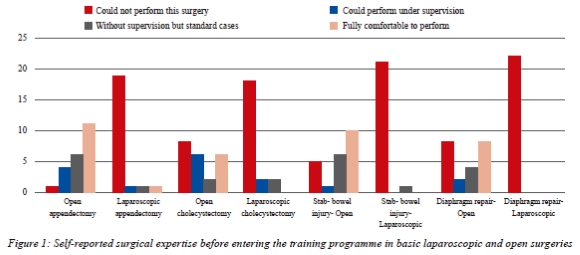
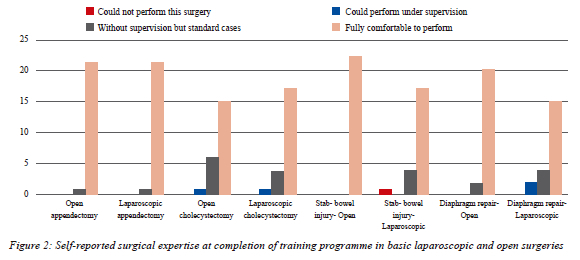
An average of 5 years (range 6 months to 18 years) of surgical experience before starting the general surgery programme was reported. Figure 1 shows the self-reported surgical expertise in basic open and laparoscopic procedures before entering the training programme while Figure 2 depicts self-reported surgical expertise at completion of training.
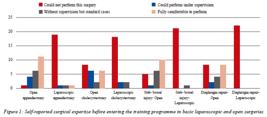
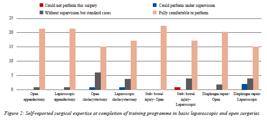
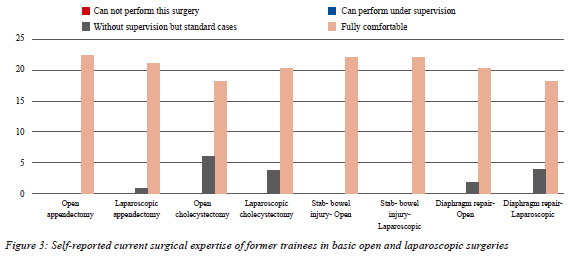
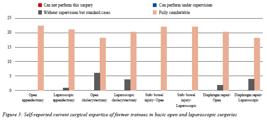
Figure 3 indicates current self-reported surgical expertise of former trainees at SMU in basic surgical approaches. The reported current average split between laparoscopic and open cases was 53% laparoscopic vs. 47% open when considering all operative cases (not only those eligible for a laparoscopic approach). This is in contrast to 66% laparoscopic vs. 34% open cases performed during training. This equates to a 13% reduction in the proportion of laparoscopic cases. The average percentage of patients offered an open approach despite the possibility of a laparoscopic approach was 35% (range 0% to 90%).
Level of difficulty in learning laparoscopy and level of satisfaction in training
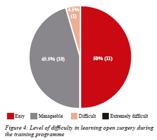
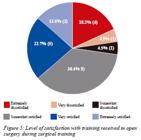
Almost three quarters (72.8%) of the participants found training in laparoscopy to be manageable, 18.2% felt it was difficult and only 9% found it easy. Most participants were either very satisfied (45.5%) or extremely satisfied (18.2%) with training received in laparoscopic surgery.
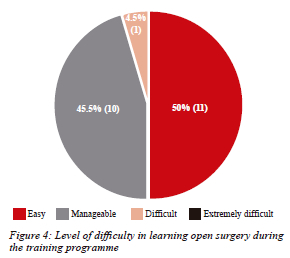
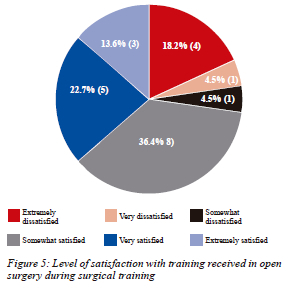
The emphasis on laparoscopy during training did not negatively affect participants' perceptions of the training they received in open surgery (Figure 4). A significant majority (72.7%) felt that the training they received in open surgery was somewhat satisfactory, very satisfying or extremely satisfying (Figure 5).
Reasons for an open approach
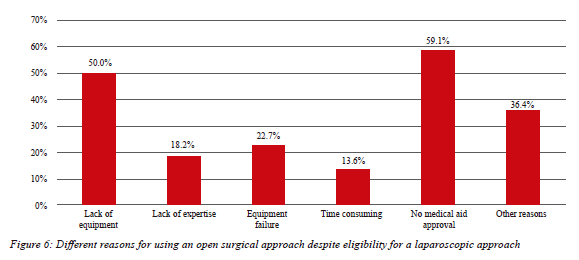
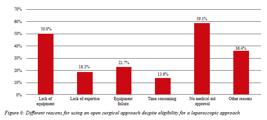
Declined medical aid approval and lack of equipment were the most common reasons for an open approach in patients eligible for a laparoscopic approach, reported by 59.1% and 50% of participants respectively (Figure 6). A total of 18.2% reported lack of expertise, whilst 22.7% reported equipment failure. Long operating times were reported by 13.6% of the participants. Other reasons cited by the participants included resistance from theatre nursing staff and lack of assistance after hours.
Discussion
Our data indicate that intensive training in MAS can result in uptake of a laparoscopic approach in 65% of procedures, with lack of health insurer approval for a laparoscopic approach and lack of access to equipment being the biggest barriers to adoption of a laparoscopic approach after training.
The response rate of 100% from the former trainees was significantly higher than response rates reported in literature exemplified by the response rate in a survey by Shay et al.5
Considering the cases that were eligible for a laparoscopic approach, and who were offered this approach, uptake of laparoscopy after intensive training in MAS at SMU was 65%. When considering all operations performed by former trainees, the average split between laparoscopic and open cases was 53% laparoscopic vs. 47% open. This is in contrast to the 66% laparoscopic vs. 34% open cases performed during training. In a recent paper by Yankunze et al.6255
The reduction in laparoscopic cases after completion of training is multifactorial. Lack of equipment in the public sector and medical aid approval in the private sector were reported to be the two major reasons. Other reasons cited included equipment failure, time-consuming procedures, resistance from theatre nursing staff and patients with complex disease requiring complicated procedures. Only 18.2% of the former trainees reported lack of expertise to be the reason for reduced uptake. This suggests that training during residency equipped these surgeons with the necessary skills to perform most basic laparoscopic procedures proficiently. These findings agree with literature on this topic.2
The high case load of laparoscopic procedures during training ensured that the former trainees had overcome the steep learning curve at completion of training. This learning curve was cited in the report by Cole et al.178
Even though South Africa is a middle-income country, it appears that with training in laparoscopy during residency, the uptake of laparoscopy is high; this would be of great benefit to low- to middle-income countries. Training addresses two of the three major barriers reported by Choy et al.4
Almost three-quarters (72.8%) of the participants found training in laparoscopy to be manageable, thus indicating that with supervised training and practice, it is not difficult to learn laparoscopy. Most participants were either very satisfied or extremely satisfied with training received in laparoscopic surgery. This indicates that training during residency, which is 5 years, does offer satisfaction to trainees, possibly due the ability to continuously improve laparoscopic skills for many procedures. A significant majority (72.7%) felt that the training they received in open surgery was somewhat satisfactory, very satisfying or extremely satisfying.
The limitations of this study are the self-reported nature of the data with the attendant possibility for recall bias and participants reporting results that may be appealing. The study did not consider patient outcomes or complications which are important aspects to consider when scrutinising any surgical approach. The small study population makes it impossible for one to make strong conclusions, however, we sought to provide insight into the opinions of surgeons who received intensive training in MAS and to pave the way for a quantitative study in the future with a bigger sample size.
Conclusion
This study suggests, despite the small sample size and self-reported data, that intensive training in MAS translated to a high uptake of laparoscopy among general surgeons trained in SMU. The biggest barriers to a laparoscopic approach after training were lack of medical aid approval in the private sector and lack of equipment in the public sector. The authors recommend that a quantitative study with a bigger sample size and a comparison of surgeons trained in other institutions be conducted in the future to validate these findings.
Acknowledgement
I am deeply grateful to Sefako Makgatho Health Sciences University, the Sefako Makgatho University Research Ethics Committee, and the Department of General Surgery for their invaluable support and contributions to this research.
Conflict of interest
The authors report no conflict of interest.
Funding source
No funding was required.
Ethical approval
This research adheres to ethical guidelines, and all procedures were conducted in accordance with the principles set forth by the Sefako Makgatho University Research Ethics Committee. The study protocol was approved under reference number SMUREC/M/242/2019: PG.
ORCID
S S Ngema https://orcid.org/0000-0003-2237-7717
REFERENCES
- 1. Cole A, O'Neill P, Sampson C, Lorgelly P. Barriers to uptake of minimal access surgery in the United Kingdom. OHE Consulting Report. London: Office of Health Economics; 2018.
-
2. Torricelli FCM, Barbosa JABA, Marchini GS. Impact of laparoscopic surgery training laboratory on surgeon's performance. World J Gastrointest Surg. 2016;8(11):735-43. https://doi.org/10.4240/wjgs.v8.i11.735.
» https://doi.org/10.4240/wjgs.v8.i11.735 -
3. Moghadamyeghaneh Z, Carmichael JC, Mills S, Pigazzi A, Stamos MJ. Variations in laparoscopic colectomy utilisation in the United States. Dis Colon Rectum. 2015;58(10):950-6. https://doi.org/10.1097/DCR.0000000000000448.
» https://doi.org/10.1097/DCR.0000000000000448 -
4. Choy I, Kitto S, Adu-Aryee N, Okrainec A. Barriers to the uptake of laparoscopic surgery in a lower-middle-income country. Surg Endosc. 2013;27(11):4009-15. https://doi.org/10.1007/s00464-013-3019-z.
» https://doi.org/10.1007/s00464-013-3019-z -
5. Shay BF, Thomas R, Monga M. Urology practice patterns after residency training in laparoscopy. J Endourol. 2002;16(4):251-6. https://doi.org/10.1089/089277902753752232.
» https://doi.org/10.1089/089277902753752232 -
6. Yankunze Y, Mwachiro MM, Lando JO, et al. Laparoscopy experience in East, Central, and Southern Africa: insights from operative case volume analysis. Surg Endosc. 2024;38:4415-21. https://doi.org/10.1007/s00464-024-10960-2.
» https://doi.org/10.1007/s00464-024-10960-2 -
7. Jrearz R, Govindarajan A, Jayaraman S. A survey of current practices and barriers to expanding laparoscopic HPB surgery in Canada. HPB. 2017;19(1):42-6. https://doi.org/10.1016/j.hpb.2016.09.010.
» https://doi.org/10.1016/j.hpb.2016.09.010 -
8. Wilkinson E, Aruparayil N, Gnanaraj J, Brown J, Jayne D. Barriers to training in laparoscopic surgery in low- and middle-income countries: a systematic review. Trop Doct. 2021;51(3):408-14. https://doi.org/10.1177/0049475521998186.
» https://doi.org/10.1177/0049475521998186