Solitary extramedullary plasmacytoma of the colon, rectum and anus
Solitary extramedullary plasmacytoma (SEP) is a neoplastic proliferation of a single clone of plasma cells that occur outside of the bone and bone marrow. It is rare, commonly occurring in the head and neck region, followed by the gastrointestinal tract. The aetiology, risk factors, natural history and consequent treatment are not well defined. We report an unusual case of SEP of the colon in an human immunodeficiency virus (HIV)-infected patient. The patient was managed with colonic resection and made an uneventful recovery. To our knowledge, this is the first reported case of extramedullary plasmacytoma of the colon and rectum in association with HIV infection.
CASE REPORT
Solitary extramedullary plasmacytoma of the colon, rectum and anus
M MjoliI; N VorajeeI; J HowlettI; Y NaidooII; T MadibaIII, IV
IDepartment of Surgery, Pietermaritzburg Hospital Complex, Pietermaritzburg, South Africa
IINational Health Laboratory Service, Greys Hospital, Pietermaritzburg, South Africa
IIIDepartment of Surgery, University of KwaZulu Natal, Durban, South Africa
IVGastrointestinal Cancer Research Centre, University of KwaZulu-Natal, Durban, South Africa
Solitary extramedullary plasmacytoma (SEP) is a neoplastic proliferation of a single clone of plasma cells that occur outside of the bone and bone marrow. It is rare, commonly occurring in the head and neck region, followed by the gastrointestinal tract. The aetiology, risk factors, natural history and consequent treatment are not well defined. We report an unusual case of SEP of the colon in an human immunodeficiency virus (HIV)-infected patient. The patient was managed with colonic resection and made an uneventful recovery. To our knowledge, this is the first reported case of extramedullary plasmacytoma of the colon and rectum in association with HIV infection.
Solitary extramedullary plasmacytoma (SEP) is a neoplastic proliferation of a single clone of plasma cells that occur outside of the bone and bone marrow.122
Case report
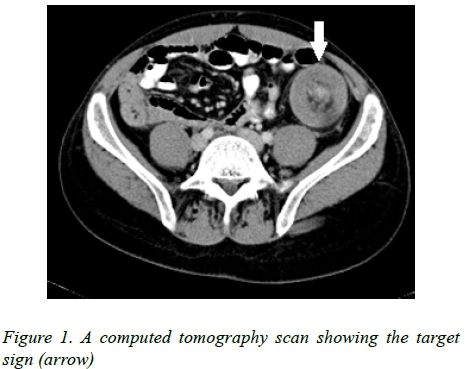
A 42-year-old African man presented to hospital with frank rectal bleeding, preceded by a four-month history of abdominal cramps. He had human immunodeficiency virus (HIV) infection with a CD4 count of 151cells/mm3Figure 1).
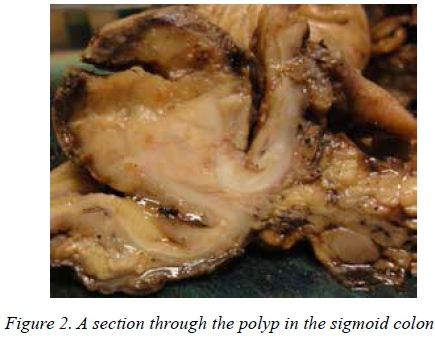
At colonoscopy, the leading part of the intussusception was visualised and confirmed to be a polyp. The intussusception could not be reduced, nor the polyp excised. Also, the colonoscope could not be advanced beyond this site. A laparotomy was undertaken, at which a sigmoid colocolic intussusception was found, with a large, 4cm polyp as a leading point (Figure 2).
A sigmoid colectomy was performed with a primary anastomosis and the patient experienced an uneventful recovery. The histology revealed the polyp to be a plasmacytoma. Immunoperoxidase staining was positive for kappa, and negative for lambda, light chains. The tumour was transmural and the lymph nodes were free from metastasis. On screening for multiple myeloma, the following observations were made:
• A slight polyclonal increase in immunoglobulin on serum protein electrophoresis, consistent with HIV infection.
• The absence of Bence-Jones protein on the urine protein electrophoresis.
• A normocellular microscopical appearance, with no plasma cell dyscrasia, was displayed on the bone marrow aspirate.
• The metastatic skeletal survey was normal.
The patient was last seen three months after the operation, at which time he had completely recovered from the surgery. He is now on a surveillance programme, in conjunction with consultations with a haematologist, for the recurrence or progression of the plasmacytoma.
Discussion
SEP is a rare condition. Only ± 25 cases have been reported in the literature to date. The upper aerodigestive tract is the most frequent location of the lesions, although it can occur in virtually any organ in the body.33
Primary plasmacytoma of the gastrointestinal tract is even rarer, occurring in approximately 10% of cases.22321
An increased incidence of plasma cell tumours has been shown in HIV-positive patients, and tend to occur at unusual sites, such as the skin, soft tissues, breasts, testes and oral cavity.444
Clinical presentation is variable, and shows a marked male predominance. The age at presentation ranges from 15-90 years.1,3,5 The symptoms are non-specific, and include constitutional symptoms, such as anorexia and weight loss.4 2-4 Specific oesophageal symptoms include dysphagia, and if the colorectum is involved, the symptoms are variable, but consistent with any colorectal or anal tumours, including a change in bowel habit.2,3
On endoscopy, gastrointestinal plasmacytoma may present as a nodular or ulcerated mass, or as a diffusely thickened mucosal fold.233
The best management approach to patients with SEP should be determined in a multidisciplinary setting, in order to achieve the best outcome. Surgery, or combined radiotherapy and surgery, are the optimal therapeutic options for the upper aerodigestive tract.3333 33 2
Evidence for use of chemotherapy in plasmacytoma is lacking.5> 5cm in size, high-grade histology, refractory and/or relapsed disease.22,3 It is reasonable to suggest an approach similar to that for anal carcinoma in the absence of case reports in anal SEP.6
Conclusion
SEP is rare, and commonly affects the caecum and sigmoid colon. Rectal SEP is even rarer. Treatment should be individualised. Segmental colectomy is appropriate for colonic plasmacytoma. Surgical excision is ideal for rectal plasmacytoma, with radiotherapy as a salvage option.
REFERENCES
- 1. Dores GM, Landgren O, McGlynn KA, et al. Plasmacytoma of bone, extramedullary plasmacytoma, and multiple myelom: incidence and survival in the United States, 1992-2004. Br J Haematol. 2009;144(1):86-94.
- 2. Salogub G, Lokhmatova E, Sozin S. Solitary bone and extramedullary plasmacytoma. Intech Open Science [homepage on the Internet].
- 2012. c2013. Available from: http://www.intechopen.com/books/multiple-myeloma-an-overview/plasmocytoma
- 3. International Myeloma Working Group. Criteria for the classification of monoclonal gammopathies, multiple myeloma and related disorders: a report of the International Myeloma Working Group. Br J Haemat. 2003;121(5):749-757.
- 5. Hughes M, Soutar R, Lucraft H, et al. Guidelines on the diagnosis and management of solitary plasmacytoma of bone, extramedullary plasmacytoma and multiple solitary plasmacytoma: 2009 update. BloodMed.com [homepage on the Internet].
- c2013. Available from: http://www.bloodmed.com/contentimage/guidelines/3454.pdf
- 6. Ntombela XH, Govender P, Sartorius B, Madiba TE. The clinicopathologic spectrum of anal cancer in KwaZulu-Natal Province, South Africa: analysis of a provincial database. Cancer Epidemiol. 2015;39(4):528-533.