Risk factors for recurrence after pilonidal sinus surgery in children and adolescents
Abstract
BACKGROUND: Acquired pilonidal sinus disease (PSD) is a condition involving hair bundles most commonly located in the midline of the sacrococcygeal region. The aim of this study is to investigate the risk factors for recurrence after the surgical treatment of PSD in children and adolescentsMETHODS: This retrospective study was conducted with patients who underwent surgery for PDS at the Paediatric Surgery Clinic of Karaman State Hospital between July 2010 and December 2018. Age, gender, weight, and height of the patients were recorded. Whether or not there was a recurrence after the surgery as well as the factors affecting recurrence in the cases with recurrence were examinedRESULTS: A total of 86 PSD patients were included in the study. Of these, 36 (41.9%) were girls and 50 (58.1%) were boys. The mean follow-up period was 15.1 ± 8.4 months. Their mean age was 15.16 ± 1.29 years. Postoperative recurrence developed in 14 patients (16.3%). Postoperative recurrence was significantly higher in those who were overweight than in those of normal weight (p < 0.001) and in females when compared to males (p = 0.014). Gender and BMI were interrelated as risk factors. The effect of female gender on the likelihood of recurrence was threefold that of BMICONCLUSION: It was observed in this study that female gender and a high BMI significantly increased the risk of PSD recurrence after surgery
paediatric pilonidal sinus; postoperative recurrence; gender; BMI
Introduction
Acquired pilonidal sinus disease (PSD) is a chronic condition involving hair bundles most commonly located in the midline of the sacrococcygeal region characterised by recurrent attacks of acute and subacute infections and the presence of one or more sinus orifices.123,4 One of the first studies investigating that the disease may be acquired is the study conducted by Boie et al. in 1952 with drivers.56 7,8 Despite significant failure rates, surgical procedures are the only potentially curative treatment for PSD. Several factors that affect recurrence have been reported but their association is highly variable.9,10 Determination of postoperative risks factors preoperatively has the potential to optimise them and reduce the risk of recurrence.11,12
The aim of this study was to investigate the risk factors for recurrence after the surgical treatment of PSD in children and adolescents.
Methods
This study was a retrospective chart review of patients undergoing surgery for PSD at the Paediatric Surgery Clinic of Karaman State Hospital between July 2010 and December 2018. The patients were operated by the same surgeon and their information was obtained from the hospital information management system (HIMS) and hospital files. Age, sex, height, weight, presence of recurrence, surgical method and body mass index (BMI) were analysed.
Analysis
Descriptive statistics of categorical data in the study were shown using frequency and percentage values. Descriptive statistics of numerical data were shown using mean and standard deviation. In the study, Mann-Whitney U test was used to compare numerical data among independent groups, and chi-square test was used to compare categorical data. Logistic regression was used for multivariate analysis of risk factors. Odds ratios and confidence interval of 95% were presented.
Results
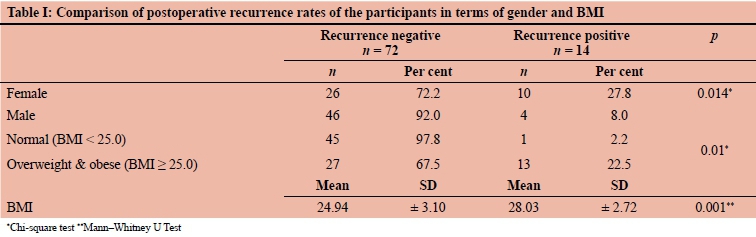
The mean age of 86 PSD patients was 15.1 ± 1.29 years. No significant difference was determined between male and female participants. Thirty-six (41.9%) participants were female and 50 (58.1%) were male. While 79 (91.9%) patients underwent primary closure, seven (8.1%) underwent flap surgery. The mean follow-up period was 15.1 (± 8.4) months. While no postoperative recurrence developed in 72 (83.7%) of the patients participating in the study, recurrence developed in 14 (16.3%). Of the 68 (86.1%) patients receiving primary closure treatment, 11 (13.9%) developed recurrence. Table I shows the relationship of gender and BMI to recurrence.
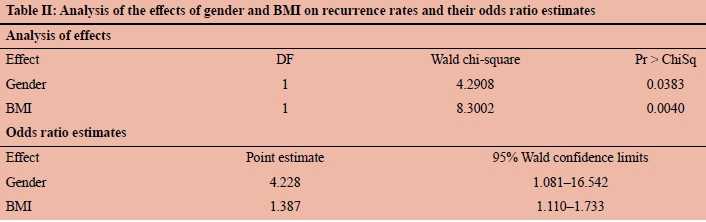
Female gender and increasing BMI were significant and interdependent risk factors for the development of recurrence. Table II shows the analysis of effect and the odds ratio estimates with female gender having a three-fold greater ratio than BMI.
Discussion
A limited number of studies have investigated the causes of recurrence after PS operations in paediatric age range. In the study conducted by Arda et al., with 14 adolescents, they reported that obesity might affect both the development of PSD and postoperative recurrence.713141516
Conclusion
In this study, recurrence was observed in female patients with high BMI. Reducing the BMI of patients, particularly females, suffering from PSD through appropriate diet and exercise programmes before surgery may decrease the recurrence. Comprehensive studies are needed to reveal the broader risk factors affecting recurrence after PSD surgery.
Conflict of interest
The authors declare no conflict of interest.
Funding source
None.
Ethical approval
In our country (Turkey), an ethics committee decision is not required for retrospective studies. Legislation related to this subject in our country is found in Turkey Pharmaceuticals and Medical Devices Agency Regulation Clinical Research.
Ethical approval was obtained from Health Sciences Ethics Committee with decision dated 27.11.2020/25.
ORCID
H Madenci https://orcid.org/0000-0002-7243-5340
REFERENCES
- 1. Karydakis GE. New approach to the problem of pilonidal sinus. Lancet. 1973;302(7843):1414-5.
- 2. Doll D, Friederichs J, Dettmann H, et al. Time and rate of sinus formation in pilonidal sinus disease. Int J Colorectal Dis. 2008;23(4):359-64.
- 3. Hull TL, Wu J. Pilonidal disease. Surg Clin North Am. 2002;82:1169-85.
- 4. Ertan T, Koc M, Gocmen E, et al. Does technique alter quality of life after pilonidal sinus surgery? Am J Surg. 2005;190(3):388-92.
- 5. Buie LA, Curtiss RK. Pilonidal disease. Surg Clin North Am. 1952;32(4):1247-59.
- 6. Çubukçu A, Gönüllü NN, Paksoy M, et al. The role of obesity on the recurrence of pilonidal sinus disease in patients who were treated by excision and Limberg flap transposition. Int J Colorectal Dis. 2000;15(3):173-5.
- 7. Arda IS, Güney LH, Sevmiç S, Hiçsonmez A. High body mass index as a possible risk factor for pilonidal sinus disease in adolescents. World J Surg. 2005;29(4):469-71.
- 8. Doll D, Friederichs J, Boulesteix AL, et al. Surgery for asymptomatic pilonidal sinus disease. Int J Colorectal Dis. 2008;23(9):839-44.
- 9. Keshvari A, Keramati MR, Fazeli MS, Kazemeini A, Nouritaromlou MK. Risk factors for complications and recurrence after the Karydakis flap. J Surg Res. 2016;204(1):55-60.
- 10. Onder A, Girgin S, Kapan M, et al. Pilonidal sinus disease: risk factors for postoperative complications and recurrence. Int Surg. 2012;97(3):224-9.
- 11. Stauffer VK, Luedi MM, Kauf P, et al. Common surgical procedures in pilonidal sinus disease: a meta-analysis, merged data analysis, and comprehensive study on recurrence. Sci Rep. 2018 Feb 15;8(1):3058.
- 12. Halleran DR, Lopez JJ, Lawrence AE, et al. Recurrence of pilonidal disease: our best is not good enough. J Surg Res. 2018;232:430-6.
- 13. Sakr M, El-Hammadi H, Moussa M, et al. The effect of obesity on the results of Karydakis technique for the management of chronic pilonidal sinus. Int J Colorectal Dis. 2003;18(1):36-9.
- 14. Oku§ A, Karahan O, Eryilmaz M, et al. Pilonidal hastaligin toplumda görülme sikligi, ya§a ve cinsiyete göre dagilimi [erken sonuçlarimiz]. Selçuk Tip Derg. 2013;29(3):120-2.
- 15. Yildiz T, Elmas B, Yucak A, Turgut HT, Ilce Z. Risk factors for pilonidal sinus disease in teenagers. Indian J Pediatr. 2017;84(2):134-8.
- 16. Çaglayan K, Günkör B, Topgül K, et al. Pilonidal sinüs hastaliginda komplikasyon ve nüks açisindan hastaya ait faktörlerin incelenmesi. Kolon Rektum. 2011;21(3):103-8.