Role of multidetector computed tomography-based component separation index in the management of large ventral hernias
Abstract
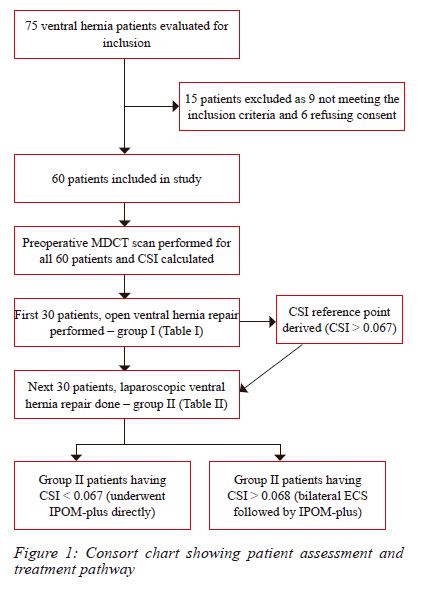
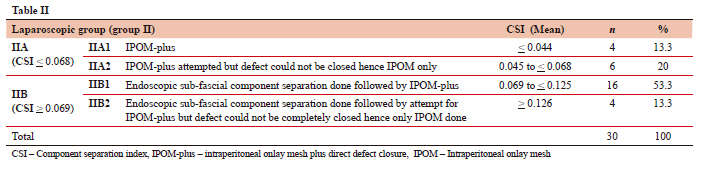
BACKGROUND: Predicting complete closure of large ventral hernias without component separation (CS) could have clinical value. The utility of multidetector computed tomography (MDCT)-based component separation index (CSI) was derived and evaluated for these hernias. METHODS: In 60 patients with a ventral hernia, a CSI was calculated based on their MDCT. In group I (first 30 patients), hernia repair was performed by an open approach and operative assessment determined the need for CS to effect complete closure. A CSI value above which defect closure needed CS was taken as the CSI reference point. In group II (second 30 patients), the hernia repair was done laparoscopically. Patients with a CSI at or below the reference point of group I underwent intraperitoneal onlay mesh (IPOM) after direct closure of the defect (IPOM-plus). The other patients had bilateral endoscopic component separation (ECS) before entry into the peritoneal cavity for an intended IPOM-plus. RESULTS: A CSI above 0.067 and 0.044 in open and laparoscopic approaches respectively required CS for complete defect closure. A CSI above 0.25 and 0.125 in open and laparoscopic approaches respectively, despite CS, predicted complete closure of defect was not possible. CONCLUSION: CSI is a more comprehensive parameter for evaluation of ventral hernia than the conventional two-dimensional parameters and can predict the need of component separation prior to complete closure of the defect in both laparoscopic and open approach.
component separation index; component separation; endoscopic component separation; multidetector computed tomography; laparoscopic ventral hernia repair; IPOM-plus
 Thumbnail