Recurrence of hepatocellular carcinoma after liver transplantation: Isolated splenic metastasis
Abstract
Despite strict selection criteria for transplantation, relapse of disease after transplantation is observed. With the improvement in survival following treatment and advances in patient monitoring and management, extrahepatic metastases have gained increasing clinical significance. Extrahepatic hepatocellular carcinoma (HCC) recurrences are usually observed in the lungs, lymph nodes, bones, and adrenal glands. The spleen has been reported rarely as a metastatic site of HCC. There is no consensus for the management of HCC recurrence after liver transplantation. Surgical resection is usually the first choice of treatment because curative-intent treatments have better survival. In this case report, we will share a rare splenic recurrence in a patient who underwent liver transplantation due to HCC.
hepatocellular carcinoma; splenic metastasis; liver transplantation
CASE REPORT
Recurrence of hepatocellular carcinoma after liver transplantation: Isolated splenic metastasis
O AydoğanI; AE SakurI; S AkalınI; UU ŞekerciII; EB CartI; A EdizsoyI
IDepartment of General Surgery, Faculty of Medicine, Adnan Menderes University, Türkiye
IIDepartment of General Surgery, Mimar Sinan State Hospital, Türkiye
SUMMARY
Despite strict selection criteria for transplantation, relapse of disease after transplantation is observed. With the improvement in survival following treatment and advances in patient monitoring and management, extrahepatic metastases have gained increasing clinical significance. Extrahepatic hepatocellular carcinoma (HCC) recurrences are usually observed in the lungs, lymph nodes, bones, and adrenal glands. The spleen has been reported rarely as a metastatic site of HCC. There is no consensus for the management of HCC recurrence after liver transplantation. Surgical resection is usually the first choice of treatment because curative-intent treatments have better survival. In this case report, we will share a rare splenic recurrence in a patient who underwent liver transplantation due to HCC.
Keywords: hepatocellular carcinoma, splenic metastasis, liver transplantation
Case report
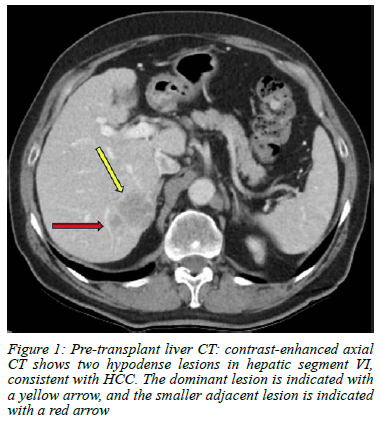
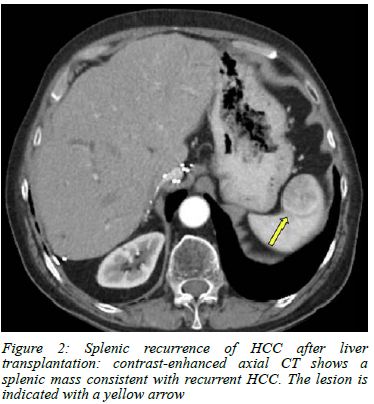
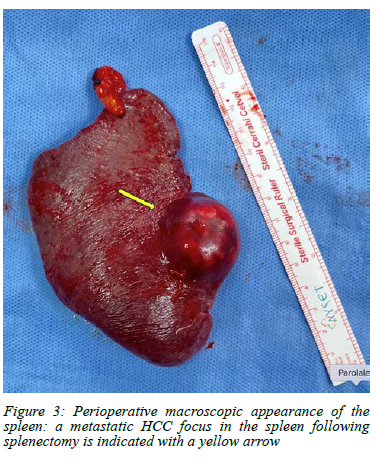
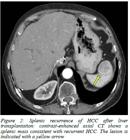
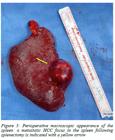
A 66-year-old male patient with hepatitis C virus ribonucleic acid (HCV-RNA) positivity for approximately 5 years presented in December 2018 with markedly elevated alpha-fetoprotein (AFP) levels (3597 ng/mL). Imaging revealed two nodules in liver segment VI consistent with hepatocellular carcinoma (HCC) (Figure 1), the largest measuring 31 × 50 mm. The patient was classified as Child-Pugh A at diagnosis. He underwent two consecutive sessions of transarterial chemoembolisation (TACE) and one session of radiofrequency ablation (RFA). No adjuvant chemotherapy was administered. Following treatment, the tumour size regressed to 40 mm, and the AFP level dropped to 7.49 ng/mL. It was concluded that the patient met the Milan criteria and was therefore considered suitable for liver transplantation.1Figure 2). At the time of diagnosis, laboratory evaluation revealed a haemoglobin level of 11.7 g/dL (reference range 13-17 g/dL), while the remaining routine biochemical parameters and coagulation profile were within normal limits. The splenic lesion was radiologically considered a recurrence of HCC, and the patient underwent splenectomy in May 2025 (Figure 3). Final histopathology confirmed a 3 × 3 × 2.7 cm metastatic HCC lesion. No intraoperative or postoperative complications occurred, and the patient was discharged uneventfully. At the 6-month follow-up, the patient remained clinically stable and continued surveillance with serial AFP measurements and imaging, with no evidence of further recurrence.
Discussion
HCC is the most common primary liver cancer and is among the important causes of mortality due to cancer according to World Health Organization (WHO) data.2343,5 Late recurrences developing thereafter are much rarer.5
With improved survival following treatment and advances in patient monitoring and management, extrahepatic metastases have gained increasing clinical significance. Due to differing approaches regarding the treatment and follow-up of HCC recurrence after LT, these cases are generally managed similarly to non-transplanted patients.5
In selected patients with limited and resectable extrahepatic metastases, surgical resection may be considered as a treatment option.6789
Isolated splenic metastasis of HCC is exceedingly rare and is typically encountered as part of disseminated hematogenous spread involving multiple organs. Isolated splenic recurrence of intra-abdominal extrahepatic HCC has previously been described by Choi et al.108
In conclusion, the survival advantage of surgical resection in the treatment of isolated extrahepatic metastases of HCC, specifically splenic metastasis, remains uncertain as such cases are very rare. Surgical resection may offer a treatment option with the advantages of lower morbidity and longer-term survival in well-selected patients. Given the uncertainty surrounding the management of recurrent HCC, long-term follow-up and further evidence are needed to evaluate post-resection outcomes.
Conflicts of interest
The authors declare no conflict of interest.
Funding source
The authors report no involvement in the research by the sponsor that could have influenced the outcome of this work.
ORCID
O Aydoğan https://orcid.org/0000-0001-9347-8481
AE Sakur https://orcid.org/0000-0001-9000-0167
S Akalın https://orcid.org/0009-0004-3759-2414
UU Şekerci https://orcid.org/0000-0002-2056-9590
EB Cartı https://orcid.org/0000-0002-7139-0339
A Edizsoy https://orcid.org/0000-0002-1259-0488
REFERENCES
-
1. Mazzaferro V, Regalia E, Doci R, et al. Liver transplantation for the treatment of small hepatocellular carcinomas in patients with cirrhosis. N Engl J Med. 1996;334:693-9. https://doi.org/10.1056/NEJM199603143341104.
» https://doi.org/10.1056/NEJM199603143341104 -
2. Sung H, Ferlay J, Siegel RL, et al. Global cancer statistics 2020: GLOBOCAN estimates of incidence and mortality worldwide for 36 cancers in 185 countries. CA Cancer J Clin. 2021;71(3):209-49. https://doi.org/10.3322/caac.21660.
» https://doi.org/10.3322/caac.21660 -
3. Lee DD, Sapisochin G, Mehta N, et al. Surveillance for HCC after liver transplantation: Increased monitoring may yield aggressive treatment options and improved post-recurrence survival. Transplantation. 2020;104(10):2105-12. https://doi.org/10.1097/TP.0000000000003117.
» https://doi.org/10.1097/TP.0000000000003117 -
4. Ho CM, Lee PH, Chen CL, et al. Long-term outcomes after resection versus transplantation for hepatocellular carcinoma within UCSF criteria. Ann Surg Oncol. 2012;19(3):826-33. https://doi.org/10.1245/s10434-011-1975-x.
» https://doi.org/10.1245/s10434-011-1975-x -
5. Ho CM, Lee CH, Lee MC, et al. Survival after treatable hepatocellular carcinoma recurrence in liver recipients: A nationwide cohort analysis. Front Oncol. 2020;10:616094. https://doi.org/10.3389/fonc.2020.616094.
» https://doi.org/10.3389/fonc.2020.616094 -
6. Sapisochin G, Goldaracena N, Astete S, et al. Benefit of treating hepatocellular carcinoma recurrence after liver transplantation and analysis of prognostic factors for survival in a large Euro-American series. Ann Surg Oncol. 2015;22(7):2286-94. https://doi.org/10.1245/s10434-014-4273-6.
» https://doi.org/10.1245/s10434-014-4273-6 -
7. Long HY, Huang TY, Xie XY, Long JT, Liu BX. Treatment strategies for hepatocellular carcinoma with extrahepatic metastasis. World J Clin Cases. 2021;9(21):5754-68. https://doi.org/10.12998/wjcc.v9.i21.5754.
» https://doi.org/10.12998/wjcc.v9.i21.5754 -
8. Poon RT, Fan ST, O'Suilleabhain CB, Wong J. Aggressive management of patients with extrahepatic and intrahepatic recurrences of hepatocellular carcinoma by combined resection and locoregional therapy. J Am Coll Surg. 2002;195(3):311-8. https://doi.org/10.1016/S1072-7515(02)01226-7.
» https://doi.org/10.1016/S1072-7515(02)01226-7 -
9. Al-Ameri A, Yu X, Zheng S. Predictors of post-recurrence survival in hepatocellular carcinoma patients following liver transplantation: Systematic review and meta-analysis. Transplant Rev. 2022;36(1):100676. https://doi.org/10.1016/j.trre.2021.100676.
» https://doi.org/10.1016/j.trre.2021.100676 -
10. Choi SB, Kim H, Kim SH, Park YN, Kim KS. Solitary extrahepatic intraabdominal metastasis from hepatocellular carcinoma after liver transplantation. Yonsei Med J. 2011;52(1):199-203. https://doi.org/10.3349/ymj.2011.52.1.199.
» https://doi.org/10.3349/ymj.2011.52.1.199