The adapted Caprini score as a proxy for postoperative venous thromboembolism prophylaxis: a tertiary hospital experience
Abstract
BACKGROUND: Postoperative patients' risk for developing venous thromboembolism (VTE) can be predicted using the adapted Caprini risk assessment model which informs administration of postoperative VTE prophylaxis. The study aimed to assess the appropriateness of postoperative VTE prophylaxis of patients according to the adapted Caprini scores and investigate whether a patient's HIV status influenced postoperative VTE prophylaxis administration. METHODS: This cohort study included patients who had elective or urgent surgery at a tertiary hospital, Bloemfontein. Data from patient files were captured on datasheets that comprised the adapted Caprini risk assessment model. The type of prophylaxis received was noted. The appropriateness of the prophylaxis prescribed was compared with the patient's score. RESULTS: Details of 147 patients were included. Three of the 16 patients who did not qualify for prophylaxis, were on VTE prophylaxis on day-one post-surgery. Only 24 (18.3%) of the 131 patients who qualified for prophylaxis were on prophylaxis one day post-surgery. Of the prophylaxis prescribed, 88.5% was enoxaparin, and 11.5% "other", mainly aspirin. Twenty-three (17.6%) patients who qualified for prophylaxis were discharged on prophylaxis. Of the 147 patients, 24 patients were HIV positive, and eight of these patients received postoperative VTE prophylaxis. CONCLUSION: The majority of postoperative patients at the various surgical departments of the hospital did not receive appropriate postoperative VTE prophylaxis compared to the adapted Caprini scores obtained from their medical information. A patient's HIV status alone did not influence the decision of administering postoperative VTE prophylaxis.
deep vein thrombosis; postoperative prophylaxis; adapted Caprini risk assessment
Background
Venous thromboembolism (VTE) includes deep venous thrombosis (DVT) and pulmonary embolism (PE).112
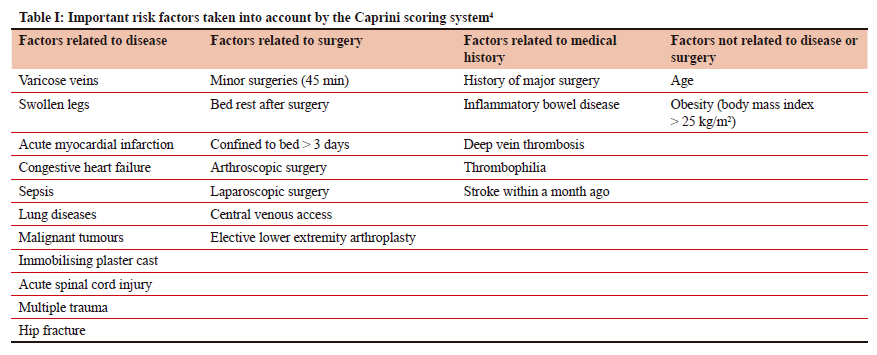
The Caprini risk assessment model (RAM) or scoring system was originally developed for surgical patients to determine the VTE risk by adding individual risk factors and placing patients into four categories: "low risk" (0-1 points), "moderate risk" (2 points), "high risk" (3-4 points), and "highest risk" (5 or more points).3Table I outlines some of the most important risk factors that the Caprini scoring system takes into account:4
The Caprini score of patients can be determined in various ways, including the evaluation of medical records or face-to-face interaction with the patient. Determining Caprini scores solely from medical records may provide inaccurate information regarding VTE in comparison to face-to-face interactions with the patients, as additional information such as family history and presence of varicose veins could be absent in medical records and only be clarified during interviews.56
The Caprini RAM was validated in a large retrospective study that included general, vascular and urology surgical patients.77
Sterbling et al.83> 5 will be the most acceptable strategy to balance the benefits of preventing VTE while at the same time minimising the risks associated with anticoagulation medication (e.g. increased bleeding risk, cost, etc.). Although a clear correlation exists between increasing Caprini score and increasing VTE risk, a systematic review has found variation in the prevalence of VTE post-surgery in the various Caprini risk groups.9
Compression stockings and intermittent pneumatic stockings are the most frequently used mechanical methods for VTE prophylaxis of the lower limb.1010 11
South Africa is burdened by a high prevalence of HIV-positive patients. Due to the HIV replication itself, an active opportunistic infection may be present while the levels of CD4+ T-cells are low.1213,14 A retrospective study12
During a prospective observational study1515
The Caprini RAM is an effective model for calculating the risk of postoperative patients to develop VTE and therefore deciding the appropriate prophylactic treatment for each unique patient. As doctors are not obliged to calculate a patient's Caprini score after surgery, it served as motivation to compare the appropriateness of VTE prophylaxis for postoperative patients with their individual Caprini scores. In addition, in view of the high prevalence of HIV in South Africa, there is a theoretical increased risk for postoperative VTE in our patient population. Our secondary objective was to evaluate the influence of a patient's HIV status on the doctor's decision to prescribe VTE prophylaxis.
Aim
The primary aim of this study was to assess the appropriateness of the postoperative VTE prophylaxis of patients according to their adapted Caprini scores at a tertiary hospital in Bloemfontein, South Africa. The secondary aim was to investigate whether a patient's HIV status influenced the decision to administer postoperative VTE prophylaxis, regardless of their Caprini scores.
Methods
Study design and sample population
The target population of this cohort study included patients 18 years and older who had elective or urgent surgery at Universitas Academic Hospital from June 2019 to October 2019. Six surgical departments were included: urology, neurosurgery, orthopaedic surgery, plastic surgery, general surgery and otorhinolaryngology. Consecutive sampling was used.
Exclusion criteria included missing files, incomplete patient files, patients who died during hospitalisation, and patients who did not consent to participate in the study. The information of 147 out of 149 patients was included. Two patients were excluded from the study as they were not discharged and were in hospital for more than 3 months.
Measurement
The adapted Caprini scoring system15> 5).
The data form included the standardised, validated, adapted Caprini scoring system.15
The researchers completed the data forms using information available to doctors after elective or urgent surgery and obtained primarily from the patients' files as well as from Meditech notes, radiology reports, clinic data and the NHLS database. Any unavailable information was captured on the data form as a 'no/no risk' since this information would not have been available to the doctors to assess whether they needed to prescribe VTE prophylaxis after surgery.
Patients were asked to sign a consent form after they read and understood the information document, which was available in English, Afrikaans, Sesotho and isiXhosa. A brief voice recording of the precise wording of a part of the information document that explained the study, in the languages mentioned, was played to the patients on a cell phone, thus avoiding confusion and ensuring clarity and consistency. If the researchers noted that a patient was still not able to fully comprehend the purpose of the study, even after playing the voice recording, the patient was excluded.
Pilot study
A pilot study included the first 10 patients of June 2019 and evaluated the appropriateness and effectiveness of the data form and methodology. Following conclusion of the pilot study, no adjustments were needed, and the 10 patients were included in the study.
Analysis
The information on the data forms was entered into a Microsoft Excel sheet. The data were analysed by the Department of Biostatistics, Faculty of Health Sciences of the University of the Free State using SAS Version 9.4. Numerical variables were summarised by medians, minimum, maximum. Categorical variables were summarised by frequencies and percentages. Patients qualified for prophylactic treatment with an adapted Caprini score of > 3.
Ethical aspects
Participation in the study was voluntary. Patients were only included once they had given written consent. All patient information gathered was kept confidential and anonymised. The researchers captured the data from patient files at the patients' bedside in the relevant wards. The data forms contained a space for the unique number that was given to each patient through a consecutive coding system (e.g., Patient Number 1).
Results
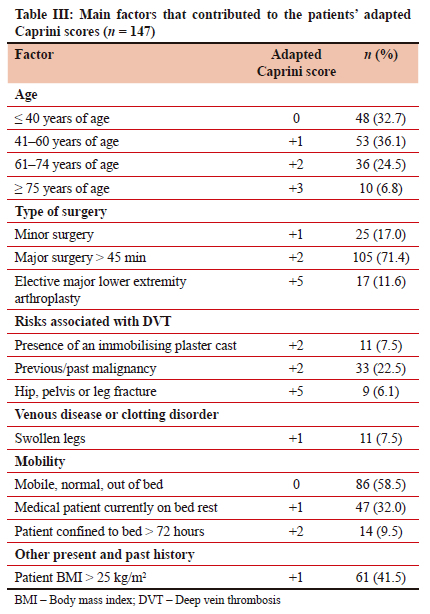
Of the 147 patients, 71 (48.3%) were male and 76 (51.7%) were female. Patient distribution according to age groups was < 40 years (n = 48; 32.7%), 41-60 years (n = 53; 36.1%), 61-74 years (n = 36; 24.5%) and > 75 years (n = 10; 6.8%).
Three-quarters of the patients were from the departments of orthopaedic surgery (n = 38; 25.9%), urology (n = 37; 25.2%) and general surgery (n = 36; 24.5%). The remaining patients were from the departments of plastic surgery (n = 14; 9.5%), neurosurgery (n = 11; 7.5%) and otorhinolaryngology (n = 11; 7.5%). As per the risk stratification for the adapted Caprini score, the majority (n = 105; 71.4%) of the patients underwent major surgery, 25 (17.0%) had minor surgery and 17 (11.6%) had elective major lower extremity arthroplasty.
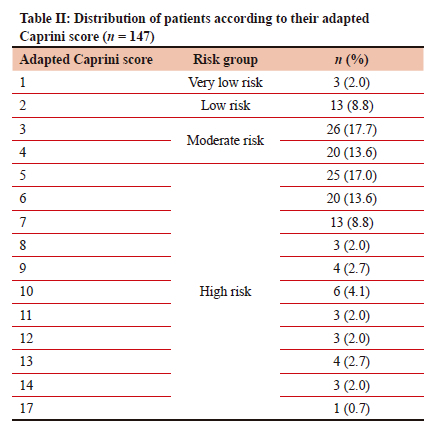
Table II shows the distribution of patients according to their adapted Caprini score and allocation to risk group. The median adapted Caprini score was 5 (range 1-17).
According to the adapted Caprini scores in Table II, three (2.0%) patients were in the very low-risk group, 13 (8.8%) in the low-risk group, 46 (31.3%) in the moderate risk group and 85 (57.8%) in the high-risk group. Table III illustrates the factors that were present in more than 5% of the population.
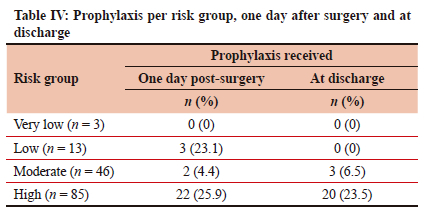
Only 16 (10.9%) of the 147 patients did not require prophylactic treatment, while 131 (89.1%) did. Only 24 (18.3%) of the 131 patients who qualified for prophylaxis were on prophylaxis one day post-surgery. Three of the 16 patients who did not qualify for prophylaxis were on prophylaxis one day post-surgery. Twenty-three (17.6%) of the patients who qualified for prophylaxis were also discharged on prophylaxis (treatment for 10 days).
Table IV shows prophylaxis per risk group. The highest adapted Caprini score obtained without receiving prophylaxis was 14.
The prophylaxis one day post-surgery was mainly enoxaparin (23, 88.5%). Three cases (11.5%) received aspirin. Patients who were discharged on prophylaxis received enoxaparin (n = 7) and other forms of prophylaxis that mainly included aspirin (n = 16).
Most (n = 140; 95.2%) did not receive any form of intermittent pneumatic stockings, two (1.4%) received intermittent pneumatic stockings intraoperatively, and five (3.4%) postoperatively.
Of the 147 patients, 24 (16.3%) patients were HIV positive, of which 21 (87.5%) were receiving antiretroviral treatment. According to their adapted Caprini scores, 20 (80.0%) of the HIV-positive patients qualified for postoperative VTE prophylaxis, of which eight (40.0%) received treatment. Seven of these eight patients had an adapted Caprini score > 5 and were thus in the high-risk group. Of the 111 HIV-negative patients who qualified for postoperative VTE prophylaxis, 16 (14.4%) received treatment, of whom 15 were in the high-risk group.
Discussion
Of 147 patients, 57.8% had a high (> 5) adapted Caprini score, placing them at a high risk of developing VTE. Possible reasons for the high adapted Caprini scores could be that 67.3% of the patients were older than 40 years and 83.0% either had major surgery or elective major lower extremity arthroplasty. Almost half of the patients had different levels of immobility, and 41.5% of patients had a BMI greater than 25 kg/m2
Almost a third (31.3%) of the patients had a moderate risk (with a score of 3-4) of developing VTE. Laryea and Champagne7
According to their adapted Caprini scores (> 3), 131 (89.1%) patients qualified for prophylaxis. Three patients who did not qualify for treatment did, however, receive VTE prophylaxis. Prophylactic resources are therefore not wasted nor used in a careless and irresponsible manner at Universitas Academic Hospital. However, the number of patients who did qualify for prophylaxis but did not receive any form of prophylaxis is worrisome. Only 24 (18.3%) patients who qualified for prophylaxis correctly received prophylaxis one day after surgery, and therefore, 81.7% of the patients who met the criteria for receiving prophylaxis did not receive treatment. A study of 179 patients at Frere Hospital in the Eastern Cape considered a Caprini score of 2 and above as at risk. Taking into account the patients' contraindications to chemoprophylaxis, 26% of at-risk patients received the correct thromboprophylactic treatment prescription.16
The preferred form of prophylaxis at Universitas Academic Hospital is enoxaparin; 23 of the 26 patients received enoxaparin one day after surgery, while three patients received other pharmacological prophylaxis, mainly aspirin. In comparison, seven patients were discharged on enoxaparin, and 16 were discharged on aspirin. The patients who were discharged on aspirin were not taking aspirin chronically, and the conclusion could be made that they were discharged on aspirin as a form of VTE prevention. At the time of our study, aspirin was often used for VTE prophylaxis in orthopaedic patients due to no access to newer generation anticoagulation, such as rivaroxaban (Xarelto), in the state sector. There is literature to support this in low-risk patients,1919
It appears that the HIV status of a patient alone does not influence the decision for administering postoperative VTE prophylaxis at Universitas Academic Hospital, but that HIV-positive patients with high scores were more likely to receive prophylaxis than HIV-negative patients with high scores.
Study limitations
The study did not investigate why patients who qualified for prophylaxis did not receive treatment. Data were not collected on whether patients were already taking thromboprophylaxis before the surgery or whether a medical condition prevented them from taking aspirin, even though they qualified for treatment as per their adapted Caprini score. Exclusion of patients due to death or not being discharged could have introduced bias. The prevalence of VTE in this cohort is not known. Patients were not followed up after discharge to determine compliance or VTE incidence. Re-evaluation is problematic since patients are from the Free State as well as Northern Cape provinces, and do not always attend follow-up visits.
Conclusion and recommendations
The majority of adapted Caprini scores calculated from 147 postoperative patients at various surgical departments at Universitas Academic Hospital were high, and therefore, most of these patients qualified for postoperative VTE prophylaxis. The number of patients who received postoperative VTE prophylaxis a day after surgery and at discharge was low. HIV status alone seemingly does not influence the decision to administer postoperative VTE prophylaxis but in conjunction with a high Caprini score led to more frequent prophylaxis prescription.
Health care practitioners should be educated regarding the existing guidelines for preventing VTE in surgical patients. These patients should also be educated on the risks and complications of postoperative VTE, which would ensure better patient compliance when receiving postoperative VTE prophylaxis. Steps to ensure that VTE risk assessment becomes part of clinical practice include mandatory determination of Caprini scores on admission or mandatory prophylaxis given to all patients in theatre, except where contra-indicated. Further research could include comparing the implementation of postoperative VTE prophylaxis in public and private health sectors of South Africa, as this may indicate the impact of financial constraints on postoperative VTE prophylaxis. Other research possibilities include a comparison between the prescription of VTE prophylaxis between the various surgical departments at Universitas Academic Hospital. In addition, patients should be followed up for 6 months or a year after discharge to assess whether they developed VTE. A questionnaire survey of prescribing doctors regarding their knowledge of existing guidelines and their attitudes towards prescribing prophylaxis would give insight into reasons for inadequate prescription.
Acknowledgements
Prof. Nicholas Pearce, Head of the Surgical Department, Universitas Academic Hospital, for support in the communication with the other surgical department heads; Ms Zelda Loots, pharmacist, Universitas Academic Hospital, for her patience and guidance to use Meditech to determine whether patients have been discharged on postoperative DVT prophylaxis; Prof. Gina Joubert, Department of Biostatistics, Faculty of Health Sciences, University of the Free State (UFS), for guidance in the research process and manuscript finalisation; and Ms T Mulder, medical editor, Faculty of Heath Sciences, UFS, for technical and editorial preparation of the manuscript.
Conflict of interest
The authors declare no conflict of interest.
Funding source
No funding source to be declared.
Ethical approval
The protocol was approved by the Health Sciences Research Ethics Committee, Faculty of Health Sciences of the University of the Free State [UFS-HSD2019/0128/2506]. Permission to conduct the study was obtained from the Free State Department of Health and Universitas Academic Hospital.
ORCIDC Moolman https://orcid.org/0009-0000-8017-0840
M du Plessis https://orcid.org/0009-0006-4602-259X
C Venter https://orcid.org/0009-0003-8838-241X
R van Wyk https://orcid.org/0009-0000-5962-9194
D Scheepers https://orcid.org/0009-0008-1234-2987
K Kruger https://orcid.org/0009-0001-1593-3968
C Vosloo https://orcid.org/0009-0004-4672-6998
L Human https://orcid.org/0009-0006-1520-2715
C van Rooyen https://orcid.org/0000-0002-5092-2957
REFERENCES
-
1. Khan F, Tritschler T, Kahn SR, Rodger MA. Venous thromboembolism. Lancet. 2021;398(10294):64-77. https://doi.org/10.1016/S0140-6736(20)32658-1.
» https://doi.org/10.1016/S0140-6736(20)32658-1 -
2. Flinterman LE, van Hylckama Vlieg A, Cannegieter SC, Rosendaal FR. Long-term survival in a large cohort of patients with venous thrombosis: Incidence and predictors. PLoS Med. 2012;9(1):e1001155. https://doi.org/10.1371/journal.pmed.1001155.
» https://doi.org/10.1371/journal.pmed.1001155 -
3. Grant PJ, Greene MT, Chopra V, et al. Assessing the Caprini score for risk assessment of venous thromboembolism in hospitalised medical patients. Am J Med. 2016;129(5):528-35. https://doi.org/10.1016/j.amjmed.2015.10.027.
» https://doi.org/10.1016/j.amjmed.2015.10.027 -
4. Obi AT, Pannucci CJ, Nackashi A, et al. Validation of the Caprini venous thromboembolism risk assessment model in critically ill surgical patients. JAMA Surg. 2015;150(10):941-8. https://doi.org/10.1001/jamasurg.2015.1841.
» https://doi.org/10.1001/jamasurg.2015.1841 -
5. Pannucci C, Fleming K. The electronic medical record underestimates venous thromboembolism risk using the 2005 Caprini score compared with face-to-face interaction. J Vasc Surg: Venous Lymphat Disord. 2017;5(1):152-3. https://doi.org/10.1016/j.jvsv.2016.10.028.
» https://doi.org/10.1016/j.jvsv.2016.10.028 -
6. Wilson S, Chen X, Cronin M, et al. Thrombosis prophylaxis in surgical patients using the Caprini risk score. Curr Probl Surg. 2022;59(11):101221. https://doi.org/10.1016/j.cpsurg.2022.101221.
» https://doi.org/10.1016/j.cpsurg.2022.101221 -
7. Laryea J, Champagne B. Venous thromboembolism prophylaxis. Clin Colon Rectal Surg. 2013;26(3):153-9. https://doi.org/10.1055/s-0033-1351130.
» https://doi.org/10.1055/s-0033-1351130 -
8. Sterbling HM, Rosen AK, Hachey KJ, et al. Caprini risk model decreases venous thromboembolism rates in thoracic surgery cancer patients. Ann Thorac Surg. 2018;105(3):879-85. https://doi.org/10.1016/j.athoracsur.2017.10.013.
» https://doi.org/10.1016/j.athoracsur.2017.10.013 -
9. Hayssen H, Cires-Drouet R, Englum B, et al. Systematic review of venous thromboembolism risk categories derived from Caprini score. J Vasc Surg Venous Lymphat Disord. 2022;10(6):1401-9.e7. https://doi.org/10.1016/j.jvsv.2022.05.003.
» https://doi.org/10.1016/j.jvsv.2022.05.003 -
10. Shaikhouni A, Baum J, Lonser RR. Deep vein thrombosis prophylaxis in the neurosurgical patient. Neurosurg Clin N Am. 2018;29(4):567-74. https://doi.org/10.1016/j.nec.2018.06.010.
» https://doi.org/10.1016/j.nec.2018.06.010 -
11. Sadaghianloo N, Dardik A. The efficacy of intermittent pneumatic compression in the prevention of lower extremity deep venous thrombosis. Vasc Surg Venous Lymph Disord. 2016;4(2):248-56. https://doi.org/10.1016/jjvsv.2015.07.006.
» https://doi.org/10.1016/jjvsv.2015.07.006 -
12. Alvaro-Meca A, Ryan P, Martínez-Larrull E, et al. Epidemiological trends of deep venous thrombosis in HIV-infected subjects (1997-2013): A nationwide population-based study in Spain. Eur J Intern Med. 2018;48:69-74. https://doi.org/10.1016/j.ejim.2017.10.012.
» https://doi.org/10.1016/j.ejim.2017.10.012 -
13. Musselwhite LW, Sheikh V, Norton TD, et al. Markers of endothelial dysfunction, coagulation and tissue fibrosis independently predict venous thromboembolism in HIV. AIDS. 2011;25(6):787-95. https://doi.org/10.1097/QAD.0b013e3283453fcb.
» https://doi.org/10.1097/QAD.0b013e3283453fcb -
14. Jackson BS, Pretorius E. Pathological clotting and deep vein thrombosis in patients with HIV. Semin Thromb Hemost. 2019;45(2):132-40. https://doi.org/10.1055/s-0038-1676374.
» https://doi.org/10.1055/s-0038-1676374 -
15. Bilgi K, Muthusamy A, Subair M, et al. Assessing the risk for development of venous thromboembolism (VTE) in surgical patients using adapted Caprini scoring system. Int J Surg. 2016;30:68-73. https://doi.org/10.1016/j.ijsu.2016.04.030.
» https://doi.org/10.1016/j.ijsu.2016.04.030 -
16. Rocher WD, Page T, Rocher M, Nel D. Venous thromboembolism risk and prophylaxis prescription in surgical patients at a tertiary hospital in Eastern Cape Province, South Africa. S Afr Med J. 2019;109(3):178-81. https://doi.org/10.7196/SAMJ.2019.v109i3.13510.
» https://doi.org/10.7196/SAMJ.2019.v109i3.13510 -
17. Ten Cate V, Prins MH. Secondary prophylaxis decision-making in venous thromboembolism: interviews on clinical practice in thirteen countries. Res Pract Thromb Haemost. 2017;1(1):41-8. https://doi.org/10.1002/rth2.12014.
» https://doi.org/10.1002/rth2.12014 -
18. Najjar PA, Madenci AL, Zogg CK, et al. Implementation of a comprehensive post-discharge venous thromboembolism prophylaxis programme for abdominal and pelvic surgery patients. J Am Coll Surg. 2016;223(6):804-13. https://doi.org/10.1016/j.jamcollsurg.2016.09.010.
» https://doi.org/10.1016/j.jamcollsurg.2016.09.010 -
19. Sidhu VS, Kelly TL, Pratt N, et al. Effect of aspirin vs enoxaparin on symptomatic venous thromboembolism in patients undergoing hip or knee arthroplasty: The CRISTAL randomised trial. JAMA. 2022;328(8):719-27. https://doi.org/10.1001/jama.2022.13416.
» https://doi.org/10.1001/jama.2022.13416 -
20. Alhassan N, Trepanier M, Sabapathy C, et al. Risk factors for post-discharge venous thromboembolism in patients undergoing colorectal resection: A NSQIP analysis. Tech Coloproctol. 2018;22(12):955-64. https://doi.org/10.1007/s10151-018-1909-8.
» https://doi.org/10.1007/s10151-018-1909-8 -
21. Agaba P, Kildow BJ, Dhotar H, Seyler TM, Bolognesi M. Comparison of postoperative complications after total hip arthroplasty among patients receiving aspirin, enoxaparin, warfarin, and factor Xa inhibitors. J Orthop. 2017;14(4):537-43. https://doi.org/10.1016/j.jor.2017.08.002.
» https://doi.org/10.1016/j.jor.2017.08.002 -
22. Alyea E, Gaston T, Austin LS, et al. The effectiveness of aspirin for venous thromboembolism prophylaxis for patients undergoing arthroscopic rotator cuff repair. Orthopaedics. 2019;42(2):e187-e192. https://doi.org/10.3928/01477447-20181227-05.
» https://doi.org/10.3928/01477447-20181227-05 -
23. Fuji T, Ochi T, Niwa S, Fujita S. Prevention of postoperative venous thromboembolism in Japanese patients undergoing total hip or knee arthroplasty: two randomised, double-blind, placebo-controlled studies with three dosage regimens of enoxaparin. J Orthop Sci. 2008;13(5):442-51. https://doi.org/10.1007/s00776-008-1264-0.
» https://doi.org/10.1007/s00776-008-1264-0 -
24. Segon YS, Summey RD, Slawski B, Kaatz S. Surgical venous thromboembolism prophylaxis: clinical practice update. Hosp Pract. 2020;48(5):248-57. https://doi.org/10.1080/21548331.2020.1788893.
» https://doi.org/10.1080/21548331.2020.1788893