Turning the tide: combined resection and radiofrequency ablation of synchronous liver metastases in colorectal cancer
Abstract
Colorectal cancer (CRC) frequently metastasises to the liver, where multimodal therapy offers the best survival outcomes. We report a 45-year-old woman with rectosigmoid adenocarcinoma and synchronous liver metastases who showed an excellent response to neoadjuvant chemotherapy, evidenced by tumour marker decline and radiologic regression. She underwent single-stage colorectal and hepatic resection (HR) with intraoperative radiofrequency ablation. Follow-up imaging confirmed complete metabolic remission and nine months of disease-free survival. This case underscores the effectiveness of integrated systemic therapy and parenchymal-sparing hepatic surgery in synchronous colorectal liver metastasis.
colorectal cancer; liver metastasis; neoadjuvant chemotherapy; radiofrequency ablation; metastasectomy
CASE REPORT
Turning the tide: combined resection and radiofrequency ablation of synchronous liver metastases in colorectal cancer
K GökçeI; M ÜnerII; N AdilII; M SheikhvatanIII
ISurgical Oncology Unit, Department of General Surgery, Faculty of Medicine, İstanbul Okan University, Turkey
IIDepartment of General Surgery, Faculty of Medicine, İstanbul Okan University, Turkey
IIIResearch Center, Faculty of Medicine, İstanbul Okan University, Turkey
SUMMARY
Colorectal cancer (CRC) frequently metastasises to the liver, where multimodal therapy offers the best survival outcomes. We report a 45-year-old woman with rectosigmoid adenocarcinoma and synchronous liver metastases who showed an excellent response to neoadjuvant chemotherapy, evidenced by tumour marker decline and radiologic regression. She underwent single-stage colorectal and hepatic resection (HR) with intraoperative radiofrequency ablation. Follow-up imaging confirmed complete metabolic remission and nine months of disease-free survival. This case underscores the effectiveness of integrated systemic therapy and parenchymal-sparing hepatic surgery in synchronous colorectal liver metastasis.
Keywords: colorectal cancer, liver metastasis, neoadjuvant chemotherapy, radiofrequency ablation, metastasectomy
Case report
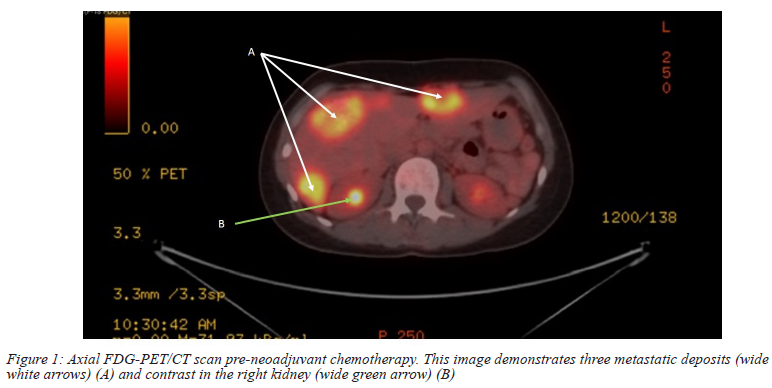
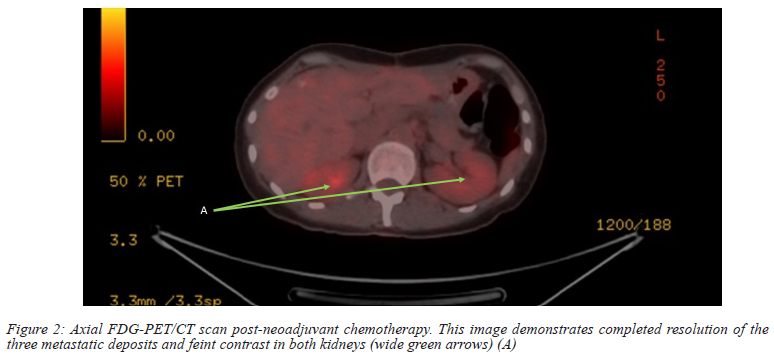
A 45-year-old woman with a diagnosis of rectosigmoid adenocarcinoma and synchronous liver metastases (Figure 1) was referred to our clinic. On admission and following full assessment for definitive diagnosis of liver metastasis, the patient was scheduled for surgical management after receiving neoadjuvant chemotherapy. The prescribed chemotherapy regimen was as follows: On day 1, oxaliplatin was given at a dose of 85 mg/m2222Figure 2). In January 2025, the patient underwent a single-stage surgical procedure consisting of a low anterior resection of the primary tumour, followed by metastasectomy of all surgically accessible peripheral lesions located at segment 2, 3, and 6. After liver metastasectomy was completed for peripheral lesions, intraoperative radiofrequency ablation (RFA) was performed for lesions located deep within the hepatic parenchyma. The lesions were detected intraoperatively, using intraoperative ultrasound and surgical exploration to identify metastases located deep within the hepatic parenchyma. The bowel resection margins were histologically free of tumour. The resection margins of the hepatic metastasectomy specimens were also clear of tumour involvement, and ablated lesions demonstrated no residual viable tumour on follow-up imaging. Following surgical resection, the patient received adjuvant chemotherapy including FOLFOX regimen (12 cycles [every 2 weeks]) as Oxaliplatin 85 mg/m2222
Discussion
Surgery for CRC with synchronous liver metastases represents a unique challenge in oncologic surgery.1234
Our patient presented with synchronous liver metastases that demonstrated significant regression following neoadjuvant chemotherapy. This response reflects the role of neoadjuvant chemotherapy in down-sizing metastatic liver deposits, thus permitting complete surgical resection.56
The complete radiological response of a metastatic deposit on imaging - known as "fading liver metastasis" - poses a surgical dilemma, as this does not necessarily translate to a pathological complete response. Occult malignant cells frequently persist despite radiologic retrogression.7
From a surgical perspective, resection of a solitary metastasis, especially after regression following neoadjuvant chemotherapy, requires precise localisation and complete resection of the original metastatic point.891011
For cases with synchronous liver metastases, the timing of colorectal and HRs - whether contemporaneous or "liver-first" - depends on multiple factors which include tumour burden, patient performance status, and institutional policies. Contemporaneous resection has gained momentum for cases with limited hepatic disease and acceptable physiological reserve, reducing hospitalisation time without compromising oncologic issues.12
Notwithstanding the short follow-up period, our case underscores the significance of a personalised, multidisciplinary approach in managing synchronous liver metastases from CRC, particularly when radiologic regression occurs after neoadjuvant chemotherapy. Careful surgical planning, integration of intraoperative imaging, and parenchymal-sparing resection are vital to achieving long term control. Continued collaboration between oncologists, radiologists, and hepatobiliary surgeons is essential to optimise issues in this evolving paradigm.
In the management of synchronous colorectal liver metastases (CRLM), the current standard of care would include either two-stage or simultaneous resection of the primary tumour and the liver metastases. Nevertheless, for selected patients, especially the elderly or those with substantial comorbidities who would not be ideal candidates for major liver resection, RFA is currently being recognised as a potential alternative to formal HR for local management of the liver disease. As suggested by emerging evidence, RFA appears to provide equivalent prognostic outcomes to HR in the management of CRLM for these selected patient populations. Moreover, RFA may also be considered as part of a simultaneous procedure together with the resection of the primary tumour, where the liver metastases are also managed in a single surgical setting, although there appears to be a current paucity of data on the use of RFA in this simultaneous setting for synchronous CRLM. 13
The place of liver transplantation (LT) in the management of multiple synchronous liver metastases from CRC is very selective and mainly experimental, limited to those with unresectable liver disease but without extrahepatic disease.1415
Conflict of interest
The authors declare no conflict of interest.
Funding source
The study was financially supported by Istanbul Okan University.
Ethical approval
The authors declare that this submission is in accordance with the principles laid down by the Responsible Research Publication Position Statements as developed at the 2nd World Conference on Research Integrity in Singapore, 2010. Prior to commencement of the case write-up, informed consent was obtained from the patient.
ORCIDK Gökçe https://orcid.org/0000-0003-4712-0512
M Üner https://orcid.org/0009-0004-5530-1051
N Adil https://orcid.org/0009-0009-8002-382X
M Sheihkvatan https://orcid.org/0000-0002-5957-5277
REFERENCES
-
1. Baidoun F, Elshiwy K, Elkeraie Y, et al. Colorectal cancer epidemiology: Recent trends and impact on outcomes. Curr Drug Targets. 2021;22(9):998-1009. https://doi.org/10.2174/1389450121999201117115717.
» https://doi.org/10.2174/1389450121999201117115717 -
2. Carbone F, Spinelli A, Ciardiello D, et al. Prognosis of early-onset versus late-onset sporadic colorectal cancer: Systematic review and meta-analysis. Eur J Cancer. 2025;215:115172. https://doi.org/10.1016/j.ejca.2024.115172.
» https://doi.org/10.1016/j.ejca.2024.115172 -
3. Tonini V, Zanni M. Why is early detection of colon cancer still not possible in 2023? World J Gastroenterol. 2024;30(3):211-24. https://doi.org/10.3748/wjg.v30.i3.211.
» https://doi.org/10.3748/wjg.v30.i3.211 -
4. Tanaka H, Yamashita K, Urabe Y, et al. Management of T1 colorectal cancer. Digestion. 2025;106(2):122-30. https://doi.org/10.1159/000540594.
» https://doi.org/10.1159/000540594 -
5. Yang C, Zhao L, Wang C, et al. Liver metastasis of colorectal cancer: Mechanism and clinical therapy (Review). Oncol Rep. 2025;54(4):130. https://doi.org/10.3892/or.2025.8963.
» https://doi.org/10.3892/or.2025.8963 -
6. Horn SR, Stoltzfus KC, Lehrer EJ, et al. Epidemiology of liver metastases. Cancer Epidemiol. 2020;67:101760. https://doi.org/10.1016/j.canep.2020.101760.
» https://doi.org/10.1016/j.canep.2020.101760 -
7. Rees M, Tekkis PP, Welsh FK, et al. Evaluation of long term survival after hepatic resection for metastatic colorectal cancer: A multifactorial model of 929 patients. Ann Surg. 2008;247:125-35. https://doi.org/10.1097/SLA.0b013e31815aa2c2.
» https://doi.org/10.1097/SLA.0b013e31815aa2c2 -
8. Zhou H, Liu Z, Wang Y, et al. Colorectal liver metastasis: Molecular mechanism and interventional therapy. Signal Transduct Target Ther. 2022;7(1):70. https://doi.org/10.1038/s41392-022-00922-2.
» https://doi.org/10.1038/s41392-022-00922-2 -
9. Tatsuta K, Sakata M, Kojima T, et al. Updated insights into the impact of adjuvant chemotherapy on recurrence and survival after curative resection of liver or lung metastases in colorectal cancer: A rapid review and meta-analysis. World J Surg Oncol. 2025;23(1):56. https://doi.org/10.1186/s12957-025-03714-4.
» https://doi.org/10.1186/s12957-025-03714-4 -
10. Zhao W, Dai S, Yue L, et al. Emerging mechanisms progress of colorectal cancer liver metastasis. Front Endocrinol (Lausanne). 2022;13:1081585. https://doi.org/10.3389/fendo.2022.1081585.
» https://doi.org/10.3389/fendo.2022.1081585 -
11. Tomita K, Matsui Y, Uka M, et al. Evidence on percutaneous radiofrequency and microwave ablation for liver metastases over the last decade. Jpn J Radiol. 2022;40(10):1035-45. https://doi.org/10.1007/s11604-022-01335-5.
» https://doi.org/10.1007/s11604-022-01335-5 -
12. Shin AE, Giancotti FG, Rustgi AK. Metastatic colorectal cancer: Mechanisms and emerging therapeutics. Trends Pharmacol Sci. 2023;44(4):222-36. https://doi.org/10.1016/j.tips.2023.01.003.
» https://doi.org/10.1016/j.tips.2023.01.003 -
13. Giuliante F, Viganò L, De Rose AM, et al. Liver-first approach for synchronous colorectal metastases: Analysis of 7360 patients from the LiverMetSurvey registry. Ann Surg Oncol. 2021;28(13):8198-208. https://doi.org/10.1245/s10434-021-10220-w.
» https://doi.org/10.1245/s10434-021-10220-w -
14. Nakayama T, Sasaki K, Margonis GA. Liver transplantation for unresectable colorectal liver metastases: A narrative review. Chin Clin Oncol. 2025;14(4):44. https://doi.org/10.21037/cco-25-46.
» https://doi.org/10.21037/cco-25-46 -
15. García D, Rebolledo P, Achurra P, et al. Liver transplantation for non-resectable colorectal liver metastases: A review. Rev Med Chil. 2022;150(5):656-63. https://doi.org/10.4067/s0034-98872022000500656.
» https://doi.org/10.4067/s0034-98872022000500656