Preoperative risk factors for 90-day postoperative mortality in patients with pancreatic ductal adenocarcinoma: a cohort-based study
Abstract
BACKGROUND: Pancreatic ductal adenocarcinoma (PDAC) has a 5-year survival rate of less than 10%. Treatment with curative intent surgery still poses high rates of overall postoperative morbidity (68.7%) and mortality (5.4%). It is therefore essential to identify preoperative factors influencing early postoperative outcomes to provide better insight for improved patient selection and care. METHODS: Sixty patients diagnosed with PDAC who had undergone surgical resection at Groote Schuur Hospital, Cape Town, between 2016 and 2023 were included. The patient cohort was divided into two groups, postoperative survival. < 90 days vs > 90 days. The groups were compared regarding demographic and preoperative assessment tools using ASA, ECOG and Codman scores, baseline clinical and imaging data, preoperative treatment and surgical related parameters. RESULTS: Significant differences were found in patients, with patients presenting with pancreatic duct dilation (p < 0.05), tumour location in the pancreatic head (p < 0.05), elevated gamma-glutamyl transferase (GGT) (p < 0.01) and carbohydrate antigen 19-9 (CA19-9) (p < 0.05). Using regression analysis, GGT serum levels > 500 U/L were correlated with mortality. < 90 days, while pancreatic duct dilatation and CA19-9 levels > 200 U/L were associated with survival > 90 days. CONCLUSIONS: The results of this study present important insights regarding risk factors influencing postoperative mortality and offer a potential roadmap for optimising preoperative care and judicious patient selection before pancreatic surgery.
pancreatic carcinoma; preoperative risk; mortality; performance status
Introduction
Pancreatic cancer has become a global health burden, currently ranking as seventh most common cause of cancer deaths worldwide for both sexes and accounting for almost as many deaths as cases.1 A four- to five-fold higher occurrence is observed in countries with high human development indexes (HDI), most likely due to higher alcohol consumption, diabetes and obesity.1 Pancreatic ductal adenocarcinoma (PDAC) constitutes roughly 85% of all pancreatic cancers, and the majority of patients with PDAC present with an advanced stage disease with 75-80% being unresectable.12 This results in a poor a median survival and a 5-year survival rate of 10%.2 Despite advances in surgical techniques and better perioperative care, the complication rates are still reported as high as 73%, and the 90-days mortality rates as ranging between 5.1% in very high HDI countries and 9.8% in low-middle HDI countries, with an overall 90-days mortality rate of 5.4%.3,4
Neoadjuvant therapy, increasing age, higher comorbidity score, lower income, case volume, and extensive surgery are known predictors of 90-days mortality.5,6 Postoperative pancreatic fistula (POPF), delayed gastric emptying (DGE), post-pancreatectomy haemorrhaging (PPH) and surgical site-infections (SSIs) significantly impact patient outcomes including hospital stay, readmission rates and mortality.4 Early recognition and management of these complications, particularly POPF and PPH, preferably before they become clinically relevant, is key to reducing perioperative mortality. Failure to rescue (FTR) patients with major complications resulting in mortality is regarded as a quality indicator, with the focus shifting from the complications per se to the actual optimal management of complications.7
Various risk scores have been designed to identify patients at higher risk for postoperative complications and mortality. Some used in pancreatic surgery have been designed for patients undergoing major surgery in general, such as the age adjusted Charlson Comorbidity Index (a-CCI) which has shown a strong association between higher a-CCI scores and an increased 30-day morbidity and mortality in patients undergoing surgery for pancreatic cancer and the Codman score which has been validated in several disciplines to accurately predict risk-adjusted outcomes.8-10 Others were specifically designed for pancreatic surgery, such as the Preoperative Pancreatic Resection (PREPARE) score, based on physiological and procedure related risk factors, the Whipple-ABACUS score, based on systemic factors such as comorbidities, steroids and signs of systemic inflammatory response syndrome (SIRS) and the Early Mortality Risk Score (EMRS) which includes four variables and comorbidities.11-13 Common elements used in these scores include age, comorbidities, tumour-related characteristics, such as size, grading, lymph node involvement and albumin-levels. Decisions based on these scores regarding surgical treatment may range from exclusion of high-risk patients from surgery to initiating other (neo)adjuvant therapies to improve the physical constitution preoperatively or pursue other treatment alternatives. However, most scores still require large-scale multicentre validation.
The aim of this study was to identify preoperative factors associated with 90-day postoperative mortality following pancreatic resection for PDAC with the goal of improving patient selection and identifying potential high-risk patients who could benefit from enhanced preoperative optimisation.
Materials and methods
Study setting, design and patient cohort
We performed a retrospective analysis of patients aged 18 and above, who underwent open pancreatic resection for histologically verified PDAC at the Hepato-pancreato-biliary (HPB) surgery service at Groote Schuur between January 2015 and January 2023. Patients for inclusion were identified from the University of Cape Town (UCT) Pancreatic Cancer Registry Study which is managed in the Electronic Data Capture (REDCap) data management platform hosted at the university.14
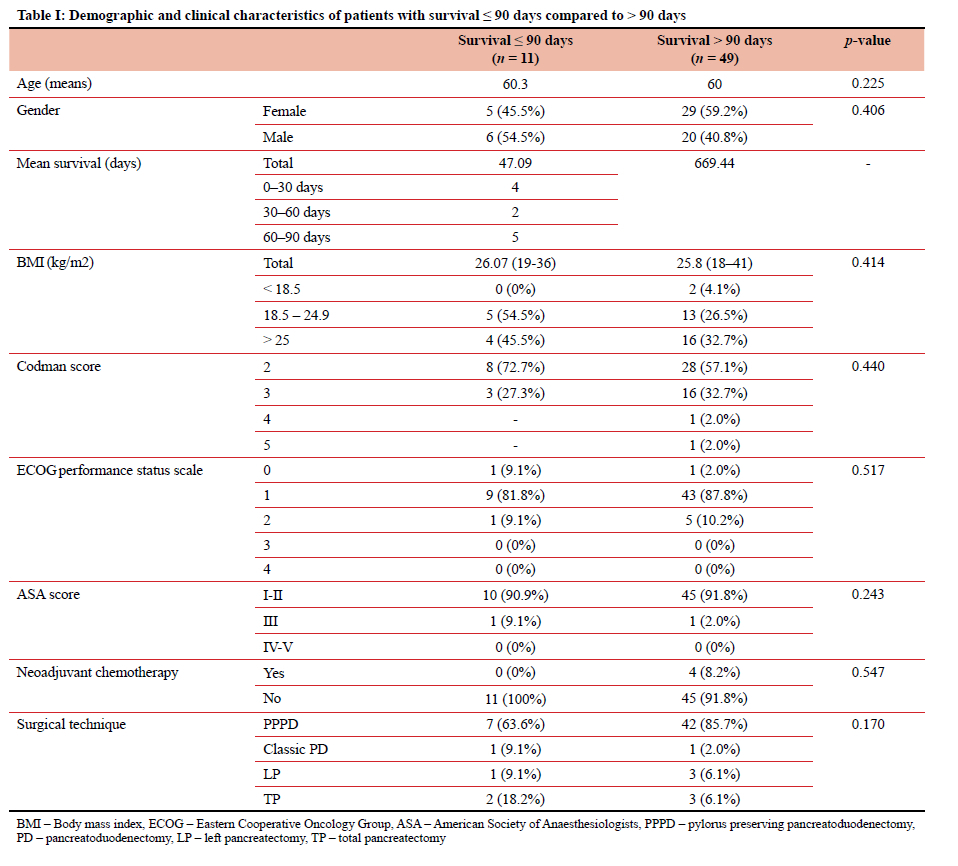
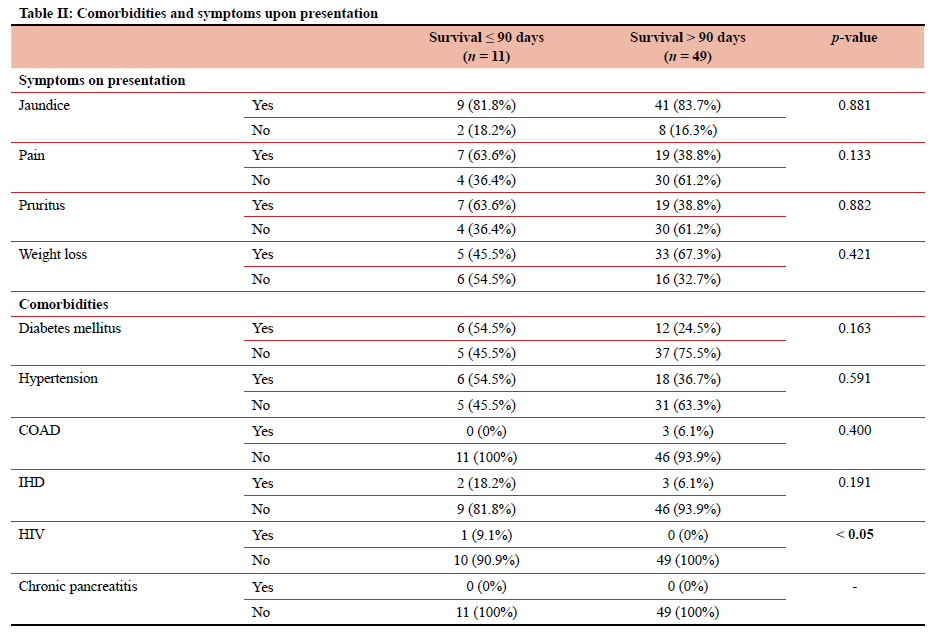
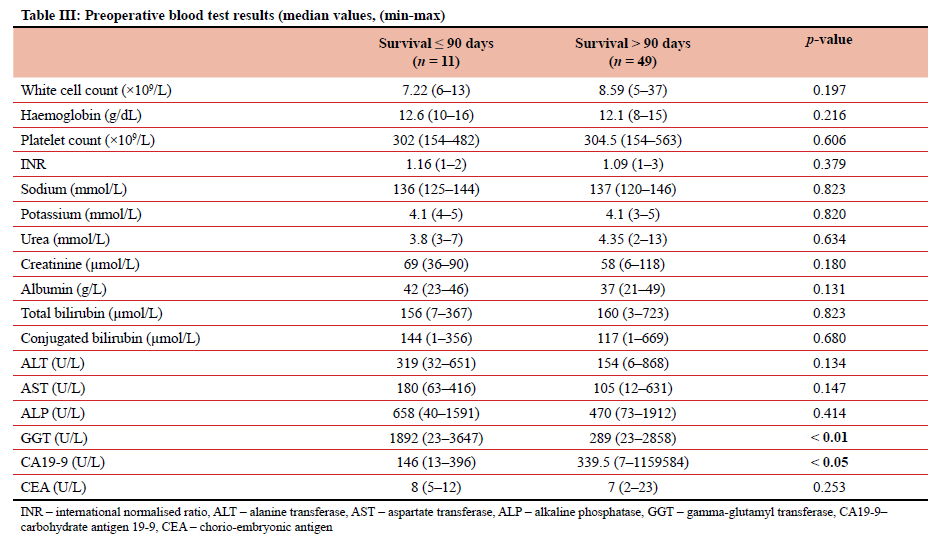
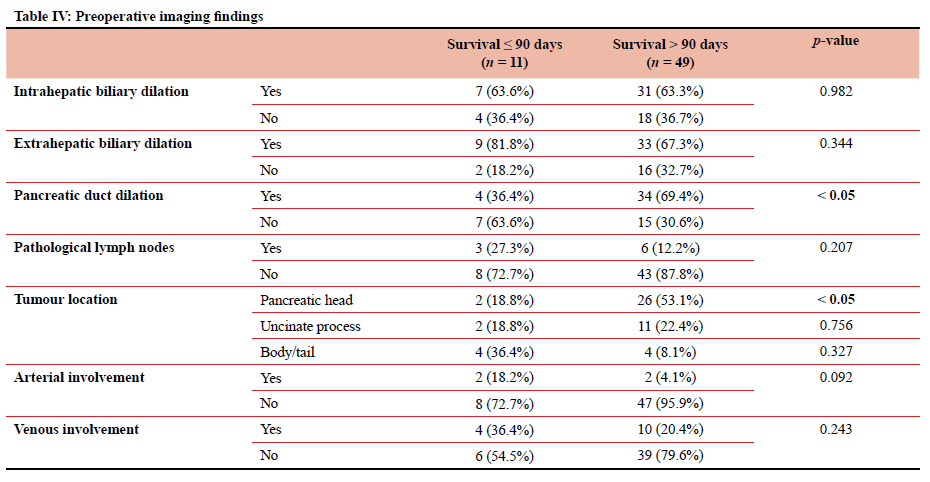
Demographic and baseline clinical parameters, laboratory test results, preoperative imaging as well as preoperative interventions and types of surgical procedures were analysed and compared in patients who died < or > than 90 days after the index operation, as tabulated in Tables I-IV.
Definitions
The American Society of Anaesthesiologists (ASA) physical status score was used to quantify patients' preoperative medical comorbidities. The level of functioning of patients was assessed according to the Eastern Cooperative Oncology Group (ECOG) performance scale. Codman score was calculated for further prediction of the operative risk.10 The pancreatic duct was considered dilated if the duct measured greater than 3 mm in the pancreatic head and/or 2 mm in the body or tail in diameter. Postoperative pancreatic fistula, DGE and PPH were graded according to ISGPS definitions.15-17
Statistical analysis
The Pearson's chi-square test was used for analysis of non-parametric categorical variables. Mann-Whitney U test was used for comparison between continuous variables. To assess the effects of these independent variables on 90 days survival, Cox Proportional Hazards Survival Analysis was conducted. In all statistical analyses, a two-tailed p-value < 0.05 was considered statistically significant. For statistical analyses, SPSS Statistics (Version 29.0) for Macintosh (IBM Corp, Armonk, NY) was used.
Results
A total of 152 patients have undergone pancreatic resection during the study period, 60 of whom were operated on for PDAC and included in the study. The 90-day mortality was 11/60 patients (18.3%). The median age was 60.1 years (41-77 years) and 34 (56.7%) were female (Table I). The mean preoperative BMI was 26.07 kg/m2. Fifty-two (86.6%) patients had an ECOG score of 1, while six (10%) patients were scored as 2 (3.4%) and only two as 0 (0%). Two (3.3%) patients were classified as ASA IV or higher. Thirty-eight (63.3%) patients were classified as Codman 2, 20 (33.3%) as Codman 3 and one (3.4%) each as Codman 4 and 5. Neoadjuvant chemotherapy was administered in 17 (28.3%) patients. Of the total cohort, 49 (82%) underwent a pylorus-preserving (PP) pancreatoduodenectomy (PD), five (8.1%) a total pancreatectomy (TP), four (6.6%) a left pancreatectomy and 2 (3.3%) a classic PD. No significant differences were found for sex, age, BMI (< 18.5 kg/m2, 18.5-24.9 kg/m2, > 25 kg/m2), the ECOG, Codman and ASA scoring systems, neoadjuvant chemotherapy or surgical techniques used between the patient cohort who survived < 90 days compared to those who survived > 90 days.
HIV status was known in all patients. Only one patient with a preoperative positive HIV status was present in the whole cohort and included in the < 90 days mortality group (Table II). Although positive HIV status was predictive for 90-days mortality the result must be interpreted with caution. The HIV prevalence in the study population was 2% which was lower than a national HIV prevalence of around 13% in South Africa.18 There were otherwise no statistically significant differences in the presence of comorbidities between the two groups.
Significantly higher serum levels of gamma-glutamyl transpeptidase (GGT) (p < 0.01) and lower levels of carbohydrate antigen 19-9 (CA19-9) (p < 0.05) were present in the < 90 days mortality group (Table III). There were otherwise no differences in the blood tests results between the two groups. As shown in Table IV, significantly more patients in the > 90 days group had pancreatic duct dilation (p < 0,05) or pancreatic head tumours (p < 0.05). Vascular involvement, both arterial and venous, did not differ significantly between the two groups.
There were no differences in the proportion of patients in the two groups that had undergone preoperative biliary drainage - via endoscopic retrograde cholangiopancreatography (ERCP) or percutaneous transhepatic cholangiography (PTC) - between the two groups, 5 (45.5%) and 35 (71.4%) in the groups that survived < and > 90 days respectively (p = 0.163).
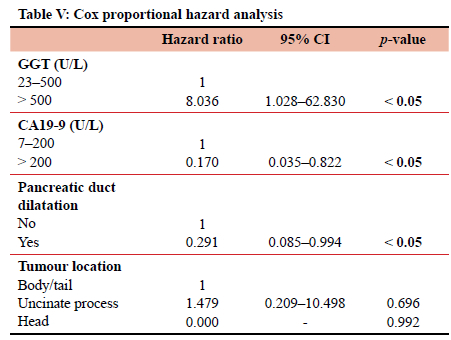
Using Cox proportional hazard for regression analysis to assess predictive factors for 90 days mortality, elevated serum GGT levels > 500 U/L (HR 8.036, CI 95%: 1.02862.839, p < 0.05) predicted survival < 90 days, whereas CA19-9 levels > 200 U/L (HR 0.170, CI 95%: 0.035-0.822, p < 0.05) and pancreatic duct dilatation (HR 0.291, CI 95%: 0.085-0.994, p < 0.05) predicted survival > 90 days, as shown in Table V.
Discussion
The 18.3% 90-day mortality observed in this study is higher than reports from high HDI countries, but in keeping with mortality reported from low HDI countries.3,6
The predictive value of elevated GGT levels for survival < 90 days is in line with previous reports that high levels were an independent risk factor for worse outcomes in patients with PDAC and the development of malignancies, including PDAC. Elevated GGT levels (> 48 U/L) was significantly associated with a lower overall survival (OS) in patients with metastatic PDAC.19 Elevated GGT levels are linked to environmental and endogen toxins, resulting in nitrosative and oxidative cell stress.20 Furthermore, elevated GGT levels may also be indicative of underlying biliary obstruction or liver dysfunction, both of which are common in patients with pancreatic head tumours. Preoperative biliary stenting of obstructing pancreatic head tumour is associated with an increased risk of postoperative complications in patients following PD and has generally been reserved for patients with cholangitis, malnutrition, very high bilirubin levels and those requiring neoadjuvant therapy.21,22 Higher levels in preoperatively stented patients may be indicative of suboptimal drainage due to stent dysfunction, which results in higher levels of bacterial overgrowth, often of resistant organisms.23 Interestingly, in our study preoperative interventional biliary drainage was not an independent predictor of survival < 90 days.
High preoperative CA19-9 levels have been shown to be a reliable predictor for poor local control following surgery, and shorter OS and disease-free survival (DFS).24 As the focus of this article was on predictors of 90-day mortality, the impact of CA19-9 levels on long-term survival was not assessed. In our cohort, values differed significantly between the two groups with almost a 10-fold increase of the median CA19-9 serum level for patients in the survival group > 90 days, compared to an only 4-fold increase in the survival < 90 days group and were associated with a lower risk of 90-days mortality based on the regression analysis. This can be explained by the fact that CA19-9 is not only a tumour marker for PDAC, but it can also induce severe pancreatitis and promote pancreatic fibrosis, which in its turn reduces clinically relevant POPF, thus less mortality.25 Another explanation might be that in our cohort the proportion of vascular involvement was relatively higher in the < 90 days survival group (yet not statistically significant), which might have increased the risk of postoperative morbidity and thus mortality.
In our study, pancreatic duct dilation was associated with a lower risk of 90-day mortality which may be related to lower rates of POPF which is a major risk factor for PPH. Technically the pancreatic anastomosis is easier to perform on a dilated duct if a duct-to-mucosa anastomotic technique is pursued, and sutures hold better in hard fibrotic pancreatic parenchyma which is often associated with pancreatic duct dilatation. The protective effect that a dilated pancreatic duct has on significant leaks from the pancreatic anastomosis in patients undergoing PD is well documented.26 Furthermore, pancreatic duct obstruction often leads to atrophy and fibrosis of the pancreas.26 The lower volumes of pancreatic secretions from an atrophic pancreas may also contribute to lower leak rates. In a nationwide Dutch study POPF and PPH were found to have the most significant impact, contributing to 25.7% and 32.8% of in-hospital mortality, respectively.27
Several reports in the literature have shown higher 90-days mortality rates ranging from 0-16% for PD compared to 0-8.7% for left pancreatic resections.342829 This is in contrast to our data which showed that tumour location in the pancreatic head was significantly associated with a > 90-days survival. This difference, however, was not significant in regression analysis.
The results of our study are particularly relevant in the context of resource-limited settings, which are often encountered in low HDI countries. As earlier described, the discrepancies in 90-days mortality rates, mainly depending in differences in FTR, between high HDI and low HDI regions, highlight the critical need for context-specific strategies to optimise postoperative care. In low HDI settings, where access to advanced radiological and interventional procedures may be limited, early identification of patients at risk of mortality is crucial. The findings of this study suggest that patients with certain risk factors can be identified preoperatively and prioritised for more intensive postoperative monitoring and prioritisation for intensive care.
There are several limitations to our study that should be considered when interpreting the results. First, the sample size was relatively small, which may have limited the statistical power to detect significant differences between groups. The retrospective nature of the study also introduces the potential for selection bias, even though we attempted to minimise this by including all eligible patients who underwent pancreatic resection for PDAC during the study period. While this study focused on baseline characteristics such as age, sex, BMI, widely used scoring systems for physical performance, preoperative blood tests, radiological imaging, in-depth assessment of physical and nutritional status have not been objects of investigation. Adding these parameters may give additional important information for more accurate risk assessment as has been shown in a recent Japanese study that identified older age, increased preoperative fat mass and decreased walking speed as predictive variables for postoperative complications in pancreatic surgery.30
Conclusion
In our study, preoperative high GGT serum levels, specifically > 500 U/L, were correlated with mortality < 90 days, while pancreatic duct dilatation and CA19-9 levels > 200 U/L were associated with survival > 90 days. This retrospective analysis of 60 patients provides important insights into factors influencing postoperative outcomes and offer a potential roadmap for judicious patient selection, optimising perioperative care and resource allocation in pancreatic surgery. Future studies with larger cohorts are necessary to validate our findings and further explore the relationships between preoperative factors and outcomes. Finally, there is a need to explore the development of context-specific, resource-sensitive algorithms for the management of patients undergoing pancreatic resection in low HDI countries.
Conflict of interest
The authors declare no conflict of interest.
Funding source
No funding was required.
Ethical approval
The registry and this study were approved by the Human Research Ethics Committee (HREC) of the Faculty of Health Sciences, UCT (HREC Ref no. R016/2016 and HREC Ref no. 523/2023). The study was conducted in accordance with the Declaration of Helsinki and according to the guidelines of good clinical practice (GCP).
ORCID
U Kotze https://orcid.org/0000-0003-1405-474X
M Bernon https://orcid.org/0000-0002-7967-8548
S Burmeister https://orcid.org/0000-0003-0888-7606
C Kloppers https://orcid.org/0000-0003-2438-6879
E Jonas https://orcid.org/0000-0003-0123-256X
H Bayadsi https://orcid.org/0000-0002-4877-5150
REFERENCES
-
1. Sung H, Ferlay J, Siegel RL, et al. Global Cancer Statistics 2020: GLOBOCAN estimates of incidence and mortality worldwide for 36 cancers in 185 countries. CA Cancer J Clin. 2021;71(3):209-49. https://doi.org/10.3322/caac.21660.
» https://doi.org/10.3322/caac.21660 -
2. Niger M, Prisciandaro M, Antista M, et al. One size does not fit all for pancreatic cancers: A review on rare histologies and therapeutic approaches. World J Gastrointest Oncol. 2020;12(8):833-49. https://doi.org/10.4251/wjgo.v12.i8.833.
» https://doi.org/10.4251/wjgo.v12.i8.833 -
3. PancreasGroup.org Collaborative. Pancreatic surgery outcomes: Multicentre prospective snapshot study in 67 countries. Br J Surg. 2024:111(1):znad330. https://doi.org/10.1093/bjs/znad330.
» https://doi.org/10.1093/bjs/znad330 -
4. Smits FJ, Henry AC, Besselink MG, et al. Algorithm-based care versus usual care for the early recognition and management of complications after pancreatic resection in the Netherlands: An open-label, nationwide, stepped-wedge cluster-randomised trial. Lancet. 2022;399(10338):1867-75. https://doi.org/10.1016/S0140-6736(22)00182-9.
» https://doi.org/10.1016/S0140-6736(22)00182-9 -
5. Wegner RE, Verma V, Hasan S, et al. Incidence and risk factors for postoperative mortality, hospitalization, and readmission rates following pancreatic cancer resection. J Gastrointest Oncol. 2019;10(6):1080-93. https://doi.org/10.21037/jgo.2019.09.01.
» https://doi.org/10.21037/jgo.2019.09.01 -
6. Swanson RS, Pezzi CM, Mallin K, Loomis AM, Winchester DP. The 90-day mortality after pancreatectomy for cancer is double the 30-day mortality: More than 20 000 resections from the national cancer data base. Ann Surg Oncol. 2014;21(13):4059-67. https://doi.org/10.1245/s10434-014-4036-4.
» https://doi.org/10.1245/s10434-014-4036-4 -
7. Elfrink AKE, Olthof PB, Swijnenburg RJ, et al. Factors associated with failure to rescue after liver resection and impact on hospital variation: A nationwide population-based study. HPB (Oxford). 2021:23(12):1837-48. https://doi.org/10.1016/j.hpb.2021.04.020.
» https://doi.org/10.1016/j.hpb.2021.04.020 -
8. Dias-Santos D, Ferrone CR, Zheng H, Lillemoe KD, Fernández-Del Castillo C. The Charlson age comorbidity index predicts early mortality after surgery for pancreatic cancer. Surgery. 2015;157(5):881-7. https://doi.org/10.1016/j.surg.2014.12.006.
» https://doi.org/10.1016/j.surg.2014.12.006 -
9. Spence RT, Guidolin K, Quereshy FA, et al. External validation of the Codman score in colorectal surgery: A pragmatic tool to drive quality improvement. Colorectal Dis. 2023;25(6):1248-56. https://doi.org/10.1111/codi.16547.
» https://doi.org/10.1111/codi.16547 -
10. Spence RT, Chang DC, Kaafarani HMA, et al. Derivation, validation and application of a pragmatic risk prediction index for benchmarking of surgical outcomes. World J Surg. 2018;42(2):533-40. https://doi.org/10.1007/s00268-017-4177-2.
» https://doi.org/10.1007/s00268-017-4177-2 -
11. Uzunoglu FG, Reeh M, Vettorazzi E, et al. Preoperative pancreatic resection (PREPARE) score: A prospective multicentre-based morbidity risk score. Ann Surg. 2014;260(5):857-63; discussion 863-4. https://doi.org/10.1097/SLA.0000000000000946.
» https://doi.org/10.1097/SLA.0000000000000946 -
12. Gleeson EM, Shaikh MF, Shewokis PA, et al. WHipple-ABACUS, a simple, validated risk score for 30-day mortality after pancreaticoduodenectomy developed using the ACS- NSQIP database. Surgery. 2016;160(5):1279-87. https://doi.org/10.1016/j.surg.2016.06.040.
» https://doi.org/10.1016/j.surg.2016.06.040 -
13. Hsu CC, Wolfgang CL, Laheru DA, et al. Early mortality risk score: Identification of poor outcomes following upfront surgery for resectable pancreatic cancer. J Gastrointest Surg. 2012;16(4):753-61. https://doi.org/10.1007/s11605-011-1811-4.
» https://doi.org/10.1007/s11605-011-1811-4 -
14. Harris PA, Taylor R, Thielke R, et al. Research electronic data capture (REDCap): A metadata-driven methodology and workflow process for providing translational research informatics support. J Biomed Inform. 2009;42(2):377-81.https://doi.org/10.1016/jobi.2008.08.010.
» https://doi.org/10.1016/jobi.2008.08.010 -
15. Bassi C, Marchegiani G, Dervenis C, et al. The 2016 update of the International study group (ISGPS) definition and grading of postoperative pancreatic fistula: 11 years after. Surgery. 2017;161(3):584-91. https://doi.org/10.1016/j.surg.2016.11.014. Epub 2016 Dec 28. Erratum in: Surgery. 2024;176(3):988-9. https://doi.org/10.1016/j.surg.2024.05.043.
» https://doi.org/10.1016/j.surg.2016.11.014 -
16. Wente MN, Bassi C, Dervenis C, et al. Delayed gastric emptying (DGE) after pancreatic surgery: A suggested definition by the International study group of pancreatic surgery (ISGPS). Surgery. 2007;142(5):761-8. https://doi.org/10.1016/j.surg.2007.05.005.
» https://doi.org/10.1016/j.surg.2007.05.005 -
17. Wente MN, Veit JA, Bassi C, et al. Postpancreatectomy haemorrhage (PPH): An International study group of pancreatic surgery (ISGPS) definition. Surgery. 2007;142(1):20-5. https://doi.org/10.1016/j.surg.2007.02.001.
» https://doi.org/10.1016/j.surg.2007.02.001 -
18. UNAIDS Joint United Nations Programme on HIV/AIDS, UNAIDS Data 2021 Reference. 2021; Geneva, Switzerland. Available from: https://www.unaids.org/en/resources/documents/2021/2021_unaids_data.
» https://www.unaids.org/en/resources/documents/2021/2021_unaids_data -
19. Xiao Y, Yang H, Lu J, et al. Serum gamma-glutamyltransferase and the overall survival of metastatic pancreatic cancer. BMC Cancer. 2019;19(1):1020. https://doi.org/10.1186/s12885-019-6250-8.
» https://doi.org/10.1186/s12885-019-6250-8 -
20. Koenig G, Seneff S. Gamma-Glutamyltransferase: A predictive biomarker of cellular antioxidant inadequacy and disease risk. Dis Markers. 2015;2015:818570. https://doi.org/10.1155/2015/818570.
» https://doi.org/10.1155/2015/818570 -
21. Blacker S, Lahiri RP, Phillips M, et al. Which patients benefit from preoperative biliary drainage in resectable pancreaticcancer? Expert Rev Gastroenterol Hepatol. 2021;15(8):855-63. https://doi.org/10.1080/17474124.2021.1915127.
» https://doi.org/10.1080/17474124.2021.1915127 -
22. Sauvanet A, Boher JM, Paye F, et al. French association of surgery. Severe jaundice increases early severe morbidity and decreases long-term survival after pancreaticoduodenectomy for pancreatic adenocarcinoma. J Am Coll Surg. 2015;221(2):380-9. https://doi.org/10.1016/j.jamcollsurg.2015.03.058.
» https://doi.org/10.1016/j.jamcollsurg.2015.03.058 -
23. Bernon MM, Steenkamp S, Dlamini S, et al. Effect of preoperative biliary drainage on intraoperative biliary cultures and surgical outcomes after pancreatic resection. S Afr J Surg. 2024;62(2):63-7. https://doi.org/10.36303/SAJS.00465.
» https://doi.org/10.36303/SAJS.00465 -
24. Guan S, Chen Y, Han Q, et al. Preoperative CA19-9 levels predict disease-free survival and overall survival in pancreatic adenocarcinoma patients after resection. Transl Cancer Res. 2019;8(3):811-20. https://doi.org/10.21037/tcr.2019.04.24.
» https://doi.org/10.21037/tcr.2019.04.24 -
25. Chikhladze S, Hipp J, Biesel E, et al. High serum CA19-9 preoperatively reducesPOPFriskafterpancreatoduodenectomy in PDAC. Surg Pract Sci. 2022;8:100051. https://doi.org/10.1016/j.sipas.2021.100051 .
» https://doi.org/10.1016/j.sipas.2021.100051 -
26. Sereide K, Healey AJ, Mole DJ, Parks RW. Pre-, peri- and post-operative factors for the development of pancreatic fistula after pancreatic surgery. HPB (Oxford). 2019;21(12):1621- 31. https://doi.org/10.1016/j.hpb.2019.06.004.
» https://doi.org/10.1016/j.hpb.2019.06.004 -
27. Smits FJ, Verweij ME, Daamen LA, et al. Impact of complications after pancreatoduodenectomy on mortality, organ failure, hospital stay, and readmission: Analysis of a nationwide audit. Ann Surg. 2022;275(1):e222-e228. https://doi.org/10.1097/SLA.0000000000003835.
» https://doi.org/10.1097/SLA.0000000000003835 -
28. Cardini B, Primaversi F, Maglione M, et al. Outcomes following pancreatic resections: Results and challenges of an Austrian university hospital compared to nationwide data and international centres. Eur Surg. 2019;51:81-9. https://doi.org/10.1007/s10353-019-0585-x.
» https://doi.org/10.1007/s10353-019-0585-x -
29. Loos M, Mack CE, Xu ATL, et al. Distal pancreatectomy: Extent of resection determines surgical risk categories. Ann Surg. 2024;279(3):479-85. https://doi.org/10.1097/SLA.0000000000005935.
» https://doi.org/10.1097/SLA.0000000000005935 -
30. Kusama N, Mitobe Y, Hyodo N, et al. Preoperative risk factors in patients with pancreatic cancer. J Clin Med Res. 2023;15(6):300-9. https://doi.org/10.14740/jocmr4906.
» https://doi.org/10.14740/jocmr4906