A simulated rugby match protocol induces physiological fatigue without decreased individual scrummaging performance
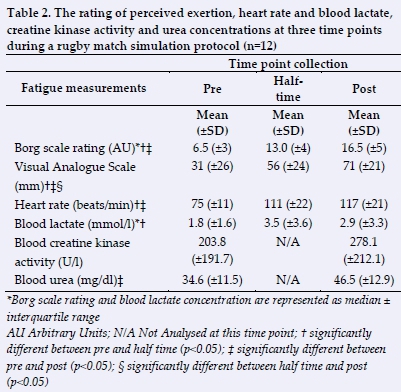
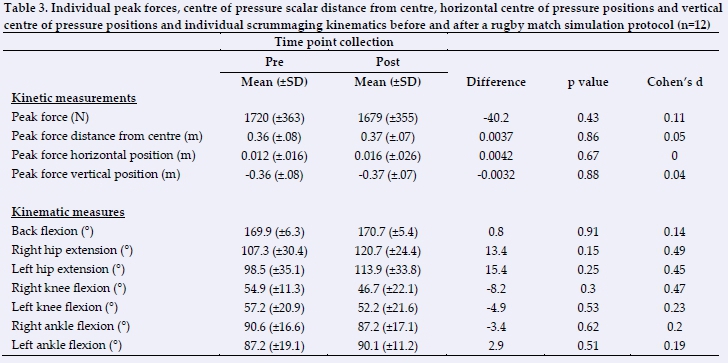
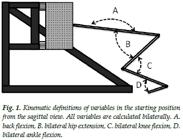
BACKGROUND: A rugby union game consists of 80 minutes of strenuous exertion. Forwards are required to participate in the arduous activity of scrummaging throughout a game OBJECTIVES: The purpose of this study was to identify whether rugby-match simulated fatigue modified individual scrummaging technique and reduced performance METHODS: Twelve forwards (body mass 106.2±13.3 kg; stature 179.5±8.4 cm) had individual scrum kinetics and kinematics assessed prior to and following a protocol that simulated a rugby match. The simulated rugby match protocol required participants to run at various velocities and perform rugby specific tasks. Rating of Perceived Exertion (RPE) was assessed using a 6-20 Borg scale and Visual Analogue Scale (VAS). Blood lactate, heart rate and RPE were measured prior to, at mid-point and after the simulated game, while markers of muscle damage (blood creatine kinase activity (CK) and urea) were measured prior to and following the protocol RESULTS: RPE (p<0.0001) and VAS (p<0.0001) showed significant increases between the pre- and post-simulation values. Of the physiological markers, heart rate (p<0.0001) and blood urea concentration (p=0.004) increased following the match simulation. No significant differences were observed for blood CK (p=0.281), individual scrummaging forces (p=0.433) or in the kinematic variables following the protocol. While physiological fatigue and subjective ratings of physiological fatigue may develop during a rugby simulation, no differences were observed in peak forces or in body kinematics at peak force CONCLUSION: Physiological fatigue does not influence individual scrummaging performance and technique
exertion; kinetics; kinematics; simulation
 Thumbnail