
 Comparison of the effect of semi-rigid ankle bracing on performance among injured v. non-injured adolescent female hockey players
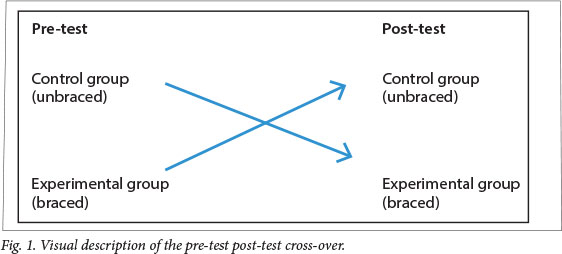
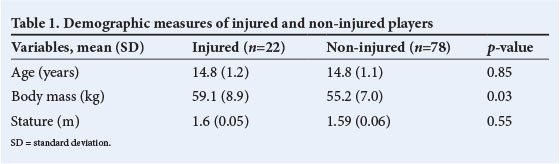
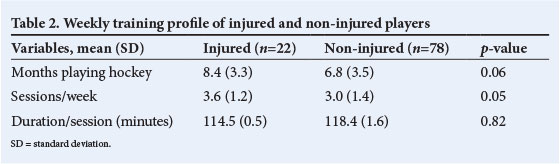
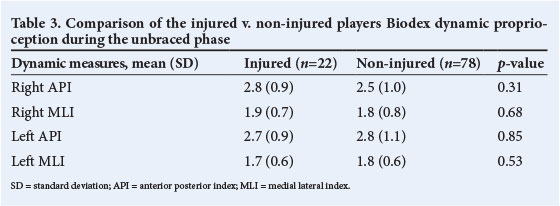
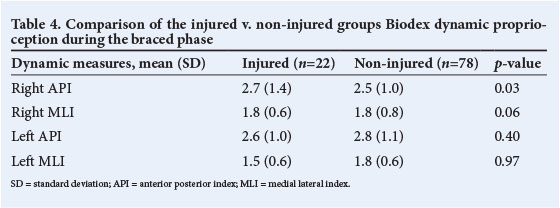
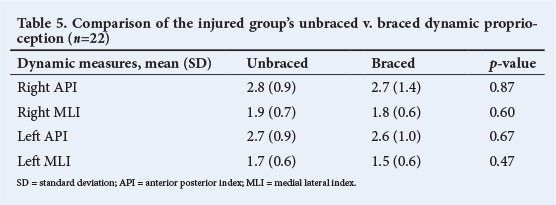
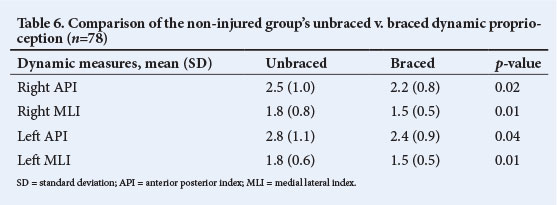
OBJECTIVE: To determine the comparative proprioceptive performance of injured v. non-injured adolescent female hockey players wearing an ankle brace METHODS: Data were collected from 100 high school players who belonged to the Highway Secondary School Hockey League, KwaZulu-Natal, via voluntary parental informed consent and player assent. Players completed an injury questionnaire probing the prevalence and nature of hockey injuries (March - August 2013). Subsequently, players completed a Biodex proprioceptive test with and without an ankle brace. Probability was set at p<0.05 RESULTS: Twenty-two players sustained ankle injuries within the 6-month study period (p<0.001). Injured players performed similarly without bracing (right anterior posterior index (RAPI) 2.8 (standard deviation (SD) 0.9); right medial lateral index (RMLI) 1.9 (0.7); left anterior posterior index (LAPI) 2.7 (0.9); left medial lateral index (LMLI) 1.7 (0.6)) compared with bracing (RAPI 2.7 (1.4); RMLI 1.8 (0.6); LAPI 2.6 (1.0); LMLI 1.5 (0.6)) (p>0.05). However, bracing improved the ankle stability of the non-injured group (RAPI 2.2 (0.8); RMLI 1.5 (0.5); LAPI 2.4 (0.9); RMLI 1.5 (0.5)) compared with their performance without a brace (RAPI 2.5 (1.0); RMLI 1.8 (0.8); LAPI 2.8 (1.1); LMLI 1.8 (0.6)) (p<0.05) CONCLUSION: Ankle bracing did not enhance the stability of injured ankles. However, ankle bracing has an ergogenic effect that enhances the stability of healthy ankles
 Thumbnail
The South African Sports Medicine Association
South African Sports Medicine Association, Research Unit for Exercise Science & Sports Medicine (ESSM), PO Box 115, Newlands, University of Cape Town, Cape Town, Western Cape, ZA, 7725, Tel: +27 21 650 4558 -
E-mail: mike.lambert@uct.ac.za